


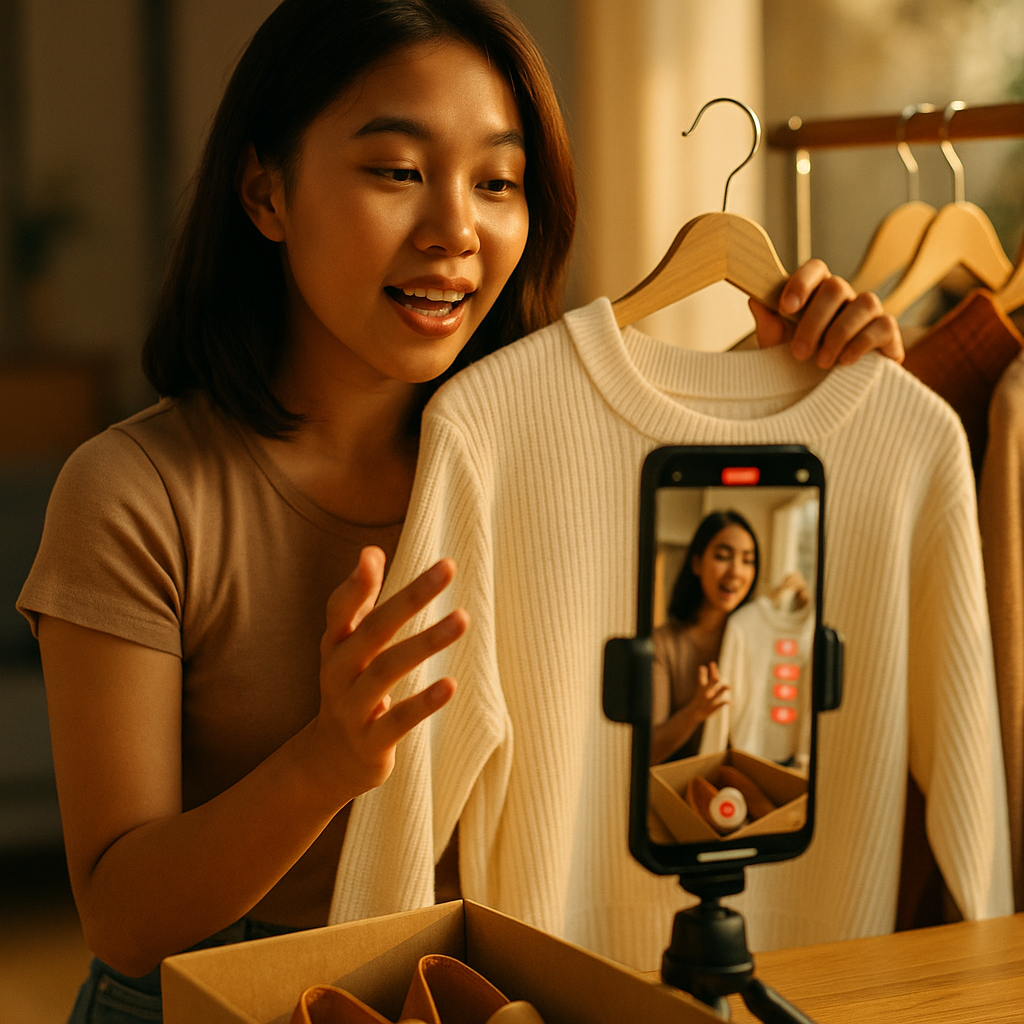
One un-boosted TikTok Shop livestream did $1.2 million in gross merchandise value in a single session, according to seller data TikTok has touted to prospective merchants. No dark posts. No spark ads. Just a host, a product, and a comment section. If you’re still treating TikTok livestream commerce as a paid-media line item, you’re overcomplicating a channel that was built to reward hustle over budget.
This isn’t a fluke. It’s a mechanic. TikTok’s algorithm treats live sessions differently than feed content, and brands that understand the mechanic can manufacture urgency and velocity without spending a dollar on amplification. Here’s the actual playbook.
Why Live Beats Feed for Conversion Velocity
Feed content optimizes for watch time and shares. Live content optimizes for real-time engagement signals: comments, gifts, shares-in-the-moment, and viewer retention curves that update every few seconds. That’s a fundamentally different scoring system, and it’s why a mid-size account with zero paid spend can suddenly find itself pushed into thousands of “For You” feeds mid-stream.
The platform wants to keep users inside the live room. Every purchase, comment, or follow during a stream tells TikTok’s recommendation engine that the room is “hot,” and hot rooms get surfaced to browsing users looking for something to watch. It’s a flywheel. Sales create visibility, and visibility creates more sales. Compare that to a static product page, where conversion depends entirely on the traffic you already paid to send there.
A livestream that hits critical mass in its first 20 minutes can see its viewer count triple organically as TikTok reallocates FYP real estate toward rooms with rising engagement velocity.
This is also why the format pairs so naturally with impulse-driven categories: beauty, apparel, novelty gadgets, and food. If you want a parallel model built around scheduled creator streams rather than organic velocity, our TikTok Shop livestream selling playbook breaks down the paid-adjacent version of this strategy.
The First 24 Hours: What Actually Moves the Needle
Doubling sales in a day isn’t about doing more. It’s about sequencing the right five actions in the right order. Here’s what that looks like in practice:
- Pre-seed the room 48 hours out. Post two to three short-form videos teasing the exact products going live, using phrases like “only available during the stream” to build anticipation.
- Open with a hook offer in the first 90 seconds. A bundle discount, a mystery gift, or a flash price drop that visibly counts down. Viewers who land in minute one need a reason to stay past minute three.
- Comment-read constantly. Hosts who read viewer names and questions aloud trigger reciprocity. Viewers who feel seen buy, and they tell friends to join.
- Rotate products every 8-12 minutes. Long dwell time on one SKU kills momentum. Fast rotation keeps the “what’s next” tension alive.
- Close with scarcity, not a sales pitch. “Last 20 units before we go offline” converts better than a generic thank-you outro.
None of this requires a media buy. It requires a rehearsed host, a tight product queue, and inventory discipline. Brands that fumble this sequence usually fail at step one: they treat the livestream as a broadcast instead of a conversation.
Organic Doesn’t Mean Unstructured
Here’s the part brand teams get wrong most often. “Organic” gets read as “unplanned.” It should mean the opposite. The absence of paid boost means every second of runtime has to earn its own attention, so the production discipline actually needs to be tighter, not looser.
Successful organic sellers script a minute-by-minute rundown before they ever hit “Go Live.” That includes:
- Product order and approximate time allocation
- Planned price drops or bundle reveals, timed to retention dips
- Backup content (Q&A, behind-the-scenes) for lulls in sales momentum
- A co-host or moderator dedicated purely to reading comments
Brands like Bloom Nutrition and Spanx have both leaned on frequent, almost daily livestream cadences rather than one-off events, letting the algorithm build up a “regular room” reputation. Consistency compounds. A brand that streams three times a week trains its buyer base to check back, which is a retention loop paid ads simply can’t replicate.
What About Inventory and Fulfillment Risk?
Doubling sales overnight sounds great until your 3PL calls asking why 4,000 orders just landed with no warning. This is the unglamorous side of live commerce that trade press rarely covers, but it’s where brands actually lose money.
Before going live, confirm three things with your fulfillment partner: surge capacity for same-day order spikes, whether your SKUs have enough on-hand inventory to survive a viral moment, and whether your CRM can handle a comment-to-DM-to-checkout flow without dropping leads. TikTok Shop’s own seller center provides real-time inventory sync, but it’s only as good as the stock data you feed it. Oversell during a stream and you’re issuing refunds and apology DMs within the hour, which tanks the exact trust you just built.
Compliance matters here too. If your host makes health, efficacy, or comparative claims live, you don’t get a second take to edit it. The FTC’s endorsement guidance applies to livestream commerce the same way it applies to static posts, and unscripted live claims are actually higher risk because there’s no editing pass to catch a problem before it airs. Brief hosts on claim boundaries before every session, not just for launch campaigns.
Choosing the Right Host Isn’t Optional
A brand-run stream with an untrained employee behind the camera rarely performs. The best organic sellers either train an internal “live specialist” or partner with a micro-creator who already has stream reps under their belt. Comfort on camera, for two or three hours straight, is a skill. It’s closer to broadcasting than content creation, and most marketing teams underestimate how different that skill set is.
Look for hosts who can improvise product benefits without sounding scripted, handle hostile or troll comments without losing energy, and read a sales dashboard in real time to know when to push a bundle harder. If you’re building a creator bench for this specifically, cross-reference performance data from adjacent formats like Amazon Live, since hosts who convert well there often transfer those instincts to TikTok. Our Amazon Live shopping playbook covers host vetting criteria that apply almost identically here.
Measuring Success Beyond GMV
Gross merchandise value is the headline metric, but it’s not the only one that matters for a brand building a repeatable program. Track average viewer retention time, comment-to-viewer ratio, and new-follower conversion during the stream. These secondary metrics tell you whether you’re building an audience or just extracting a one-time spike.
A stream that generates $30,000 in GMV but zero new followers is a transaction. A stream that generates $18,000 but adds 2,000 followers who watched more than five minutes is building an asset. Weight your KPIs accordingly, especially if you’re presenting results to leadership expecting compounding returns, not one-off wins.
Brands optimizing purely for single-session GMV tend to burn out their audience within six to eight weeks; brands optimizing for retention and follower growth see stream performance improve month over month.
Data from eMarketer shows social commerce in the US crossing well past the $100 billion mark, with live formats representing a growing share of that spend. TikTok isn’t disclosing exact organic-versus-paid livestream splits, but category buyers in beauty and apparel consistently report organic-only streams outperforming boosted ones on cost-per-acquisition, simply because boosted traffic doesn’t carry the same “I found this myself” trust signal.
For brands managing multi-platform creator campaigns, it’s worth briefing your livestream approach alongside your broader content calendar. Our guide on building one brief across platform algorithms is useful if your team is running TikTok Shop alongside other commerce channels and wants consistent messaging without duplicating creative work three times over.
Where Brands Get the Format Wrong
The most common failure isn’t a bad host or bad product. It’s impatience. Teams launch a stream, see modest numbers in the first ten minutes, and pull the plug or panic-pivot the script. TikTok’s algorithm needs a runway. Most organic streams don’t hit their velocity inflection until the 20-30 minute mark, once enough engagement signals accumulate for the platform to start pushing the room wider.
The second failure is treating every stream as a launch event instead of a routine. Novelty gets attention once. Reliability builds a shopping habit. If your stream calendar is inconsistent, you’re rebuilding audience trust from zero every single time you go live, and that’s an expensive way to run a sales channel.
The Takeaway
Run a scripted, product-rotated, comment-heavy livestream three times this week before you spend a dollar on boosting it. Measure retention and follower growth alongside GMV, and only layer in paid amplification once you’ve proven the organic format converts on its own.
FAQs
Do I need a large following to run a successful organic TikTok livestream?
No. TikTok’s live algorithm surfaces rooms based on real-time engagement velocity, not existing follower count, so smaller accounts with tight scripting and active comment engagement can outperform larger accounts running passive streams.
How long should a TikTok Shop livestream run to maximize organic reach?
Most successful organic sellers run sessions between 90 minutes and three hours. Shorter streams often end before the algorithm’s discovery window kicks in, typically around the 20 to 30 minute mark.
What’s the biggest inventory risk with organic live selling?
Overselling during an unexpected viral spike. Confirm surge capacity with your fulfillment partner and sync real-time stock data with TikTok Shop’s seller center before every session.
Can paid boosts hurt an organic livestream’s performance?
They can dilute the authenticity signal that drives organic discovery. Many brands find boosted traffic converts at a lower rate because viewers sense the difference between an algorithmically surfaced room and a paid placement.
What metrics matter beyond total sales?
Viewer retention time, comment-to-viewer ratio, and new-follower conversion during the stream. These indicate whether the session built a repeatable audience or just produced a one-time transaction spike.
Top Influencer Marketing Agencies
The leading agencies shaping influencer marketing in 2026
Agencies ranked by campaign performance, client diversity, platform expertise, proven ROI, industry recognition, and client satisfaction. Assessed through verified case studies, reviews, and industry consultations.
Moburst

-
2

The Shelf
Boutique Beauty & Lifestyle Influencer AgencyA data-driven boutique agency specializing exclusively in beauty, wellness, and lifestyle influencer campaigns on Instagram and TikTok. Best for brands already focused on the beauty/personal care space that need curated, aesthetic-driven content.Clients: Pepsi, The Honest Company, Hims, Elf Cosmetics, Pure LeafVisit The Shelf → -
3

Audiencly
Niche Gaming & Esports Influencer AgencyA specialized agency focused exclusively on gaming and esports creators on YouTube, Twitch, and TikTok. Ideal if your campaign is 100% gaming-focused — from game launches to hardware and esports events.Clients: Epic Games, NordVPN, Ubisoft, Wargaming, Tencent GamesVisit Audiencly → -
4

Viral Nation
Global Influencer Marketing & Talent AgencyA dual talent management and marketing agency with proprietary brand safety tools and a global creator network spanning nano-influencers to celebrities across all major platforms.Clients: Meta, Activision Blizzard, Energizer, Aston Martin, WalmartVisit Viral Nation → -
5

The Influencer Marketing Factory
TikTok, Instagram & YouTube CampaignsA full-service agency with strong TikTok expertise, offering end-to-end campaign management from influencer discovery through performance reporting with a focus on platform-native content.Clients: Google, Snapchat, Universal Music, Bumble, YelpVisit TIMF → -
6

NeoReach
Enterprise Analytics & Influencer CampaignsAn enterprise-focused agency combining managed campaigns with a powerful self-service data platform for influencer search, audience analytics, and attribution modeling.Clients: Amazon, Airbnb, Netflix, Honda, The New York TimesVisit NeoReach → -
7

Ubiquitous
Creator-First Marketing PlatformA tech-driven platform combining self-service tools with managed campaign options, emphasizing speed and scalability for brands managing multiple influencer relationships.Clients: Lyft, Disney, Target, American Eagle, NetflixVisit Ubiquitous → -
8

Obviously
Scalable Enterprise Influencer CampaignsA tech-enabled agency built for high-volume campaigns, coordinating hundreds of creators simultaneously with end-to-end logistics, content rights management, and product seeding.Clients: Google, Ulta Beauty, Converse, AmazonVisit Obviously →