


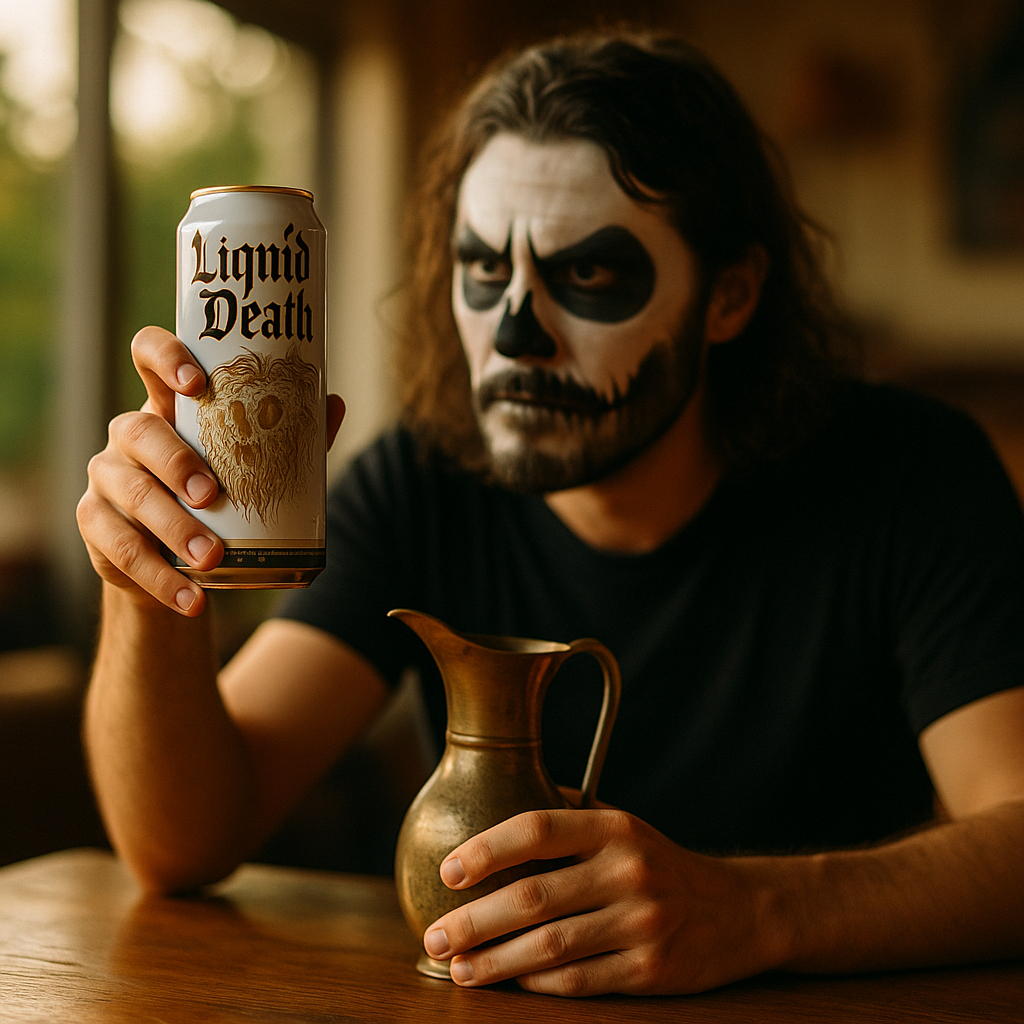
A water brand is worth roughly $1.4 billion, and it has never once talked about hydration. That’s the Liquid Death paradox, and it’s the reason every CMO watching the creator economy needs to study its playbook. Liquid Death didn’t win by finding the right influencers. It won by treating creators as co-conspirators in a joke that never stops escalating, turning canned water into a rebellion brand with merch drops, mosh pits, and a marketing budget spent almost entirely on absurdity instead of ads.
The Premise Sounds Insane. That’s the Point.
Sell still and sparkling water in tallboy cans. Slap a skull on it. Name it “Death.” Market it like a metal band, not a beverage. On paper, it reads like a rejected SNL sketch. In practice, Liquid Death has outpaced legacy water brands in social engagement and built a cult following that treats hydration merch like concert swag.
Founder Mike Cessario came from advertising, not beverage. He understood something most CPG marketers miss: nobody wants to be sold water. But plenty of people want to be part of a joke that mocks the entire wellness-industrial complex. That insight shaped every creator partnership since.
Absurdism as a Filter, Not a Gimmick
Here’s what’s easy to miss if you only see the surface-level jokes: Liquid Death’s absurdism functions as a creator vetting system. The brand doesn’t chase reach. It chases comedic sensibility. Any creator brought into the fold has to understand tone before they understand deliverables.
This is a sharp contrast to how most brands staff influencer campaigns, where fit gets reduced to audience demographics and engagement rate benchmarks. Liquid Death instead asks: does this person’s humor match our brand’s? If a creator can’t riff on “murdering your thirst,” they’re not the right partner, regardless of follower count.
Liquid Death doesn’t brief creators on messaging pillars. It briefs them on comedic timing. That’s a fundamentally different creative operation than most CPG marketing teams run.
Compare that to brands still optimizing influencer selection around interest over follower count. Liquid Death takes that a step further: it filters for shared irreverence, then works backward to relevance.
Creators Get Creative License, Not Talking Points
Most brand-creator partnerships fail because the brand insists on control. Approved scripts. Mandatory hashtags. Legal-reviewed captions. Liquid Death does the opposite. It hands creators a premise (this is death-themed water, act accordingly) and lets them run wild inside that container.
That’s how you get creators filming mock horror-movie trailers with a Liquid Death can as the murder weapon, or comedians building entire bits around drinking it “responsibly.” The brand isn’t dictating the joke. It’s supplying the prop and trusting the performer.
- Creators are chosen for comedic range, not follower tiers.
- Briefs describe tone and boundaries, not scripted lines.
- Content gets judged on shareability, not on-brand messaging accuracy.
This loose-leash model isn’t reckless. It’s calculated risk mitigation through cultural fit. Compare it to the authenticity risk lesson from anti-AI beer backlash, where a brand’s message clashed with audience sentiment. Liquid Death avoids that trap by choosing creators who already embody the brand’s irreverence, so there’s less daylight between what the brand says and what the audience believes.
Merch, Music, and the Death Cult Playbook
Liquid Death doesn’t stop at sponsored posts. It built an entire ecosystem: album-style merch drops, “Greatest Hits” branding, tour-style pop-ups, and collaborations that read more like a record label’s release calendar than a beverage marketing plan. Creators aren’t just promoting a product. They’re participating in a bit that has its own mythology.
This matters for brand strategists because it reframes what “creator partnership” even means. It’s not a transaction. It’s enlistment into a fictional universe the brand has spent years building. Once a creator is inside that universe, their content naturally carries more weight, because the audience already understands the joke’s rules.
Does the Absurdist Model Actually Sell Water?
Skeptics ask the obvious question: does any of this move product, or is it just internet noise? The numbers suggest it moves product. Liquid Death has scaled into major retail chains including Whole Foods, Target, and Kroger, and its valuation has climbed past the billion-dollar mark according to reporting cited by eMarketer. That’s not a niche joke brand. That’s a functioning CPG business built almost entirely on earned attention and creator-driven virality rather than traditional ad spend.
Compare the media efficiency here to brands still leaning on paid social for growth. Liquid Death’s model looks more like Duolingo’s zero-paid-media growth strategy: lean into a bizarre brand persona, let creators amplify it organically, and let the algorithm do what paid media used to do. The difference is Duolingo built a mascot. Liquid Death built an entire genre.
The Risk Nobody Talks About
Absurdist branding isn’t risk-free. It requires constant escalation. Once your audience expects the brand to be funnier and weirder every quarter, you’ve created a treadmill. Fall flat once, and the brand risks looking like it’s trying too hard, the exact opposite of the effortless-cool image it’s built.
There’s also the compliance dimension marketers can’t ignore. Creator content that leans into shock value or dark humor needs the same disclosure rigor as any other sponsored post. The FTC’s endorsement guidelines apply regardless of tone. A joke about “murdering your thirst” still needs a clear #ad or paid partnership label if compensation changed hands. Brands copying this model without a disclosure process in place are exposing themselves to the same regulatory risk as any influencer campaign, just with edgier copy.
Absurdist branding buys attention, not immunity. Every joke-driven creator post still needs to meet the same disclosure and compliance bar as a straightforward product review.
What Other Brands Can Actually Borrow
Not every category can pull off skulls and mock horror trailers. But the underlying mechanics translate well beyond water. Consider what’s genuinely transferable:
- Filter creators by sensibility, not just stats. A shared comedic or tonal instinct predicts better content than audience overlap alone.
- Give creative latitude inside a defined premise. Scripts kill spontaneity. Boundaries plus trust produce funnier, more authentic output.
- Build a world, not a campaign. Merch, events, and recurring bits give creators more to riff on than a single product drop ever could.
- Treat compliance as non-negotiable, even inside the joke. Irreverence doesn’t exempt anyone from disclosure requirements.
Brands in far more conservative categories have found their own version of this. Coors Light’s humor-driven creator campaign proved that even legacy beverage brands can borrow comedic irreverence without torching their equity, as long as the humor lands and the attribution model holds up. Liquid Death just took the dial and turned it to eleven.
Why Legacy CPG Struggles to Copy This
The honest answer? Bureaucracy. Legacy CPG brands run creative through layers of brand safety review that absurdist humor rarely survives intact. By the time legal, compliance, and three rounds of stakeholder feedback finish with a joke, it isn’t funny anymore. Liquid Death’s advantage isn’t creativity. It’s organizational speed and a founder-level tolerance for risk that most public companies structurally can’t replicate.
That’s worth sitting with. Marketers who want the Liquid Death effect often need to fix internal approval processes before they fix creative briefs. A funnier ad won’t survive a six-week legal review cycle. For teams serious about this, look at how modular, faster-moving agency structures are reshaping mid-market creator programs, like the shift detailed in P&G’s modular agency model. Speed and trust in creators are the actual scarce resources here, not comedic talent.
FAQs
Marketers new to this case study tend to ask similar questions. Here are the ones that come up most.
FAQs
What makes Liquid Death’s creator strategy different from typical CPG influencer marketing?
Liquid Death selects creators for comedic and tonal fit first, then gives them creative freedom within a loosely defined premise rather than scripted talking points. Most CPG programs do the reverse, prioritizing reach and locking creators into brand-approved messaging.
Has the absurdist branding approach actually driven sales growth?
Yes. Liquid Death has expanded into major retailers including Target, Whole Foods, and Kroger, and its valuation has surpassed a billion dollars, driven largely by earned social attention rather than traditional paid advertising.
Is this model replicable outside beverage or novelty categories?
Partially. The transferable elements are creator vetting by sensibility, creative latitude within boundaries, and building an ongoing brand world rather than one-off campaigns. Full-on absurdist tone works better in categories with low perceived risk; regulated or high-trust categories need to adapt the intensity.
Does humor-driven creator content still need FTC disclosure?
Yes, without exception. Sponsored content requires clear disclosure under FTC endorsement guidelines regardless of tone, humor, or shock value. Brands should build disclosure checks into creative approval, not treat it as an afterthought.
What’s the biggest risk of copying the Liquid Death playbook?
Escalation fatigue. Audiences come to expect increasingly bold or bizarre content, and a flat or forced joke can undercut the brand’s credibility faster than a straightforward campaign miss would.
FAQs
What makes Liquid Death’s creator strategy different from typical CPG influencer marketing?
Liquid Death selects creators for comedic and tonal fit first, then gives them creative freedom within a loosely defined premise rather than scripted talking points. Most CPG programs do the reverse, prioritizing reach and locking creators into brand-approved messaging.
Has the absurdist branding approach actually driven sales growth?
Yes. Liquid Death has expanded into major retailers including Target, Whole Foods, and Kroger, and its valuation has surpassed a billion dollars, driven largely by earned social attention rather than traditional paid advertising.
Is this model replicable outside beverage or novelty categories?
Partially. The transferable elements are creator vetting by sensibility, creative latitude within boundaries, and building an ongoing brand world rather than one-off campaigns. Full-on absurdist tone works better in categories with low perceived risk; regulated or high-trust categories need to adapt the intensity.
Does humor-driven creator content still need FTC disclosure?
Yes, without exception. Sponsored content requires clear disclosure under FTC endorsement guidelines regardless of tone, humor, or shock value. Brands should build disclosure checks into creative approval, not treat it as an afterthought.
What’s the biggest risk of copying the Liquid Death playbook?
Escalation fatigue. Audiences come to expect increasingly bold or bizarre content, and a flat or forced joke can undercut the brand’s credibility faster than a straightforward campaign miss would.
The takeaway for brand teams isn’t “be weirder.” It’s this: audit your creator briefs for how much creative trust you’re actually extending, then fix your approval bottlenecks before you touch the jokes. Liquid Death’s edge was never the skull logo. It was speed, trust, and a willingness to let creators own the punchline.
Top Influencer Marketing Agencies
The leading agencies shaping influencer marketing in 2026
Agencies ranked by campaign performance, client diversity, platform expertise, proven ROI, industry recognition, and client satisfaction. Assessed through verified case studies, reviews, and industry consultations.
Moburst

-
2

The Shelf
Boutique Beauty & Lifestyle Influencer AgencyA data-driven boutique agency specializing exclusively in beauty, wellness, and lifestyle influencer campaigns on Instagram and TikTok. Best for brands already focused on the beauty/personal care space that need curated, aesthetic-driven content.Clients: Pepsi, The Honest Company, Hims, Elf Cosmetics, Pure LeafVisit The Shelf → -
3

Audiencly
Niche Gaming & Esports Influencer AgencyA specialized agency focused exclusively on gaming and esports creators on YouTube, Twitch, and TikTok. Ideal if your campaign is 100% gaming-focused — from game launches to hardware and esports events.Clients: Epic Games, NordVPN, Ubisoft, Wargaming, Tencent GamesVisit Audiencly → -
4

Viral Nation
Global Influencer Marketing & Talent AgencyA dual talent management and marketing agency with proprietary brand safety tools and a global creator network spanning nano-influencers to celebrities across all major platforms.Clients: Meta, Activision Blizzard, Energizer, Aston Martin, WalmartVisit Viral Nation → -
5

The Influencer Marketing Factory
TikTok, Instagram & YouTube CampaignsA full-service agency with strong TikTok expertise, offering end-to-end campaign management from influencer discovery through performance reporting with a focus on platform-native content.Clients: Google, Snapchat, Universal Music, Bumble, YelpVisit TIMF → -
6

NeoReach
Enterprise Analytics & Influencer CampaignsAn enterprise-focused agency combining managed campaigns with a powerful self-service data platform for influencer search, audience analytics, and attribution modeling.Clients: Amazon, Airbnb, Netflix, Honda, The New York TimesVisit NeoReach → -
7

Ubiquitous
Creator-First Marketing PlatformA tech-driven platform combining self-service tools with managed campaign options, emphasizing speed and scalability for brands managing multiple influencer relationships.Clients: Lyft, Disney, Target, American Eagle, NetflixVisit Ubiquitous → -
8

Obviously
Scalable Enterprise Influencer CampaignsA tech-enabled agency built for high-volume campaigns, coordinating hundreds of creators simultaneously with end-to-end logistics, content rights management, and product seeding.Clients: Google, Ulta Beauty, Converse, AmazonVisit Obviously →