


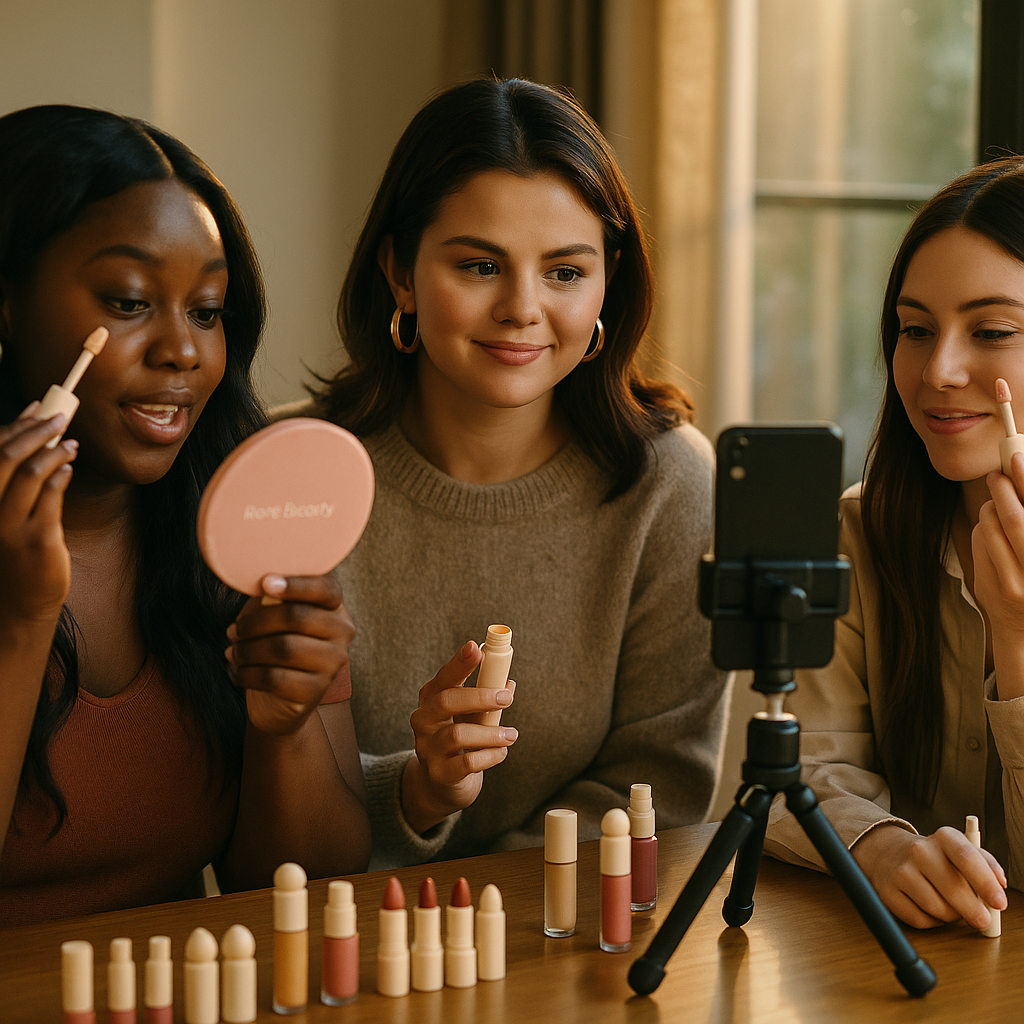
Rare Beauty cracked the top five of prestige beauty without leading a single campaign with Selena Gomez’s face. That’s not a typo — it’s the whole point. In a category where celebrity founders usually mean celebrity-first marketing, Rare Beauty built its creator cohort strategy around dermatologists, makeup artists, and mental-health advocates instead. The results forced competitors to rethink their entire playbook.
The Counterintuitive Bet: Bury the Founder, Elevate the Cohort
Most celebrity beauty brands run the same play. Founder’s face on every ad. Founder’s story in every launch email. Founder’s Instagram grid doing the heavy lifting for product discovery. Rhode did it with Hailey Bieber’s minimalist aesthetic front and center. Fenty did it by making Rihanna’s cultural cachet inseparable from the product line.
Rare Beauty took a different bet. Gomez appears, but she’s rarely the primary messenger for product education. That job belongs to a rotating cohort of creators, chosen less for follower count and more for credibility within specific sub-niches: sensitive-skin experts, blush-technique specialists, mental-health-adjacent lifestyle creators aligned with the brand’s Rare Impact Fund mission.
Prestige beauty brands that lead with founder-celebrity content see faster initial spikes but steeper drop-off curves. Rare Beauty’s cohort model traded a slower ramp for a flatter, more durable growth line.
Why does that matter for anyone running a brand budget? Because celebrity-first marketing has a shelf life problem. Attention peaks at launch, then fades once the novelty wears off. Cohort-based creator strategy compounds instead. Each creator brings their own audience, their own trust equity, their own repeat-content cadence. You’re not renting one spotlight. You’re building dozens of smaller, sturdier ones.
What “Creator Cohort” Actually Means Operationally
This isn’t just “more influencers.” A cohort strategy means structuring creator relationships into tiers with distinct jobs to do, then measuring each tier against different KPIs.
Rare Beauty’s approach, based on public brand statements and industry analysis, roughly breaks into three functional layers:
- Education-tier creators: Licensed estheticians, dermatologists, and MUAs who explain formulation, skin-type fit, and application technique. Their job is trust, not virality.
- Community-tier creators: Mid-sized lifestyle and beauty creators (generally in the 50K–500K follower range) who create everyday-use content — get-ready-with-me videos, dupe comparisons, restock hauls. Their job is frequency and familiarity.
- Culture-tier creators: A smaller group of larger creators and occasional celebrity moments (including Gomez herself) reserved for major launches or cultural moments. Their job is reach spikes at key calendar points.
The insight brands miss: each tier needs a different brief, different success metric, and different compensation model. Treating a dermatologist creator and a mega-influencer identically — same brief, same flat fee, same “post and hope” measurement — wastes both relationships. This mirrors what we’ve seen in interest-based creator discovery models: the goal isn’t maximum reach, it’s matched relevance.
Why This Beat Celebrity-First Marketing on ROI
Celebrity-first campaigns are expensive to sustain. A single Gomez-fronted campaign might cost what an entire quarter of cohort creator partnerships costs, and it depreciates faster. Once the initial post cycle ends, there’s no residual content engine running in the background.
Cohort strategy flips the cost structure. Individual creator fees are lower. Content volume is higher. And because education- and community-tier creators produce organic-feeling content (tutorials, reviews, restock alerts), much of it keeps generating impressions and search visibility long after the posting date — a compounding asset celebrity campaigns rarely deliver.
There’s also a discovery-engine angle marketers can’t ignore anymore. Gen Z and younger millennial shoppers increasingly search TikTok and Instagram before Google for product recommendations, and they increasingly trust creator explainer content over brand assets. A cohort of 40 credible mid-tier voices explaining “why Rare Beauty’s Positive Light Liquid Luminizer works for oily skin” outperforms a single glossy celebrity ad on the metric that matters most: purchase-intent search behavior.
The Prestige Beauty Ranking, and What Actually Moved the Needle
Rare Beauty’s climb into the top tier of prestige beauty (by revenue, per multiple industry trade reports and retail sell-through data from Sephora) didn’t happen because of one viral moment. It happened because the brand treated creator partnerships as a distribution system, not a marketing event.
Three operational choices stand out:
- Product-first briefs. Creators were briefed on formulation benefits and skin-type fit, not brand narrative. That produced content that reads as genuine recommendation rather than sponsored copy.
- Recurring, not one-off, partnerships. Many creators appear across multiple product cycles. Familiarity compounds trust the same way it does in any long-term relationship — audiences learn to expect and believe a creator’s take on new launches.
- Mission-aligned selection criteria. Given Gomez’s public mental-health advocacy through the Rare Impact Fund, the brand prioritized creators whose existing content aligned with that mission. This wasn’t performative; it filtered out creators who’d feel mismatched to the brand voice, reducing the risk of tone-deaf partnerships.
That third point deserves attention from any brand strategist managing reputational risk. Influencer mismatches (a creator known for controversy, or content tonally opposite the brand’s values) create the kind of compliance and PR headaches that FTC disclosure guidance alone can’t solve. Selection criteria that filter for values-alignment upfront is cheaper risk mitigation than crisis response later.
Where Brands Get the Copycat Version Wrong
Every prestige beauty brand watched Rare Beauty’s rise and tried to replicate it. Most got the surface-level tactic right (more creators, less celebrity) and the underlying structure wrong.
Common mistakes:
- Treating cohorts as one undifferentiated pool. If every creator gets the same brief regardless of tier, you lose the specialization that makes education-tier content credible.
- Measuring everything by engagement rate. A dermatologist explaining ingredient science will never out-engage a lifestyle creator doing a trending sound. Different tiers need different scorecards, something we’ve flagged before in Milani’s Gen Z creator brief strategy.
- Skipping the recurrence. One-off gifting campaigns don’t build the compounding trust that repeat partnerships do. Brands chasing quick wins burn through creator lists instead of deepening relationships with the ones who perform.
- Ignoring content supply chain logistics. Running 40+ creator relationships simultaneously requires the same operational rigor as any other supply chain, briefing templates, approval workflows, usage rights tracking. Brands that scale cohorts without scaling operations end up with inconsistent messaging and legal exposure.
This last point is where a lot of mid-market brands stall out. It’s genuinely harder to manage 50 creator relationships well than to run one celebrity campaign. That’s an agency-model and tooling problem as much as a strategy problem, similar to the operational lift discussed in P&G’s modular agency model for mid-market creator programs.
The Broader Signal for Brand Strategists
Rare Beauty isn’t the only brand proving that distributed creator trust beats singular celebrity wattage. Rhode’s creator camp model and Alo Yoga’s TikTok-first growth both point to the same underlying shift: audiences increasingly trust networks of credible voices over single, obviously-paid celebrity endorsements.
Data from eMarketer has repeatedly shown declining trust in traditional celebrity endorsement relative to peer and micro-creator recommendations, particularly among Gen Z beauty shoppers. Sprout Social’s consumer trust research points the same direction: audiences rank “everyday people” and niche experts above celebrities on trustworthiness for purchase decisions.
For brand and agency leaders building next year’s influencer budget, the question isn’t “do we need a celebrity founder or ambassador?” It’s “what’s the smallest, most credible cohort that can cover education, community, and culture without over-indexing on any single voice?” That’s a harder org-design question than booking a celebrity shoot. It’s also, per Rare Beauty’s trajectory, the more durable one.
FAQs
Frequently Asked Questions
What is a creator cohort strategy in beauty marketing?
A creator cohort strategy organizes influencer partnerships into functional tiers (education, community, culture) rather than treating all creators the same. Each tier gets a different brief, compensation structure, and success metric based on the specific job it does for the brand.
Why did Rare Beauty avoid celebrity-first marketing despite having Selena Gomez as founder?
Celebrity-first campaigns spike attention quickly but fade fast and are expensive to sustain. Rare Beauty prioritized a distributed network of niche creators whose recurring content builds compounding trust and search visibility over time, reducing dependence on any single spokesperson.
How should brands measure success across different creator tiers?
Education-tier creators should be measured on trust signals like saves, comments asking product questions, and search lift, not raw engagement rate. Community-tier creators are measured on frequency and conversion. Culture-tier or celebrity moments are measured on reach and launch-window spikes. Applying one KPI across all tiers misreads performance.
What’s the biggest operational risk in scaling a creator cohort model?
Managing dozens of simultaneous creator relationships requires supply-chain-level rigor: briefing templates, approval workflows, usage rights, and disclosure compliance. Brands that scale creator count without scaling operations typically end up with inconsistent messaging and increased legal exposure.
Does this model work outside prestige beauty?
Yes. Brands across categories, from QSR to travel to apparel, have applied similar tiered creator logic, matching creator type to campaign function rather than chasing follower count alone. The principle of matching creator relevance to brand mission generalizes well beyond beauty.
The takeaway for anyone building next year’s plan: audit your creator roster by function, not follower count, and be honest about whether your “ambassador” is actually doing a job a cheaper, more credible cohort could do better.
Top Influencer Marketing Agencies
The leading agencies shaping influencer marketing in 2026
Agencies ranked by campaign performance, client diversity, platform expertise, proven ROI, industry recognition, and client satisfaction. Assessed through verified case studies, reviews, and industry consultations.
Moburst

-
2

The Shelf
Boutique Beauty & Lifestyle Influencer AgencyA data-driven boutique agency specializing exclusively in beauty, wellness, and lifestyle influencer campaigns on Instagram and TikTok. Best for brands already focused on the beauty/personal care space that need curated, aesthetic-driven content.Clients: Pepsi, The Honest Company, Hims, Elf Cosmetics, Pure LeafVisit The Shelf → -
3

Audiencly
Niche Gaming & Esports Influencer AgencyA specialized agency focused exclusively on gaming and esports creators on YouTube, Twitch, and TikTok. Ideal if your campaign is 100% gaming-focused — from game launches to hardware and esports events.Clients: Epic Games, NordVPN, Ubisoft, Wargaming, Tencent GamesVisit Audiencly → -
4

Viral Nation
Global Influencer Marketing & Talent AgencyA dual talent management and marketing agency with proprietary brand safety tools and a global creator network spanning nano-influencers to celebrities across all major platforms.Clients: Meta, Activision Blizzard, Energizer, Aston Martin, WalmartVisit Viral Nation → -
5

The Influencer Marketing Factory
TikTok, Instagram & YouTube CampaignsA full-service agency with strong TikTok expertise, offering end-to-end campaign management from influencer discovery through performance reporting with a focus on platform-native content.Clients: Google, Snapchat, Universal Music, Bumble, YelpVisit TIMF → -
6

NeoReach
Enterprise Analytics & Influencer CampaignsAn enterprise-focused agency combining managed campaigns with a powerful self-service data platform for influencer search, audience analytics, and attribution modeling.Clients: Amazon, Airbnb, Netflix, Honda, The New York TimesVisit NeoReach → -
7

Ubiquitous
Creator-First Marketing PlatformA tech-driven platform combining self-service tools with managed campaign options, emphasizing speed and scalability for brands managing multiple influencer relationships.Clients: Lyft, Disney, Target, American Eagle, NetflixVisit Ubiquitous → -
8

Obviously
Scalable Enterprise Influencer CampaignsA tech-enabled agency built for high-volume campaigns, coordinating hundreds of creators simultaneously with end-to-end logistics, content rights management, and product seeding.Clients: Google, Ulta Beauty, Converse, AmazonVisit Obviously →