


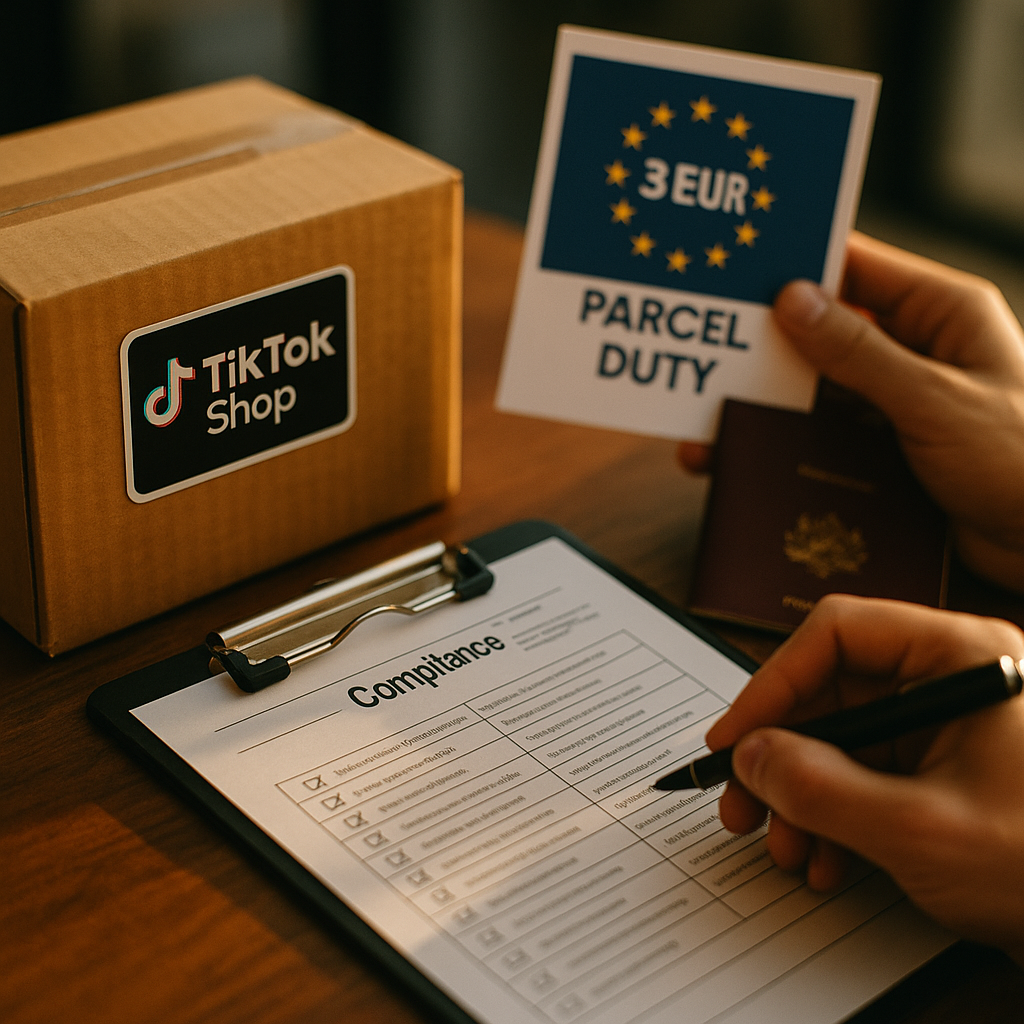
Every parcel under €150 shipped into the EU used to slip past customs duty-free. That era ends soon. Once the European Commission’s flat-fee regime lands, every low-value package — including the sneaker samples and skincare minis your TikTok Shop creators unbox on camera — carries a €3 handling charge. For merchants running high-volume, low-cost SKUs through TikTok Shop, TikTok Shop compliance just became a margin problem, not just a legal one.
This isn’t a distant regulatory footnote. It’s a rewrite of the unit economics that made TikTok Shop’s cross-border model work in the first place. Merchants who treat it as a shipping-line tweak will get blindsided. Here’s what actually needs to change before enforcement begins.
What the €3 flat duty actually changes
The EU has been signaling the death of the de minimis exemption for over a year, largely in response to the flood of ultra-low-cost parcels from platforms like Shein, Temu, and yes, TikTok Shop. The new flat-fee structure applies a standardized €3 charge per parcel for low-value goods entering the EU, replacing the patchwork of duty-free thresholds that let sub-€150 shipments through untaxed.
Sounds small. It isn’t. Run the math on a merchant shipping 50,000 parcels a month at an average order value of €18. That’s an extra €150,000 in monthly duty exposure, and someone has to absorb it: the merchant, the platform, or the customer at checkout. TikTok Shop has not committed publicly to eating that cost, which means most of it will land on sellers unless contracts say otherwise.
A €3 flat fee on a €12 impulse-buy item isn’t a rounding error — it can erase the entire margin on the SKU.
The mechanics mirror what’s already reshaping influencer payment structures elsewhere in the EU. If you haven’t read how the parcel tariff is forcing renegotiation of creator contracts, it’s worth reviewing alongside this checklist — the two issues are financially linked. See our breakdown on rewriting creator payment contracts for the payment-side implications.
Who this hits hardest
Not every TikTok Shop merchant feels this equally. Risk concentrates in a few predictable places:
- High-volume, low-AOV sellers — beauty minis, phone accessories, novelty items. Thin margins can’t absorb a flat per-parcel fee.
- Dropshippers and fulfillment-by-platform sellers shipping direct from non-EU warehouses, particularly China-based suppliers.
- Affiliate-heavy programs where creators drive volume through gifted product and discount codes, inflating parcel count without raising per-order value.
- Multi-SKU bundle sellers who split shipments to game weight-based shipping tiers — a practice EU customs authorities are now specifically watching for.
If your TikTok Shop strategy leans on volume over margin, this rule doesn’t just cut into profit. It can flip profitable SKUs negative overnight.
The compliance checklist
This is the operational core. Treat it as a pre-rollout audit, not a wish list.
1. Map your parcel-level cost structure
Pull your last 90 days of EU order data and calculate true landed cost per parcel, including the new €3 fee. Segment by SKU, not just by category. You need to know exactly which products go from profitable to loss-making. Most merchants have never done this at the SKU level because de minimis made it irrelevant. It isn’t anymore.
2. Update customs declarations and HS codes
Flat-fee enforcement depends on accurate Harmonized System (HS) codes and correct customs valuation. Sloppy or generic HS coding, common among merchants who batch-upload thousands of SKUs, invites delays, fines, and parcel seizures. Audit your product catalog now, not after the first shipment gets held at a distribution hub.
3. Revisit creator gifting and seeding programs
Every PR box, gifted haul, and affiliate sample shipped to an EU-based creator is now a dutiable parcel. If you’re seeding 200 creators a month with product bundles, that’s 200 additional flat fees stacking on top of your existing cost base. Build this into creator program budgets before your next campaign cycle, and revisit payment terms with creators whose contracts assume the old cost structure. Our guide on creator payment contract changes covers the clauses worth renegotiating first.
4. Decide who absorbs the fee — and disclose it
You have three options: absorb it into product cost, pass it to the consumer at checkout, or split it. Whichever you choose, pricing transparency matters. EU consumer protection rules already require clear disclosure of total landed costs at checkout for cross-border sales. Burying the fee invites complaints and platform penalties.
5. Audit fulfillment partners and warehouse locations
Merchants fulfilling from EU-based warehouses (rather than shipping parcel-by-parcel from outside the bloc) may reduce exposure significantly, since bulk import already clears customs differently than direct-to-consumer parcels. If you don’t already have EU fulfillment infrastructure, now’s the time to model the cost-benefit of setting one up versus absorbing per-parcel fees indefinitely.
6. Reconcile with existing disclosure and ad compliance obligations
This rollout doesn’t happen in isolation. TikTok Shop merchants are already juggling FTC-style disclosure requirements, EU Digital Services Act obligations, and platform-specific ad policies. A pricing change that affects checkout transparency intersects with consumer protection law generally. If your compliance function has been siloed — legal handles disclosure, finance handles duties — this is the moment to merge those workstreams. For a broader view of how EU platform scrutiny is expanding, see our coverage of the DSA crackdown on creator risk.
7. Build the fee into your compliance calendar
Regulatory changes like this rarely arrive alone. Brands running EU-facing creator programs are also tracking DSA enforcement, autoplay restrictions, and evolving disclosure standards simultaneously. Treat the flat parcel duty as one line item in a broader annual compliance calendar rather than a one-off fire drill. Our framework for building a compliance calendar is a useful template for slotting this in alongside other EU deadlines.
What TikTok Shop itself is (and isn’t) doing
TikTok Shop has publicly supported harmonized EU customs enforcement, largely because inconsistent de minimis rules created friction for its own cross-border logistics. But “supporting the policy” and “absorbing the cost for sellers” are different things. As of now, TikTok has not announced blanket duty absorption for merchants. Some sellers report early signals that platform-level logistics partnerships may offer bulk customs clearance discounts, but nothing is guaranteed or uniform across markets.
Merchants should not assume TikTok Shop will quietly eat this cost. Build your own model instead. Assume you’re responsible for the €3 fee, and treat any platform subsidy as upside, not a planning baseline.
Where the real financial exposure hides
The obvious cost is the €3 per parcel. The hidden cost is process failure: misdeclared customs values, incorrect HS codes, or parcels held at the border because a merchant didn’t update fulfillment paperwork in time. According to Statista’s e-commerce trade data, cross-border parcel volumes into the EU from Asia-Pacific sellers have grown at double-digit rates annually — meaning customs infrastructure is already strained. Delays and rejected shipments during the rollout period are likely, especially for merchants who haven’t pre-registered or updated their customs documentation.
There’s also brand-risk exposure. If creators unbox gifted product and complain publicly about customs delays or surprise fees passed to buyers, that’s a disclosure and reputation problem layered on top of a logistics one. Compliance teams should loop in whoever manages creator relations, not just finance and ops.
A short list of what to do this quarter
- Run the SKU-level margin analysis before your next inventory order.
- Confirm HS codes across your full catalog with your customs broker.
- Get written confirmation from TikTok Shop (or your fulfillment partner) on who owns the €3 fee contractually.
- Update creator gifting budgets and contracts to reflect new shipping costs.
- Add checkout-level fee disclosure to your EU storefront before enforcement begins.
None of this requires a legal team the size of a multinational’s. It requires someone in finance and someone in ops actually talking to each other before the invoices start arriving. For more on how EU regulatory shifts are reshaping brand-creator financial arrangements more broadly, HubSpot’s marketing research and eMarketer’s e-commerce forecasts are useful benchmarks for modeling downstream consumer price sensitivity.
Visible FAQ
Frequently Asked Questions
What is the EU’s €3 flat parcel duty?
It’s a standardized customs handling fee the European Commission is applying to low-value parcels entering the EU, replacing the previous de minimis exemption that let shipments under €150 pass duty-free.
Does the €3 fee apply per parcel or per item?
The fee applies per parcel, not per item, which means merchants who bundle multiple SKUs into a single shipment face proportionally lower per-unit exposure than those shipping single-item parcels.
Will TikTok Shop absorb the new duty on behalf of merchants?
No official commitment has been made. TikTok Shop has not announced blanket absorption of the €3 fee, so merchants should plan as though they’re responsible for the cost unless their seller agreement states otherwise.
How does this affect creator gifting and seeding programs?
Gifted product shipments to EU-based creators now count as dutiable parcels, adding cost to seeding programs that previously shipped duty-free under de minimis thresholds.
What should merchants do first to prepare?
Start with a SKU-level margin audit, confirm HS code accuracy with a customs broker, and clarify contractually who absorbs the fee — the merchant, the platform, or the customer.
Does this rule affect all EU member states equally?
Yes, the flat-fee structure is designed as an EU-wide harmonization measure, replacing inconsistent national enforcement of the previous de minimis exemption.
The merchants who come out ahead won’t be the ones who wait for TikTok Shop to clarify policy. They’ll be the ones who ran the SKU-level math this week and rebuilt pricing before enforcement hits.
Top Influencer Marketing Agencies
The leading agencies shaping influencer marketing in 2026
Agencies ranked by campaign performance, client diversity, platform expertise, proven ROI, industry recognition, and client satisfaction. Assessed through verified case studies, reviews, and industry consultations.
Moburst

-
2

The Shelf
Boutique Beauty & Lifestyle Influencer AgencyA data-driven boutique agency specializing exclusively in beauty, wellness, and lifestyle influencer campaigns on Instagram and TikTok. Best for brands already focused on the beauty/personal care space that need curated, aesthetic-driven content.Clients: Pepsi, The Honest Company, Hims, Elf Cosmetics, Pure LeafVisit The Shelf → -
3

Audiencly
Niche Gaming & Esports Influencer AgencyA specialized agency focused exclusively on gaming and esports creators on YouTube, Twitch, and TikTok. Ideal if your campaign is 100% gaming-focused — from game launches to hardware and esports events.Clients: Epic Games, NordVPN, Ubisoft, Wargaming, Tencent GamesVisit Audiencly → -
4

Viral Nation
Global Influencer Marketing & Talent AgencyA dual talent management and marketing agency with proprietary brand safety tools and a global creator network spanning nano-influencers to celebrities across all major platforms.Clients: Meta, Activision Blizzard, Energizer, Aston Martin, WalmartVisit Viral Nation → -
5

The Influencer Marketing Factory
TikTok, Instagram & YouTube CampaignsA full-service agency with strong TikTok expertise, offering end-to-end campaign management from influencer discovery through performance reporting with a focus on platform-native content.Clients: Google, Snapchat, Universal Music, Bumble, YelpVisit TIMF → -
6

NeoReach
Enterprise Analytics & Influencer CampaignsAn enterprise-focused agency combining managed campaigns with a powerful self-service data platform for influencer search, audience analytics, and attribution modeling.Clients: Amazon, Airbnb, Netflix, Honda, The New York TimesVisit NeoReach → -
7

Ubiquitous
Creator-First Marketing PlatformA tech-driven platform combining self-service tools with managed campaign options, emphasizing speed and scalability for brands managing multiple influencer relationships.Clients: Lyft, Disney, Target, American Eagle, NetflixVisit Ubiquitous → -
8

Obviously
Scalable Enterprise Influencer CampaignsA tech-enabled agency built for high-volume campaigns, coordinating hundreds of creators simultaneously with end-to-end logistics, content rights management, and product seeding.Clients: Google, Ulta Beauty, Converse, AmazonVisit Obviously →