


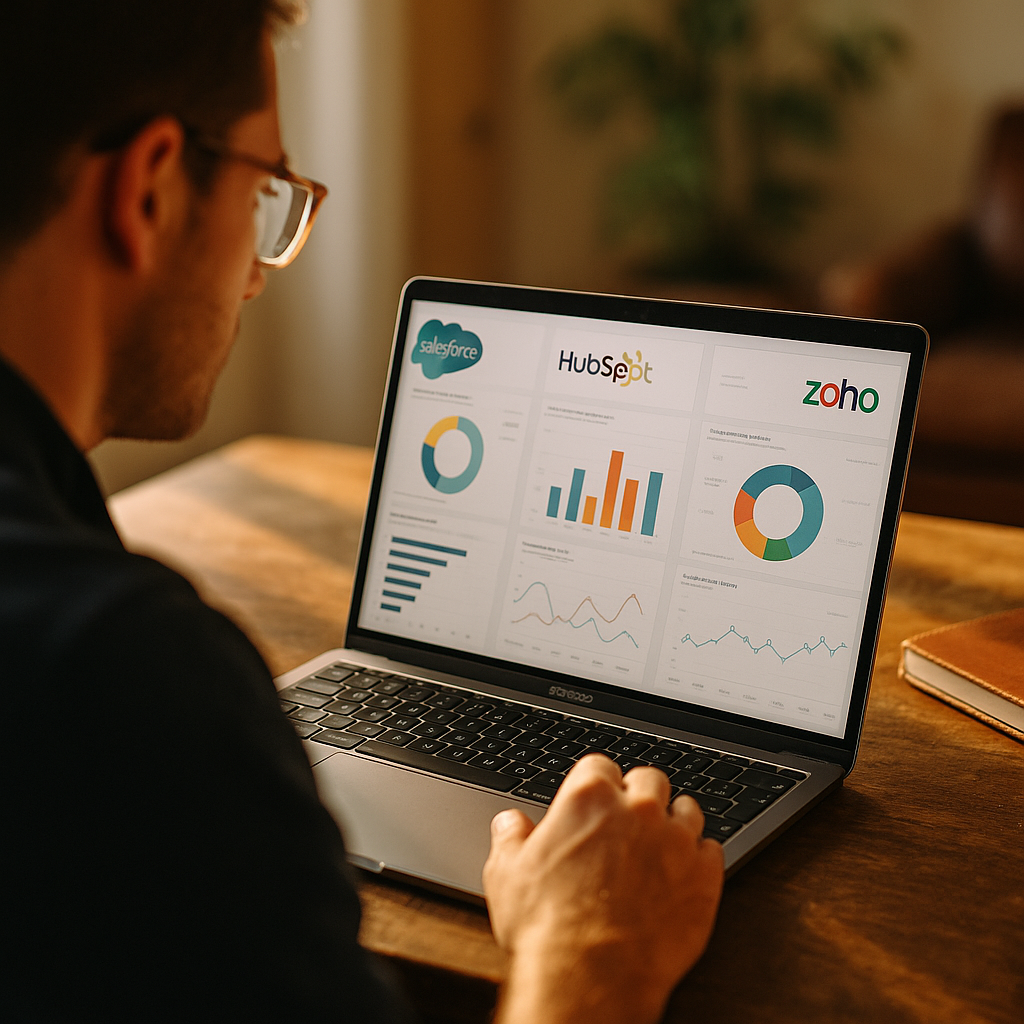
Salesforce says its AI agents can now trace revenue back to the exact touchpoint that closed the deal. HubSpot claims something similar. Zoho too. So why do most marketing ops teams still export data to spreadsheets to figure out what actually worked? Agentic attribution is the CRM industry’s newest big promise, and like most big promises, it’s part real, part roadmap slide. This guide breaks down what Salesforce, HubSpot, and Zoho have actually shipped versus what they’re still selling on vibes.
What “Agentic Attribution” Actually Means
Strip away the marketing language and agentic attribution is a simple idea: instead of a static dashboard showing you last-touch or multi-touch models, an AI agent continuously re-evaluates which touchpoints, content assets, and rep actions actually influenced a closed deal, then adjusts budget or workflow recommendations without a human triggering the analysis.
That’s the pitch, anyway. In practice, “agentic” gets used to describe everything from a scheduled batch job with a chatbot front end to a genuinely autonomous system that can re-weight attribution models and push recommendations into ad platforms on its own. The gap between those two things is where buyers get burned.
If a vendor can’t tell you exactly which data sources feed the attribution model and how often it re-trains, you’re not buying an agent — you’re buying a report generator with better UX.
We covered the credibility gap in detail in our earlier piece testing vendor claims directly: testing Salesforce, HubSpot, and Zoho against their own marketing copy. The short version: all three have real capability, none of it matches the keynote demos exactly.
Salesforce: Agentforce and the Data Cloud Dependency
Salesforce’s Agentforce is the most ambitious of the three, and also the most dependent on infrastructure you probably don’t have fully deployed yet. Agentforce’s attribution capabilities lean heavily on Data Cloud — Salesforce’s CDP layer — to unify signals across Sales Cloud, Marketing Cloud, and third-party sources before an agent can reason over them.
Here’s the catch most buyers miss: Agentforce doesn’t do attribution on raw CRM data out of the box. It needs Data Cloud harmonizing identity and events first. If your org hasn’t invested in that unification layer, you’re not getting agentic attribution — you’re getting Einstein Analytics with a new coat of paint. Salesforce’s own product documentation is fairly upfront about this dependency once you get past the announcement pages.
The upside: once Data Cloud is live, Agentforce agents can genuinely surface which campaigns, content touches, and rep sequences correlate with pipeline movement, and update those weights on a rolling basis rather than a quarterly review cycle. For enterprises already committed to the Salesforce ecosystem, that’s a meaningful upgrade. For everyone else, it’s a multi-quarter implementation project disguised as a feature toggle.
We’ve written previously about how this compares to other platforms positioning themselves as the central nervous system for AI marketing decisions — see our breakdown of agentic marketing readiness across Databricks, Salesforce, and Adobe.
HubSpot’s Breeze: Smaller Scope, Faster Time-to-Value
HubSpot took a different bet. Rather than building an all-encompassing agent layer, Breeze focuses on specific, bounded use cases: content attribution scoring, deal-influence tagging, and lifecycle stage prediction. It’s less ambitious than Agentforce on paper, but that narrower scope means it actually works with the data most mid-market teams already have in their portal.
Breeze’s attribution reporting pulls from HubSpot’s native contact timeline, which means every email open, form fill, ad click, and page view already logged in the CRM gets folded into the model without a separate data warehouse project. That’s the real advantage here: HubSpot customers get something functional in weeks, not quarters.
The tradeoff is depth. Breeze’s agentic layer doesn’t reason particularly well across non-HubSpot data sources. If your paid media, influencer, or offline event data lives outside the HubSpot ecosystem, you’re back to manual stitching or a third-party connector. HubSpot has acknowledged this gap publicly and continues to expand its integration marketplace to close it, but as of now it’s a real limitation for brands running multi-platform influencer and paid programs.
Zoho: The Underdog With Surprising Transparency
Zoho doesn’t get the analyst-day airtime that Salesforce and HubSpot do, but its Zia agent layer is worth a serious look, particularly for mid-market brands that find the other two either too expensive or too architecturally demanding. Zia’s attribution features are more modest in scope, mostly confined to lead-source weighting and basic multi-touch modeling, but Zoho has been unusually candid about what’s rules-based versus what’s genuinely ML-driven.
That transparency matters more than it sounds. A lot of vendors blur the line between “AI-powered” and “if-this-then-that logic with a machine learning label slapped on it.” Zoho’s documentation actually distinguishes the two, which makes it easier for a buyer to set realistic expectations before signing a contract.
Zoho’s ceiling is lower. It won’t do the kind of cross-channel, real-time re-weighting that Agentforce promises at full deployment. But for a mid-market team with a $2-5M marketing budget and no dedicated data science function, Zia’s honesty about its own limits might be worth more than a bigger platform’s overpromising.
Where the ROI Case Actually Holds Up
Let’s talk numbers, because attribution tools live and die on whether they change budget decisions. According to eMarketer research on marketing measurement adoption, a majority of brands still report low-to-moderate confidence in their attribution data, even after investing in dedicated tools. Agentic layers don’t automatically fix that confidence gap — they just automate the same modeling assumptions faster, which is either an improvement or a liability depending on whether those assumptions were sound to begin with.
The realistic ROI case for agentic attribution isn’t “better numbers.” It’s fewer analyst-hours spent building the same recurring report, and faster reallocation when a channel underperforms. If your team currently takes two weeks to notice a campaign has gone cold and reroute spend, an agent that flags it in near-real time is worth paying for even if the underlying attribution model is only marginally more accurate than what you had before.
The real ROI of agentic attribution is speed of reaction, not accuracy of the model. Don’t buy on accuracy claims you can’t independently verify.
This is a pattern we’ve flagged across the broader AI marketing stack — see our take on autonomous programmatic buying, where the same “faster, not necessarily smarter” dynamic plays out in media buying decisions.
What to Demand Before You Sign
Before any CRM vendor gets budget approval for an agentic attribution add-on, run through this checklist:
- Data lineage transparency: Which systems feed the attribution model, and how are conflicting signals resolved?
- Re-training cadence: Is the model updated continuously, daily, or on a batch schedule that just looks continuous in the UI?
- Override controls: Can your team correct or reject an agent’s attribution weighting, and does that correction persist?
- Cross-platform reach: Does the agent reason over data outside the CRM, including influencer and paid social platforms, or only native CRM events?
- Explainability: Can the vendor show you, in plain language, why the agent assigned credit to a specific touchpoint?
Most of this maps directly to the governance framework we outlined in our agentic CRM buyer’s checklist, which goes deeper on write-access permissions specifically. If a vendor is asking for write access to your ad accounts or CRM records to “close the loop” on attribution, that’s a separate and much bigger governance conversation. Our AI vendor scorecard is a useful companion document for that evaluation.
Also worth asking: how does this attribution layer talk to the rest of your stack? Most agentic CRM features still operate in a silo relative to your CDP, ad platforms, and creator management tools. We’ve documented this repeatedly — see why marketing AI tools still refuse to talk to each other and the broader martech interoperability gap for context on why this keeps happening across the industry.
Picking the Right Fit for Your Org
There’s no universal winner here, which is a frustrating but honest answer. Salesforce Agentforce makes sense if you’re already deep in Data Cloud or willing to commit budget to get there — enterprise brands with complex, multi-brand portfolios will get the most out of the cross-channel reasoning once it’s fully wired up. HubSpot Breeze is the pragmatic choice for mid-market teams who want something working inside a quarter, provided most of your customer data already lives natively in HubSpot. Zoho Zia is the value play for teams that want honest, bounded AI without the enterprise price tag or the multi-year implementation runway.
None of the three is going to hand you a fully autonomous attribution system today, no matter what the product page says. What they will give you, if implemented correctly, is a meaningfully faster feedback loop between spend and signal. In 2026, that speed advantage is the actual differentiator, not the AI label.
Frequently Asked Questions
What is agentic attribution in a CRM platform?
Agentic attribution refers to AI agents within a CRM that continuously analyze which marketing touchpoints and sales activities influenced a deal, updating those insights automatically rather than requiring a manual report-building process.
Is Salesforce Agentforce’s attribution feature fully autonomous?
Not entirely. Agentforce’s attribution capabilities depend heavily on Salesforce Data Cloud for identity resolution and data unification. Without that layer properly implemented, the agent’s insights are significantly limited.
How is HubSpot Breeze different from Salesforce Agentforce for attribution?
Breeze has a narrower scope focused on native HubSpot data, like email, forms, and page views, making it faster to deploy but less capable of reasoning across external data sources compared to Agentforce.
Does Zoho’s Zia offer genuine AI-driven attribution?
Zia offers a mix of rules-based logic and machine learning-driven attribution, and Zoho is relatively transparent about which features fall into each category, making it easier for buyers to set accurate expectations.
What should marketing teams demand before buying an agentic attribution tool?
Buyers should require clarity on data lineage, model re-training frequency, override and correction controls, cross-platform data reach, and clear explainability of how credit is assigned to specific touchpoints.
Does agentic attribution actually improve marketing ROI?
The clearest ROI comes from faster reaction time to underperforming channels rather than dramatically more accurate attribution models. Teams should evaluate speed-to-insight as much as, or more than, claimed accuracy improvements.
Next step: Before your next renewal cycle, ask each vendor to walk through one real attribution decision end-to-end, from raw signal to recommended action, and document exactly where a human had to intervene. That single exercise will tell you more than any product demo.
Frequently Asked Questions
What is agentic attribution in a CRM platform?
Agentic attribution refers to AI agents within a CRM that continuously analyze which marketing touchpoints and sales activities influenced a deal, updating those insights automatically rather than requiring a manual report-building process.
Is Salesforce Agentforce’s attribution feature fully autonomous?
Not entirely. Agentforce’s attribution capabilities depend heavily on Salesforce Data Cloud for identity resolution and data unification. Without that layer properly implemented, the agent’s insights are significantly limited.
How is HubSpot Breeze different from Salesforce Agentforce for attribution?
Breeze has a narrower scope focused on native HubSpot data, like email, forms, and page views, making it faster to deploy but less capable of reasoning across external data sources compared to Agentforce.
Does Zoho’s Zia offer genuine AI-driven attribution?
Zia offers a mix of rules-based logic and machine learning-driven attribution, and Zoho is relatively transparent about which features fall into each category, making it easier for buyers to set accurate expectations.
What should marketing teams demand before buying an agentic attribution tool?
Buyers should require clarity on data lineage, model re-training frequency, override and correction controls, cross-platform data reach, and clear explainability of how credit is assigned to specific touchpoints.
Does agentic attribution actually improve marketing ROI?
The clearest ROI comes from faster reaction time to underperforming channels rather than dramatically more accurate attribution models. Teams should evaluate speed-to-insight as much as, or more than, claimed accuracy improvements.
Top Influencer Marketing Agencies
The leading agencies shaping influencer marketing in 2026
Agencies ranked by campaign performance, client diversity, platform expertise, proven ROI, industry recognition, and client satisfaction. Assessed through verified case studies, reviews, and industry consultations.
Moburst

-
2

The Shelf
Boutique Beauty & Lifestyle Influencer AgencyA data-driven boutique agency specializing exclusively in beauty, wellness, and lifestyle influencer campaigns on Instagram and TikTok. Best for brands already focused on the beauty/personal care space that need curated, aesthetic-driven content.Clients: Pepsi, The Honest Company, Hims, Elf Cosmetics, Pure LeafVisit The Shelf → -
3

Audiencly
Niche Gaming & Esports Influencer AgencyA specialized agency focused exclusively on gaming and esports creators on YouTube, Twitch, and TikTok. Ideal if your campaign is 100% gaming-focused — from game launches to hardware and esports events.Clients: Epic Games, NordVPN, Ubisoft, Wargaming, Tencent GamesVisit Audiencly → -
4

Viral Nation
Global Influencer Marketing & Talent AgencyA dual talent management and marketing agency with proprietary brand safety tools and a global creator network spanning nano-influencers to celebrities across all major platforms.Clients: Meta, Activision Blizzard, Energizer, Aston Martin, WalmartVisit Viral Nation → -
5

The Influencer Marketing Factory
TikTok, Instagram & YouTube CampaignsA full-service agency with strong TikTok expertise, offering end-to-end campaign management from influencer discovery through performance reporting with a focus on platform-native content.Clients: Google, Snapchat, Universal Music, Bumble, YelpVisit TIMF → -
6

NeoReach
Enterprise Analytics & Influencer CampaignsAn enterprise-focused agency combining managed campaigns with a powerful self-service data platform for influencer search, audience analytics, and attribution modeling.Clients: Amazon, Airbnb, Netflix, Honda, The New York TimesVisit NeoReach → -
7

Ubiquitous
Creator-First Marketing PlatformA tech-driven platform combining self-service tools with managed campaign options, emphasizing speed and scalability for brands managing multiple influencer relationships.Clients: Lyft, Disney, Target, American Eagle, NetflixVisit Ubiquitous → -
8

Obviously
Scalable Enterprise Influencer CampaignsA tech-enabled agency built for high-volume campaigns, coordinating hundreds of creators simultaneously with end-to-end logistics, content rights management, and product seeding.Clients: Google, Ulta Beauty, Converse, AmazonVisit Obviously →