


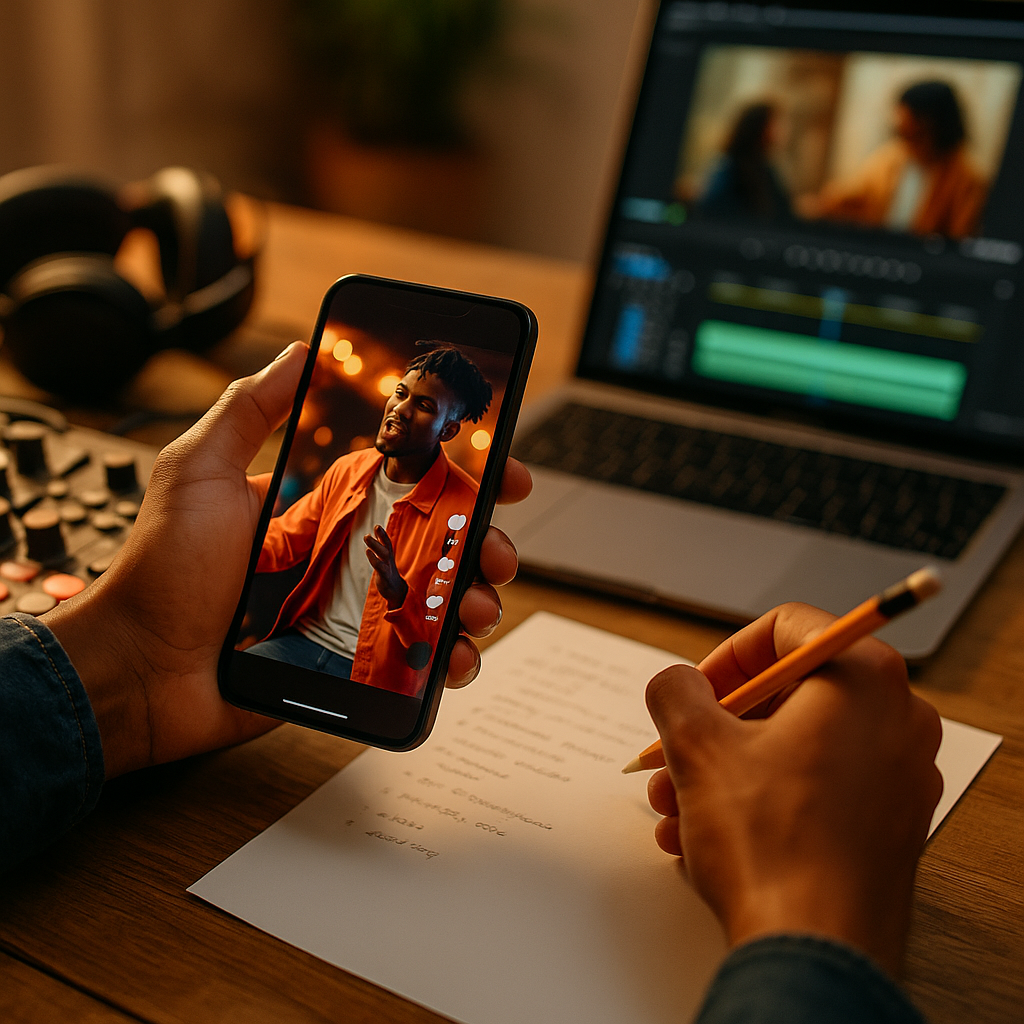
Skippable ads get skipped. That’s the whole problem in one sentence. Yet a 90-second brand film styled like a music video, full needle drops, choreography, and visual flex, can rack up millions of organic views without a media dollar behind it. The music-video brand spot is back, and it’s quietly outperforming the polished, funnel-obsessed content most brands keep greenlighting.
Why now? Because audiences are exhausted by ads that announce themselves as ads. A format built for pure entertainment, borrowed from MTV’s golden era and reworked for vertical feeds, sidesteps that fatigue entirely. It doesn’t sell. It performs. And performance, it turns out, is what gets shared.
What Counts as a Music-Video Brand Spot in 2026?
Strip away the nostalgia and the format has clear mechanics: a licensed or original track driving the edit, choreography or stylized movement, high-contrast visual identity, and a narrative arc that resolves emotionally rather than transactionally. Think of Apple’s product films set to a single artist’s track, or Charli XCX-adjacent brand collaborations that feel like extensions of an album rollout rather than a campaign.
The brand appears, but it doesn’t dominate. Product placement is woven into the choreography or set design instead of bolted on with a CTA card. That’s the discipline most marketing teams struggle with. Everyone wants the shareability of entertainment content, but few are willing to let the brand recede far enough into the background to earn it.
Entertainment-first creative works because it asks nothing of the viewer except attention. The moment a spot asks for a click, a follow, or a purchase, it stops being entertainment and becomes an ad again.
The ROI Case: Why Organic Shares Beat Paid Reach
Let’s talk numbers, because creative teams need more than “it feels cool” to get budget approved. Organic shares carry compounding distribution value that paid media can’t replicate. A view from a paid placement stops when the budget stops. A share creates a new distribution node every time it happens, and platform algorithms reward content with high share-to-view ratios by pushing it into more feeds for free.
According to eMarketer, engagement-driven organic reach has become one of the few remaining growth levers as paid social costs climb across nearly every major platform. Brands chasing cost-per-thousand efficiency are increasingly finding that a single viral entertainment spot outperforms a mid-six-figure paid push, simply because the content earns its own algorithmic momentum.
There’s also a halo effect on brand favorability. HubSpot’s research on content marketing consistently shows that entertainment and utility content outperform direct-response creative on brand recall metrics, even when direct-response wins on immediate conversion. For upper-funnel awareness and creator partnership programs, that recall matters more than a same-day click.
Directing for Shareability, Not Just Watchability
Watchability gets you completion rate. Shareability gets you reach. They’re not the same skill, and most brand teams brief for the former without realizing the latter is what actually moves the needle.
Here’s what separates a spot people finish from a spot people forward to a group chat:
- A visual hook in the first two seconds. Not a logo. A moment. Choreography snap, wardrobe reveal, color shift, something that reads as “this is different” before the brain has time to categorize it as an ad.
- Music that could stand alone. If the track wouldn’t hold up as a standalone reel on a music account, it won’t carry your brand spot either. This is where licensing budget actually matters more than production budget.
- A visual signature, not a product shot. The best entertainment-first spots make you remember a color palette, a dance move, or a location before you remember the product. That’s intentional, and it’s counterintuitive for brand teams trained to maximize logo visibility.
- An ending that resolves the feeling, not the offer. No CTA card. No “shop now.” The emotional beat closes the loop; the brand name is enough of a signature.
This is a different kind of brief than most creative teams are used to writing. It borrows more from music video treatments and short-film loglines than from performance marketing templates. If your brief still includes a CTA in the shot list, you’re briefing the wrong format. For adjacent formats where narrative discipline matters just as much, the same logic shows up in POV video storytelling, where immersion has to come before message.
Casting Creators as Performers, Not Endorsers
This format lives or dies on talent selection. You’re not casting someone who talks well about a product. You’re casting someone who can move, perform, or hold a camera’s attention without dialogue. That’s a different creator pool than most talent teams default to, and it’s worth expanding your roster deliberately.
Dancers, musicians, and creators with a strong visual aesthetic (not necessarily the biggest follower count) tend to outperform traditional brand ambassadors in this format. A creator with 200K followers and a distinct visual style can out-share a million-follower lifestyle influencer if the content itself is more watchable and more forwardable.
Brief the performance, not the message. Give creators a mood board, a track, and a movement direction. Let them interpret. The moment you hand a performer a script with brand talking points, you’ve collapsed the format back into a standard ad read, and the entertainment value evaporates. This is the same principle driving success in narrative-first GRWM content, where beats replace ad copy entirely.
Compliance Doesn’t Disappear Just Because It’s Entertaining
Here’s the part legal and compliance teams need to hear clearly: entertainment-first doesn’t mean disclosure-free. The FTC’s endorsement guidelines still apply whether the content is a testimonial or a choreographed music-video-style spot. If a creator is paid or gifted product to appear, that relationship needs disclosure, even if the spot never says a word about the product’s features.
This trips up a lot of brand teams because the format feels closer to art than advertising. It isn’t. Regulators don’t grade on creative merit.
Music licensing is the second landmine. Original composition avoids the clearance headache entirely but costs more upfront. Licensed tracks require sync rights, and platform-native music libraries (TikTok’s commercial music library, for instance) often restrict usage once a video crosses from organic-feeling content into paid promotion. If you plan to boost the spot as an ad after it launches organically, confirm licensing covers that use case before you shoot a single frame. Nothing kills a strong performing spot faster than a takedown notice three days into its viral run.
For teams that have navigated similar disclosure balancing acts in other formats, the same care shows up in before-and-after compliance briefs and in split-screen reaction format guidance, both of which deal with keeping creative loose while keeping paperwork tight.
Measuring What Actually Matters
Standard campaign dashboards weren’t built for this format, and that’s a real operational problem. Completion rate and CTR undersell entertainment-first content because the value is downstream: shares, saves, remixes, and sound usage on the platform’s own audio library.
Track these instead:
- Share-to-view ratio — the clearest proxy for organic distribution momentum.
- Sound or audio page usage — if your track shows up being reused by other creators, that’s earned media you didn’t pay for.
- Duet, stitch, and remix volume on platforms that support it.
- Branded search lift in the days following launch, since entertainment spots often drive curiosity-based search rather than immediate click-through.
Sprout Social’s engagement benchmarking tools and native platform analytics from TikTok Ads Manager and Meta Business Suite can surface most of these metrics, but someone on the team needs to actually build the dashboard around share velocity rather than defaulting to the completion-rate report every platform hands you by default.
Where This Format Breaks
Not every brand should chase this. Highly regulated categories (pharma, finance, insurance) struggle to make entertainment-first work because compliance review slows down the iterative, feel-first production process this format demands. B2B brands also tend to force it awkwardly; a SaaS platform doing a choreographed music-video spot without a clear creative rationale reads as try-hard rather than confident.
The format works best for consumer categories where identity and lifestyle already do heavy lifting: beauty, fashion, beverage, fitness, entertainment, and youth-skewing tech. If your product doesn’t have an emotional or aspirational dimension, force-fitting a music-video treatment onto it usually just produces an expensive, confusing video nobody shares.
Frequently Asked Questions
FAQs
What makes a music-video brand spot different from a standard branded video?
The key difference is narrative and musical structure over direct messaging. A music-video brand spot uses choreography, a strong original or licensed track, and visual style to create an entertainment experience, with the brand embedded rather than announced. Standard branded video typically leads with product benefit and a call to action.
Do these spots still need influencer disclosure?
Yes. If a creator is compensated or given free product in exchange for appearing, FTC endorsement guidelines require clear disclosure regardless of how entertainment-focused the content looks. Compliance obligations don’t change based on creative format.
How do I brief a creator for this format without over-directing them?
Provide a mood board, reference track, and movement or tone direction rather than a scripted shot list. Let the creator interpret the brief through their own performance style. Over-scripting collapses the format back into a traditional ad read and undercuts the entertainment value that drives shares.
What metrics prove this format is working?
Share-to-view ratio, sound or audio reuse by other creators, duet and stitch volume, and branded search lift are stronger indicators than completion rate or CTR, which undersell the downstream organic distribution this format is designed to generate.
Which brand categories benefit most from this approach?
Consumer categories with an emotional or aspirational dimension, such as beauty, fashion, beverage, fitness, and entertainment, tend to see the strongest results. Highly regulated categories and B2B brands generally struggle to make the format feel authentic.
Does music licensing complicate this format?
Yes, significantly. Licensed tracks require sync rights, and platform music libraries often restrict usage if organic content is later boosted as a paid ad. Confirm licensing terms before production to avoid takedowns mid-campaign.
Next step: before your next brand film brief goes out, cut the CTA card and the shot list of product features, and replace them with a mood board and a track. If the creative team can’t describe the spot without mentioning the product, it’s not ready for this format yet.
Top Influencer Marketing Agencies
The leading agencies shaping influencer marketing in 2026
Agencies ranked by campaign performance, client diversity, platform expertise, proven ROI, industry recognition, and client satisfaction. Assessed through verified case studies, reviews, and industry consultations.
Moburst

-
2

The Shelf
Boutique Beauty & Lifestyle Influencer AgencyA data-driven boutique agency specializing exclusively in beauty, wellness, and lifestyle influencer campaigns on Instagram and TikTok. Best for brands already focused on the beauty/personal care space that need curated, aesthetic-driven content.Clients: Pepsi, The Honest Company, Hims, Elf Cosmetics, Pure LeafVisit The Shelf → -
3

Audiencly
Niche Gaming & Esports Influencer AgencyA specialized agency focused exclusively on gaming and esports creators on YouTube, Twitch, and TikTok. Ideal if your campaign is 100% gaming-focused — from game launches to hardware and esports events.Clients: Epic Games, NordVPN, Ubisoft, Wargaming, Tencent GamesVisit Audiencly → -
4

Viral Nation
Global Influencer Marketing & Talent AgencyA dual talent management and marketing agency with proprietary brand safety tools and a global creator network spanning nano-influencers to celebrities across all major platforms.Clients: Meta, Activision Blizzard, Energizer, Aston Martin, WalmartVisit Viral Nation → -
5

The Influencer Marketing Factory
TikTok, Instagram & YouTube CampaignsA full-service agency with strong TikTok expertise, offering end-to-end campaign management from influencer discovery through performance reporting with a focus on platform-native content.Clients: Google, Snapchat, Universal Music, Bumble, YelpVisit TIMF → -
6

NeoReach
Enterprise Analytics & Influencer CampaignsAn enterprise-focused agency combining managed campaigns with a powerful self-service data platform for influencer search, audience analytics, and attribution modeling.Clients: Amazon, Airbnb, Netflix, Honda, The New York TimesVisit NeoReach → -
7

Ubiquitous
Creator-First Marketing PlatformA tech-driven platform combining self-service tools with managed campaign options, emphasizing speed and scalability for brands managing multiple influencer relationships.Clients: Lyft, Disney, Target, American Eagle, NetflixVisit Ubiquitous → -
8

Obviously
Scalable Enterprise Influencer CampaignsA tech-enabled agency built for high-volume campaigns, coordinating hundreds of creators simultaneously with end-to-end logistics, content rights management, and product seeding.Clients: Google, Ulta Beauty, Converse, AmazonVisit Obviously →