


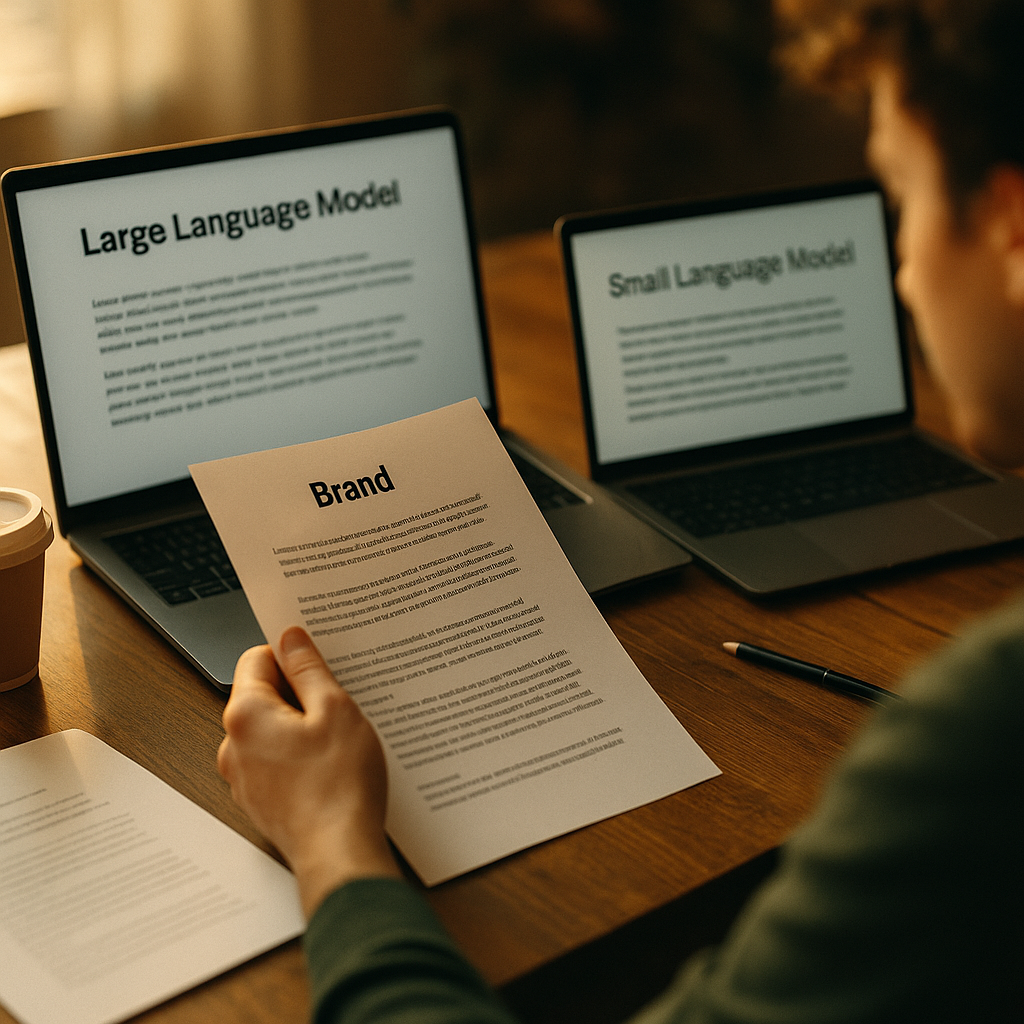
GPT-4-class models cost roughly 20 to 30 times more per query than a well-tuned small language model doing the same brand copy task. That’s not a rounding error, it’s a budget line. As marketing teams push more copy generation into production, the question isn’t which model is smartest. It’s which model is smart enough, cheap enough, and controllable enough to ship a hundred product descriptions before lunch. This is where small language models for brand copy are quietly winning the argument that scale always wins.
The Scale Obsession Was Never About Marketing
The frontier-model arms race — GPT, Gemini, Claude, all racing toward trillion-parameter territory — was built for general reasoning, coding, and open-ended research. Brand copy is a different animal. It’s narrow, repetitive, and governed by rules: tone of voice, banned words, legal disclaimers, SKU formatting. You don’t need a model that can debate philosophy to write “50% off waterproof hiking boots, limited stock” in your brand’s voice, twelve times a day, in nine languages.
Small language models (SLMs) — typically under 10 billion parameters, sometimes as small as 1-3 billion — are trained or fine-tuned on narrower datasets and narrower tasks. Think Microsoft’s Phi family, Mistral’s smaller models, or Google’s Gemma line. They trade general-purpose reasoning for speed, cost control, and predictability. For a brand pumping out product listings, ad variations, or email subject lines at scale, predictability is worth more than genius.
The real cost of a large language model isn’t the API bill. It’s the unpredictability tax: the QA hours spent catching hallucinated claims, off-brand tone, and compliance slips before copy goes live.
Where Efficiency Actually Beats Scale
Nobody’s arguing SLMs beat GPT-4 or Gemini on a blind creativity test. That’s not the point. The point is task fit. Three scenarios where smaller wins:
- High-volume, templated copy. Product descriptions, meta titles, ad variant testing at scale. A fine-tuned 3B model running on your own infrastructure can churn through thousands of SKUs faster and cheaper than routing every call through a frontier API.
- Regulated categories. Finance, healthcare, alcohol, pharma. A narrow model trained specifically on your approved claims library is easier to audit than a general model prone to improvising benefit statements it wasn’t authorized to make.
- Real-time and edge use cases. Personalized on-site copy, chatbot responses, dynamic creative optimization. Latency matters. A small model running close to the point of use beats a round trip to a massive cloud model every time.
This isn’t a new idea in engineering circles — HubSpot’s own content tooling has leaned into smaller, task-specific models for exactly this reason. Marketing is just catching up to what MLOps teams figured out two years ago.
The Cost Math, Spelled Out
Let’s talk numbers, because that’s what gets budget approved. A frontier model API call for a few hundred tokens of generated copy can run several cents per request. Multiply that across 50,000 product variants, three languages, and quarterly refreshes, and you’re looking at a five- or six-figure annual spend just on inference — before you count the human review layer needed to catch errors.
A fine-tuned small model, self-hosted or run through a lighter-weight API, can cut that per-call cost by an order of magnitude. Training and fine-tuning have upfront costs, sure. But for high-volume, repeatable tasks, the breakeven point often arrives inside the first quarter. We’ve broken this down in more detail in fine-tuning vs vendor LLM licensing, and the math holds up across most brand copy use cases: volume is the variable that decides whether scale or efficiency wins.
There’s also the hidden cost of vendor lock-in. Every brand that’s built an entire content pipeline around one frontier model’s API has felt the pain when pricing changes or rate limits shift. Smaller, more portable models reduce that exposure — a point we’ve explored in the vendor lock-in risk audit for martech.
Compliance and Risk: The Argument CFOs Actually Care About
Marketing leaders love talking about creativity. CFOs and legal teams care about risk. This is where small language models make their strongest case.
A large general-purpose model, prompted to write ad copy, will occasionally hallucinate a claim, invent a statistic, or drift off brand voice — especially under high-volume automated generation with limited human review. That’s a liability, not just an annoyance. The FTC has been increasingly vocal about unsubstantiated advertising claims, and FTC guidance on endorsements and advertising makes clear that brands, not the AI vendor, carry the compliance burden.
Small, narrowly trained models fine-tuned on your approved claims, tone guidelines, and legal disclaimers are inherently easier to constrain. They’ve seen less of the internet’s noise and more of your brand’s actual approved language. That narrower training data is a feature, not a limitation, when the job is staying inside guardrails.
A model that knows less about the world but knows everything about your brand guidelines will out-perform a genius model with no guardrails, every time compliance is on the line.
This connects directly to the broader conversation around stopping AI hallucinations in marketing. Retrieval-augmented generation paired with a small model, grounded in your actual brief and claims library, is often more reliable than a massive model working from general training data alone.
What Gets Lost When You Go Small
Let’s be honest about the tradeoffs, because overselling SLMs helps nobody.
Small models are weaker at open-ended creative leaps. If you need a campaign concept from scratch, a brand narrative that hasn’t been done before, or copy that needs to reason through nuanced cultural context, a frontier model still has the edge. SLMs are workhorses, not visionaries. They execute a defined brief well. They don’t originate a Cannes Lions-worthy idea.
They also require more upfront investment in fine-tuning and data curation. You can’t just point a small model at your brand and expect magic — it needs a clean, well-labeled dataset of approved copy, style guides, and examples of what “good” looks like. Teams underestimate this step constantly, then wonder why their small model output sounds generic. Garbage in, generic out.
The realistic setup most sophisticated teams land on is hybrid: a frontier model for ideation, concepting, and campaign strategy, and a fine-tuned small model for execution at scale. We covered this split in detail in small language models vs fine-tuned LLMs for brand copy — the short version is that most brands don’t need to choose one architecture; they need to route tasks to the right one.
Building the Business Case Internally
Getting budget for a small-model pipeline means speaking two languages: marketing ROI and technical risk. Here’s a framework that tends to land with finance and legal stakeholders alike:
- Volume audit. Map every copy-generation task by monthly volume. Anything over a few thousand units a month is a strong SLM candidate.
- Risk tier. Flag regulated categories and high-legal-exposure copy (financial claims, health claims, pricing) as priority for narrow, auditable models.
- Latency requirements. Real-time personalization and chat use cases favor smaller, faster models by default.
- Governance layer. Whatever model architecture you choose, pair it with human-override checkpoints. The AI governance checklist for autonomous agents applies just as well to copy generation as it does to media buying — the underlying principle of “who signs off before it ships” doesn’t change by use case.
Recent industry data backs the shift. eMarketer’s ongoing coverage of AI adoption in marketing has tracked growing enterprise interest in smaller, task-specific models as inference costs and data privacy concerns push teams away from blanket frontier-model deployment. Meanwhile, Statista’s AI market data shows enterprise spend on AI infrastructure increasingly split between large foundation models and smaller specialized deployments — not consolidating around one architecture.
A Word on Brand Voice Consistency
One underrated advantage: small models fine-tuned on your archive tend to drift less over time. Frontier models get updated by their vendors on schedules you don’t control, and sometimes your brand voice output shifts subtly after a model version update — a real headache for teams who’ve spent months dialing in prompts. A self-hosted or vendor-locked small model, by contrast, stays exactly as reliable as the day you fine-tuned it, until you choose to retrain it. That kind of version control isn’t glamorous, but ask any brand ops lead who’s dealt with an unannounced model update wrecking six months of prompt engineering. Stability is a feature.
FAQs
Frequently Asked Questions
What counts as a small language model in marketing contexts?
Generally, models under 10 billion parameters, often fine-tuned from open-source bases like Mistral, Phi, or Gemma, and optimized for a narrow set of tasks rather than general reasoning.
Are small language models cheaper to run than frontier LLMs?
Yes, typically by a significant margin per query, especially at high volume. The savings come from lower inference costs and reduced need for extensive human QA on hallucinated or off-brand output.
Can small language models handle creative campaign ideation?
Not well. They excel at executing defined briefs at scale but generally underperform frontier models on open-ended creative concepting. Most brands use a hybrid approach: frontier models for ideation, small models for execution.
How much data do you need to fine-tune a small language model for brand voice?
There’s no universal number, but most teams need a curated dataset of several hundred to a few thousand approved copy examples, plus clear style and compliance guidelines, to get consistent results.
Do small language models reduce compliance risk?
They can, when trained narrowly on approved claims and legal-reviewed language. That narrower scope makes them easier to audit than general-purpose models prone to improvising claims.
Should every brand switch from large to small models?
No. The decision depends on volume, risk tier, and creative complexity of the task. Most sophisticated teams run both, routing high-volume execution to small models and strategic ideation to larger ones.
Next step: audit your last quarter of copy-generation spend by task type, flag anything high-volume and low-creative-complexity, and pilot a fine-tuned small model on that segment before your next budget cycle locks in another year of frontier-model bills.
Frequently Asked Questions
What counts as a small language model in marketing contexts?
Generally, models under 10 billion parameters, often fine-tuned from open-source bases like Mistral, Phi, or Gemma, and optimized for a narrow set of tasks rather than general reasoning.
Are small language models cheaper to run than frontier LLMs?
Yes, typically by a significant margin per query, especially at high volume. The savings come from lower inference costs and reduced need for extensive human QA on hallucinated or off-brand output.
Can small language models handle creative campaign ideation?
Not well. They excel at executing defined briefs at scale but generally underperform frontier models on open-ended creative concepting. Most brands use a hybrid approach: frontier models for ideation, small models for execution.
How much data do you need to fine-tune a small language model for brand voice?
There’s no universal number, but most teams need a curated dataset of several hundred to a few thousand approved copy examples, plus clear style and compliance guidelines, to get consistent results.
Do small language models reduce compliance risk?
They can, when trained narrowly on approved claims and legal-reviewed language. That narrower scope makes them easier to audit than general-purpose models prone to improvising claims.
Should every brand switch from large to small models?
No. The decision depends on volume, risk tier, and creative complexity of the task. Most sophisticated teams run both, routing high-volume execution to small models and strategic ideation to larger ones.
Top Influencer Marketing Agencies
The leading agencies shaping influencer marketing in 2026
Agencies ranked by campaign performance, client diversity, platform expertise, proven ROI, industry recognition, and client satisfaction. Assessed through verified case studies, reviews, and industry consultations.
Moburst

-
2

The Shelf
Boutique Beauty & Lifestyle Influencer AgencyA data-driven boutique agency specializing exclusively in beauty, wellness, and lifestyle influencer campaigns on Instagram and TikTok. Best for brands already focused on the beauty/personal care space that need curated, aesthetic-driven content.Clients: Pepsi, The Honest Company, Hims, Elf Cosmetics, Pure LeafVisit The Shelf → -
3

Audiencly
Niche Gaming & Esports Influencer AgencyA specialized agency focused exclusively on gaming and esports creators on YouTube, Twitch, and TikTok. Ideal if your campaign is 100% gaming-focused — from game launches to hardware and esports events.Clients: Epic Games, NordVPN, Ubisoft, Wargaming, Tencent GamesVisit Audiencly → -
4

Viral Nation
Global Influencer Marketing & Talent AgencyA dual talent management and marketing agency with proprietary brand safety tools and a global creator network spanning nano-influencers to celebrities across all major platforms.Clients: Meta, Activision Blizzard, Energizer, Aston Martin, WalmartVisit Viral Nation → -
5

The Influencer Marketing Factory
TikTok, Instagram & YouTube CampaignsA full-service agency with strong TikTok expertise, offering end-to-end campaign management from influencer discovery through performance reporting with a focus on platform-native content.Clients: Google, Snapchat, Universal Music, Bumble, YelpVisit TIMF → -
6

NeoReach
Enterprise Analytics & Influencer CampaignsAn enterprise-focused agency combining managed campaigns with a powerful self-service data platform for influencer search, audience analytics, and attribution modeling.Clients: Amazon, Airbnb, Netflix, Honda, The New York TimesVisit NeoReach → -
7

Ubiquitous
Creator-First Marketing PlatformA tech-driven platform combining self-service tools with managed campaign options, emphasizing speed and scalability for brands managing multiple influencer relationships.Clients: Lyft, Disney, Target, American Eagle, NetflixVisit Ubiquitous → -
8

Obviously
Scalable Enterprise Influencer CampaignsA tech-enabled agency built for high-volume campaigns, coordinating hundreds of creators simultaneously with end-to-end logistics, content rights management, and product seeding.Clients: Google, Ulta Beauty, Converse, AmazonVisit Obviously →