


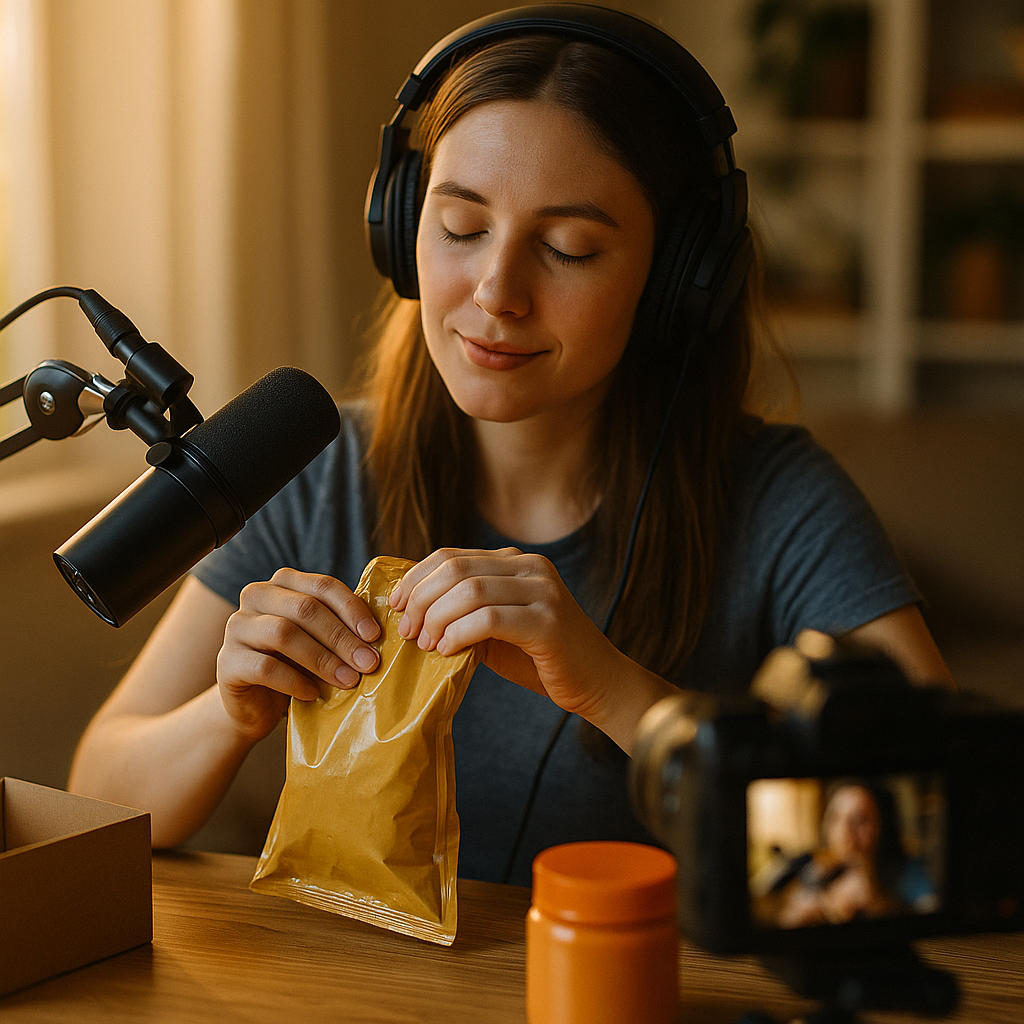
Videos tagged #packagingasmr have racked up billions of views, and the crinkle of a chip bag now converts better than half the polished ads in your media plan. If you’re running CPG influencer programs and still briefing lifestyle shots over a product, you’re leaving retention on the table. The packaging ASMR format isn’t a novelty anymore. It’s a measurable content category with its own production rules, and brands that ignore it are missing one of the cheapest high-completion-rate formats in the creator toolkit.
Why a Crinkle Sound Outperforms a Voiceover
Sound designers will tell you the human brain treats certain frequencies, the crinkle of foil, the pop of a vacuum seal, the scrape of a lid, as involuntarily attention-grabbing. That’s the entire premise of ASMR content, and CPG brands have quietly figured out how to weaponize it. No dialogue. No brand messaging read aloud. Just texture, sound, and pacing doing the persuasion work.
The format works because it strips away the thing viewers scroll past fastest: a person talking at them. Instead, the product becomes the performer. A resealable pouch, a cardboard sleeve, a foil-wrapped bar, each becomes a tactile object with its own sonic signature. Viewers aren’t being sold to. They’re watching something satisfying happen, and the brand rides along for free.
Packaging ASMR content routinely posts completion rates 20-40% higher than standard product demo videos, because the format rewards patience instead of punishing it.
Platforms have noticed too. TikTok’s algorithm favors watch-through and rewatch behavior, and ASMR content is engineered for both. A well-shot unwrap sequence gets replayed, not skipped. That’s a direct signal to the recommendation engine, and it’s why brands working with creators on TikTok’s ad platform are increasingly pairing organic ASMR content with paid boosts once organic performance validates the cut.
What Makes a Brief Actually Work
Most brands get this wrong by treating packaging ASMR like any other UGC brief: send product, ask for “authentic content,” hope for the best. That approach produces shaky, poorly lit footage that undersells the format entirely.
A real ASMR brief needs to specify:
- Microphone proximity — creators need a lav mic or shotgun mic within 6-12 inches of the packaging, not just phone audio.
- Lighting for texture — side lighting or soft diffused light that shows foil creases, condensation, or matte-vs-gloss contrast.
- Pacing instructions — slow, deliberate movement. Rushing the unwrap kills the sensory payoff.
- Silence tolerance — no music overlay, or minimal ambient track under -20dB, so the product sound stays dominant.
- Multiple takes per package state — sealed, half-open, fully unwrapped, and the “reveal” shot.
This is where a lot of brands underinvest. You’re not briefing a testimonial. You’re briefing a small sound and motion production, and creators who’ve done it before know the difference between a satisfying unwrap and one that just looks like someone opening mail.
If your team is used to writing briefs for talking-head content, this format requires a different muscle. It’s closer to the discipline used in annotated screen-record content, where the visual sequence carries the message instead of narration.
Packaging design becomes the creative asset, not an afterthought
Here’s the uncomfortable part for brand teams: if your packaging wasn’t designed with sound and texture in mind, ASMR content will expose that. A thin, cheap-sounding wrapper reads as thin and cheap on camera, amplified by a good mic. Conversely, brands that invest in tactile packaging, embossed textures, satisfying resealable closures, distinct foil sounds, get content that essentially markets itself.
This has already started influencing packaging R&D at the CPG level. Some snack and beauty brands are now testing package materials partly for their acoustic profile, not just shelf appeal or sustainability metrics. It sounds trivial until you see the view counts.
The Creator Selection Problem
Not every creator can shoot this well, and follower count is a poor predictor of ASMR competence. The creators who excel tend to come from a specific lane: mukbang, unboxing, or slow-living content, where patience and sound design are already core skills.
Look for creators whose existing content shows:
- Consistent close-up framing with steady hands or a tripod rig
- Prior use of external mics (check video captions or behind-the-scenes posts)
- A content history that leans slow-paced rather than high-energy
- Comments from their own audience specifically praising sound quality
Vetting on sound competence is unusual for most influencer marketing teams, and it’s worth building into your creator scoring alongside the usual engagement and audience-fit metrics. Agencies scaling this at volume are starting to treat it the way they treat UGC content harvesting, sourcing raw unwrap footage from multiple creators and repurposing the strongest cuts across paid and organic channels.
Compliance: The Part Brands Keep Skipping
Packaging ASMR feels harmless because there’s no spoken claim to fact-check. No one says “this cured my skin” over a satisfying unwrap. But the FTC’s disclosure rules still apply, and brands have gotten burned assuming a wordless video is somehow exempt.
If the creator was paid, gifted product, or has a material connection to the brand, disclosure is required regardless of whether they say a single word on camera. The FTC’s endorsement guidance doesn’t carve out an exception for silent content. A text overlay or on-screen caption reading “#ad” or “Gifted by [Brand]” satisfies the requirement without disrupting the ASMR aesthetic.
The bigger compliance risk is actually claims made implicitly through visuals. If a creator’s unwrap sequence shows a product looking dramatically different from what a customer receives, larger portion, different color, extra packaging flourish, that’s a deceptive advertising problem even without a single spoken word. Brief creators explicitly to film the actual retail unit, not a curated press sample.
Brands running this format at scale should build the same disclosure QA layer they’d use for blind taste-test content or other claims-adjacent formats: a checklist reviewed before content goes live, not after a complaint arrives.
Where This Fits in the Funnel
Packaging ASMR isn’t a bottom-funnel format. It won’t out-convert a comparison video or a direct testimonial. Its real value is top-of-funnel discovery and brand recall, the kind of passive, ambient exposure that builds familiarity before a purchase decision ever happens.
Data from eMarketer consistently shows short-form video driving disproportionate awareness lift relative to its production cost, and ASMR content is among the cheapest formats to produce at scale. No script, no talent fee for on-camera speaking, minimal editing. A creator with a decent mic and steady hands can turn around a usable cut same-day.
That cost efficiency is the real ROI story here. Compare it to a produced brand film with a six-figure budget, and a batch of packaging ASMR videos from ten creators might cost less than a single shoot day, while generating comparable or better watch-through rates.
The lowest-cost format in your creator program might also be the one with the highest completion rate. That combination is rare enough to prioritize testing immediately.
Where it pairs well is alongside heavier-lift formats. Run packaging ASMR for top-funnel reach, then retarget engaged viewers with something more conversion-focused, like the customer-handoff unboxing format or a split-decision comparison video. Sequencing formats this way turns a single creator relationship into a mini funnel instead of a one-off post.
Measuring what actually matters
Standard engagement metrics undersell this format. Likes and comments matter less than:
- Completion rate and rewatch rate — the core signal that the sensory hook worked
- Sound-on rate — platforms like TikTok surface this in creator analytics, and it’s the clearest proxy for ASMR effectiveness
- Save and share rate — satisfying content gets bookmarked and sent to friends more than it gets commented on
- Branded search lift — a delayed but real signal that awareness content is doing its job
Tools like Sprout Social or platform-native analytics dashboards can help track these across a creator roster, but the key is setting expectations with stakeholders before launch. If your CMO is expecting direct-response numbers from an awareness format, that’s a briefing failure on your end, not a format failure.
Next Step
Start small: brief three creators with strong sound instincts, give them the acoustic and lighting specs above, and run the content against a standard product demo for two weeks. Let completion rate and sound-on rate decide whether packaging ASMR earns a permanent slot in your content mix.
FAQs
What is packaging ASMR in influencer marketing?
It’s a content format where creators film close-up, sound-focused sequences of unwrapping or opening a product, prioritizing texture and audio over spoken messaging or brand claims.
Does packaging ASMR content need an FTC disclosure?
Yes. Any material connection between the brand and creator, paid partnership, gifted product, or affiliate link, requires disclosure regardless of whether the video includes spoken words. An on-screen text disclosure works well without disrupting the format.
What equipment should creators use for this format?
A dedicated lav or shotgun microphone positioned close to the packaging, steady framing (tripod or gimbal), and soft directional lighting that highlights texture. Phone-only audio rarely delivers the sound quality the format needs.
Is packaging ASMR effective for conversion or just awareness?
It performs best as a top-of-funnel awareness and recall format. Brands typically pair it with more conversion-focused formats, like comparison videos or unboxing testimonials, to move viewers further down the funnel.
How do I find creators who are good at this format?
Look at creators already active in unboxing, mukbang, or slow-content niches. Check for evidence of external mic use, steady camera work, and audience comments specifically praising sound quality in past videos.
FAQs
What is packaging ASMR in influencer marketing?
It’s a content format where creators film close-up, sound-focused sequences of unwrapping or opening a product, prioritizing texture and audio over spoken messaging or brand claims.
Does packaging ASMR content need an FTC disclosure?
Yes. Any material connection between the brand and creator, paid partnership, gifted product, or affiliate link, requires disclosure regardless of whether the video includes spoken words. An on-screen text disclosure works well without disrupting the format.
What equipment should creators use for this format?
A dedicated lav or shotgun microphone positioned close to the packaging, steady framing (tripod or gimbal), and soft directional lighting that highlights texture. Phone-only audio rarely delivers the sound quality the format needs.
Is packaging ASMR effective for conversion or just awareness?
It performs best as a top-of-funnel awareness and recall format. Brands typically pair it with more conversion-focused formats, like comparison videos or unboxing testimonials, to move viewers further down the funnel.
How do I find creators who are good at this format?
Look at creators already active in unboxing, mukbang, or slow-content niches. Check for evidence of external mic use, steady camera work, and audience comments specifically praising sound quality in past videos.
Top Influencer Marketing Agencies
The leading agencies shaping influencer marketing in 2026
Agencies ranked by campaign performance, client diversity, platform expertise, proven ROI, industry recognition, and client satisfaction. Assessed through verified case studies, reviews, and industry consultations.
Moburst

-
2

The Shelf
Boutique Beauty & Lifestyle Influencer AgencyA data-driven boutique agency specializing exclusively in beauty, wellness, and lifestyle influencer campaigns on Instagram and TikTok. Best for brands already focused on the beauty/personal care space that need curated, aesthetic-driven content.Clients: Pepsi, The Honest Company, Hims, Elf Cosmetics, Pure LeafVisit The Shelf → -
3

Audiencly
Niche Gaming & Esports Influencer AgencyA specialized agency focused exclusively on gaming and esports creators on YouTube, Twitch, and TikTok. Ideal if your campaign is 100% gaming-focused — from game launches to hardware and esports events.Clients: Epic Games, NordVPN, Ubisoft, Wargaming, Tencent GamesVisit Audiencly → -
4

Viral Nation
Global Influencer Marketing & Talent AgencyA dual talent management and marketing agency with proprietary brand safety tools and a global creator network spanning nano-influencers to celebrities across all major platforms.Clients: Meta, Activision Blizzard, Energizer, Aston Martin, WalmartVisit Viral Nation → -
5

The Influencer Marketing Factory
TikTok, Instagram & YouTube CampaignsA full-service agency with strong TikTok expertise, offering end-to-end campaign management from influencer discovery through performance reporting with a focus on platform-native content.Clients: Google, Snapchat, Universal Music, Bumble, YelpVisit TIMF → -
6

NeoReach
Enterprise Analytics & Influencer CampaignsAn enterprise-focused agency combining managed campaigns with a powerful self-service data platform for influencer search, audience analytics, and attribution modeling.Clients: Amazon, Airbnb, Netflix, Honda, The New York TimesVisit NeoReach → -
7

Ubiquitous
Creator-First Marketing PlatformA tech-driven platform combining self-service tools with managed campaign options, emphasizing speed and scalability for brands managing multiple influencer relationships.Clients: Lyft, Disney, Target, American Eagle, NetflixVisit Ubiquitous → -
8

Obviously
Scalable Enterprise Influencer CampaignsA tech-enabled agency built for high-volume campaigns, coordinating hundreds of creators simultaneously with end-to-end logistics, content rights management, and product seeding.Clients: Google, Ulta Beauty, Converse, AmazonVisit Obviously →