


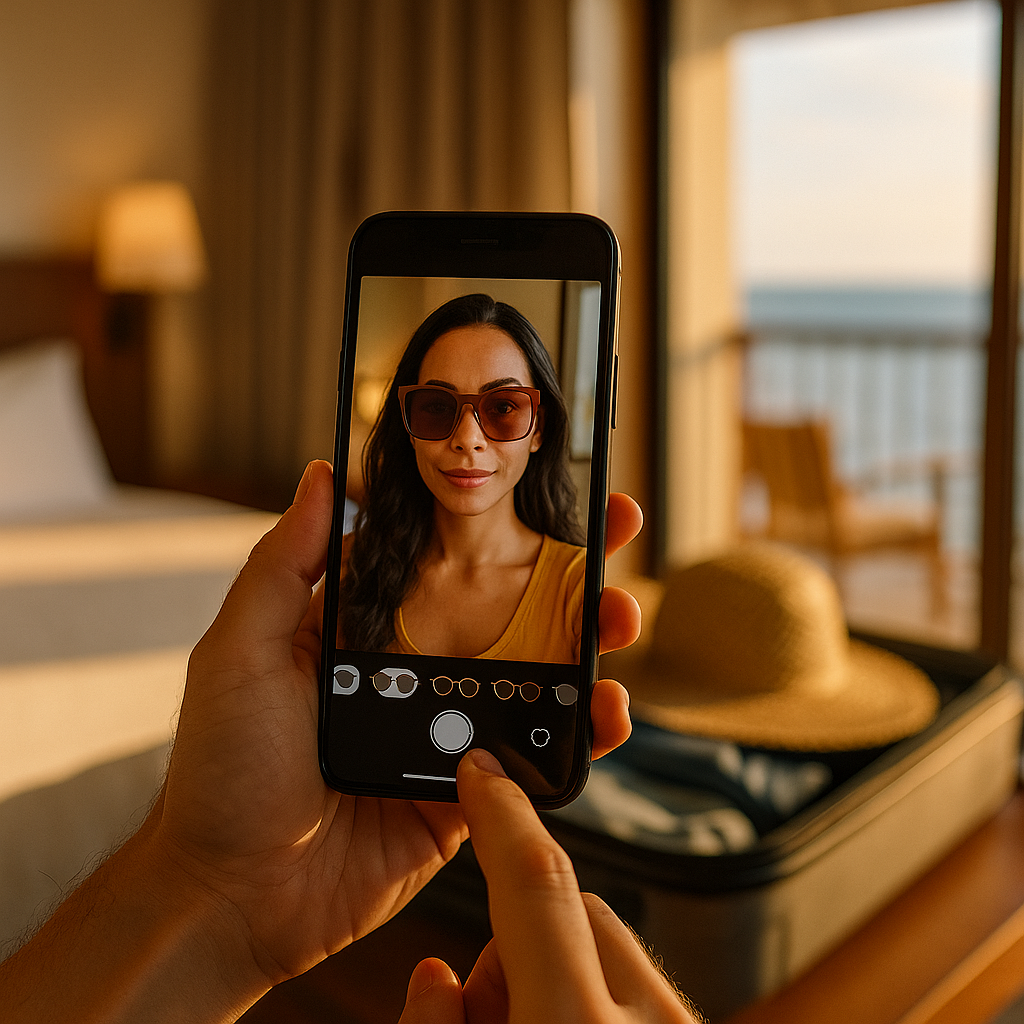
Only 22% of travel shoppers trust a destination photo before they’ve seen it “live” in some form, yet most travel brands still brief influencer reels like it’s 2019. Interactive shoppable reels change that math by letting travelers preview a room, a seat, or a shore excursion inside the video itself, then book without leaving the app. The catch? Most brands can’t attribute a single commission dollar back to the AR moment that closed the sale.
Why “Watch and Wonder” No Longer Converts
Travel content has always sold a feeling. The problem is feelings don’t book flights. A stunning infinity pool reel gets saves and shares, sure, but the viewer still has to leave the app, search three OTAs, and second-guess the room category before committing. That drop-off is where most influencer travel budgets quietly die.
Shoppable reels with embedded AR try-before-you-book features close that gap. Instead of a passive scroll-stopper, the creator video becomes a functional shelf: tap the cabin, see a 3D walkthrough, tap “hold rate,” done. It’s the difference between a billboard and a storefront.
A reel that shows a suite isn’t a preview anymore — it’s a purchase environment, and brands that brief it like one are the ones seeing attributable commission lift.
We’ve covered adjacent territory in shoppable AR snippets for travel creators and in the broader AR and XR ad experiences playbook. This piece goes narrower: the actual brief structure that pairs AR try-before-you-book with clean commission attribution, so finance stops asking “which creator drove this” and marketing actually has an answer.
The Core Problem: Great AR, Broken Attribution
Here’s the uncomfortable truth. Plenty of travel brands have already built AR room previews, virtual cabin tours, or 360-degree excursion walkthroughs. Marriott, Hilton, and several cruise lines have dabbled in this for years. The technology isn’t the bottleneck. The bottleneck is that these AR experiences get bolted onto creator content as an afterthought, with no consistent tagging structure connecting the AR interaction to a booking event.
Ask any affiliate manager at a mid-size OTA how much revenue came from “AR-assisted” bookings last quarter. Most will shrug. The AR click happened on one platform, the booking happened on another, and the commission got attributed to whatever last-touch link fired, usually a generic bio link with zero context. That’s not measurement, that’s guesswork with a nicer interface.
A proper brief framework fixes this at the source, before a single frame gets shot.
What Changes When You Brief for Attribution First
Most creative briefs start with the creative: shot list, tone, hashtags, deliverables. Flip that order for shoppable travel reels. Attribution architecture comes first, creative comes second. If you can’t answer “how will we know this AR tap led to this booking” before the shoot, you’re not ready to brief the shoot.
- Unique AR trigger tags per creator, per destination package, per booking window.
- Deep-linked booking CTAs that carry UTM parameters plus a platform-native affiliate tag (think TikTok Shop’s creator tagging or Instagram’s product tagging combined with your OTA’s affiliate ID).
- A shared measurement window agreed with the creator’s management, typically 14-30 days for travel given the longer consideration cycle.
- A single source-of-truth dashboard, not five spreadsheets across three agencies.
Get this wrong and you’ll spend six figures on AR production only to argue about ROI in the next budget review. Get it right and you have a repeatable model you can scale across every destination in your portfolio.
The Five-Part Brief Framework
This is the structure we recommend to travel brands and their agencies. It’s not radically different from other performance-driven creator formats, but the AR layer adds two components most standard briefs skip entirely: the try-before-you-book asset spec and the attribution handshake.
1. The Hook Window (First 3 Seconds)
Standard advice, but worth repeating because travel creators still get this wrong constantly. Open on the AR moment itself, not a talking-head intro. Viewers should see the tap-to-preview interaction within the first three seconds or you lose the scroll-stopping advantage entirely. This mirrors what we’ve seen work in teaser arc formats, where the payoff needs to be visible early enough to earn the watch-through.
2. The Try-Before-You-Book Sequence
This is the functional core. The creator demonstrates the AR interaction live: pointing a phone at a printed brochure, tapping an in-app marker, or using a QR overlay that launches a 3D cabin or room model. Brief this precisely:
- Specify which AR trigger the creator uses (branded app, Instagram AR effect, or platform-native AR shopping tool).
- Require a visible “before and after” moment: static image, then the AR reveal.
- Mandate at least one interaction the creator performs on-camera (rotate the room, switch cabin categories, toggle seasonal views) so it reads as functional, not decorative.
This sequence is where most of the “wow” happens, and it’s also where most brands under-brief. Vague instructions like “show off the AR feature” produce inconsistent footage that’s hard to A/B test across creators.
4. The Commission Attribution Layer
Every AR tap needs a corresponding trackable event. Structure it like this:
- Trigger ID: unique code embedded in the AR asset tied to that specific creator and campaign.
- CTA link: deep link with UTM source, medium, campaign, and creator-specific affiliate parameter.
- Booking confirmation webhook: pushes back to your affiliate platform (Impact, Partnerize, or an in-house system) so the AR-to-booking chain is documented, not inferred.
- Reconciliation window: defined at 14, 21, or 30 days depending on your average booking lead time.
Brands running this well typically use a platform like Impact or Partnerize to handle the affiliate math, while the AR trigger data feeds in as a custom parameter rather than a bolt-on report. If your current setup can’t pass that trigger ID through to the booking confirmation, fix the plumbing before you brief a single creator.
5. Compliance and Disclosure, Built In
AR try-before-you-book content still needs standard FTC-compliant disclosure, and it needs to happen inside the interactive moment, not just in a caption. If a viewer taps into an AR room preview and books directly from that experience, the disclosure needs to be visible before the tap, not buried three scrolls down. Check the FTC’s endorsement guidance for the baseline rules, and loop your legal team in early if the AR experience lives outside the native platform (say, a branded WebAR page), since disclosure requirements can shift depending on where the interaction actually happens.
What Good Looks Like: A Hypothetical Cruise Line Brief
Picture a mid-size cruise line briefing ten creators for a Caribbean itinerary launch. Instead of “post a reel about the ship,” the brief specifies: open on AR cabin comparison (interior vs. balcony), demonstrate the 3D toggle live, CTA drives to a deep link with creator-specific affiliate ID, disclosure appears in first frame, and booking webhook confirms attribution within a 21-day window.
Run that across ten creators and you get comparable data. You can see which creator’s AR demo drove the highest tap-to-book rate, which cabin category converted best from AR previews, and whether the interactive element outperformed a standard walkthrough video. That’s the kind of data that actually informs next quarter’s creator mix, not just next quarter’s vibes.
Standardize the trigger and the tracking, and ten creators become ten data points instead of ten disconnected vibes.
This approach borrows structurally from what’s worked in split-screen itinerary comparison formats and booking reaction videos, both of which prioritize a visible, repeatable moment of decision that’s easy to tag and track.
Where This Breaks Down (And How to Prevent It)
Three failure points show up repeatedly when brands try this without a framework:
- Platform fragmentation. The AR interaction happens on one app, the booking on another, and nothing bridges them. Fix: agree on a single deep-linking standard before production, not after.
- Creator inconsistency. Ten creators, ten different ways of demonstrating the AR feature, none of them comparable. Fix: a tight shot list for the try-before-you-book sequence specifically, even if the rest of the video stays flexible.
- Attribution lag. Travel bookings rarely close same-day. If your reconciliation window is set at seven days, you’ll systematically undercount performance. Fix: match the window to your actual average booking lead time, pulled from historical OTA data, not a guess.
According to eMarketer’s retail media and travel commerce coverage, interactive and shoppable formats continue to outperform static video on engagement, but the ROI story only holds up when attribution infrastructure is treated as a first-class production requirement, not an analytics afterthought.
Scaling It Across Your Creator Roster
Once the framework works for one campaign, the temptation is to scale fast. Resist doing that without a shared brief template. Every creator, every destination, every AR partner needs to plug into the same trigger-tagging and affiliate structure, or you’ll end up right back where you started: a pile of pretty AR content with no clean revenue story attached. Tools like Sprout Social for social listening and performance tracking, paired with your affiliate platform, can help centralize this without building custom infrastructure from scratch.
For brands managing high creator volume, it’s worth studying how countdown-to-departure formats and local guide takeover briefs handle multi-creator consistency. The same discipline applies here, just with an AR layer bolted onto the front of the funnel instead of the back.
Next step: before your next travel campaign, draft the attribution layer first, the AR shot list second, and refuse to greenlight production until both pass a test booking end-to-end. If you can’t trace one full commission cycle from AR tap to confirmed booking in a dry run, your creators shouldn’t be filming yet.
FAQs
What makes a shoppable reel different from a standard travel influencer video?
A shoppable reel embeds a functional booking or preview action directly inside the content, such as an AR room tour with a tap-to-book CTA, rather than relying on viewers to leave the app and search separately.
Which platforms currently support AR try-before-you-book features for travel?
Instagram and TikTok both support AR effects and product tagging that can be adapted for travel previews, while some travel brands build branded WebAR experiences hosted outside the native app for deeper 3D room or cabin tours.
How long should the attribution reconciliation window be for travel bookings?
Most travel brands use a 14 to 30 day window, matched to their historical average booking lead time, since travel purchases rarely convert same-day like impulse retail categories.
Do AR shoppable reels require additional FTC disclosure beyond a standard caption?
Yes, disclosure should appear within the interactive moment itself, ideally before the viewer taps into the AR experience, not only in the caption or video description.
What’s the biggest reason attribution fails on these campaigns?
Platform fragmentation, where the AR interaction and the final booking happen on different systems with no shared trigger ID or deep-link structure connecting them.
FAQs
What makes a shoppable reel different from a standard travel influencer video?
A shoppable reel embeds a functional booking or preview action directly inside the content, such as an AR room tour with a tap-to-book CTA, rather than relying on viewers to leave the app and search separately.
Which platforms currently support AR try-before-you-book features for travel?
Instagram and TikTok both support AR effects and product tagging that can be adapted for travel previews, while some travel brands build branded WebAR experiences hosted outside the native app for deeper 3D room or cabin tours.
How long should the attribution reconciliation window be for travel bookings?
Most travel brands use a 14 to 30 day window, matched to their historical average booking lead time, since travel purchases rarely convert same-day like impulse retail categories.
Do AR shoppable reels require additional FTC disclosure beyond a standard caption?
Yes, disclosure should appear within the interactive moment itself, ideally before the viewer taps into the AR experience, not only in the caption or video description.
What’s the biggest reason attribution fails on these campaigns?
Platform fragmentation, where the AR interaction and the final booking happen on different systems with no shared trigger ID or deep-link structure connecting them.
Top Influencer Marketing Agencies
The leading agencies shaping influencer marketing in 2026
Agencies ranked by campaign performance, client diversity, platform expertise, proven ROI, industry recognition, and client satisfaction. Assessed through verified case studies, reviews, and industry consultations.
Moburst

-
2

The Shelf
Boutique Beauty & Lifestyle Influencer AgencyA data-driven boutique agency specializing exclusively in beauty, wellness, and lifestyle influencer campaigns on Instagram and TikTok. Best for brands already focused on the beauty/personal care space that need curated, aesthetic-driven content.Clients: Pepsi, The Honest Company, Hims, Elf Cosmetics, Pure LeafVisit The Shelf → -
3

Audiencly
Niche Gaming & Esports Influencer AgencyA specialized agency focused exclusively on gaming and esports creators on YouTube, Twitch, and TikTok. Ideal if your campaign is 100% gaming-focused — from game launches to hardware and esports events.Clients: Epic Games, NordVPN, Ubisoft, Wargaming, Tencent GamesVisit Audiencly → -
4

Viral Nation
Global Influencer Marketing & Talent AgencyA dual talent management and marketing agency with proprietary brand safety tools and a global creator network spanning nano-influencers to celebrities across all major platforms.Clients: Meta, Activision Blizzard, Energizer, Aston Martin, WalmartVisit Viral Nation → -
5

The Influencer Marketing Factory
TikTok, Instagram & YouTube CampaignsA full-service agency with strong TikTok expertise, offering end-to-end campaign management from influencer discovery through performance reporting with a focus on platform-native content.Clients: Google, Snapchat, Universal Music, Bumble, YelpVisit TIMF → -
6

NeoReach
Enterprise Analytics & Influencer CampaignsAn enterprise-focused agency combining managed campaigns with a powerful self-service data platform for influencer search, audience analytics, and attribution modeling.Clients: Amazon, Airbnb, Netflix, Honda, The New York TimesVisit NeoReach → -
7

Ubiquitous
Creator-First Marketing PlatformA tech-driven platform combining self-service tools with managed campaign options, emphasizing speed and scalability for brands managing multiple influencer relationships.Clients: Lyft, Disney, Target, American Eagle, NetflixVisit Ubiquitous → -
8

Obviously
Scalable Enterprise Influencer CampaignsA tech-enabled agency built for high-volume campaigns, coordinating hundreds of creators simultaneously with end-to-end logistics, content rights management, and product seeding.Clients: Google, Ulta Beauty, Converse, AmazonVisit Obviously →