


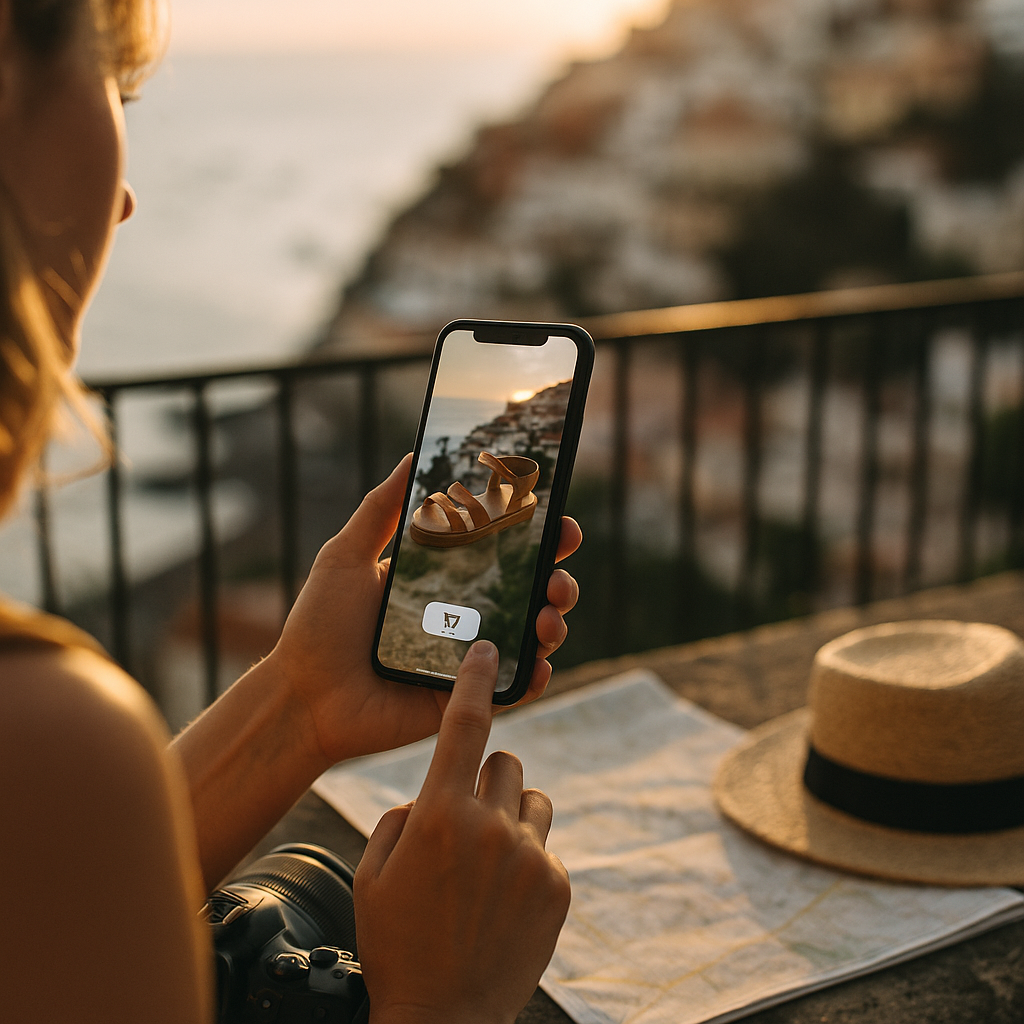
Only 2.8% of travel content viewers ever click through to a booking page. The rest scroll past, bookmark, and forget. A shoppable AR layer embedded directly in creator content changes that math by collapsing inspiration and booking into one tap, no link-in-bio required.
Why Travel Brands Need a New Conversion Layer
Travel marketing has a leaky-funnel problem that’s older than Instagram itself. A creator posts a stunning reel from Santorini, viewers swoon, and then… nothing. They forget the destination name by dinner, or they open five browser tabs trying to reconstruct what they saw. That friction kills bookings.
Shoppable AR snippets solve for exactly this gap. Instead of directing viewers offsite, brands brief creators to embed augmented reality overlays directly into video content, letting viewers tap a floating price tag, hotel pin, or “book this room” icon while the video still plays. No app switch. No search bar. The commerce layer lives inside the content itself.
This isn’t a gimmick. Instagram, TikTok, and Snap have all expanded AR ad tooling over the past two years, and travel is one of the categories best suited to visual, spatial storytelling. A room tour, a rooftop bar view, a cliffside infinity pool — these are inherently three-dimensional experiences that translate well to AR anchoring. The format works because it matches how people already browse travel content: visually, impulsively, and on mobile.
Travel bookings driven by social discovery rose sharply according to recent eMarketer research on creator-influenced purchase paths — but conversion still lags because the booking step happens outside the content experience. Shoppable AR closes that gap by design.
What Is a Shoppable AR Snippet, Exactly?
Think of it as a hybrid between a product tag and a mini interactive layer. The creator films normal travel content — a walkthrough, a “day in the life,” a hotel review — and then an AR overlay is added in post or live-tracked during filming. Viewers see small interactive markers: a suitcase icon over a packed bag, a calendar icon over a room, a price bubble over a view.
Tap the marker, and a booking card slides up. Dates, price, availability, and a “reserve” button, all without leaving the video. Some platforms let brands connect this directly to a booking engine’s API, so availability updates in real time instead of showing stale pricing.
This is meaningfully different from a standard swipe-up link or pinned comment. Those require the viewer to break attention and navigate elsewhere. AR snippets keep the viewer inside the narrative while still enabling a transaction. It’s the same psychological principle behind shoppable livestream formats, just compressed into short-form video instead of a 45-minute stream.
Where This Fits in the Format Landscape
Travel brands already lean on formats like booking reaction videos and countdown-to-departure content to build urgency. Shoppable AR isn’t a replacement for those narrative arcs — it’s the conversion mechanism layered on top. You still need the emotional hook. AR just shortens the distance between “I want this” and “I booked this.”
It also pairs naturally with split-screen itinerary comparisons, where viewers are already evaluating options side by side. Add AR price tags to each side, and you’ve turned a comparison video into a live decision tool.
Briefing Creators: What to Actually Tell Them
Here’s where most brands fumble. They hand creators a generic “add AR elements” note and hope for the best. That doesn’t work, because AR tagging requires specific framing, pacing, and technical constraints that most travel creators haven’t dealt with before.
Your brief needs to cover:
- Anchor points: Tell creators exactly which objects or moments should carry an AR tag — a hotel façade, a pool view, a menu item. Vague instructions like “tag anything interesting” produce inconsistent results.
- Hold time: AR markers need at least 1.5 to 2 seconds of stable framing to track properly. Fast pans or shaky handheld footage break the overlay. Brief creators to hold shots longer than they normally would.
- Booking card content: Specify what data populates the tap-through card. Price range, minimum stay, cancellation policy. Don’t leave this to the platform’s default template; it often under-informs.
- Disclosure placement: Paid partnership labels and AR tags can visually compete for space. Brief creators on where disclosure sits so it isn’t obscured, per FTC endorsement guidance.
- Fallback CTA: Not every viewer’s device supports AR rendering. Always brief a spoken or on-screen backup link.
Creators who’ve worked with AR before (many beauty and fashion creators have, through Meta’s AR ad tools) adapt fast. Travel creators newer to the format need a test shoot first. Budget for one pilot video before scaling to a full slate.
Brief for stability, not spontaneity. AR tracking punishes shaky, fast-cut travel footage — the opposite of what usually wins on TikTok.
The Production Reality Nobody Mentions
AR overlays sound simple in a strategy deck and get complicated fast on location. Lighting changes between takes, Wi-Fi in remote destinations is unreliable for live-tracked AR, and hotel partners often want approval over how their property is depicted, tagged, and priced on screen.
Build in buffer time. A shoot that would normally take three hours for standard content can stretch to five or six once you’re accounting for multiple AR-stable takes, lighting resets, and partner sign-off on the booking card copy.
Also worth flagging: not every AR tool integrates cleanly with every booking engine. Some travel brands are still running manual updates to keep AR-displayed pricing accurate, which is a compliance risk if prices drift from what’s shown at checkout. Loop in your booking engine’s dev team before greenlighting a creator slate at scale. This is genuinely a cross-functional project, not just a marketing brief.
Platform Differences Worth Knowing
Instagram and Snap currently offer the most mature AR ad infrastructure for brand use, with Meta’s Meta for Business platform supporting Spark AR-derived effects inside ads. TikTok’s AR tooling is earlier-stage but expanding, and its TikTok for Business hub has started rolling out effect-house integrations for branded campaigns. If your audience skews TikTok-first, expect more manual workarounds for now; if Instagram or Snap dominates your travel demo, the tooling is more plug-and-play.
This mirrors broader shifts covered in our AR and XR ad experiences playbook, where platform maturity varies wildly by format and vertical. Travel happens to be one of the stronger fits for AR specifically because of the spatial, destination-driven nature of the content.
Measuring What Actually Matters
Vanity metrics won’t tell you if this format works. Views and likes measure attention, not intent. For AR shoppable snippets, track:
- Tap-through rate on AR markers — the percentage of viewers who interact with the overlay at all.
- Card-to-booking conversion — how many people who opened the booking card completed a reservation.
- Time-to-book — how quickly a tap converts to a confirmed reservation, compared to standard link-in-bio funnels.
- Device compatibility drop-off — how many viewers saw the AR prompt but couldn’t render it, which tells you if you need a stronger fallback CTA.
Compare these against your baseline for other creator formats. If you’re already running local guide takeover videos or packing-list bundle content, you likely have conversion benchmarks already. Use those as your control group. Early testing from brands experimenting with in-content commerce, per Sprout Social’s engagement research, suggests interactive formats can meaningfully outperform static link CTAs on completion rate, though sample sizes in travel specifically are still small. Treat this as a hypothesis to test, not a guarantee.
Budget and Risk Considerations
AR production costs more than a standard UGC video, typically 20 to 40% more depending on whether you need custom-built AR effects versus platform-native templates. Factor that into creator fees and production timelines from the start, not as a surprise line item later.
Legal risk is real but manageable. The main exposure points are pricing accuracy (make sure AR-displayed rates match live booking engine data), disclosure visibility (don’t let the AR layer bury the paid partnership label), and data handling if the booking card collects any personal information directly. Run this past legal before your first live campaign, not after.
One more practical note: rights and usage terms need to explicitly cover AR assets, not just the underlying video. Many standard creator contracts don’t address interactive overlays at all. Update your templates before you brief your first shoot.
For brands still building foundational trust signals before layering on interactive commerce, formats like employee takeover content or compliant testimonial formats are worth reviewing for how disclosure and authenticity intersect with conversion goals more broadly.
FAQs
Frequently Asked Questions
What makes shoppable AR different from a standard swipe-up link?
Swipe-up links pull viewers out of the content entirely. Shoppable AR keeps the video playing and layers an interactive booking card directly on screen, reducing drop-off caused by app switching or page reloads.
Which travel brands or destinations benefit most from this format?
Properties with strong visual identity, hotels, resorts, boutique stays, tour operators, benefit most because AR relies on visually distinct anchor points like room views, façades, or activities. Generic flight bookings are harder to visualize this way.
Do creators need special equipment to produce AR-tagged content?
No special camera equipment is required, but creators need training on stable framing and hold times so AR tracking software can lock onto anchor points. A smartphone with current AR-effect tools is usually sufficient.
How do we keep AR-displayed pricing accurate?
Connect the AR booking card to your live booking engine API rather than hardcoding prices at time of filming. Manual updates create compliance risk if displayed rates drift from actual checkout prices.
Is AR shoppable content FTC-compliant by default?
No. Disclosure requirements still apply, and brands must ensure paid partnership labels remain visible and aren’t obscured by AR overlays. Review current FTC guidance before launch.
What’s a realistic budget increase for adding AR to existing creator briefs?
Expect production costs to rise 20 to 40% over standard UGC video, driven by additional takes for stable tracking, AR effect development, and partner approval cycles for booking card content.
Run one pilot shoot before committing budget to a full creator slate. Test tap-through and booking completion against your existing formats, then scale only what actually moves reservations, not just views.
Top Influencer Marketing Agencies
The leading agencies shaping influencer marketing in 2026
Agencies ranked by campaign performance, client diversity, platform expertise, proven ROI, industry recognition, and client satisfaction. Assessed through verified case studies, reviews, and industry consultations.
Moburst

-
2

The Shelf
Boutique Beauty & Lifestyle Influencer AgencyA data-driven boutique agency specializing exclusively in beauty, wellness, and lifestyle influencer campaigns on Instagram and TikTok. Best for brands already focused on the beauty/personal care space that need curated, aesthetic-driven content.Clients: Pepsi, The Honest Company, Hims, Elf Cosmetics, Pure LeafVisit The Shelf → -
3

Audiencly
Niche Gaming & Esports Influencer AgencyA specialized agency focused exclusively on gaming and esports creators on YouTube, Twitch, and TikTok. Ideal if your campaign is 100% gaming-focused — from game launches to hardware and esports events.Clients: Epic Games, NordVPN, Ubisoft, Wargaming, Tencent GamesVisit Audiencly → -
4

Viral Nation
Global Influencer Marketing & Talent AgencyA dual talent management and marketing agency with proprietary brand safety tools and a global creator network spanning nano-influencers to celebrities across all major platforms.Clients: Meta, Activision Blizzard, Energizer, Aston Martin, WalmartVisit Viral Nation → -
5

The Influencer Marketing Factory
TikTok, Instagram & YouTube CampaignsA full-service agency with strong TikTok expertise, offering end-to-end campaign management from influencer discovery through performance reporting with a focus on platform-native content.Clients: Google, Snapchat, Universal Music, Bumble, YelpVisit TIMF → -
6

NeoReach
Enterprise Analytics & Influencer CampaignsAn enterprise-focused agency combining managed campaigns with a powerful self-service data platform for influencer search, audience analytics, and attribution modeling.Clients: Amazon, Airbnb, Netflix, Honda, The New York TimesVisit NeoReach → -
7

Ubiquitous
Creator-First Marketing PlatformA tech-driven platform combining self-service tools with managed campaign options, emphasizing speed and scalability for brands managing multiple influencer relationships.Clients: Lyft, Disney, Target, American Eagle, NetflixVisit Ubiquitous → -
8

Obviously
Scalable Enterprise Influencer CampaignsA tech-enabled agency built for high-volume campaigns, coordinating hundreds of creators simultaneously with end-to-end logistics, content rights management, and product seeding.Clients: Google, Ulta Beauty, Converse, AmazonVisit Obviously →