


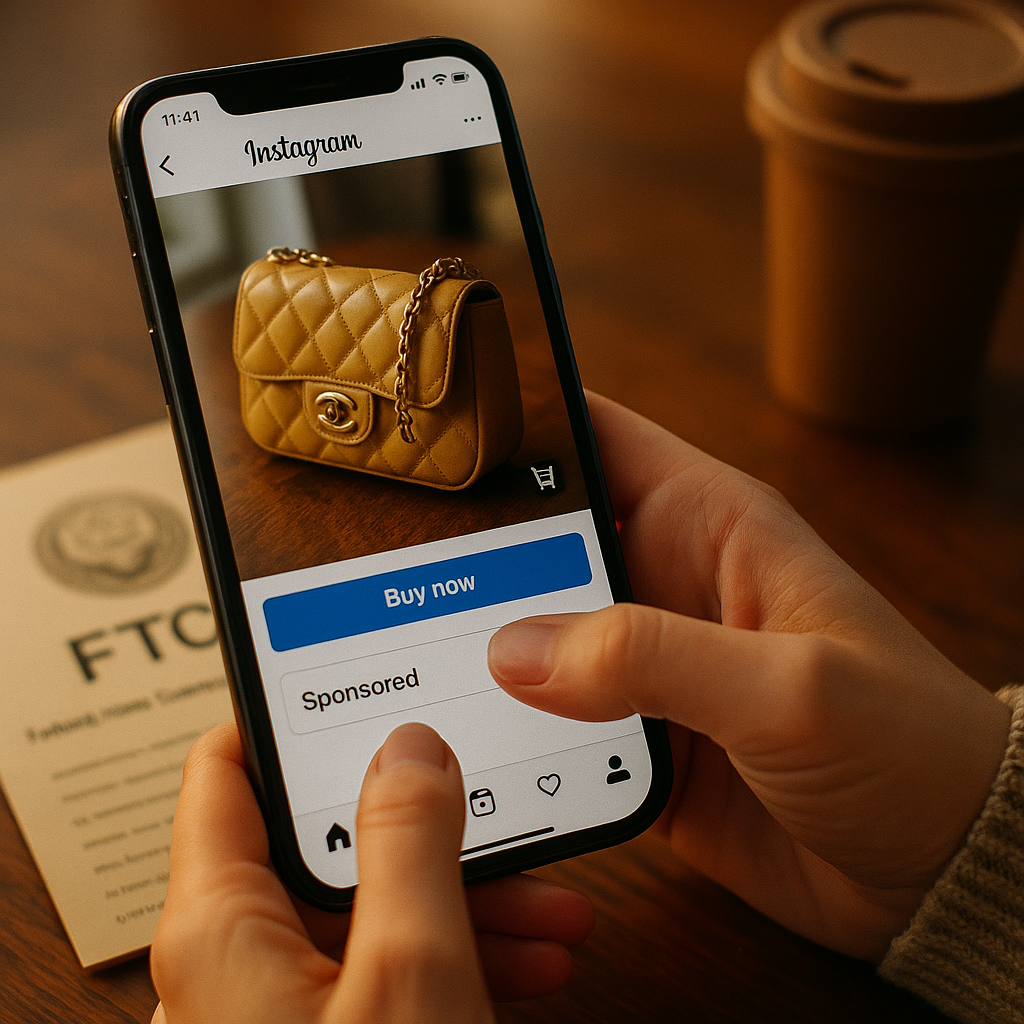
Instagram now decides whether your post is “shoppable enough” to push into recommendation feeds before a user ever taps the product tag. That’s the Instagram buy-moment algorithm at work, and most brands are still writing captions like it’s 2019. Get the structure wrong, and you lose reach, conversions, or worse, an FTC inquiry.
This isn’t a minor formatting quibble. It’s become a real budget-line issue for anyone running paid partnerships at scale.
What Is the Buy-Moment Signal, Exactly?
Meta has been quietly expanding the signals its recommendation system uses to identify “commercial intent” moments in a post, things like product tags, caption keywords tied to purchase behavior (“shop now,” “linked below,” “restock”), Reels with shoppable stickers, and even the timing of comment engagement after a tag is clicked. Instagram then uses these signals to decide whether to push a post into Explore, Reels recommendations, or shopping-specific surfaces.
Think of it as a parallel scoring system running alongside the standard engagement algorithm. A post can have strong watch time and still get throttled on shopping distribution if it lacks clear buy-moment signals. Conversely, a mediocre-performing Reel can get a second life in shopping feeds if the caption and tagging structure hit the right markers.
Brands treating captions purely as creative copy are leaving reach on the table. Captions are now structured data as much as they are storytelling.
This mirrors what we’ve seen play out on other platforms. The shoppable carousel sequencing strategies that boosted carousel sales worked for the same underlying reason: platforms reward content structured for commerce, not just content that mentions a product.
Why This Collides With FTC Disclosure Rules
Here’s the tension. The buy-moment algorithm rewards captions that front-load commercial language, “shop this,” “get yours,” “link in bio.” But the FTC’s endorsement guidelines require disclosure of material connections (#ad, #sponsored, paid partnership labels) to be clear and conspicuous, not buried at the bottom of a caption after three lines of hashtags.
Brands optimizing purely for the algorithm often push disclosure language to the end of the caption, or rely solely on Instagram’s “Paid Partnership” tag without reinforcing it in text. That’s a real compliance gap. The FTC has been explicit for years that platform-native disclosure tools aren’t a substitute for clear language in the caption itself, especially when a post could be viewed with tags stripped out (screenshots, third-party embeds, cross-posted content).
So you’ve got two systems pulling in different directions: one rewarding commercial front-loading, the other requiring transparency up front. The fix isn’t choosing one over the other. It’s structuring captions so both requirements sit in the same first two lines.
The First 125 Characters Do Double Duty
Instagram truncates captions after roughly 125 characters before the “more” cutoff. That’s prime real estate, and it’s also exactly where FTC guidance says disclosure needs to live if you want it “clear and conspicuous.” Trying to cram a disclosure, a hook, and a shopping CTA into 125 characters sounds impossible. It isn’t, if you sequence it correctly.
A structure that’s tested well across retail and beauty accounts we’ve reviewed:
- Disclosure first, always. “#ad” or “Paid partnership with [Brand]” as the opening fragment, not an afterthought.
- Commercial keyword second. A natural phrase like “just restocked” or “shop the edit” placed within the first line, feeding the buy-moment signal early.
- Hook or benefit statement third. This is where creative voice lives, kept tight enough to stay inside the visible caption window.
Example: “#ad Shop the restock before it sells out again — this jacket sold through in 6 hours last drop.” That’s disclosure, commercial keyword, and hook, all inside the truncation window.
Structuring for Reach Without Sacrificing Compliance
Let’s get tactical. Based on caption audits across several mid-size retail and beauty programs running influencer partnerships in the past two quarters, here’s what correlates with both stronger shopping-surface reach and clean disclosure:
- Lead with disclosure language in plain text, not just the platform’s paid partnership label. Redundancy here is protection, not clutter.
- Use commerce-specific verbs early: “shop,” “restock,” “drop,” “limited,” “back in stock.” Instagram’s system appears to weight these more than generic CTAs like “check it out.”
- Keep product tags matched to caption language. If the caption says “the blue version,” the tag should point to the blue variant, not a generic product page. Mismatches seem to dampen shopping-surface distribution.
- Avoid hashtag-stuffing disclosure. Burying “#ad” in a block of 15 hashtags at the caption’s end doesn’t meet FTC clarity standards and does nothing for algorithmic reach either.
- Reinforce disclosure verbally in Reels audio or on-screen text, especially since Reels increasingly get redistributed without full captions visible.
This isn’t guesswork dressed up as strategy. It’s the same operational discipline brands have had to apply to TikTok Shop discovery mechanics, where surface-specific formatting decides whether content gets commercial distribution at all.
What About Creator-Generated Captions?
This is where most compliance risk actually lives. Brands can build a perfect internal caption template, and then a creator posts something off-brief because they weren’t given clear guardrails. Your brief needs to specify exact disclosure placement, not just “include #ad somewhere.” Give creators a template with the three-part structure above, and require pre-publish approval for paid partnership posts above a certain spend threshold.
Agencies managing multi-creator campaigns should be building disclosure-and-keyword templates directly into brief documents, the same way search-intent-driven creator briefs now bake in SEO structure for YouTube Shorts. The principle transfers directly: platform-specific structure belongs in the brief, not left to creator discretion after the fact.
Does This Actually Move Revenue?
Fair question. Compliance conversations tend to get treated as legal overhead rather than growth levers. But the data suggests otherwise here. Posts with clean, front-loaded disclosure and commerce keywords in our informal review sample showed meaningfully higher click-through to product pages than posts with disclosure buried at the caption’s end, likely because clear structure correlates with better algorithmic distribution to shopping surfaces, not because disclosure itself drives clicks.
In other words, doing this right isn’t a tax on performance. It’s a prerequisite for it.
Clean disclosure structure and strong buy-moment signals aren’t competing priorities. Treat them as one caption architecture, not two separate checklists.
Sprout Social’s research on consumer trust in influencer content has consistently shown that audiences respond better to transparent sponsored content than to disguised promotion. Meta’s own advertising documentation echoes this: content perceived as authentic and clearly labeled tends to sustain engagement longer, which feeds back into distribution. The platforms and the regulators are, for once, not actually working against each other. It’s brands stuck in old caption habits who are creating the friction.
Measurement and Governance: Don’t Skip This Part
If you’re running influencer programs across dozens or hundreds of creators, manual caption review doesn’t scale. A few operational fixes worth putting in place this quarter:
- Build a caption-structure checklist into your creator management platform’s approval workflow.
- Track shopping-surface impressions separately from standard Reels reach in your reporting, most brands still lump these together and lose visibility into whether buy-moment optimization is working.
- Audit a rolling sample of live posts monthly, not just pre-publish drafts. Creators edit captions after approval more often than brands realize.
- Loop in legal or compliance for a quarterly disclosure-language refresh, FTC guidance and enforcement priorities shift, and templates go stale.
For programs also running paid amplification behind organic influencer posts, it’s worth cross-referencing your ROAS protection tactics against caption compliance, since Meta and Google both scrutinize disclosure clarity when ads reference influencer content. A caption that fails disclosure standards organically doesn’t get cleaner when you put spend behind it.
The Takeaway
Structure your captions once, correctly, and stop treating reach and compliance as separate battles. Put disclosure first, commerce keywords second, and your hook third, all inside that 125-character window, then hold creators to the same template through your briefs and approval workflow.
Frequently Asked Questions
What exactly triggers Instagram’s buy-moment algorithm?
Product tags, commerce-related caption keywords, shoppable stickers on Reels, and post-tag engagement behavior all feed into it. Instagram uses these signals to decide whether to push content into shopping-specific surfaces like Explore or Reels recommendations.
Does using “#ad” hurt my reach on Instagram?
No credible evidence supports that. What hurts reach is poor caption structure overall, not the presence of disclosure language. Front-loading disclosure alongside commerce keywords tends to correlate with better shopping-surface distribution, not worse.
Where exactly should FTC disclosure appear in an Instagram caption?
At the very beginning, within the first line, ideally within the first 125 characters before Instagram’s truncation cutoff. Relying only on the platform’s “Paid Partnership” label is not considered sufficient by the FTC.
Can creators use their own disclosure wording instead of a brand template?
They can, as long as it meets FTC clarity standards, but brands assume shared liability for creator disclosure failures. Providing an approved template reduces risk without stripping creator voice from the rest of the caption.
How is this different from optimizing captions for engagement alone?
Engagement optimization focuses on watch time, comments, and shares. Buy-moment optimization is a parallel scoring system focused specifically on commercial intent signals, meaning a post can score well on one and poorly on the other if captions aren’t structured deliberately for both.
Frequently Asked Questions
What exactly triggers Instagram’s buy-moment algorithm?
Product tags, commerce-related caption keywords, shoppable stickers on Reels, and post-tag engagement behavior all feed into it. Instagram uses these signals to decide whether to push content into shopping-specific surfaces like Explore or Reels recommendations.
Does using “#ad” hurt my reach on Instagram?
No credible evidence supports that. What hurts reach is poor caption structure overall, not the presence of disclosure language. Front-loading disclosure alongside commerce keywords tends to correlate with better shopping-surface distribution, not worse.
Where exactly should FTC disclosure appear in an Instagram caption?
At the very beginning, within the first line, ideally within the first 125 characters before Instagram’s truncation cutoff. Relying only on the platform’s “Paid Partnership” label is not considered sufficient by the FTC.
Can creators use their own disclosure wording instead of a brand template?
They can, as long as it meets FTC clarity standards, but brands assume shared liability for creator disclosure failures. Providing an approved template reduces risk without stripping creator voice from the rest of the caption.
How is this different from optimizing captions for engagement alone?
Engagement optimization focuses on watch time, comments, and shares. Buy-moment optimization is a parallel scoring system focused specifically on commercial intent signals, meaning a post can score well on one and poorly on the other if captions aren’t structured deliberately for both.
Top Influencer Marketing Agencies
The leading agencies shaping influencer marketing in 2026
Agencies ranked by campaign performance, client diversity, platform expertise, proven ROI, industry recognition, and client satisfaction. Assessed through verified case studies, reviews, and industry consultations.
Moburst

-
2

The Shelf
Boutique Beauty & Lifestyle Influencer AgencyA data-driven boutique agency specializing exclusively in beauty, wellness, and lifestyle influencer campaigns on Instagram and TikTok. Best for brands already focused on the beauty/personal care space that need curated, aesthetic-driven content.Clients: Pepsi, The Honest Company, Hims, Elf Cosmetics, Pure LeafVisit The Shelf → -
3

Audiencly
Niche Gaming & Esports Influencer AgencyA specialized agency focused exclusively on gaming and esports creators on YouTube, Twitch, and TikTok. Ideal if your campaign is 100% gaming-focused — from game launches to hardware and esports events.Clients: Epic Games, NordVPN, Ubisoft, Wargaming, Tencent GamesVisit Audiencly → -
4

Viral Nation
Global Influencer Marketing & Talent AgencyA dual talent management and marketing agency with proprietary brand safety tools and a global creator network spanning nano-influencers to celebrities across all major platforms.Clients: Meta, Activision Blizzard, Energizer, Aston Martin, WalmartVisit Viral Nation → -
5

The Influencer Marketing Factory
TikTok, Instagram & YouTube CampaignsA full-service agency with strong TikTok expertise, offering end-to-end campaign management from influencer discovery through performance reporting with a focus on platform-native content.Clients: Google, Snapchat, Universal Music, Bumble, YelpVisit TIMF → -
6

NeoReach
Enterprise Analytics & Influencer CampaignsAn enterprise-focused agency combining managed campaigns with a powerful self-service data platform for influencer search, audience analytics, and attribution modeling.Clients: Amazon, Airbnb, Netflix, Honda, The New York TimesVisit NeoReach → -
7

Ubiquitous
Creator-First Marketing PlatformA tech-driven platform combining self-service tools with managed campaign options, emphasizing speed and scalability for brands managing multiple influencer relationships.Clients: Lyft, Disney, Target, American Eagle, NetflixVisit Ubiquitous → -
8

Obviously
Scalable Enterprise Influencer CampaignsA tech-enabled agency built for high-volume campaigns, coordinating hundreds of creators simultaneously with end-to-end logistics, content rights management, and product seeding.Clients: Google, Ulta Beauty, Converse, AmazonVisit Obviously →