


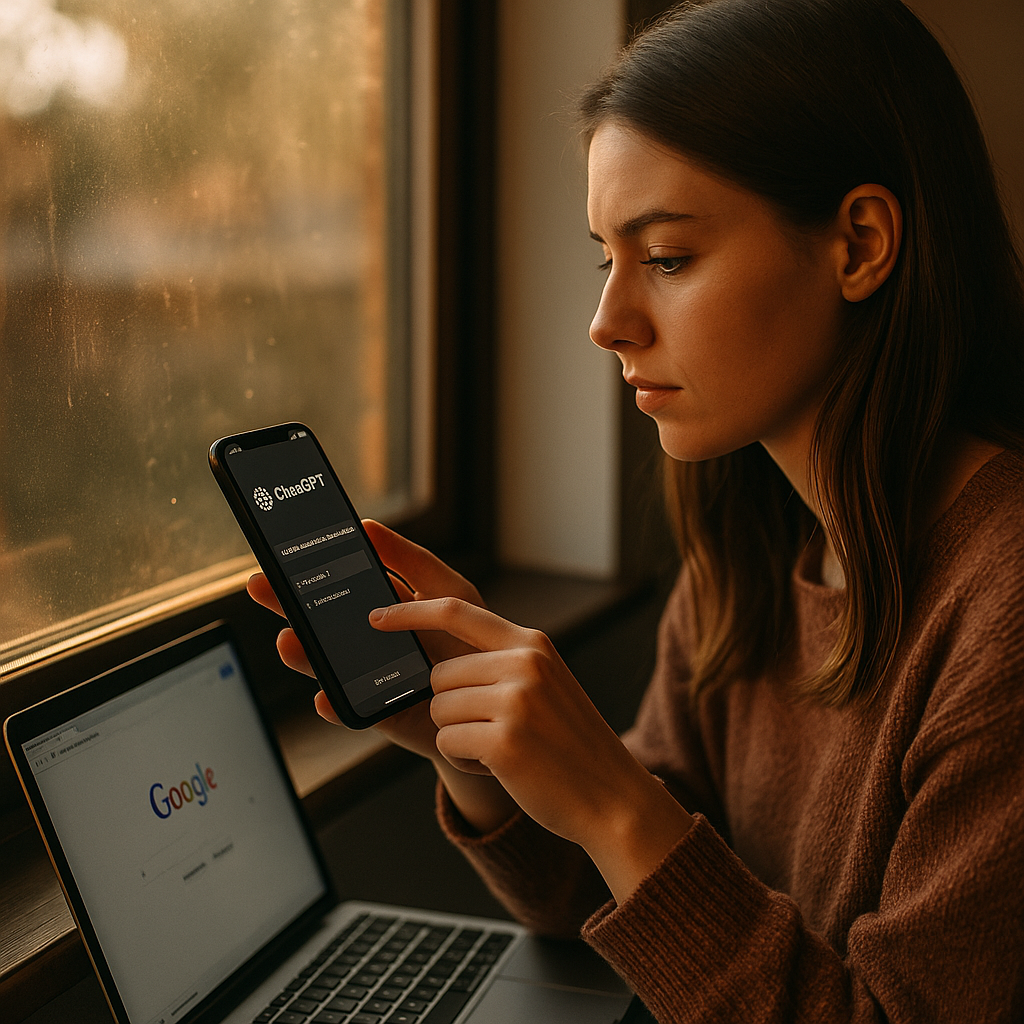
Sixty-four percent of Gen Z shoppers say they’d rather ask ChatGPT than Google before buying something. That single stat should be reordering marketing roadmaps right now. It isn’t, and that gap is going to cost brands market share to competitors who redesign their funnels around consumer AI search habits instead of legacy SEO thinking.
The generational split nobody’s funnel accounts for
Here’s the uncomfortable part: most brands still build one funnel and assume it works for every age cohort. It doesn’t, and AI search is exposing that assumption fast.
Millennials and Gen X still largely default to Google, even when they eventually cross-check answers with an AI tool. Gen Z is different. They’re not treating ChatGPT as a supplement to search — for a huge share of product research, it is the search engine. That’s a behavioral shift, not a channel preference, and it has downstream effects on everything from content structure to attribution modeling.
We covered the topline numbers on this shift in a recent breakdown of McKinsey’s research, which found roughly half of all consumers now start product research in an AI tool rather than a traditional search engine. But averages hide the story. Break it down by age and the pattern gets sharper: older cohorts use AI search as a second opinion, younger ones use it as the first and sometimes only stop before purchase.
Gen Z isn’t abandoning Google. They’re skipping the ten blue links entirely and going straight to a synthesized answer, which means your brand’s first impression now happens inside someone else’s chat interface, not your landing page.
Why ChatGPT-first behavior breaks the traditional funnel
Think about the classic funnel: awareness, consideration, conversion, loyalty. Each stage assumed a visible touchpoint — an ad, a search result, a landing page — where marketers could measure and optimize.
ChatGPT-first research collapses awareness and consideration into a single, largely invisible step. A Gen Z consumer asks “what’s the best skincare routine for combination skin under $50” and gets a synthesized answer that may or may not mention your product by name. There’s no click. No session. No pixel fire. Your brand either shows up in that answer or it doesn’t, and you often won’t know which happened.
This is the core operational problem: you can’t A/B test a funnel stage you can’t see. Traditional analytics stacks built around GA4 events and last-click attribution simply weren’t designed for a world where the deciding moment happens inside a chatbot, not on your domain.
- Gen Z consumers are more likely to ask AI tools for direct comparisons (“X vs Y for oily skin”) rather than browsing category pages.
- They ask follow-up questions in the same thread, refining intent in ways search engines never captured.
- They treat AI answers as pre-vetted, which raises the trust bar for whatever brand does get mentioned.
- Purchase often happens on a retailer’s app or Amazon, skipping the brand’s owned site almost entirely.
What older generations still do differently
Millennials tend to use AI search for narrowing options after they’ve already Googled a category. Gen X and Boomers, per most usage data from platforms like eMarketer, still lean on search engines and even direct retailer sites first, treating AI chat as a novelty or a shortcut for specific questions rather than a research hub.
That means brands targeting a 45-year-old buyer and a 19-year-old buyer with the same content strategy are optimizing for two fundamentally different discovery paths. One still rewards classic on-page SEO. The other rewards structured, citation-worthy content that large language models can lift and summarize accurately.
Funnel redesign: what actually needs to change
Redesigning the funnel doesn’t mean throwing out everything you know about content marketing. It means adding a layer.
Start with content structure. AI models favor clear, factual, well-organized content — think FAQ blocks, comparison tables, and direct answers to specific questions — over long narrative copy stuffed with brand voice. If your product pages read like ad copy instead of reference material, you’re harder for a model to cite accurately. Our piece on AI Overviews rewarding classic SEO signals makes a related point: there’s no shortcut hack here, just disciplined, well-structured content that happens to double as LLM training-friendly material.
Second, rethink where the “consideration” stage actually lives. If Gen Z’s consideration phase happens inside a chat thread, your job is to make sure trustworthy, third-party validation exists in places models pull from — review sites, Reddit threads, YouTube comparisons, creator content. This is exactly why influencer and creator partnerships matter more now, not less. A well-regarded creator’s honest comparison video often becomes training or retrieval fodder for AI answers in a way your own site copy never will.
Third, build measurement around referral proxies instead of chasing perfect attribution. Track branded search lift, direct traffic spikes after creator campaigns, and share-of-voice in AI answers using emerging tools built for this purpose. It’s imperfect. It’s still better than pretending the old funnel still explains behavior it no longer captures.
Sequencing content for how Gen Z actually reads
One overlooked fix: content sequencing. If half your audience’s research starts in AI search, the order in which you present information across owned channels needs to mirror how AI tools chunk and summarize content. Lead with the direct answer, follow with supporting detail, and close with proof points and citations. That’s the format AI models replicate most reliably, and it’s also just better UX for impatient readers. We go deeper on this in our guide to fixing content sequencing for AI-driven research.
Trust is the real currency, and it’s fragile
Here’s where it gets risky for brands moving too aggressively into this space. Gen Z is also the most skeptical generation about AI-generated recommendations, especially when they suspect sponsorship or manipulation. Recent consumer trust data shows sponsored chatbot suggestions erode credibility fast, sometimes faster than a bad review would.
We’ve written about this tension directly: sponsored AI chatbot recommendations are already damaging trust, and the broader AI trust gap means CMOs can’t just buy their way into AI visibility the way they bought paid search placements for two decades. There’s no obvious “pay to be mentioned” model yet, and regulators are watching closely — the FTC has already signaled scrutiny of undisclosed AI-influenced endorsements, a topic worth reviewing on the FTC’s official site.
The brands winning Gen Z’s AI-first research moment aren’t the ones gaming the system. They’re the ones with genuinely strong third-party proof: reviews, creator content, and comparison data that AI models can retrieve without needing to guess at intent.
Operational checklist for marketing teams
If you’re a brand strategist trying to move fast on this without a full rebuild, here’s where to focus budget and attention over the next two quarters:
- Audit your AI visibility. Manually query ChatGPT, Perplexity, and Google’s AI Overviews with the questions your Gen Z buyers actually ask. Note whether you’re mentioned, and how accurately.
- Restructure top-funnel content around direct-answer formatting rather than brand narrative, without losing your voice entirely.
- Invest in creator and review ecosystems that function as retrieval sources for AI models, not just engagement plays. This overlaps heavily with existing influencer strategy, so budget conversations should already be happening alongside teams reading micro-creator commission structures.
- Set expectations with finance that attribution will be fuzzier in this environment, and build reporting frameworks around proxies rather than false precision.
- Monitor regulatory movement on AI disclosure requirements, since this space is evolving quickly and unevenly across markets, a dynamic explored in our compliance map for brand marketers.
None of this requires abandoning your existing SEO or paid search investment. It requires accepting that a meaningful, growing share of your future customers are making decisions before they ever see your website, and building visibility strategies for that reality using resources like HubSpot’s marketing research and platform-specific guidance from Google’s own support documentation on AI-generated search features.
Next step: Pull your last quarter’s top ten Gen Z-relevant product queries and run them through ChatGPT and Google’s AI Overviews this week. If your brand doesn’t show up accurately in at least half of them, that’s your funnel redesign priority list, ranked and ready.
Frequently Asked Questions
What is ChatGPT-first research behavior?
It refers to consumers, especially Gen Z, defaulting to AI chat tools like ChatGPT as their primary research method before purchase, rather than starting with a traditional search engine like Google.
How does Gen Z’s AI search habit differ from Millennials?
Millennials typically use AI tools to narrow options after an initial Google search. Gen Z more often skips traditional search entirely, using AI chat as the first and sometimes only research step before buying.
Why is traditional funnel attribution breaking down with AI search?
Because the awareness and consideration stages now often happen inside a chatbot conversation that brands can’t track. There’s no click, session, or pixel event, making last-click attribution models increasingly unreliable.
How can brands improve visibility in AI-generated answers?
Focus on structured, direct-answer content, strong third-party validation through reviews and creator content, and clear factual formatting that large language models can retrieve and cite accurately.
Does paid advertising work to influence AI chatbot recommendations?
Not reliably yet, and consumers, particularly Gen Z, react negatively to sponsored AI recommendations they perceive as inauthentic, which can damage brand trust faster than it builds visibility.
FAQ Schema
Top Influencer Marketing Agencies
The leading agencies shaping influencer marketing in 2026
Agencies ranked by campaign performance, client diversity, platform expertise, proven ROI, industry recognition, and client satisfaction. Assessed through verified case studies, reviews, and industry consultations.
Moburst

-
2

The Shelf
Boutique Beauty & Lifestyle Influencer AgencyA data-driven boutique agency specializing exclusively in beauty, wellness, and lifestyle influencer campaigns on Instagram and TikTok. Best for brands already focused on the beauty/personal care space that need curated, aesthetic-driven content.Clients: Pepsi, The Honest Company, Hims, Elf Cosmetics, Pure LeafVisit The Shelf → -
3

Audiencly
Niche Gaming & Esports Influencer AgencyA specialized agency focused exclusively on gaming and esports creators on YouTube, Twitch, and TikTok. Ideal if your campaign is 100% gaming-focused — from game launches to hardware and esports events.Clients: Epic Games, NordVPN, Ubisoft, Wargaming, Tencent GamesVisit Audiencly → -
4

Viral Nation
Global Influencer Marketing & Talent AgencyA dual talent management and marketing agency with proprietary brand safety tools and a global creator network spanning nano-influencers to celebrities across all major platforms.Clients: Meta, Activision Blizzard, Energizer, Aston Martin, WalmartVisit Viral Nation → -
5

The Influencer Marketing Factory
TikTok, Instagram & YouTube CampaignsA full-service agency with strong TikTok expertise, offering end-to-end campaign management from influencer discovery through performance reporting with a focus on platform-native content.Clients: Google, Snapchat, Universal Music, Bumble, YelpVisit TIMF → -
6

NeoReach
Enterprise Analytics & Influencer CampaignsAn enterprise-focused agency combining managed campaigns with a powerful self-service data platform for influencer search, audience analytics, and attribution modeling.Clients: Amazon, Airbnb, Netflix, Honda, The New York TimesVisit NeoReach → -
7

Ubiquitous
Creator-First Marketing PlatformA tech-driven platform combining self-service tools with managed campaign options, emphasizing speed and scalability for brands managing multiple influencer relationships.Clients: Lyft, Disney, Target, American Eagle, NetflixVisit Ubiquitous → -
8

Obviously
Scalable Enterprise Influencer CampaignsA tech-enabled agency built for high-volume campaigns, coordinating hundreds of creators simultaneously with end-to-end logistics, content rights management, and product seeding.Clients: Google, Ulta Beauty, Converse, AmazonVisit Obviously →