


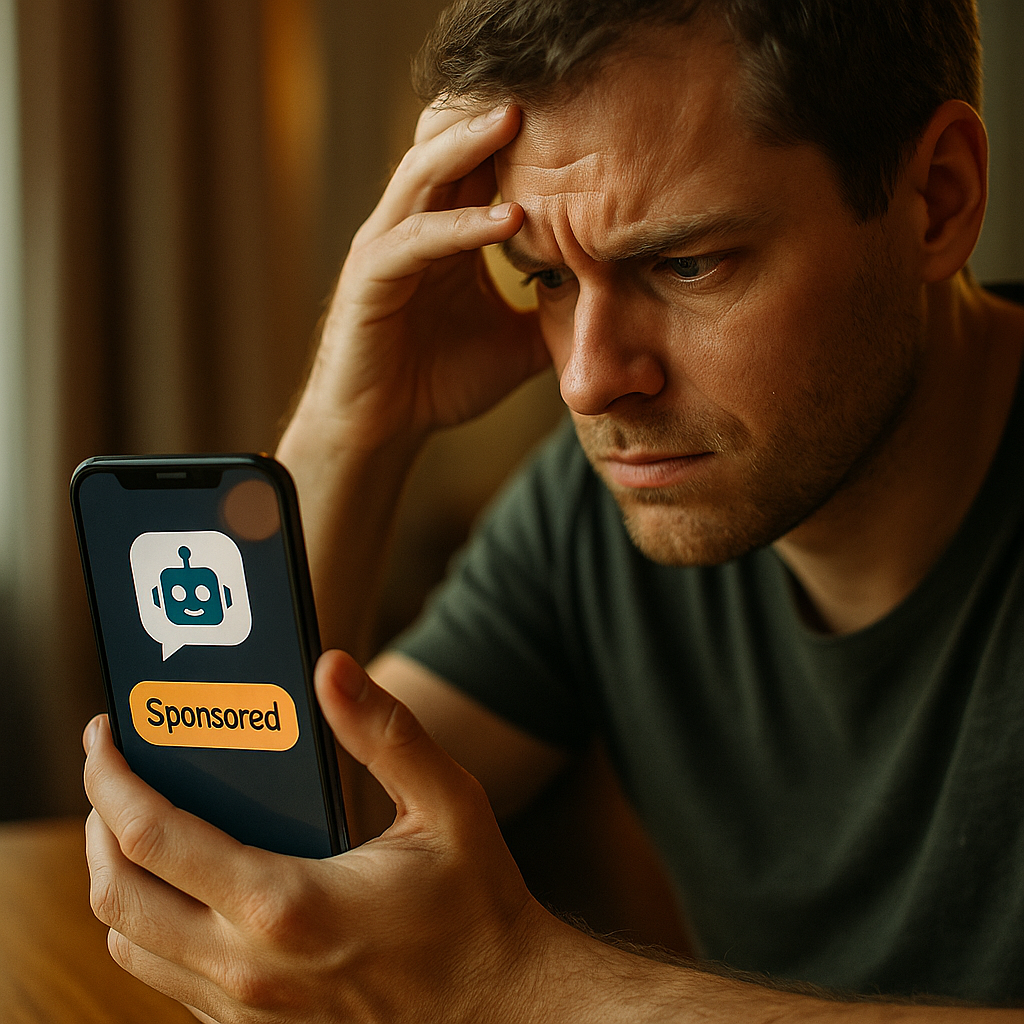
Sixty-one percent of consumers say they’d trust a chatbot recommendation less if they knew it was sponsored. That’s not a rounding error — it’s a warning shot. Brands racing to embed conversational commerce into every touchpoint are discovering that consumer skepticism toward sponsored AI chatbot recommendations is scaling faster than the technology itself.
Marketing teams love a new channel. Conversational commerce checks every box: personalization, speed, always-on availability, and a shopping experience that feels less like an ad and more like advice. That last part is exactly the problem. When advice starts feeling like advertising, trust collapses — and it collapses quietly, long before churn or complaint data shows up in a dashboard.
The Trust Gap Nobody Budgeted For
Here’s the uncomfortable truth: brands built influencer marketing on the premise that audiences trust people more than banner ads. Chatbots were supposed to inherit some of that trust by mimicking conversational, human-feeling interaction. Early sentiment data suggests the opposite is happening.
A recent consumer survey cited by eMarketer found that trust in AI-generated product recommendations drops sharply the moment users suspect commercial influence — even when the recommendation itself is accurate. This isn’t about product quality. It’s about disclosure, transparency, and whether the assistant is working for the shopper or for the brand’s margin targets.
Sentiment data across multiple studies points to the same pattern: users don’t reject AI recommendations outright, they reject undisclosed commercial intent hiding inside a conversational interface.
This echoes what Influencers Time covered in the consumer AI trust gap — the broader erosion of confidence in AI-mediated brand messaging isn’t isolated to chatbots. It’s systemic, and conversational commerce is simply the newest surface where it shows up.
Why Conversational Commerce Feels Different From Search
Search ads are labeled. Sponsored posts carry disclosure hashtags. Consumers have two decades of pattern recognition for spotting paid placement in those formats. Chatbot conversations break that pattern entirely.
When a shopper asks a conversational assistant “what’s the best running shoe under $150,” they expect an answer shaped like advice from a knowledgeable friend, not a ranked list influenced by affiliate commissions or brand partnerships. The format itself signals impartiality even when the underlying model is anything but impartial. That mismatch between expectation and reality is where skepticism festers.
It matters more now because half of consumers now start research in AI search, according to McKinsey data referenced in earlier Influencers Time reporting. Conversational discovery isn’t a niche behavior anymore. It’s becoming a primary research channel, which means trust failures at this layer carry outsized reputational risk.
What the Early Sentiment Numbers Actually Show
- Disclosure sensitivity is asymmetric: Consumers penalize brands more harshly for hidden sponsorship in chatbots than in traditional influencer content, likely because they perceive AI as a neutral utility rather than a media channel.
- Repeat-use intent drops fast: Survey data from multiple martech vendors shows a measurable decline in “would use again” scores once users learn a recommendation engine has commercial ties, even a single instance.
- Younger users are more skeptical, not less: Despite higher comfort with AI tools generally, Gen Z respondents report lower trust in sponsored bot recommendations than older cohorts — a reversal of the usual “digital native = more trusting” assumption.
- Category matters: Skepticism spikes in health, finance, and parenting-related queries, where perceived stakes are higher and impartiality matters more.
None of this means conversational commerce is doomed. It means brands scaling it without sentiment tracking are flying blind into a trust minefield.
What Brands Are Getting Wrong
Most conversational commerce rollouts treat the chatbot as a conversion tool first and a trust surface second. That ordering is backwards. Marketing teams are optimizing for click-through and basket size, while sentiment data — the leading indicator of long-term adoption — sits unmonitored.
Consider how this played out with paid search and social a decade ago: platforms had to be forced into disclosure standards by regulators and public backlash. Chatbots are heading toward the same reckoning, except the feedback loop is faster and the reputational damage is more personal, because conversational interfaces feel intimate in a way a banner ad never did.
There’s also a data governance angle. The FTC has already signaled interest in AI-driven endorsement practices, and disclosure requirements that apply to influencer content are increasingly being read as applicable to algorithmic recommendations too. Brands that treat chatbot sponsorship as a gray area are underestimating both regulatory and consumer risk simultaneously — a theme also explored in the AI regulation patchwork compliance map.
If your chatbot recommendation logic can’t survive being explained plainly to a customer, it can’t survive scale either.
The Metrics Brands Should Be Tracking Now
Most teams track conversion rate, session length, and query resolution. Almost none track sentiment specific to sponsorship perception. That needs to change before scaling further. A minimal tracking framework should include:
- Trust decay rate: Measure sentiment before and after a user learns a recommendation was sponsored, via post-interaction micro-surveys.
- Disclosure clarity score: Test whether users can identify sponsored content within the chatbot flow without being told explicitly.
- Repeat engagement post-disclosure: Track whether users who encounter a disclosed sponsorship return to the assistant within 30 days.
- Category-level skepticism variance: Segment sentiment by product category, since health and finance queries carry different trust thresholds than fashion or home goods.
- Sentiment divergence by generation: Don’t assume younger users are automatically more forgiving of AI-driven sponsorship; the data increasingly says otherwise.
This isn’t abstract brand-safety theater. It’s the same operational discipline brands already apply to influencer disclosure compliance, just ported to a new channel. Teams that built rigorous FTC-compliant disclosure workflows for creator content have a head start — the muscle memory transfers.
Disclosure Design Is a Competitive Advantage, Not a Compliance Tax
Here’s a reframe worth sitting with: brands that get disclosure right in conversational commerce may actually outperform those that hide it, because transparency itself becomes a differentiator in a market where users are primed to distrust AI recommendations by default.
Think about how Sprout Social and other platforms have documented rising consumer demand for authenticity markers across digital channels. The same appetite applies here. A chatbot that says “this recommendation includes a sponsored partner, here’s why we still think it’s a good fit” may retain more trust than one that stays silent and gets caught.
This is consistent with what’s happening in adjacent AI marketing debates. Influencers Time’s coverage of brands cutting back on AI targeting shows a broader pattern: consumers are rewarding restraint and transparency over aggressive personalization, even when the personalization is technically more “accurate.”
The same logic applies to vendor selection. Choosing between conversational AI providers isn’t just a technical decision anymore, it’s a trust-architecture decision. That’s the same reasoning behind frameworks like the one in the OpenAI vs Anthropic vendor selection framework — model choice increasingly reflects brand risk tolerance, not just capability benchmarks.
Where This Intersects With Influencer Compliance
Brands running influencer programs already navigate FTC disclosure rules for human creators. Conversational commerce introduces a parallel obligation with less regulatory clarity but arguably higher consumer sensitivity. Marketing and legal teams should treat chatbot sponsorship disclosure with the same rigor as creator contracts, not as an afterthought bolted onto a martech deployment.
Agencies advising on both influencer strategy and AI deployment are uniquely positioned here. The operational playbooks overlap more than most CMOs realize.
Before You Scale: A Short Pre-Flight Checklist
- Run a sentiment baseline study before launch, not after complaints surface.
- Build disclosure language directly into the conversational flow, tested for clarity with real users.
- Segment sentiment tracking by product category and demographic, since skepticism isn’t evenly distributed.
- Audit whether affiliate or partnership incentives are influencing ranked recommendations, and disclose accordingly.
- Set a trust-decay threshold that triggers a pause on scaling if sentiment drops below it.
None of this is exotic. It’s the same rigor brands apply to paid media disclosure, adapted for a channel that feels more personal and therefore carries higher stakes when trust breaks.
FAQs
Why are consumers more skeptical of sponsored chatbot recommendations than sponsored social posts?
Chatbots are perceived as neutral utilities rather than media channels, so undisclosed commercial influence feels like a bigger breach of expectation than a labeled sponsored post on social media.
Does Gen Z trust AI chatbot recommendations more than older generations?
Not necessarily. Early sentiment data shows Gen Z respondents are often more skeptical of sponsored bot recommendations than older cohorts, despite general comfort with AI tools.
What metrics should brands track before scaling conversational commerce?
Trust decay rate, disclosure clarity scores, repeat engagement after disclosure, category-level skepticism variance, and generational sentiment divergence are the core metrics to monitor.
Are there legal requirements for disclosing sponsored AI recommendations?
Regulatory guidance is still evolving, but agencies like the FTC have signaled that endorsement disclosure principles applied to influencer content increasingly extend to algorithmic and AI-driven recommendations.
Can transparent disclosure actually improve chatbot performance?
Yes. Sentiment data suggests brands that disclose sponsorship clearly can retain more consumer trust than those that hide it, since transparency is increasingly rewarded in AI-mediated interactions.
The brands that win conversational commerce won’t be the ones with the fastest deployment — they’ll be the ones tracking trust decay before it shows up as churn. Start with a sentiment baseline this quarter, not after the backlash forces one.
Top Influencer Marketing Agencies
The leading agencies shaping influencer marketing in 2026
Agencies ranked by campaign performance, client diversity, platform expertise, proven ROI, industry recognition, and client satisfaction. Assessed through verified case studies, reviews, and industry consultations.
Moburst

-
2

The Shelf
Boutique Beauty & Lifestyle Influencer AgencyA data-driven boutique agency specializing exclusively in beauty, wellness, and lifestyle influencer campaigns on Instagram and TikTok. Best for brands already focused on the beauty/personal care space that need curated, aesthetic-driven content.Clients: Pepsi, The Honest Company, Hims, Elf Cosmetics, Pure LeafVisit The Shelf → -
3

Audiencly
Niche Gaming & Esports Influencer AgencyA specialized agency focused exclusively on gaming and esports creators on YouTube, Twitch, and TikTok. Ideal if your campaign is 100% gaming-focused — from game launches to hardware and esports events.Clients: Epic Games, NordVPN, Ubisoft, Wargaming, Tencent GamesVisit Audiencly → -
4

Viral Nation
Global Influencer Marketing & Talent AgencyA dual talent management and marketing agency with proprietary brand safety tools and a global creator network spanning nano-influencers to celebrities across all major platforms.Clients: Meta, Activision Blizzard, Energizer, Aston Martin, WalmartVisit Viral Nation → -
5

The Influencer Marketing Factory
TikTok, Instagram & YouTube CampaignsA full-service agency with strong TikTok expertise, offering end-to-end campaign management from influencer discovery through performance reporting with a focus on platform-native content.Clients: Google, Snapchat, Universal Music, Bumble, YelpVisit TIMF → -
6

NeoReach
Enterprise Analytics & Influencer CampaignsAn enterprise-focused agency combining managed campaigns with a powerful self-service data platform for influencer search, audience analytics, and attribution modeling.Clients: Amazon, Airbnb, Netflix, Honda, The New York TimesVisit NeoReach → -
7

Ubiquitous
Creator-First Marketing PlatformA tech-driven platform combining self-service tools with managed campaign options, emphasizing speed and scalability for brands managing multiple influencer relationships.Clients: Lyft, Disney, Target, American Eagle, NetflixVisit Ubiquitous → -
8

Obviously
Scalable Enterprise Influencer CampaignsA tech-enabled agency built for high-volume campaigns, coordinating hundreds of creators simultaneously with end-to-end logistics, content rights management, and product seeding.Clients: Google, Ulta Beauty, Converse, AmazonVisit Obviously →