


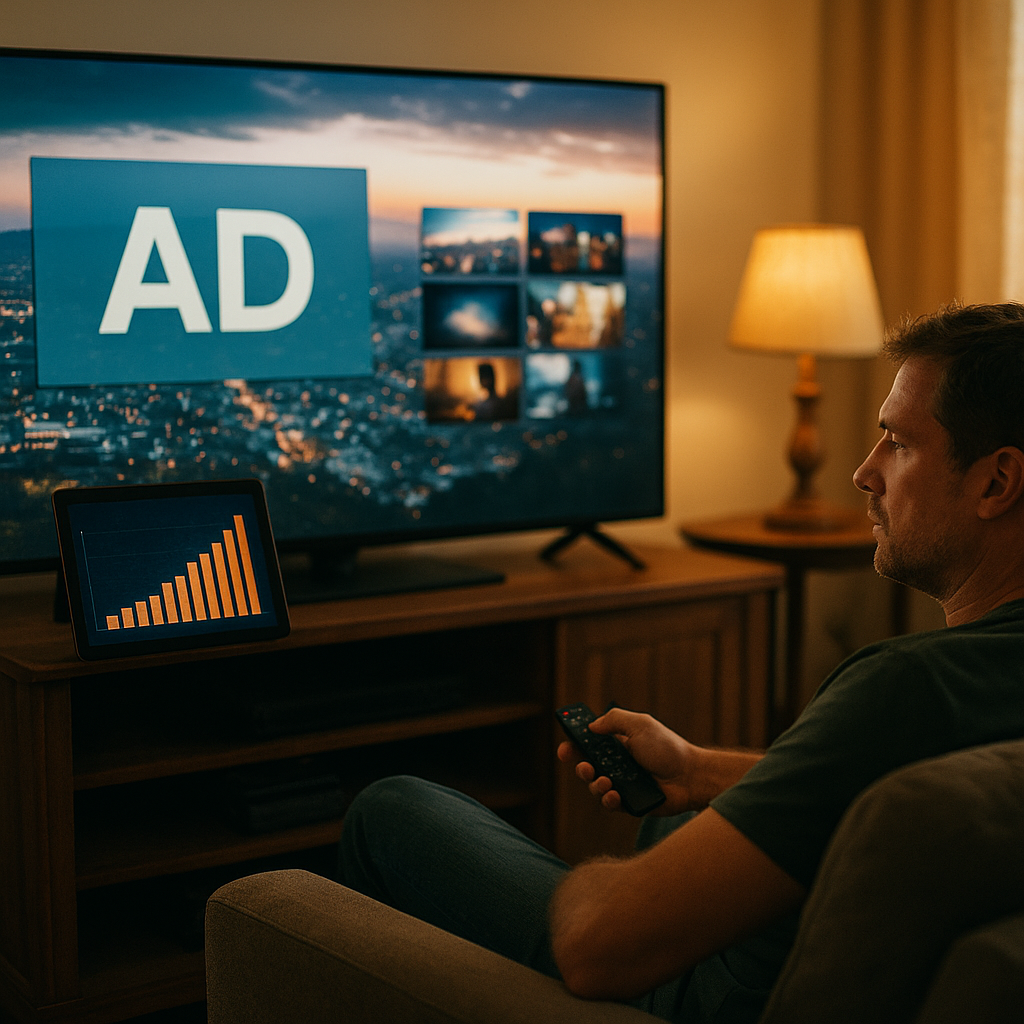
Americans now spend less time actively watching what’s on screen, even as the screen itself multiplies its ad slots. Nielsen and eMarketer data both point the same direction: attention per viewing hour is falling, while CTV ad inventory keeps growing at double-digit rates. That’s not a contradiction platforms want you to notice. But brands buying streaming media in bulk need to reckon with it now, not after the next upfront.
The Math Doesn’t Work the Way Sellers Pitch It
Here’s the pitch you’ve heard in every CTV sales deck for the past two years: streaming inventory is scarce, premium, and brand-safe compared to open web programmatic. Buy now before prices climb. It’s a reasonable pitch when supply is tight. The problem is supply isn’t tight anymore.
Roku, Amazon Fire TV, LG, Samsung, and a growing list of FAST channels (Tubi, Pluto TV, The Roku Channel) have all added ad load and ad slots over the past several quarters. Amazon alone expanded Prime Video’s ad inventory dramatically after shifting to an ads-by-default model. Netflix’s ad tier has scaled past 190 million monthly active users globally, per the company’s own disclosures, and it keeps adding ad formats: pause ads, shoppable overlays, sponsored recommendation rows. More inventory, sold to more buyers, at a moment when the actual behavioral evidence shows viewers are half-watching, second-screening, or leaving the room entirely.
This is the attention recession in its purest form: supply expanding while the underlying resource it’s supposed to deliver, human focus, keeps contracting.
CTV ad inventory has grown faster than viewer attention has held steady, which means the effective cost per second of genuine engagement is quietly rising even as sellers advertise falling CPMs.
What “Attention Recession” Actually Means for Streaming Buys
The term gets thrown around loosely, so let’s define it for this context. An attention recession describes a period where total available attention (measured in focused, undistracted viewing minutes) shrinks or stagnates, even as the channels competing for that attention multiply. It’s not that people are watching less TV. Nielsen’s Gauge data shows total streaming time is still climbing. It’s that the quality of attention per viewing session is degrading.
Second-screen behavior is the biggest culprit. Multiple studies, including ones from Adobe and Deloitte, have shown that a majority of streaming viewers are on a phone or laptop during at least part of a viewing session. Ad breaks are exactly when that second-screen switch happens most. You bought a 15-second CTV spot. You got maybe 6 seconds of eyes-on-screen, if that.
This matters differently for a big-budget upfront buyer versus a performance marketer running direct-response CTV. If you’re already thinking about how consolidated inventory affects your negotiating leverage, our piece on CTV inventory consolidation is the natural companion read here. Fewer sellers control more inventory, and now that inventory carries a bigger attention discount than the rate card admits.
Why Platforms Keep Adding Inventory Anyway
Simple: because they can, and because the demand side hasn’t pushed back hard enough yet. Ad-supported streaming is the fastest-growing revenue line for nearly every major platform. Netflix, Disney+, Peacock, Max, and Paramount+ have all leaned harder into ad tiers because subscription growth alone couldn’t hit the numbers investors want. More ad slots, more ad formats, more programmatic access through The Trade Desk, Google DV360, and Amazon DSP. It’s a rational business move for them.
It becomes irrational for buyers only if they keep paying premium CPMs for inventory that’s diluting in actual attention value. That’s the gap marketers need to close in their planning process, not next year, but in the next quarterly media plan.
The Data Brands Should Actually Be Tracking
Most CTV reporting still centers on completion rate, reach, and frequency. Those metrics tell you the ad played. They don’t tell you anyone watched it. A few data points deserve more weight in your planning:
- Co-viewing and second-screen indices from measurement partners like iSpot or VideoAmp, which estimate attentive viewing versus passive exposure.
- Ad pod position: attention drops sharply after the second ad in a pod. If your buy is landing in slot four or five, you’re paying premium rates for recession-level attention.
- Device-level engagement signals where available, particularly on connected TV apps that report whether the screen was active or backgrounded.
- Outcome-based attribution, not just impressions. Did the CTV spend actually move site visits, app installs, or in-store lift?
eMarketer’s CTV ad spend forecasts keep climbing, and Statista’s viewing-time data confirms streaming hours are up. Both can be true while attention quality per dollar declines. That’s the nuance most media plans miss because it’s easier to report reach than to admit half of it was noise.
Where This Intersects With the Broader Attention Recession Story
CTV isn’t operating in isolation. The same forces squeezing attention on streaming, ad fatigue, multi-device habits, algorithmic overload, are hitting paid social, search, and even AI-generated answer engines. We covered the automation side of this shift in our planning guide on AI ad automation, which looks at how programmatic tools are trying to compensate for declining human attention with better targeting math. CTV buyers should read that alongside this piece, because the two trends are compounding, not separate.
There’s also a trust dimension. As AI-driven ad decisioning takes on more of the buying and optimization work, consumer skepticism toward automated ad experiences is rising in parallel. Our ongoing coverage of AI ad trust erosion is relevant context: viewers who don’t trust why they’re seeing an ad are even less likely to give it real attention, compounding the recession rather than fixing it.
Rising inventory plus falling trust plus fragmented attention is a three-part squeeze most media plans still model as a single-variable problem.
What Brands Should Actually Do About It
None of this means pull out of CTV. It’s still one of the most measurable, brand-safe environments compared to open web display, and reach is genuinely strong. The fix is buying smarter, not buying less.
- Negotiate for pod position, not just CPM. First-in-pod placement commands real attention premiums; ask sellers to guarantee it contractually rather than treating it as a soft preference.
- Shift budget toward shorter, punchier creative. Six-second bumpers are outperforming 30-second spots on completed-attention metrics in several agency benchmarks, because they front-load the message before the second-screen switch happens.
- Diversify measurement partners. Don’t rely solely on the platform’s own reporting. Cross-reference with third-party attention and outcome data.
- Treat FAST channels differently from premium AVOD. Tubi and Pluto audiences skew toward more passive, background viewing. Price and creative strategy should reflect that, not mirror your Hulu or Peacock buy.
- Build attention-adjusted CPM into planning. If a seller’s raw CPM is $28 but only 55% of impressions are genuinely attentive, your real cost is closer to $51. Model it that way internally, even if the seller won’t.
Marketers who’ve already had to defend creator and influencer budgets against similar attention-quality questions will recognize the pattern. It’s the same discipline behind CFO-friendly creator deal structures: tie spend to demonstrable engagement, not just delivered impressions. CTV planning needs the same rigor, and finance teams are increasingly going to ask for it whether media teams are ready or not.
A Quick Word on Compliance and Disclosure
As CTV inventory expands into shoppable formats, pause ads, and sponsored content rows, disclosure requirements don’t disappear just because the format is new. The FTC’s guidance on endorsements and advertising still applies when influencer or creator content gets repurposed into CTV placements, a growing trend as brands push social-native creative onto the big screen. Legal and compliance teams should review streaming-specific creative the same way they review social posts, not assume broadcast-style pre-clearance covers it.
FAQs
What is the attention recession in advertising?
It refers to a period where the total supply of focused, undistracted consumer attention shrinks or stagnates even as the number of channels and ad formats competing for it keeps growing. The result is declining attention quality per ad dollar spent, even when reach and impression volume look strong.
Why is CTV ad inventory growing if attention is declining?
Streaming platforms are scaling ad-supported tiers and adding new formats (pause ads, shoppable overlays, sponsored rows) because ad revenue has become critical to subscriber economics. Netflix, Amazon, and major FAST channels have all expanded inventory to meet advertiser demand, independent of whether viewer attention is keeping pace.
How can brands measure real attention on CTV, not just impressions?
Look beyond completion rate and reach. Use co-viewing and second-screen indices from measurement partners, track ad pod position, and prioritize outcome-based attribution tied to site visits, app installs, or in-store lift rather than raw impression counts.
Should brands reduce CTV spend because of the attention recession?
Not necessarily. CTV remains one of the more measurable and brand-safe environments available. The smarter response is renegotiating for better pod positions, shortening creative, and building attention-adjusted CPM models rather than pulling budget outright.
Does second-screen behavior really affect CTV ad performance?
Yes. Multiple studies from Adobe and Deloitte show a majority of streaming viewers use a phone or laptop during viewing sessions, with switching behavior spiking during ad breaks specifically. This directly reduces effective attention on paid CTV spots even when the ad technically completes.
FAQs
What is the attention recession in advertising?
It refers to a period where the total supply of focused, undistracted consumer attention shrinks or stagnates even as the number of channels and ad formats competing for it keeps growing. The result is declining attention quality per ad dollar spent, even when reach and impression volume look strong.
Why is CTV ad inventory growing if attention is declining?
Streaming platforms are scaling ad-supported tiers and adding new formats (pause ads, shoppable overlays, sponsored rows) because ad revenue has become critical to subscriber economics. Netflix, Amazon, and major FAST channels have all expanded inventory to meet advertiser demand, independent of whether viewer attention is keeping pace.
How can brands measure real attention on CTV, not just impressions?
Look beyond completion rate and reach. Use co-viewing and second-screen indices from measurement partners, track ad pod position, and prioritize outcome-based attribution tied to site visits, app installs, or in-store lift rather than raw impression counts.
Should brands reduce CTV spend because of the attention recession?
Not necessarily. CTV remains one of the more measurable and brand-safe environments available. The smarter response is renegotiating for better pod positions, shortening creative, and building attention-adjusted CPM models rather than pulling budget outright.
Does second-screen behavior really affect CTV ad performance?
Yes. Multiple studies from Adobe and Deloitte show a majority of streaming viewers use a phone or laptop during viewing sessions, with switching behavior spiking during ad breaks specifically. This directly reduces effective attention on paid CTV spots even when the ad technically completes.
Next step: Audit your last two CTV media plans for pod position and completion-versus-attention gaps before your next renewal conversation. If sellers can’t produce attention-adjusted data, that’s your negotiating leverage, use it.
Top Influencer Marketing Agencies
The leading agencies shaping influencer marketing in 2026
Agencies ranked by campaign performance, client diversity, platform expertise, proven ROI, industry recognition, and client satisfaction. Assessed through verified case studies, reviews, and industry consultations.
Moburst

-
2

The Shelf
Boutique Beauty & Lifestyle Influencer AgencyA data-driven boutique agency specializing exclusively in beauty, wellness, and lifestyle influencer campaigns on Instagram and TikTok. Best for brands already focused on the beauty/personal care space that need curated, aesthetic-driven content.Clients: Pepsi, The Honest Company, Hims, Elf Cosmetics, Pure LeafVisit The Shelf → -
3

Audiencly
Niche Gaming & Esports Influencer AgencyA specialized agency focused exclusively on gaming and esports creators on YouTube, Twitch, and TikTok. Ideal if your campaign is 100% gaming-focused — from game launches to hardware and esports events.Clients: Epic Games, NordVPN, Ubisoft, Wargaming, Tencent GamesVisit Audiencly → -
4

Viral Nation
Global Influencer Marketing & Talent AgencyA dual talent management and marketing agency with proprietary brand safety tools and a global creator network spanning nano-influencers to celebrities across all major platforms.Clients: Meta, Activision Blizzard, Energizer, Aston Martin, WalmartVisit Viral Nation → -
5

The Influencer Marketing Factory
TikTok, Instagram & YouTube CampaignsA full-service agency with strong TikTok expertise, offering end-to-end campaign management from influencer discovery through performance reporting with a focus on platform-native content.Clients: Google, Snapchat, Universal Music, Bumble, YelpVisit TIMF → -
6

NeoReach
Enterprise Analytics & Influencer CampaignsAn enterprise-focused agency combining managed campaigns with a powerful self-service data platform for influencer search, audience analytics, and attribution modeling.Clients: Amazon, Airbnb, Netflix, Honda, The New York TimesVisit NeoReach → -
7

Ubiquitous
Creator-First Marketing PlatformA tech-driven platform combining self-service tools with managed campaign options, emphasizing speed and scalability for brands managing multiple influencer relationships.Clients: Lyft, Disney, Target, American Eagle, NetflixVisit Ubiquitous → -
8

Obviously
Scalable Enterprise Influencer CampaignsA tech-enabled agency built for high-volume campaigns, coordinating hundreds of creators simultaneously with end-to-end logistics, content rights management, and product seeding.Clients: Google, Ulta Beauty, Converse, AmazonVisit Obviously →