


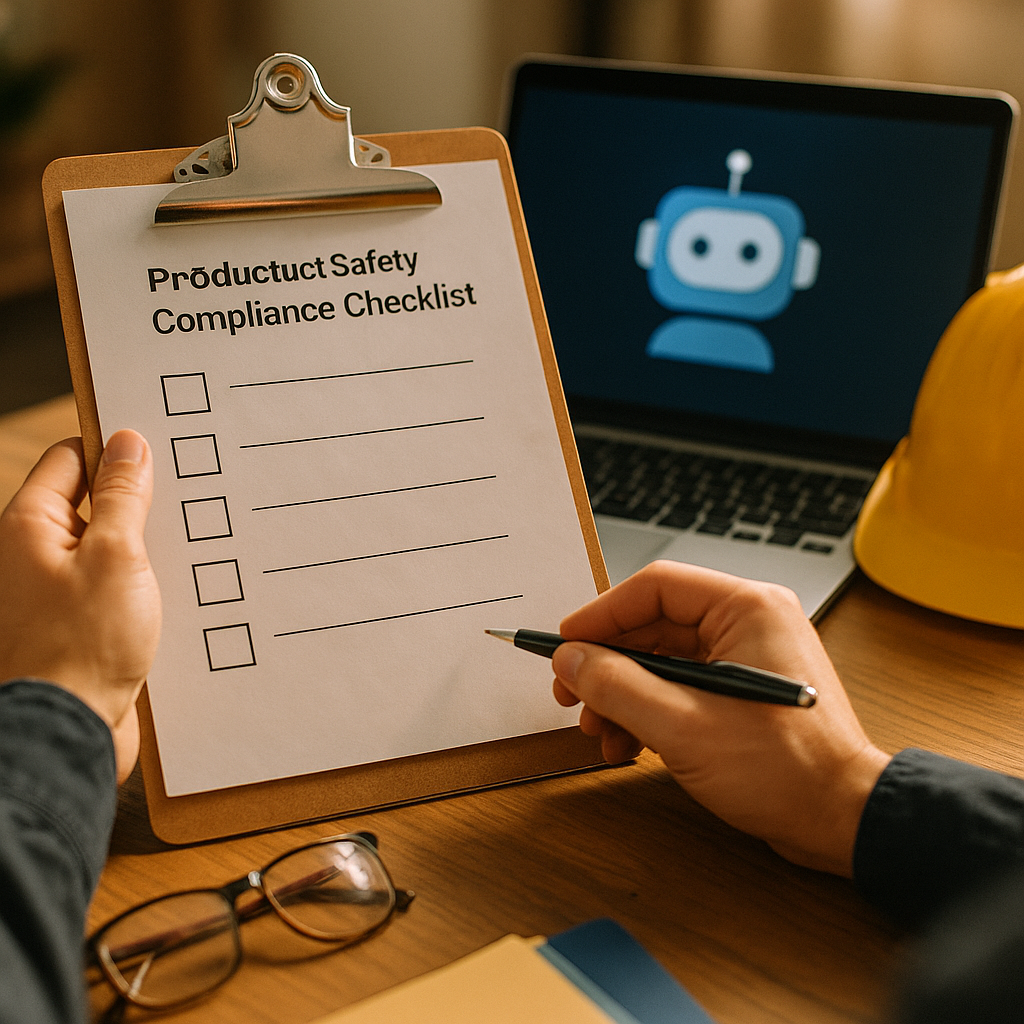
73% of consumers now expect an instant response when they ask a brand about product safety, yet almost none of them realize they may be talking to a chatbot with zero human backup. That gap is where lawsuits get born. A compliance checklist for brands using AI chatbots to field safety questions isn’t a nice-to-have anymore. It’s the difference between a scalable support channel and a regulatory liability sitting on your homepage.
Let’s be honest about why this matters right now. Brands rushed AI chatbots into customer service to cut costs and handle volume. Fine, for FAQs about shipping or returns. But product safety questions — “is this safe for pregnant women,” “can I use this near an open flame,” “what’s the choking hazard risk for my toddler” — sit in a different risk category entirely. Get that answer wrong, and you’re not dealing with a bad review. You’re dealing with the FTC, product liability counsel, and potentially the CPSC.
Why “No Human in the Loop” Is a Red Flag, Not a Feature
Marketing teams love to pitch full automation as an efficiency win. Zero headcount, 24/7 coverage, instant answers. Sounds great in a board deck. But when there’s no escalation path to a human, the chatbot becomes the final word on safety guidance — and your brand owns every word it generates.
Large language models hallucinate. That’s not a bug you patch away; it’s an inherent property of how they generate text. A Statista survey on AI adoption in customer service found that a majority of companies deploying generative AI chatbots hadn’t fully audited them for accuracy on regulated or high-stakes topics. Product safety is about as high-stakes as customer-facing content gets.
If your chatbot can answer a safety question but can’t recognize when it should refuse to answer, you don’t have a support tool — you have an unmonitored spokesperson.
The Compliance Checklist for Brands Using AI Chatbots on Product Safety
Here’s the operational framework. Treat this as a pre-launch and quarterly audit document, not a one-time sign-off.
1. Map every question type the bot might receive to a risk tier
Not every question carries the same liability. “What color options do you offer” is low risk. “Can this supplement interact with blood thinners” is high risk. Build a taxonomy: low, medium, high. Anything tagged high-risk should trigger a hard stop, not a generative answer. This mirrors the substantiation logic brands already apply to influencer-driven health claims — see our health claims checklist for the underlying framework.
2. Require a documented escalation trigger, even a minimal one
“No human escalation path” doesn’t have to mean zero human involvement, ever. It can mean the bot detects a high-risk keyword cluster and routes to a ticket queue reviewed within a defined SLA — four hours, same business day, whatever your risk tolerance allows. What it cannot mean is silence. A chatbot that answers a safety question and then has no mechanism to flag that interaction for review is the exact scenario regulators point to when arguing a company failed to exercise reasonable care.
3. Log everything, and mean it
Every AI-brand interaction touching safety, dosage, allergens, or hazard warnings needs a retained log: the question asked, the exact answer given, the model version, and timestamp. This isn’t paranoia. It’s the same paper-trail logic brands are already applying to AI-generated content in creator briefs, detailed in our piece on AI tool usage documentation. If a chatbot’s answer is ever cited in a complaint or lawsuit, you need the receipts, not a shrug.
4. Pre-approve the safety-answer library, don’t let the model freelance
The safest architecture pairs generative AI’s conversational flexibility with a locked, legal-reviewed knowledge base for safety-specific content. The model can paraphrase and contextualize, but it shouldn’t invent new safety claims on the fly. Any brand letting a chatbot generate novel safety guidance in real time, unconstrained by an approved source document, is one hallucinated answer away from a recall-adjacent PR crisis.
5. Disclose that it’s AI, clearly and early
Consumers have a right to know they’re not talking to a person, especially when the topic is safety. The FTC has been explicit that deceptive impersonation of human support, even implicitly, is an actionable practice. Our earlier coverage on chatbot substantiation requirements breaks down why “AI-labeled but still authoritative-sounding” isn’t good enough on its own — substantiation and disclosure are separate obligations, and you need both.
6. Build a kill switch, and test it quarterly
Can someone on your team disable or restrict the chatbot’s safety-answer function within minutes of discovering a bad output pattern? If the answer involves paging three vendors and waiting on a support ticket, that’s not a kill switch, that’s a delay mechanism. Test this quarterly like you’d test a fire drill.
7. Align chatbot claims with existing marketing claims, always
Here’s a scenario that trips up more brands than you’d expect: the chatbot gives a safety answer that contradicts the label, the packaging insert, or a claim an influencer made in a sponsored post. Now you’ve got an internal consistency problem that’s discoverable in litigation. Cross-reference your chatbot’s approved answer set against your influencer campaign messaging and packaging copy on a recurring basis, not just at launch.
Where This Intersects With Influencer and Creator Content
Brands running influencer programs alongside AI chatbots face a compounding risk. If a creator makes a safety-adjacent claim in a sponsored post — “safe for all skin types,” say — and your chatbot independently confirms or contradicts that claim to a different consumer, you’ve created two competing sources of brand truth. Regulators and plaintiffs’ attorneys love competing sources of truth; it’s low-hanging fruit for a deceptive practices claim.
This is why the escalation protocols brands use for undisclosed sponsorships and the ones used for AI chatbot safety answers shouldn’t live in separate silos. If your legal and marketing teams are handling creator sponsorship escalation in one workflow and chatbot safety escalation in another, with no shared review, you’re building two compliance systems that could contradict each other under pressure.
A brand’s AI chatbot and its influencer program are, legally speaking, the same voice speaking to the same consumer. Treat them as one compliance surface, not two.
What Regulators Are Actually Watching For
The FTC hasn’t issued a chatbot-specific safety rule yet, but its existing authority under Section 5 of the FTC Act covers deceptive and unfair practices broadly enough to apply directly. The agency has signaled, through public statements and its ongoing scrutiny of AI-driven consumer interactions, that a chatbot giving materially misleading safety information is treated the same as a human employee doing so. There’s no AI carve-out. Check FTC.gov directly for current enforcement guidance before finalizing any chatbot deployment involving regulated product categories.
In the UK, the ICO has also flagged automated decision-making and AI-driven consumer interactions as an area of increasing scrutiny, particularly where personal health or safety data informs the exchange. If your chatbot operates across US, UK, or EU markets, you’re not dealing with one regulatory framework, you’re dealing with three overlapping ones. That’s a similar dynamic to what brands face with youth-targeted campaigns, covered in our EU DSA versus US social rules roadmap, and the parallel is instructive: multi-jurisdiction compliance requires a lowest-common-denominator standard, not a patchwork.
The Cost Math Brands Keep Getting Wrong
Finance teams evaluate chatbot ROI on support-ticket deflection and headcount savings. Fair enough, that’s real value. HubSpot’s research on customer service automation consistently shows meaningful cost reduction from AI-first support models. But that math almost never includes the tail-risk cost: a single product liability suit tied to a bad chatbot safety answer can run into seven figures once you count legal defense, settlement, and reputational damage.
Run the numbers properly. Deflection savings minus expected litigation exposure, weighted by probability, gives you the real ROI. Most brands skip that second half of the equation entirely.
A Practical Rollout Sequence
- Audit current chatbot transcripts for any safety-adjacent question, even if unprompted by your original design
- Tier every identified question by risk level and assign an approved-response protocol per tier
- Build the minimal-viable escalation path, even if it’s just a flagged queue, not a live agent
- Cross-check chatbot answers against current packaging, labeling, and influencer campaign claims
- Add clear AI disclosure language at the first point of contact, not buried in a footer
- Schedule quarterly review of logs, escalation triggers, and kill-switch functionality
- Loop legal and marketing into a shared review calendar so chatbot and creator compliance don’t drift apart
None of this requires abandoning automation. It requires treating automated safety answers with the same rigor you’d apply to a human support rep’s training manual, because that’s functionally what the chatbot is.
Visible FAQs
Do brands legally need a human escalation path for AI chatbots answering safety questions?
There’s no blanket federal law mandating human escalation for every chatbot interaction. But under FTC Section 5 authority, a brand can be held liable for deceptive or unfair practices if an AI chatbot gives materially misleading safety information with no mechanism to catch or correct it. In practice, a documented escalation trigger significantly reduces that liability exposure.
What counts as a “high-risk” product safety question for chatbot purposes?
Generally, any question involving allergens, dosage, age restrictions, interaction with medical conditions, choking or injury hazards, or contradicting a printed warning label. If getting the answer wrong could plausibly cause physical harm or contradict regulatory guidance, tier it high-risk and route it away from unmonitored generative response.
Can a chatbot disclose it’s AI without undermining customer trust?
Yes, and data on consumer sentiment suggests transparency actually builds trust rather than eroding it, provided the disclosure comes with a credible answer. What damages trust is discovering later that an AI gave confident-sounding but wrong safety information while pretending to be, or being mistaken for, a human agent.
How often should brands audit chatbot safety responses?
Quarterly at minimum, more frequently if the underlying model is updated or retrained. Model updates can silently change response patterns on regulated topics, so any vendor-side model change should trigger a fresh safety-response audit regardless of your standing schedule.
Does the chatbot need to match influencer marketing claims exactly?
It needs to be consistent, not identical in wording. If an influencer’s sponsored content makes a safety claim and the chatbot contradicts or fails to substantiate it, that inconsistency is discoverable and can be used as evidence of deceptive practices across your whole marketing operation.
Next step: pull your last 90 days of chatbot transcripts, flag every safety-adjacent question, and check whether a human ever saw them. If the answer is no, that’s your starting point, not a future project.
Top Influencer Marketing Agencies
The leading agencies shaping influencer marketing in 2026
Agencies ranked by campaign performance, client diversity, platform expertise, proven ROI, industry recognition, and client satisfaction. Assessed through verified case studies, reviews, and industry consultations.
Moburst

-
2

The Shelf
Boutique Beauty & Lifestyle Influencer AgencyA data-driven boutique agency specializing exclusively in beauty, wellness, and lifestyle influencer campaigns on Instagram and TikTok. Best for brands already focused on the beauty/personal care space that need curated, aesthetic-driven content.Clients: Pepsi, The Honest Company, Hims, Elf Cosmetics, Pure LeafVisit The Shelf → -
3

Audiencly
Niche Gaming & Esports Influencer AgencyA specialized agency focused exclusively on gaming and esports creators on YouTube, Twitch, and TikTok. Ideal if your campaign is 100% gaming-focused — from game launches to hardware and esports events.Clients: Epic Games, NordVPN, Ubisoft, Wargaming, Tencent GamesVisit Audiencly → -
4

Viral Nation
Global Influencer Marketing & Talent AgencyA dual talent management and marketing agency with proprietary brand safety tools and a global creator network spanning nano-influencers to celebrities across all major platforms.Clients: Meta, Activision Blizzard, Energizer, Aston Martin, WalmartVisit Viral Nation → -
5

The Influencer Marketing Factory
TikTok, Instagram & YouTube CampaignsA full-service agency with strong TikTok expertise, offering end-to-end campaign management from influencer discovery through performance reporting with a focus on platform-native content.Clients: Google, Snapchat, Universal Music, Bumble, YelpVisit TIMF → -
6

NeoReach
Enterprise Analytics & Influencer CampaignsAn enterprise-focused agency combining managed campaigns with a powerful self-service data platform for influencer search, audience analytics, and attribution modeling.Clients: Amazon, Airbnb, Netflix, Honda, The New York TimesVisit NeoReach → -
7

Ubiquitous
Creator-First Marketing PlatformA tech-driven platform combining self-service tools with managed campaign options, emphasizing speed and scalability for brands managing multiple influencer relationships.Clients: Lyft, Disney, Target, American Eagle, NetflixVisit Ubiquitous → -
8

Obviously
Scalable Enterprise Influencer CampaignsA tech-enabled agency built for high-volume campaigns, coordinating hundreds of creators simultaneously with end-to-end logistics, content rights management, and product seeding.Clients: Google, Ulta Beauty, Converse, AmazonVisit Obviously →