


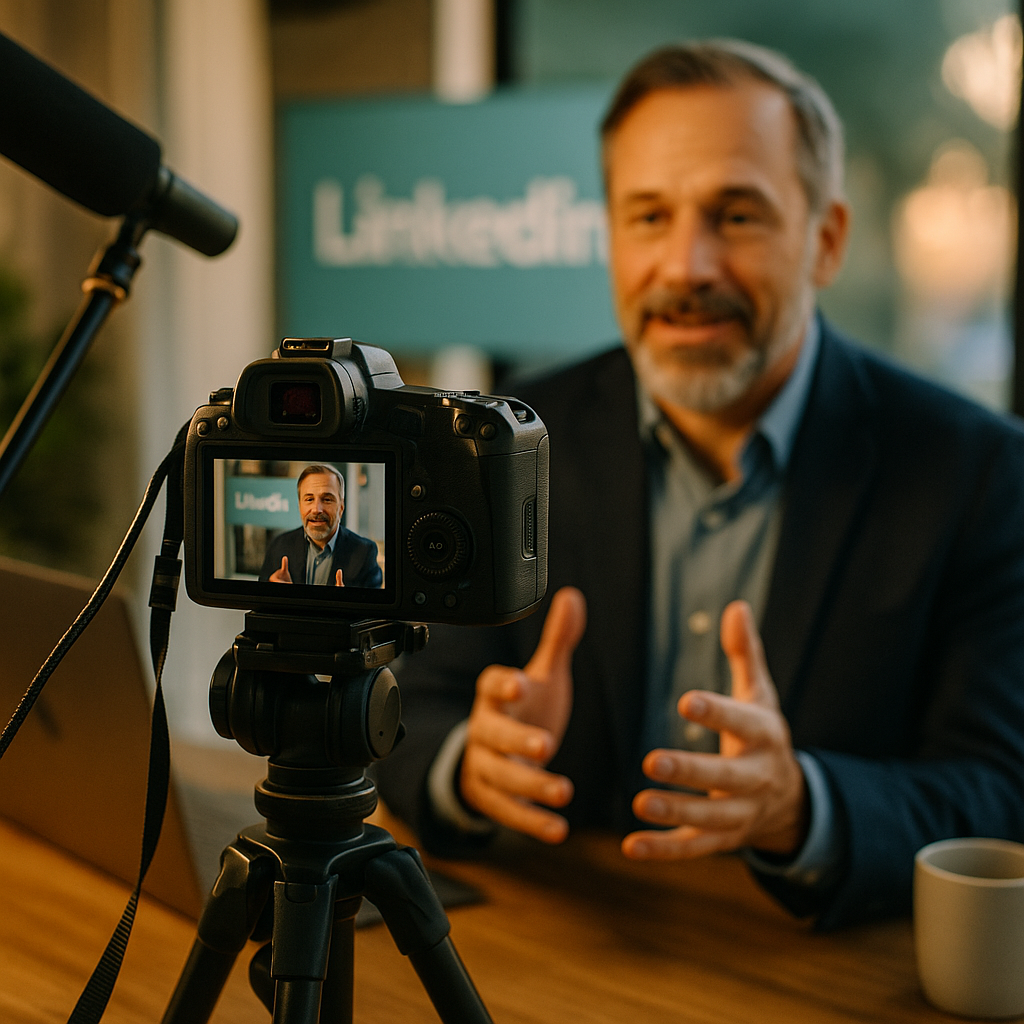
LinkedIn now pushes native video to 4x more reach than static posts from the same account, and the platform’s latest weighting update rewards a very specific format: structured, dwell-time-optimized talking-head clips. The LinkedIn video playbook that worked eighteen months ago is dead. If your executives are still filming unstructured “thought leadership” rambles, you’re feeding the algorithm signals that actively suppress distribution.
Why the Old Talking-Head Format Stopped Working
For years, the formula was simple: prop a laptop on a desk, have the CEO riff for ninety seconds, slap on a caption, post. It worked because LinkedIn’s video algorithm was still relatively primitive, weighting mostly on initial engagement velocity — likes and comments in the first hour.
That’s no longer how the system scores video. LinkedIn has shifted toward a dwell-time and completion-rate model, closer to what TikTok and YouTube Shorts have run for years. The platform is explicit about this shift in its own creator and marketing resources: video that holds attention past the first eight seconds gets pushed into secondary distribution pools, while video that loses viewers early gets throttled almost immediately, regardless of who posted it.
This matters more for B2B than almost any other content type, because executive talking-heads are inherently low-production, low-novelty content. There’s no dance trend to lean on. No trending audio. Just a person, a camera, and an argument. If that argument doesn’t structure itself around retention, the algorithm buries it before your target buyer ever scrolls past it.
LinkedIn’s new weighting model treats the first eight seconds of a video as a qualifying round — fail to hook attention there, and the platform stops recommending the clip to anyone outside your immediate network.
What the New Algorithm Weighting Actually Rewards
Three signals now carry outsized weight in LinkedIn’s video ranking, based on platform documentation and pattern analysis across brand accounts we’ve tracked this year:
- Completion rate relative to length. A 45-second clip watched to 80% outperforms a 3-minute clip watched to 20%, even with fewer total watch-seconds.
- Rewatch and scrub-back behavior. Viewers who scrub back to replay a specific line — usually a stat or a contrarian claim — signal high-value content to the model.
- Comment quality over comment volume. This echoes what we’ve seen with LinkedIn’s broader shift toward community signals over reactions. A handful of substantive replies now outweighs fifty generic “Great insight!” comments.
Notice what’s missing from that list: production value. LinkedIn isn’t rewarding polish. It’s rewarding structure. That’s genuinely good news for brands without a studio budget, but it means the entire creative brief for executive video needs rebuilding around pacing, not polish.
The Eight-Second Hook Isn’t Optional Anymore
Here’s the uncomfortable truth for most comms teams: your CFO’s warm-up sentence is now the single biggest reason your video underperforms. “Hi everyone, thanks for tuning in, today I want to talk about…” is a completion-rate killer. LinkedIn’s model reads that as low-value framing and starts suppressing reach before the substance even arrives.
The fix is blunt. Open on the claim, not the context. Structure every executive clip like this:
- Second 0-3: State the counterintuitive claim or number cold, no preamble.
- Second 3-8: Name the stakes — why should a buyer or peer care right now.
- Second 8-30: Deliver the mechanism or evidence.
- Final 10-15 seconds: A specific, non-generic call to action or forward-looking statement.
Test this against your last five executive posts. Most B2B talking-heads spend the first eight seconds on throat-clearing. That’s exactly the window LinkedIn now uses to decide whether to distribute the clip at all.
Length, Captions, and the Vertical Question
LinkedIn’s sweet spot for executive talking-head content currently sits between 40 and 90 seconds. Shorter clips struggle to establish enough substance to trigger the “quality watch” signal; anything past two minutes needs serious editorial justification (an earnings breakdown, a product deep-dive) or completion rates collapse.
Format matters too, though not the way most teams assume. Vertical 9:16 video is not mandatory on LinkedIn the way it is on TikTok or Shorts — where vertical framing drives search intent differently — but square (1:1) and vertical formats do consistently outperform horizontal in mobile feed real estate. Roughly 60% of LinkedIn traffic is mobile. Shooting horizontal talking-head video in 2026 is leaving reach on the table for no aesthetic gain.
Captions are non-negotiable, and not just for accessibility compliance. LinkedIn autoplays muted by default, meaning your hook line needs to work as on-screen text before a single word is heard. Burn in captions with the hook line emphasized — bold, larger type, whatever your brand system allows — because that’s the frame most viewers actually judge in the first two seconds.
Should Every Executive Clip Be Native, or Can You Repost?
Native upload wins, consistently. LinkedIn’s own algorithm deprioritizes links out to YouTube or Vimeo embeds, and third-party watch-time data doesn’t feed back into LinkedIn’s ranking model the same way native view data does. If your executive video program is still built around “post the YouTube link with a caption,” you’re actively working against the platform’s weighting logic. Download the raw file, upload it natively, every time. It’s more operational overhead. It’s also the difference between 2,000 views and 40,000.
The Comment-Bait Trap Executives Keep Falling Into
There’s a temptation, once you know comments matter, to end every clip with “What do you think? Drop your take below.” Don’t. LinkedIn’s spam and engagement-bait detection has gotten considerably better at flagging generic CTAs, and the platform has publicly signaled it deprioritizes posts that use manipulative engagement patterns, similar to how Meta and TikTok have cracked down on engagement bait in their own ad policies.
The better move: end on a specific, answerable question tied to the argument you just made. “Would your team cut the vendor or renegotiate?” generates a real comment. “Thoughts?” generates nothing the algorithm values.
Generic engagement-bait CTAs are now a liability, not a growth hack. LinkedIn’s ranking model increasingly discounts comment volume that spikes from templated prompts rather than genuine reaction to content.
Building the Production Pipeline Without Blowing the Budget
Most B2B brands don’t need a studio. They need a repeatable, low-friction capture process that respects executive time (which is, let’s be honest, the scarcest resource in any comms calendar). A few operational notes from teams running this well:
- Batch record. Get 20-30 minutes of raw executive commentary quarterly, then cut into 4-6 separate clips. One sitting, six weeks of content.
- Script the first line only. Executives resent full scripts and it shows on camera. Script the hook line word-for-word; let the rest be conversational.
- Edit for scrub-back moments. Identify the one stat or claim per clip worth a text overlay callout — that’s what drives the rewatch signal LinkedIn’s model tracks.
- Track completion rate, not views. LinkedIn’s native analytics now surface average watch percentage. Make that the KPI your team reports on, not raw view count, which is a vanity metric under the new weighting.
This mirrors a broader trend across platforms: creator-economy formats are increasingly judged on retention economics rather than reach alone, similar to how CPM negotiations now hinge on watch-time data rather than impressions. B2B video is catching up to what performance creators have known for years.
What This Means for Budget and Headcount
If your influencer or comms budget still allocates video production the same way it did two years ago, it’s time to recalibrate. Structured executive video isn’t a “nice to have” side project for the social team anymore, it’s a core distribution channel that competes directly with paid reach for share of feed. Brands treating LinkedIn video as a compliance checkbox (post something monthly, check the box) are getting outpaced by competitors running lightweight but disciplined production cadences.
Data from eMarketer continues to show B2B marketers increasing video spend allocation year over year, and Sprout Social’s platform research consistently ranks LinkedIn among the highest-trust channels for executive-driven content among business buyers. The audience appetite is there. The algorithm now simply demands better craft to reach it.
FAQs
Frequently Asked Questions
How long should a B2B executive talking-head video be on LinkedIn?
Between 40 and 90 seconds performs best under the current weighting model. Shorter clips often lack enough substance to trigger quality-watch signals, while clips over two minutes need strong editorial justification to maintain completion rates.
Does LinkedIn’s algorithm penalize horizontal video?
Not directly, but horizontal video underperforms in mobile feed real estate, where roughly 60% of LinkedIn traffic occurs. Square or vertical framing consistently captures more screen space and improves early retention.
Should executives read from a script on camera?
Script the opening hook line word-for-word since it determines whether the algorithm continues distributing the clip. Beyond that, conversational delivery tends to read as more authentic and holds attention better than a fully scripted monologue.
Is it better to upload video natively or link out to YouTube?
Native upload wins consistently. LinkedIn’s ranking model weighs native watch-time data far more heavily than third-party link clicks, so uploading the raw file directly produces significantly more reach than posting an external video link.
Do comments still matter for LinkedIn video reach?
Yes, but comment quality now outweighs comment volume. Generic engagement-bait prompts like “thoughts?” are increasingly discounted by the algorithm, while specific, answerable questions tied to the video’s argument generate higher-value engagement signals.
Pull your last five executive videos and time the first eight seconds of each. If any open with a greeting instead of the claim, you’ve found your next edit before you shoot another frame.
Top Influencer Marketing Agencies
The leading agencies shaping influencer marketing in 2026
Agencies ranked by campaign performance, client diversity, platform expertise, proven ROI, industry recognition, and client satisfaction. Assessed through verified case studies, reviews, and industry consultations.
Moburst

-
2

The Shelf
Boutique Beauty & Lifestyle Influencer AgencyA data-driven boutique agency specializing exclusively in beauty, wellness, and lifestyle influencer campaigns on Instagram and TikTok. Best for brands already focused on the beauty/personal care space that need curated, aesthetic-driven content.Clients: Pepsi, The Honest Company, Hims, Elf Cosmetics, Pure LeafVisit The Shelf → -
3

Audiencly
Niche Gaming & Esports Influencer AgencyA specialized agency focused exclusively on gaming and esports creators on YouTube, Twitch, and TikTok. Ideal if your campaign is 100% gaming-focused — from game launches to hardware and esports events.Clients: Epic Games, NordVPN, Ubisoft, Wargaming, Tencent GamesVisit Audiencly → -
4

Viral Nation
Global Influencer Marketing & Talent AgencyA dual talent management and marketing agency with proprietary brand safety tools and a global creator network spanning nano-influencers to celebrities across all major platforms.Clients: Meta, Activision Blizzard, Energizer, Aston Martin, WalmartVisit Viral Nation → -
5

The Influencer Marketing Factory
TikTok, Instagram & YouTube CampaignsA full-service agency with strong TikTok expertise, offering end-to-end campaign management from influencer discovery through performance reporting with a focus on platform-native content.Clients: Google, Snapchat, Universal Music, Bumble, YelpVisit TIMF → -
6

NeoReach
Enterprise Analytics & Influencer CampaignsAn enterprise-focused agency combining managed campaigns with a powerful self-service data platform for influencer search, audience analytics, and attribution modeling.Clients: Amazon, Airbnb, Netflix, Honda, The New York TimesVisit NeoReach → -
7

Ubiquitous
Creator-First Marketing PlatformA tech-driven platform combining self-service tools with managed campaign options, emphasizing speed and scalability for brands managing multiple influencer relationships.Clients: Lyft, Disney, Target, American Eagle, NetflixVisit Ubiquitous → -
8

Obviously
Scalable Enterprise Influencer CampaignsA tech-enabled agency built for high-volume campaigns, coordinating hundreds of creators simultaneously with end-to-end logistics, content rights management, and product seeding.Clients: Google, Ulta Beauty, Converse, AmazonVisit Obviously →