


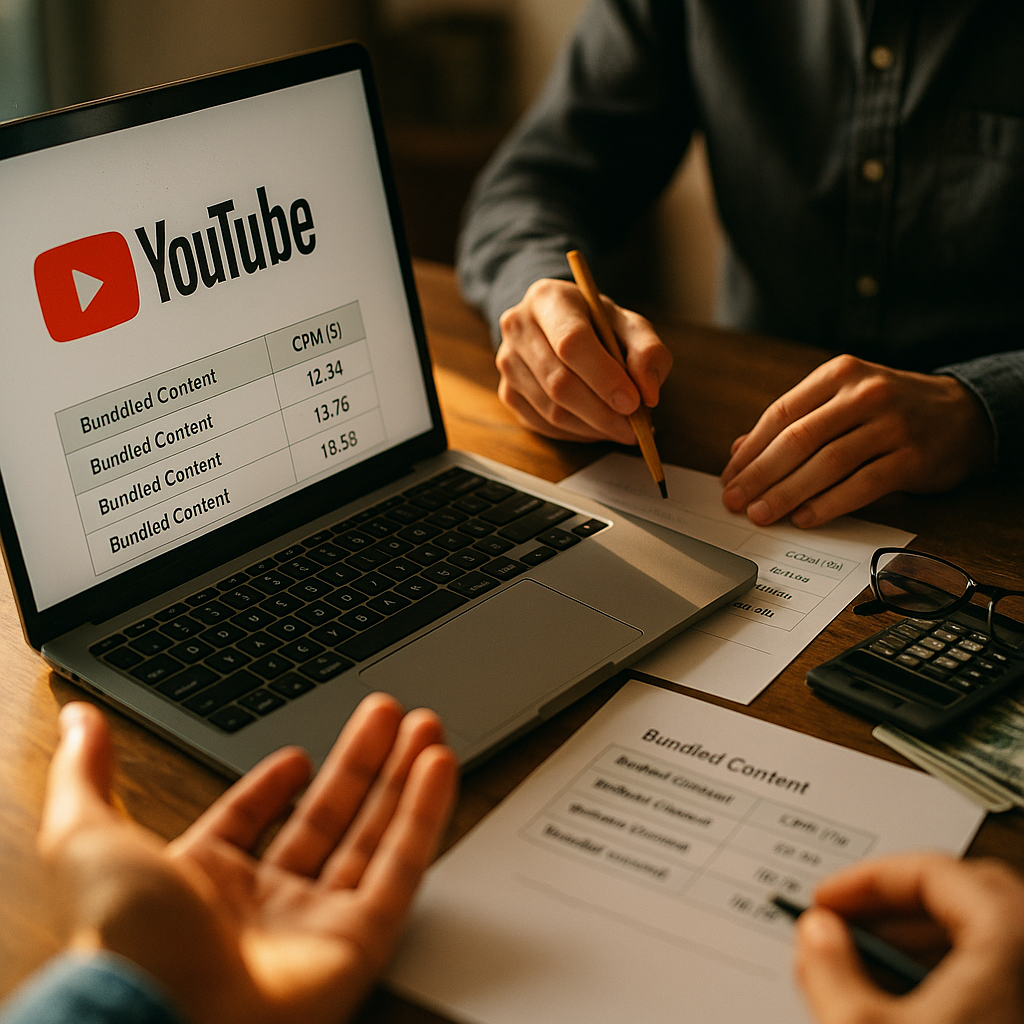
One 90-minute video podcast, four Shorts, and a Community poll — priced as a single line item. Is that a fair sponsorship package, or is someone getting fleeced? The YouTube long-form creator bundle has become the default ask from top-tier talent, and most brands still don’t have a framework for pricing it. This is the playbook.
Why Bundles Replaced Single-Video Buys
Two years ago, you bought a dedicated integration or a pre-roll mention and moved on. That model is dying. Creators with sizable podcast audiences now bundle formats because YouTube’s algorithm rewards cross-format posting frequency, and because a single 60-second Short doesn’t cover their production overhead anymore.
Think about the economics from the creator’s side. A weekly video podcast requires a studio, editors, a thumbnail designer, sometimes a booking producer. Shorts are cut from that same footage but need separate hooks and captions. Community posts cost almost nothing to produce. Bundling lets creators smooth out their revenue across formats that have wildly different production costs — and it lets them charge a premium for the “halo” effect of appearing consistently across a subscriber’s feed.
For brands, the upside is real: repetition across formats drives recall in a way one-off placements don’t. The downside is that pricing gets murky fast, and agencies are paying flat “package rates” without knowing what they’re actually buying.
If you can’t break a bundle into its component CPMs, you’re not negotiating — you’re just paying whatever the media kit says.
What’s Actually Inside a Typical Bundle
Most creator bundles pulling six-figure sponsorship rates break down into three components:
- The video podcast integration — a mid-roll or dedicated segment inside a long-form episode, typically 60-90 seconds, sometimes with a host-read script.
- Shorts derivatives — usually 2-5 vertical clips pulled from the same episode, re-hooked for the algorithm, often posted over a two-week window.
- Community tab activity — a poll, an image post, or a text update that references the sponsor, mostly used to extend engagement windows and signal boost the long-form video.
Each of these has a different job. The podcast segment builds trust through the host’s voice. Shorts drive reach and discovery to non-subscribers. Community posts are retention plays — they nudge existing subscribers back to the channel and juice the algorithm’s perception that the creator is “active,” which can lift the reach of the paid content itself.
Treat them as separate line items with separate KPIs, even if you’re buying them as one bundle. That’s the only way to audit whether you got fair value.
Pricing the Bundle: A Framework, Not a Guess
Here’s the mistake most brand teams make: they ask for a “podcast + Shorts + Community” quote and accept whatever number comes back. Instead, request itemized CPMs for each format, then apply a bundling discount expectation of 10-20% off the sum of parts. If a creator won’t itemize, that’s a signal you’re dealing with someone unaccustomed to sophisticated buyers — or someone padding the number.
A reasonable starting framework:
- Anchor CPM on the podcast segment. Use the creator’s average views over the last 90 days, not lifetime average, and not their best-performing outlier episode.
- Discount Shorts CPM by 30-50% relative to long-form, since view definitions differ (a Short “view” often counts at autoplay, not intentional watch-through).
- Treat Community posts as added value, not a paid line item, unless the creator has unusually high Community engagement (reactions, comments) relative to subscriber count.
- Apply the bundle discount to the summed total, and get it in writing as a percentage, not just a flat final number — this protects you if any single format underdelivers.
This mirrors how upfront bundle negotiations work at scale, where networks package inventory across formats and expect buyers to push back on blended rates. The same discipline applies at the individual-creator level, just with less standardized documentation.
Is the CPM Premium Actually Worth It?
Short answer: sometimes. Long answer: it depends entirely on whether you’re measuring the right outcome. If your goal is pure reach, a Shorts-only buy from a mid-tier creator will almost always beat a bundled premium from a bigger name. If your goal is consideration and trust — the kind that shows up in brand lift studies or post-purchase surveys — the podcast segment does the heavy lifting, and the Shorts/Community layer just extends its shelf life.
We’ve covered this tension before when breaking down whether a creator partnership bundle justifies its premium CPM. The short version: bundles win on frequency and format diversity, not on efficiency. If your media plan is efficiency-driven, don’t buy a bundle to satisfy a reach KPI — you’ll overpay for a halo effect you can’t easily attribute.
eMarketer and Statista data on video ad spend consistently show YouTube capturing a growing share of connected-TV and long-form budgets, which is exactly why creators are pricing their podcast segments closer to broadcast sponsorship rates than influencer-marketing rates. Know which market you’re actually buying into before you negotiate.
Structuring the Contract So You Don’t Get Burned
Bundled deals fail most often because the contract doesn’t specify sequencing, timing, or minimum performance thresholds per format. Build these into every scope of work:
- Posting windows. Specify that Shorts derivatives must post within 14 days of the long-form episode, not “sometime this quarter.” Delayed cutdowns lose relevance fast.
- Format-specific disclosure language. The FTC’s endorsement guidance applies to every format in the bundle individually — a disclosed podcast segment doesn’t automatically cover an undisclosed Short cut from it. Confirm each asset carries its own clear disclosure, per FTC guidelines.
- Usage rights per format. Decide upfront whether you can repurpose the podcast segment as a paid social ad, and whether that requires additional compensation.
- Minimum view guarantees or make-goods. If the podcast episode underperforms the creator’s 90-day average by more than 20%, negotiate a make-good Short or bonus Community post rather than a straight refund — it keeps the relationship collaborative rather than adversarial.
This level of contract specificity is standard practice on CTV and upfront-style deals, which is why the YouTube CTV creator campaign model is a useful reference point even if you’re not buying living-room inventory. The discipline transfers.
Measurement: What to Actually Track Per Format
Don’t blend metrics across formats into one blended report — it hides which piece of the bundle is doing the work. Track separately:
- Podcast segment: average view duration through the ad break, completion rate, and any trackable link clicks if the host reads a URL or code.
- Shorts: reach to non-subscribers (available in YouTube Analytics under traffic source), swipe-away rate, and comment sentiment.
- Community posts: engagement rate relative to the creator’s typical Community post performance, not relative to video engagement — different baseline entirely.
Cross-reference this with Sprout Social or your own social listening tool to catch sentiment shifts the platform’s native analytics won’t surface, especially on Community posts where comment threads can turn critical fast if the sponsor read feels forced.
If you’re running affiliate links alongside the bundle — increasingly common when a Shorts cutdown includes a shoppable overlay — apply the same brief discipline covered in the Shorts affiliate playbook. Attribution windows matter more when you’ve got three formats potentially driving the same conversion.
When Bundling Doesn’t Make Sense
Not every campaign needs the full stack. If you’re testing a new creator relationship, buy the podcast segment alone first. See how the audience responds, check comment sentiment, confirm the host actually delivers the read the way they pitched it. Add Shorts and Community in a second flight once you’ve validated the fit.
Bundling also backfires when a creator’s Community tab is dormant — some channels have subscriber counts in the millions but a Community tab nobody visits. Paying a premium for an inactive format is just a discount you didn’t ask for. Check the creator’s Community post frequency and engagement over the last 60 days before agreeing to pay for it as a line item.
Next step: before your next YouTube creator negotiation, request itemized CPMs for each format in writing, apply a 10-20% bundle discount to the sum, and build format-specific make-goods into the contract. That single change will do more for your ROI than any amount of reach chasing.
FAQs
What is a YouTube long-form creator bundle?
It’s a sponsorship package combining a video podcast integration with derivative Shorts and Community tab posts, sold by the creator as one deal instead of separate buys.
How much discount should I expect for bundling formats?
A reasonable range is 10-20% off the sum of each format’s individual CPM, though this varies by creator size and how active their Community tab actually is.
Should Shorts and podcast segments have the same CPM?
No. Shorts views are typically counted differently (often at autoplay) and carry lower intent than long-form watch-through, so a 30-50% CPM discount relative to the podcast segment is standard.
Do Community posts need separate FTC disclosure?
Yes. Each sponsored asset, including a Community post, needs its own clear disclosure under FTC endorsement guidance — disclosure on the podcast segment doesn’t carry over automatically.
How do I know if a bundle is worth the premium versus a single-format buy?
If your goal is pure reach efficiency, a single-format buy usually wins. If you’re optimizing for trust, recall, and repeated exposure, the bundle’s cross-format frequency justifies the premium.
Top Influencer Marketing Agencies
The leading agencies shaping influencer marketing in 2026
Agencies ranked by campaign performance, client diversity, platform expertise, proven ROI, industry recognition, and client satisfaction. Assessed through verified case studies, reviews, and industry consultations.
Moburst

-
2

The Shelf
Boutique Beauty & Lifestyle Influencer AgencyA data-driven boutique agency specializing exclusively in beauty, wellness, and lifestyle influencer campaigns on Instagram and TikTok. Best for brands already focused on the beauty/personal care space that need curated, aesthetic-driven content.Clients: Pepsi, The Honest Company, Hims, Elf Cosmetics, Pure LeafVisit The Shelf → -
3

Audiencly
Niche Gaming & Esports Influencer AgencyA specialized agency focused exclusively on gaming and esports creators on YouTube, Twitch, and TikTok. Ideal if your campaign is 100% gaming-focused — from game launches to hardware and esports events.Clients: Epic Games, NordVPN, Ubisoft, Wargaming, Tencent GamesVisit Audiencly → -
4

Viral Nation
Global Influencer Marketing & Talent AgencyA dual talent management and marketing agency with proprietary brand safety tools and a global creator network spanning nano-influencers to celebrities across all major platforms.Clients: Meta, Activision Blizzard, Energizer, Aston Martin, WalmartVisit Viral Nation → -
5

The Influencer Marketing Factory
TikTok, Instagram & YouTube CampaignsA full-service agency with strong TikTok expertise, offering end-to-end campaign management from influencer discovery through performance reporting with a focus on platform-native content.Clients: Google, Snapchat, Universal Music, Bumble, YelpVisit TIMF → -
6

NeoReach
Enterprise Analytics & Influencer CampaignsAn enterprise-focused agency combining managed campaigns with a powerful self-service data platform for influencer search, audience analytics, and attribution modeling.Clients: Amazon, Airbnb, Netflix, Honda, The New York TimesVisit NeoReach → -
7

Ubiquitous
Creator-First Marketing PlatformA tech-driven platform combining self-service tools with managed campaign options, emphasizing speed and scalability for brands managing multiple influencer relationships.Clients: Lyft, Disney, Target, American Eagle, NetflixVisit Ubiquitous → -
8

Obviously
Scalable Enterprise Influencer CampaignsA tech-enabled agency built for high-volume campaigns, coordinating hundreds of creators simultaneously with end-to-end logistics, content rights management, and product seeding.Clients: Google, Ulta Beauty, Converse, AmazonVisit Obviously →