


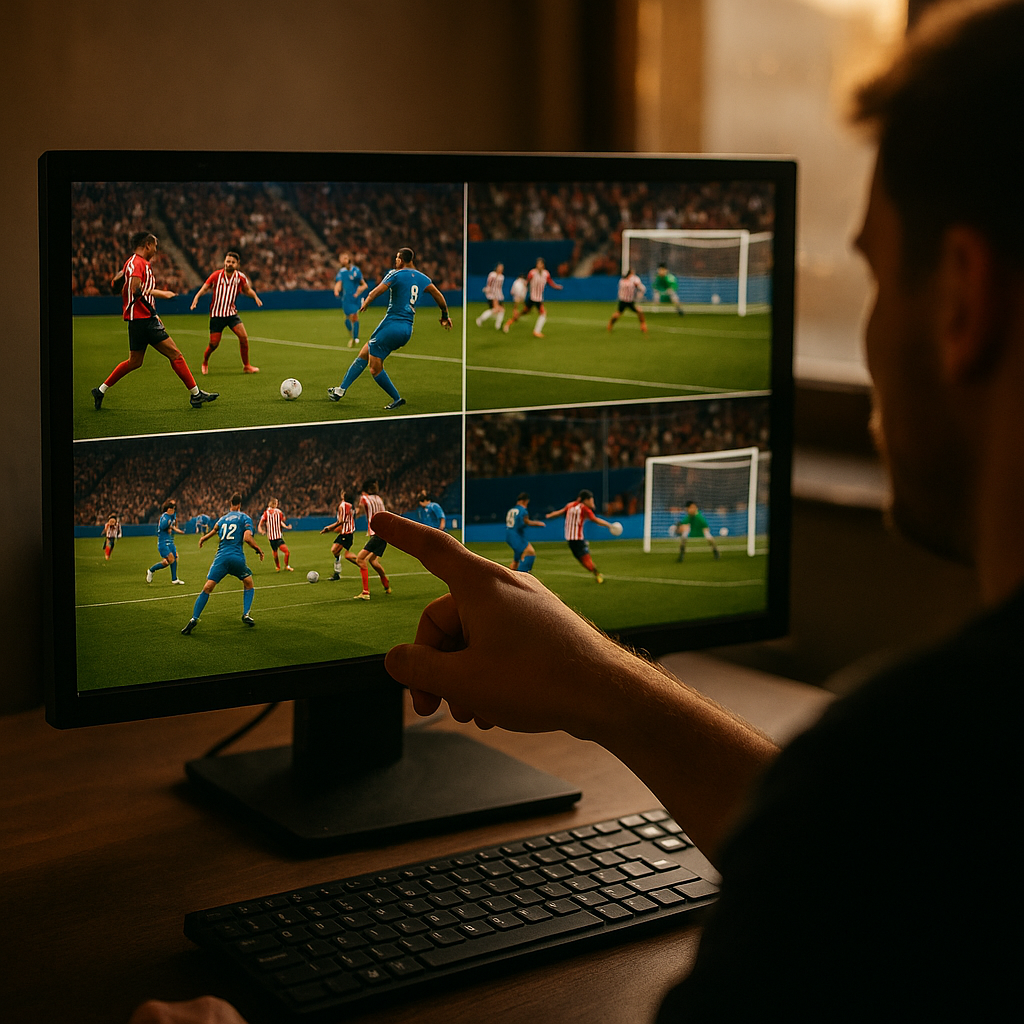
Product demos get skipped in 1.7 seconds on average, according to eMarketer engagement data. So why do brands keep sending creators single-camera, single-take briefs? The multi-angle replay format — split-screen slow motion showing a product from three perspectives simultaneously — is quietly becoming the highest-converting demo style in paid social. It answers the skeptic’s real question before they ask it: does this thing actually work?
What the Multi-Angle Replay Format Actually Is
Picture three synced video panels stacked or tiled on screen. One shows the product from the front. One catches a close-up of the mechanism, the seal, the hinge, the spray pattern. One shows the result — the stain lifting, the lid locking, the fabric drying. All three run in slow motion, all three replay the same three-second action from different vantage points.
It’s not a new camera trick. Sports broadcasters have used multi-angle replay since the 1960s to settle disputed calls. Brands are borrowing the same logic: settle the disputed claim. Does the blender actually crush ice, or did the creator just say it does? Split-screen slow motion removes the ambiguity because the viewer sees mechanism, action, and outcome at once, with no cuts to hide behind.
A single-angle demo asks viewers to trust the creator’s word. A three-angle replay asks viewers to trust their own eyes — and that’s a much easier sell.
Why This Format Is Gaining Ground Now
Three forces are converging. First, editing tools got cheap. CapCut, InShot, and even native TikTok editing now offer templated split-screen and multi-cam layouts that used to require a professional NLE. Second, skepticism toward influencer claims is climbing — Sprout Social’s consumer trust research has repeatedly shown authenticity concerns rising even as influencer spend grows. Third, platforms are rewarding watch-through rate more than ever, and a synced three-panel replay is inherently rewatchable. Viewers loop it just to catch details they missed on the first pass.
This isn’t a gimmick chasing a trend cycle, either. It’s a direct response to the same skepticism that’s driving formats like demonstration-first briefs and claim-testing content. Gen Z and millennial buyers don’t want to be told. They want to be shown, from angles they can’t dismiss as staged.
The Three Angles That Actually Matter
Not every product needs the same three perspectives. But most function-forward demos map cleanly onto this structure:
- The mechanism angle: tight macro shot on the moving part — the zipper teeth, the pump nozzle, the blade, the clasp.
- The action angle: a mid-shot of the full gesture — the hand twisting, pressing, pouring, wiping.
- The outcome angle: the proof — the surface clean, the seal watertight, the food cooked through.
Brief creators to shoot all three in a single continuous take if the product allows it, using multiple phones or a tripod rig with the product centered in frame. Sync in post using a clap or light flash as a reference point. Most editors line these up in under ten minutes once footage is organized.
Briefing Creators Without Killing the Authenticity
Here’s the tension every brand manager runs into: the more technical the brief, the more staged the video feels. A three-camera synced shoot sounds like a commercial set, not a creator’s bedroom. So how do you keep it real?
Give creators the outcome you need, not the shot list. Tell them: “We need viewers to see the mechanism close-up, the full gesture, and the result — in slow motion, side by side.” Let them figure out whether that’s three phones taped to a desk lamp or one phone and two reshoots from different angles. Creators who’ve done this format before (and there are more every month) usually have a rig or workaround already.
It also helps to reference formats they already know. If a creator has done split-screen debate videos or split-personality content, they already understand the split-screen editing logic. You’re just changing what fills each panel.
Sample Brief Language
Something like this works well in a creator brief doc:
- Shoot the same 3-5 second action three times, from three distinct angles (macro, mid, result).
- Slow each clip to 0.5x speed minimum during the key moment.
- Sync all three into a tiled or stacked split-screen layout.
- Voiceover or on-screen text should describe function, not opinion (“the seal compresses fully” vs. “I love how it seals”).
- Keep total format under 20 seconds — replay value comes from tightness, not length.
That last point matters more than brands think. A bloated 45-second multi-angle demo loses the punch. The format works because it’s dense: three angles, one moment, immediate proof.
The FTC Angle Nobody Talks About
Slow-motion multi-angle demos can accidentally oversell. If the mechanism angle shows a “perfect” result that isn’t representative of typical use, that’s a materially misleading demonstration under FTC endorsement guidance. Brands have gotten burned on this before with skincare “instant results” edits and kitchen gadget demos that only worked with a hand-selected test food.
Require creators to disclose if any angle uses an edited speed ramp that changes perceived performance (not just cosmetic slow-motion, but anything that implies faster or more dramatic action than reality). And require the standard #ad or #sponsored disclosure clearly, on all three panels or in the caption, not buried in one corner of a split-screen where it might get missed. This is the same discipline covered in FTC-safe UGC briefing and it applies just as directly here.
A multi-angle replay is persuasive precisely because it looks like proof. That’s exactly why it needs tighter compliance review than a standard single-shot demo, not looser.
Where It Performs Best (and Where It Falls Flat)
This format shines for products with a visible mechanical or chemical action: cleaning products, kitchen tools, skincare application, fitness equipment, packaging that seals or locks. Anything where “how it works” is genuinely hard to explain in words but easy to see.
It falls flat for pure lifestyle or emotional-appeal products. A perfume ad doesn’t benefit from three angles of someone spraying their wrist. Save this format for function claims, not vibe claims.
It also performs unevenly by platform. TikTok and Instagram Reels reward the loop-and-rewatch behavior this format encourages. YouTube Shorts works too. But traditional in-feed static image ads obviously can’t carry it, and it’s wasted on channels where users scroll past video entirely, like some display placements.
Retail and CPG Are Already Running With It
Grocery and home goods brands have picked this up fast, often pairing it with existing trust-building formats. A brand doing nano-creator aisle tours for a buyer pitch, for example, can layer in a multi-angle replay of the product’s opening mechanism or pour function as supporting proof. Similarly, brands leaning on packaging ASMR content find that adding a second or third angle to the unboxing moment increases completion rate, because the sound cue from ASMR pairs naturally with the visual proof from split-screen.
CPG buyers are increasingly asking for this kind of layered proof before greenlighting shelf placement, according to conversations with category managers at regional grocery chains. A three-angle video showing package integrity during a drop test, for instance, does more to reassure a buyer than a spec sheet.
Measuring It Properly
Standard engagement metrics undersell this format. Track completion rate and loop count specifically, since the format’s value is in rewatch behavior. If a platform reports “average watch time exceeding video length,” that’s your signal the multi-angle replay is working, because it means people are looping the split-screen to catch a detail.
Also track comment sentiment for skepticism markers, words like “fake,” “edited,” or “staged.” If those show up frequently, the demo reads as too polished. Go rougher. Ironically, a slightly shaky handheld version of one angle can increase trust in the other two.
Common Mistakes Brands Make
- Overproducing all three angles equally. One clean, one raw, one close-up usually reads more authentic than three studio-quality shots.
- Ignoring audio sync. Misaligned sound across panels breaks the illusion instantly and reads as sloppy, not real.
- Making it too long. Once you clear 20-25 seconds, viewers stop treating it as proof and start treating it as an ad.
- Forgetting mobile-first framing. Three panels on a phone screen get cramped fast. Test the split-screen crop before greenlighting a full creator batch.
Run a small test batch, two or three creators, before scaling this format across a campaign. The synced-shot requirement means some creators will nail it on the first take and others will need a reshoot round, and you’ll want to know which creators can handle the technical lift before committing budget to a full slate.
Frequently Asked Questions
What is the multi-angle replay format in influencer marketing?
It’s a video format where a product action is filmed from three different perspectives simultaneously, typically a mechanism close-up, a mid-shot of the action, and a result shot, then synced into a split-screen layout and played back in slow motion to prove function.
Which products benefit most from this format?
Products with a visible mechanical, chemical, or physical action perform best: cleaning products, kitchen gadgets, skincare application, packaging seals, fitness equipment. Lifestyle or fragrance products generally don’t benefit as much since there’s no function to prove.
Do creators need special equipment to shoot this?
Not necessarily. Many creators use two or three phones on tripods or improvised stands, syncing footage in post using a clap or flash as a reference point. Editing apps like CapCut and InShot have built-in split-screen templates that make assembly straightforward.
What are the FTC risks with slow-motion product demos?
The main risk is a demo that implies performance beyond what’s typical, since slow motion and multi-angle editing can visually exaggerate results. Brands should require clear #ad disclosure on every panel and confirm the demonstrated result reflects normal product use, per FTC guidance.
How long should a multi-angle replay video be?
Best performance tends to come in under 20 seconds. The format’s strength is density and rewatch value, and longer edits start to feel like traditional advertising rather than proof-based content.
How is success measured for this format?
Completion rate and loop count matter more than standard view counts, since the split-screen format is designed to be rewatched. Comment sentiment analysis for skepticism keywords also helps flag whether the demo is landing as authentic proof or overproduced marketing.
Start small: brief two creators on a single three-angle demo, review the sync and disclosure before scaling, then fold winning cuts into your paid rotation. The format proves itself fastest when the product actually has something worth proving.
Top Influencer Marketing Agencies
The leading agencies shaping influencer marketing in 2026
Agencies ranked by campaign performance, client diversity, platform expertise, proven ROI, industry recognition, and client satisfaction. Assessed through verified case studies, reviews, and industry consultations.
Moburst

-
2

The Shelf
Boutique Beauty & Lifestyle Influencer AgencyA data-driven boutique agency specializing exclusively in beauty, wellness, and lifestyle influencer campaigns on Instagram and TikTok. Best for brands already focused on the beauty/personal care space that need curated, aesthetic-driven content.Clients: Pepsi, The Honest Company, Hims, Elf Cosmetics, Pure LeafVisit The Shelf → -
3

Audiencly
Niche Gaming & Esports Influencer AgencyA specialized agency focused exclusively on gaming and esports creators on YouTube, Twitch, and TikTok. Ideal if your campaign is 100% gaming-focused — from game launches to hardware and esports events.Clients: Epic Games, NordVPN, Ubisoft, Wargaming, Tencent GamesVisit Audiencly → -
4

Viral Nation
Global Influencer Marketing & Talent AgencyA dual talent management and marketing agency with proprietary brand safety tools and a global creator network spanning nano-influencers to celebrities across all major platforms.Clients: Meta, Activision Blizzard, Energizer, Aston Martin, WalmartVisit Viral Nation → -
5

The Influencer Marketing Factory
TikTok, Instagram & YouTube CampaignsA full-service agency with strong TikTok expertise, offering end-to-end campaign management from influencer discovery through performance reporting with a focus on platform-native content.Clients: Google, Snapchat, Universal Music, Bumble, YelpVisit TIMF → -
6

NeoReach
Enterprise Analytics & Influencer CampaignsAn enterprise-focused agency combining managed campaigns with a powerful self-service data platform for influencer search, audience analytics, and attribution modeling.Clients: Amazon, Airbnb, Netflix, Honda, The New York TimesVisit NeoReach → -
7

Ubiquitous
Creator-First Marketing PlatformA tech-driven platform combining self-service tools with managed campaign options, emphasizing speed and scalability for brands managing multiple influencer relationships.Clients: Lyft, Disney, Target, American Eagle, NetflixVisit Ubiquitous → -
8

Obviously
Scalable Enterprise Influencer CampaignsA tech-enabled agency built for high-volume campaigns, coordinating hundreds of creators simultaneously with end-to-end logistics, content rights management, and product seeding.Clients: Google, Ulta Beauty, Converse, AmazonVisit Obviously →