


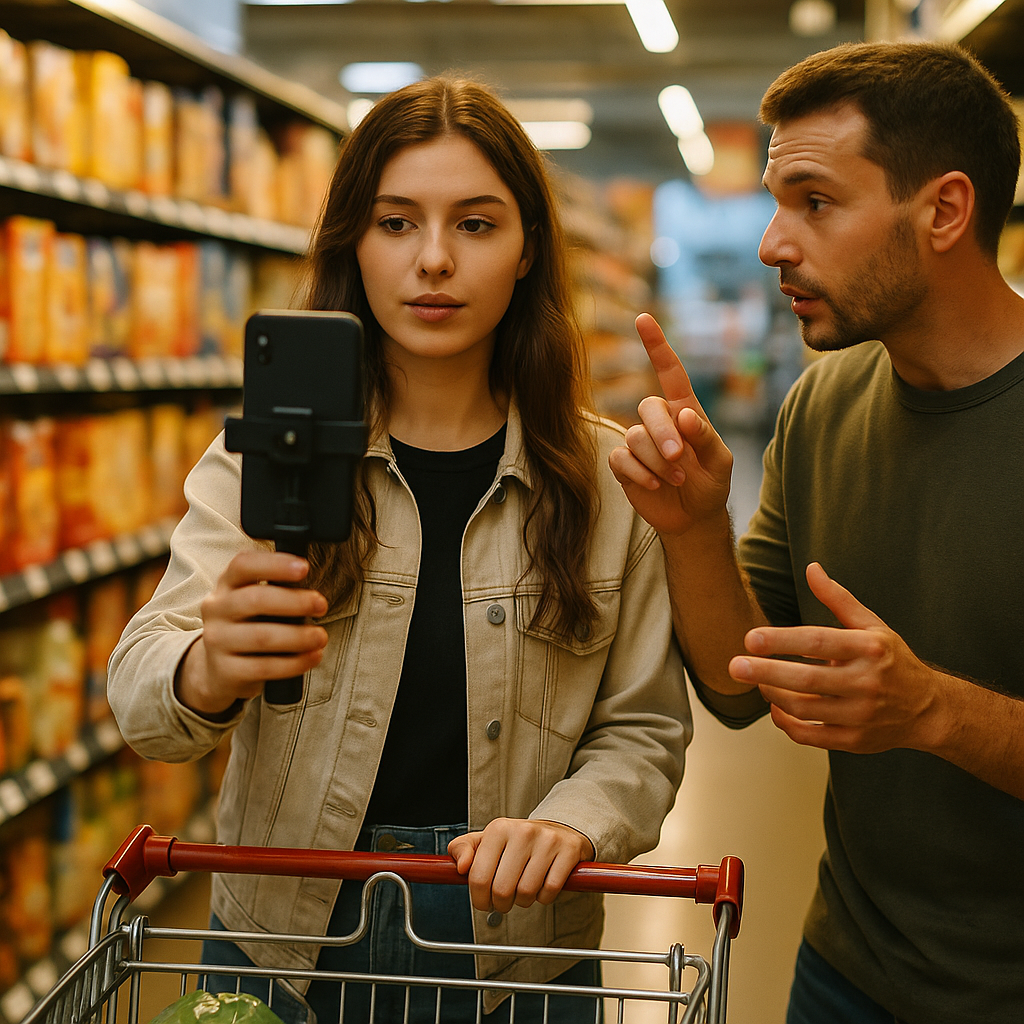
Shoppers now spend an average of just 13 seconds scanning a shelf before deciding what goes in the cart. No CPG ad, no matter how well-produced, gets that kind of attention. But a shaky, unfiltered video of a nano-creator standing in aisle 7, holding two boxes side by side? People watch that to the end. The grocery-aisle walkthrough format is quietly becoming one of the highest-trust content types in the CPG playbook, and most brands haven’t figured out how to brief it properly yet.
Why Polished CPG Ads Are Losing the Shelf War
Consumers have been trained by two decades of advertising to distrust anything that looks like a commercial. A 30-second spot showing a family beaming over cereal doesn’t answer the one question shoppers actually have standing in the aisle: is this worth 40 cents more than the store brand?
That’s the gap nano-creators fill. Someone with 3,000 to 15,000 followers, filming on their phone with no ring light and no script, reads as a neighbor rather than a spokesperson. When that person picks up your product next to a competitor’s, reads both labels out loud, and gives an honest take, it functions less like an ad and more like word-of-mouth with a camera attached.
Trust in CPG buying decisions is built at the shelf, not in the media plan — and nano-creators are the only format currently capable of replicating that moment authentically on video.
This isn’t a fringe tactic anymore. Retail media spend is projected to keep climbing, with eMarketer’s retail media forecasts showing brands shifting more budget toward lower-funnel, in-store-adjacent content. The grocery-aisle walkthrough sits exactly at that intersection: awareness content that doubles as a purchase decision aid.
What the Format Actually Looks Like
Strip away the marketing jargon and the format is simple. A creator walks into a real grocery store (Kroger, Publix, Target, a regional chain, doesn’t matter) and films themselves comparing your product against one or two direct competitors on the same shelf. Ingredients, price per ounce, nutrition panels, packaging claims. All in real time, all unedited or lightly edited.
The magic is in the imperfection. If the creator flips the box over twice looking for the sugar content, that’s not a flaw to fix in editing — that’s the moment viewers trust most. It mirrors exactly what they do themselves.
Compare this to the broader category of nano-creator aisle tours, which brands have started using as proof points in buyer pitches to retailers. The walkthrough format is a sibling tactic, but aimed squarely at the consumer rather than the category manager. Both rely on the same core insight: real shelf presence, captured by a real person, carries weight that studio content can’t buy.
Why Nano-Creators Specifically, Not Macro or Mid-Tier
Bigger isn’t better here. A creator with half a million followers walking through a grocery store reads as a paid stunt — viewers know they didn’t just happen to be in aisle 7 comparing granola bars. Nano-creators, by contrast, look like they’re doing what they’d do anyway. Their engagement rates also tend to outperform larger tiers on trust-related metrics, a pattern Sprout Social’s audience research has documented repeatedly across categories.
There’s also a budget argument. Running 40 nano-creators through a walkthrough brief costs a fraction of one mid-tier campaign, and it generates far more content variety, more shelf locations, more regional pricing data points. For CPG brands trying to prove authenticity at scale, that math works in their favor.
Briefing the Walkthrough Without Killing the Authenticity
Here’s where most brand teams get it wrong. They write a script. They specify exact talking points, mandate a smile, require the product to be held at a certain angle. The moment a creator reads from a script in a grocery store, the entire format collapses. Viewers can smell scripted content from a mile away, especially in a setting that’s supposed to feel spontaneous.
Instead, brief the outcome, not the words. A strong brief for this format includes:
- The comparison point — price per unit, protein content, sugar grams, ingredient sourcing, whatever matters most to your product’s positioning.
- The competitive set — name one or two specific competitor SKUs to feature, so the comparison is concrete rather than vague.
- The store type — grocery chain, warehouse club, or discount retailer, since pricing and shelf placement vary wildly.
- The disclosure requirement — clear guidance on FTC-compliant language, delivered naturally, not as a legal disclaimer bolted onto the end.
- A soft CTA — “grab this one if you’re watching sugar” reads better than “buy now, link in bio.”
Leave the rest alone. Don’t specify camera angle, don’t require a specific opening line, don’t mandate enthusiasm. The format’s entire value proposition rests on it looking unmanufactured.
This is the same discipline that makes formats like the ingredient swap challenge work: give creators a clear job, then get out of the way. Over-direction is the single fastest way to turn a trust-building format into another ad nobody believes.
FTC Compliance Isn’t Optional — And It’s Easier Than You Think
Every walkthrough involving a paid partnership needs a disclosure, full stop. The FTC’s endorsement guidelines apply regardless of follower count or whether the creator considers themselves a “real” influencer. Nano-creators, in particular, sometimes assume the rules don’t apply to them because their audience is small. It does. They apply the same way.
The good news: disclosure fits naturally into this format. A creator can say “this is a paid partnership with [Brand], but here’s my honest read on the two” and it doesn’t break the spell. In fact, it can add credibility, since it signals the creator is comparing rather than shilling. Brands that have handled this well borrow techniques similar to what’s used in the split-screen debate format, where two products get compared side by side without either creator sounding like a paid spokesperson.
Legal teams should review disclosure language once, then let creators paraphrase it in their own words for every video. Rigid, identical disclosure text across dozens of creators is itself a red flag to viewers — and to regulators watching for coordinated, misleading patterns.
Measuring What Actually Matters
Views are the least useful metric here. What you want to track:
- Comment sentiment — are viewers asking where to find it, or arguing with the comparison?
- Save rate — shelf-comparison content gets saved by people planning their next shopping trip, a strong purchase-intent signal.
- Store locator clicks — if your brand link includes a “find in store” option, this is your closest proxy to in-store conversion.
- Repeat creator requests — if nano-creators are asking to feature your product again unprompted, the format is resonating organically.
Attribution will always be imperfect for in-store CPG purchases influenced by social content. That’s fine. Treat this format as a trust-building layer in a broader mix, not a last-click conversion driver. Brands running HubSpot’s content attribution frameworks alongside retail sales lift studies tend to get the clearest read on whether walkthrough content is moving actual purchase behavior.
Where This Format Breaks Down
It’s not foolproof. A few failure modes show up consistently:
Over-scripted comparisons. If the creator’s script clearly favors your product on every single metric, viewers notice, and trust evaporates instantly. Let the comparison be honest, even if that means your product loses on one data point. A creator saying “theirs has less sugar, but yours has better protein” builds more credibility than a sweep in your favor.
Stale competitive sets. Shelf prices and formulations change. A comparison brief written six months ago might reference a competitor SKU that’s been reformulated or delisted. Refresh briefs quarterly.
Regional pricing mismatches. A creator in a low-cost-of-living market comparing prices will show numbers that don’t match a shopper in a major metro. Either standardize on price-per-unit language or explicitly note the region.
None of these are dealbreakers. They’re just the maintenance cost of a format that trades control for credibility. Brands used to tightly scripted content sometimes struggle with how little creative oversight this format demands, which is honestly the whole point.
The Bigger Shift This Format Represents
Grocery-aisle walkthroughs are part of a broader move away from studio-perfect UGC toward content that documents a real decision-making moment. It’s the same instinct behind formats like the product rescue format or the reverse unboxing format: showing the messy, unscripted middle of a purchase journey instead of the polished before-and-after.
For CPG brands specifically, the aisle is the last mile of trust. Digital ads can build awareness, but the final decision often happens standing in front of the shelf, phone in one hand, box in the other. Content that mirrors that exact moment, filmed by someone who looks and sounds like the shopper themselves, is doing something no 30-second spot can replicate.
Start small: brief five nano-creators this quarter with a single, specific comparison point, and measure comment sentiment before scaling. The format rewards restraint in production and precision in the brief, not the other way around.
FAQs
What is the grocery-aisle walkthrough format?
It’s a content format where a nano-creator films themselves in a real grocery store comparing a brand’s product against one or two competitors on the shelf, typically covering price, ingredients, or nutrition data in real time.
Why use nano-creators instead of larger influencers for this format?
Nano-creators read as authentic shoppers rather than paid spokespeople, which is critical for a format that depends on looking spontaneous and unscripted. Larger creators tend to break the illusion of a genuine, unplanned shelf comparison.
How do you keep grocery-aisle walkthrough content FTC compliant?
Require clear, natural-language disclosure of the paid partnership, reviewed once by legal and then paraphrased by each creator in their own words. Avoid identical disclosure scripts across multiple creators, which can look coordinated and misleading.
What metrics matter most for this format?
Comment sentiment, save rate, and store locator clicks matter more than raw views. These signals correlate more closely with purchase intent than impressions do.
How often should the competitive comparison brief be updated?
Quarterly at minimum. Shelf prices, package sizes, and competitor formulations change often enough that a stale brief can produce inaccurate or misleading comparisons.
Can this format work for categories beyond CPG?
Yes, though it’s most powerful for categories with visible, comparable shelf attributes like price, ingredients, or serving size. It’s less effective for products without clear side-by-side comparison points.
FAQs
What is the grocery-aisle walkthrough format?
It’s a content format where a nano-creator films themselves in a real grocery store comparing a brand’s product against one or two competitors on the shelf, typically covering price, ingredients, or nutrition data in real time.
Why use nano-creators instead of larger influencers for this format?
Nano-creators read as authentic shoppers rather than paid spokespeople, which is critical for a format that depends on looking spontaneous and unscripted. Larger creators tend to break the illusion of a genuine, unplanned shelf comparison.
How do you keep grocery-aisle walkthrough content FTC compliant?
Require clear, natural-language disclosure of the paid partnership, reviewed once by legal and then paraphrased by each creator in their own words. Avoid identical disclosure scripts across multiple creators, which can look coordinated and misleading.
What metrics matter most for this format?
Comment sentiment, save rate, and store locator clicks matter more than raw views. These signals correlate more closely with purchase intent than impressions do.
How often should the competitive comparison brief be updated?
Quarterly at minimum. Shelf prices, package sizes, and competitor formulations change often enough that a stale brief can produce inaccurate or misleading comparisons.
Can this format work for categories beyond CPG?
Yes, though it’s most powerful for categories with visible, comparable shelf attributes like price, ingredients, or serving size. It’s less effective for products without clear side-by-side comparison points.
Top Influencer Marketing Agencies
The leading agencies shaping influencer marketing in 2026
Agencies ranked by campaign performance, client diversity, platform expertise, proven ROI, industry recognition, and client satisfaction. Assessed through verified case studies, reviews, and industry consultations.
Moburst

-
2

The Shelf
Boutique Beauty & Lifestyle Influencer AgencyA data-driven boutique agency specializing exclusively in beauty, wellness, and lifestyle influencer campaigns on Instagram and TikTok. Best for brands already focused on the beauty/personal care space that need curated, aesthetic-driven content.Clients: Pepsi, The Honest Company, Hims, Elf Cosmetics, Pure LeafVisit The Shelf → -
3

Audiencly
Niche Gaming & Esports Influencer AgencyA specialized agency focused exclusively on gaming and esports creators on YouTube, Twitch, and TikTok. Ideal if your campaign is 100% gaming-focused — from game launches to hardware and esports events.Clients: Epic Games, NordVPN, Ubisoft, Wargaming, Tencent GamesVisit Audiencly → -
4

Viral Nation
Global Influencer Marketing & Talent AgencyA dual talent management and marketing agency with proprietary brand safety tools and a global creator network spanning nano-influencers to celebrities across all major platforms.Clients: Meta, Activision Blizzard, Energizer, Aston Martin, WalmartVisit Viral Nation → -
5

The Influencer Marketing Factory
TikTok, Instagram & YouTube CampaignsA full-service agency with strong TikTok expertise, offering end-to-end campaign management from influencer discovery through performance reporting with a focus on platform-native content.Clients: Google, Snapchat, Universal Music, Bumble, YelpVisit TIMF → -
6

NeoReach
Enterprise Analytics & Influencer CampaignsAn enterprise-focused agency combining managed campaigns with a powerful self-service data platform for influencer search, audience analytics, and attribution modeling.Clients: Amazon, Airbnb, Netflix, Honda, The New York TimesVisit NeoReach → -
7

Ubiquitous
Creator-First Marketing PlatformA tech-driven platform combining self-service tools with managed campaign options, emphasizing speed and scalability for brands managing multiple influencer relationships.Clients: Lyft, Disney, Target, American Eagle, NetflixVisit Ubiquitous → -
8

Obviously
Scalable Enterprise Influencer CampaignsA tech-enabled agency built for high-volume campaigns, coordinating hundreds of creators simultaneously with end-to-end logistics, content rights management, and product seeding.Clients: Google, Ulta Beauty, Converse, AmazonVisit Obviously →