


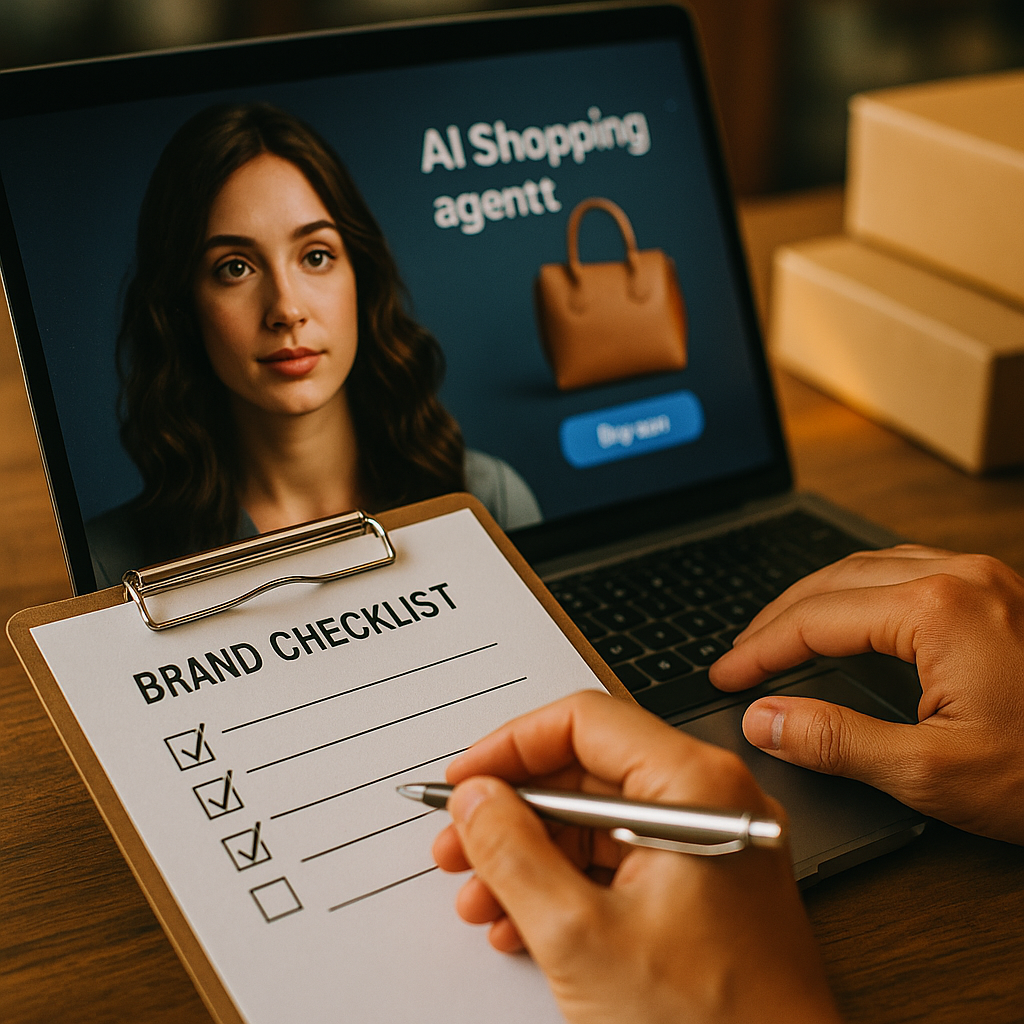
An AI shopping agent just recommended your product to 40,000 users this morning. Nobody disclosed a paid placement. That’s not a hypothetical — it’s Tuesday. As AI shopping agent recommendations become the default interface for product discovery, the FTC has made clear that endorsement rules don’t stop applying just because the “endorser” is a chatbot instead of a person.
Brands that treated AI agents as a compliance loophole are about to learn otherwise. The Endorsement Guides never required a human mouth to trigger disclosure obligations — they require a “connection” that would affect how a reasonable consumer weighs the recommendation. An algorithm nudged by a paid placement fee is exactly that connection.
Why Non-Human Actors Are Now Squarely in Scope
For years, the industry treated the FTC’s Endorsement Guides as a people problem: influencers, testimonials, reviewers. Then generative AI shopping assistants — think ChatGPT shopping plugins, Amazon’s Rufus, Google’s AI Mode, and a growing wave of white-label agents embedded in retail apps — started making product recommendations at scale, often without any visible sponsorship trail.
The FTC’s position, reinforced through recent enforcement actions and guidance updates, treats an AI agent’s recommendation the same as a human’s when money, free product, or preferential ranking influenced the output. The “non-human actor” framing isn’t a loophole-closer for some future problem. It’s a clarification that the existing rule always covered this.
If a brand pays to influence what an AI shopping agent recommends, and that influence isn’t disclosed, the FTC treats it as a material omission — regardless of whether a human or a model generated the words.
Why does this matter more now than it did two years ago? Because AI shopping agents have moved from novelty to infrastructure. eMarketer data shows a sharp rise in consumers starting product searches inside AI chat interfaces rather than traditional search or marketplace browsing. When the recommendation layer shifts, so does the liability layer.
The Core Compliance Checklist
Treat this as your baseline audit. If you can’t check every box, you have exposure.
- Disclose material connections at the point of recommendation. If your brand paid for placement, boosted ranking, or provided free product to train or fine-tune the agent’s preference weighting, that connection needs to be disclosed in the same interaction where the recommendation appears — not buried in a terms page three clicks away.
- Audit the agent’s training and ranking inputs. Know exactly what data, affiliate fees, or sponsorship arrangements shaped the recommendation logic. If you can’t explain why the agent recommended your SKU over a competitor’s, you can’t defend the disclosure adequacy.
- Document the agent’s disclosure language. “Sponsored” or “paid partnership” needs to appear in the actual output text or UI element the consumer sees, not just in a developer-facing API log.
- Verify claims the agent makes on your behalf. AI agents hallucinate. If an agent claims your supplement “cures inflammation” without substantiation, your brand owns that claim exposure just as it would if an influencer said it. This mirrors the substantiation standard covered in our AI nutrition claims compliance framework.
- Map the vendor chain. Most brands don’t build shopping agents in-house. You’re relying on a platform (Amazon, Perplexity, a retail media network, a startup agent tool). Contractually require that vendor to disclose material connections and give you audit rights over the recommendation logic.
- Retain output logs for at least the FTC’s typical lookback window. If an agent recommended your product 50,000 times last quarter, you need records showing what disclosure language accompanied each version of that recommendation, especially if the agent’s output varies by session.
- Test for consistency across sessions and personas. AI agents don’t give the same answer twice. Run adversarial testing — ask the same shopping question from ten different account profiles — to confirm disclosure isn’t randomly dropped in some output paths.
Where Brands Get This Wrong
Three failure patterns show up repeatedly in early enforcement chatter and industry post-mortems.
First: brands assume the platform (not them) owns disclosure liability. Wrong. The FTC has consistently held that the party benefiting from the endorsement — the brand — shares responsibility even when a third-party platform generates the content. This is the same logic that underpins disclosure audits for UGC clipping networks: outsourcing the mechanism doesn’t outsource the accountability.
Second: brands treat “sponsored” tags as a checkbox rather than a UX requirement. A disclosure that’s technically present but visually or contextually invisible (gray text, tiny font, buried after three paragraphs of AI-generated praise) fails the “clear and conspicuous” standard the same way it would in influencer content.
Third — and this one catches even sophisticated teams — brands don’t realize their affiliate or performance marketing arrangements with AI shopping tools count as material connections. If you pay a commission every time the agent drives a purchase, that’s disclosable, full stop. This is the same principle explored in the FTC Handy settlement analysis on affiliate disclosure obligations, just applied to a machine intermediary instead of a person.
A commission-based ranking boost is a material connection whether the recommender has a face or a training corpus.
Building the Governance Layer: Who Actually Owns This?
Most compliance failures aren’t legal failures — they’re org chart failures. Nobody owns AI agent disclosure because it falls between marketing, legal, and product/engineering. Fix that first.
Assign a single accountable owner (usually within brand legal or trust & safety) who signs off on every AI shopping integration before launch. That owner needs veto power, not just advisory input.
Build an escalation path similar to the one described in our escalation trigger policy for undisclosed sponsorships — except the trigger here is an automated monitoring alert, not a human tip. You need tooling that samples agent outputs regularly and flags missing disclosure language before a regulator or journalist finds it first.
Vendor contracts matter enormously here. If a third-party AI shopping platform builds the agent, your indemnification language needs to explicitly cover disclosure failures baked into their model behavior. The same contractual logic used in indemnification frameworks for AI creator-matching platforms applies directly: don’t assume “we didn’t write the output” protects you from liability if you paid for the placement.
What About State-Level Rules Layered on Top?
The FTC isn’t the only regulator paying attention. Several states have moved on synthetic performer and AI disclosure rules that intersect with shopping agent recommendations, particularly where the agent uses a synthetic voice or avatar to deliver the pitch. If your AI shopping assistant has a branded persona with a synthetic voice, cross-check obligations against our state synthetic performer disclosure comparison — state law can be stricter than the federal baseline, and preemption isn’t guaranteed.
International brands face an added layer. If your AI shopping agent operates in markets governed by the EU AI Act’s transparency obligations, the disclosure bar is different again. Our EU AI Act reconciliation guide breaks down where US and EU transparency rules diverge, which matters if your shopping agent serves a global customer base from a single backend.
Practical Testing Protocol Before Launch
Don’t wait for a complaint to discover your agent’s blind spots. Run this before any AI shopping integration goes live:
- Query the agent from a fresh, unauthenticated session and confirm disclosure appears on sponsored recommendations.
- Query with a logged-in loyalty account and confirm personalization doesn’t strip the disclosure language.
- Test voice-based outputs (smart speaker integrations) — disclosure read aloud is different from disclosure displayed on screen, and the FTC has flagged audio-only disclosure as a distinct compliance question, similar to concerns raised around chatbot disclosure rules across state lines.
- Have legal review a sample of 20-30 output transcripts monthly, not just at launch. Model updates change behavior without notice.
- Confirm your brief to any AI vendor or in-house prompt engineering team documents intended disclosure behavior — this creates the paper trail regulators will ask for first, much like the documentation standard described in AI tool usage briefs for creators.
None of this is exotic. It’s the same discipline brands already apply to influencer contracts and sponsored content, just pointed at a different execution layer. The tooling changed. The legal standard didn’t.
FAQs
Frequently Asked Questions
Does the FTC Endorsement Guide actually name AI shopping agents specifically?
The Guides themselves are written broadly around “endorsements” and “material connections,” not around specific technologies. Recent FTC statements and enforcement patterns make clear the agency interprets AI-generated recommendations as falling under existing endorsement principles, rather than requiring a separate rule for non-human actors.
Who is liable if an AI shopping agent fails to disclose a paid placement — the brand or the platform?
Both can be. The FTC has historically pursued the party that benefits from the endorsement (the brand) alongside any platform that facilitated it. Contractual indemnification with your AI vendor doesn’t eliminate FTC liability, though it can shift financial responsibility after the fact.
Is a “sponsored” label enough, or does the AI agent need to explain the relationship in more detail?
A clear, conspicuous label is typically sufficient if it appears at the point of recommendation and isn’t buried or visually diminished. The standard mirrors influencer disclosure rules: consumers need to understand there’s a material connection before they act on the recommendation, not after.
Do free product samples given to train an AI shopping agent count as a material connection?
Yes. If free product, data access, or preferential API terms influenced how the agent ranks or describes your product, that’s a disclosable material connection, functionally similar to gifting rules that already apply to human creators.
How often should brands audit AI shopping agent outputs for compliance?
Monthly sampling is a reasonable baseline, with additional review triggered after any model update, prompt change, or new retail integration. Static one-time compliance checks don’t hold up because agent behavior drifts as underlying models get retrained.
Does this apply to voice assistants and smart speakers, not just chat-based shopping agents?
Yes. Any interface where a non-human actor recommends a product based on a paid or incentivized relationship falls under the same disclosure logic, whether the output is text, voice, or an on-screen card in a shopping app.
Start with an inventory: list every AI shopping surface your products currently appear on, confirm who controls the ranking logic, and assign one accountable owner to sign off before the next model update ships. That single step closes most of the exposure brands are carrying right now.
Top Influencer Marketing Agencies
The leading agencies shaping influencer marketing in 2026
Agencies ranked by campaign performance, client diversity, platform expertise, proven ROI, industry recognition, and client satisfaction. Assessed through verified case studies, reviews, and industry consultations.
Moburst

-
2

The Shelf
Boutique Beauty & Lifestyle Influencer AgencyA data-driven boutique agency specializing exclusively in beauty, wellness, and lifestyle influencer campaigns on Instagram and TikTok. Best for brands already focused on the beauty/personal care space that need curated, aesthetic-driven content.Clients: Pepsi, The Honest Company, Hims, Elf Cosmetics, Pure LeafVisit The Shelf → -
3

Audiencly
Niche Gaming & Esports Influencer AgencyA specialized agency focused exclusively on gaming and esports creators on YouTube, Twitch, and TikTok. Ideal if your campaign is 100% gaming-focused — from game launches to hardware and esports events.Clients: Epic Games, NordVPN, Ubisoft, Wargaming, Tencent GamesVisit Audiencly → -
4

Viral Nation
Global Influencer Marketing & Talent AgencyA dual talent management and marketing agency with proprietary brand safety tools and a global creator network spanning nano-influencers to celebrities across all major platforms.Clients: Meta, Activision Blizzard, Energizer, Aston Martin, WalmartVisit Viral Nation → -
5

The Influencer Marketing Factory
TikTok, Instagram & YouTube CampaignsA full-service agency with strong TikTok expertise, offering end-to-end campaign management from influencer discovery through performance reporting with a focus on platform-native content.Clients: Google, Snapchat, Universal Music, Bumble, YelpVisit TIMF → -
6

NeoReach
Enterprise Analytics & Influencer CampaignsAn enterprise-focused agency combining managed campaigns with a powerful self-service data platform for influencer search, audience analytics, and attribution modeling.Clients: Amazon, Airbnb, Netflix, Honda, The New York TimesVisit NeoReach → -
7

Ubiquitous
Creator-First Marketing PlatformA tech-driven platform combining self-service tools with managed campaign options, emphasizing speed and scalability for brands managing multiple influencer relationships.Clients: Lyft, Disney, Target, American Eagle, NetflixVisit Ubiquitous → -
8

Obviously
Scalable Enterprise Influencer CampaignsA tech-enabled agency built for high-volume campaigns, coordinating hundreds of creators simultaneously with end-to-end logistics, content rights management, and product seeding.Clients: Google, Ulta Beauty, Converse, AmazonVisit Obviously →