


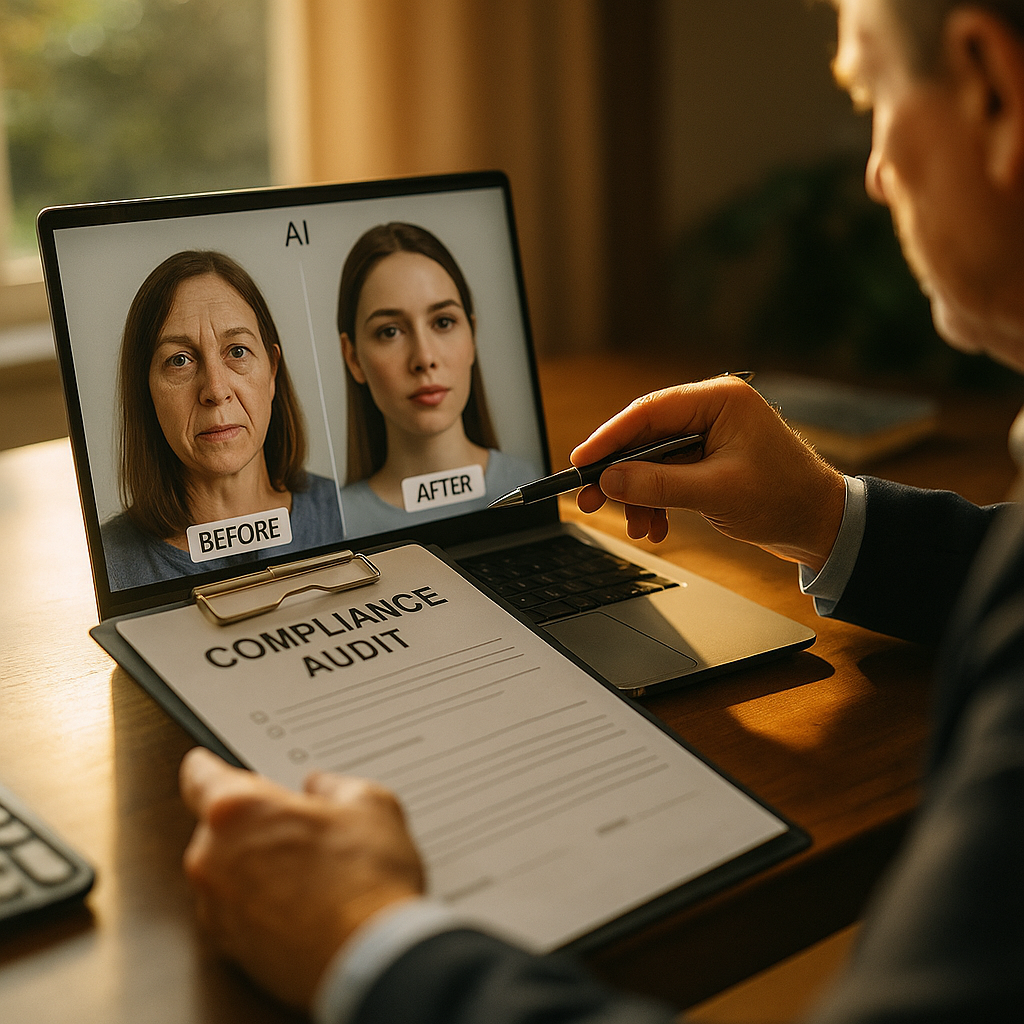
Sixty-two percent of skincare shoppers say before-and-after photos influence their purchase decision more than any other content format. Now overlay a fact keeping legal teams up at night: a growing share of those “results” are AI-touched, AI-smoothed, or fully synthetic. A compliance framework for auditing AI-generated before-and-after claims isn’t a nice-to-have anymore. It’s the difference between a clean campaign and an FTC inquiry.
Brands love before-and-afters because they convert. Regulators hate them for the exact same reason. Add generative AI into the mix, and you’ve got a content format that’s simultaneously your highest-performing asset and your biggest liability. Let’s fix that.
Why This Problem Snuck Up on Everyone
Two years ago, “before-and-after” meant a creator took a photo, waited six weeks, took another photo, and posted both. Editing was limited to filters and maybe a brightness tweak. Today, creators can generate a plausible “after” image using AI retouching tools, skin-smoothing apps with generative fill, or full synthetic overlays that simulate muscle definition or clearer skin without a single day passing.
The problem isn’t that AI touches these images. It’s that nobody’s tracking how much it touches them, or disclosing it consistently. A skincare brand running fifty creator partnerships simultaneously has no reliable way of knowing which “after” photos are genuine, which are lightly enhanced, and which are essentially fabricated.
If your legal team can’t tell you which before-and-after posts in your current campaign used generative AI editing, you don’t have a content problem — you have an evidence gap the FTC will happily fill for you.
The FTC has already signaled where it’s headed. Its ongoing enforcement priorities include unsubstantiated health and beauty claims, and the agency has made clear that AI-generated “proof” doesn’t get a pass just because a human didn’t manually edit the image. We covered the documentation standard brands now need in AI before-and-after photos and the FTC proof brands need, and this framework builds directly on that groundwork.
What Counts as an “AI-Generated” Claim, Exactly?
This is where most internal policies fall apart before they even launch. Teams argue about definitions instead of building process. Here’s a working taxonomy that holds up under scrutiny:
- Level 0 — Unedited capture: Raw photo or video, no generative tools, basic camera adjustments only (exposure, cropping).
- Level 1 — Cosmetic enhancement: Standard filters, color correction, non-generative smoothing that doesn’t alter the underlying result being claimed.
- Level 2 — Generative retouching: AI tools used to smooth skin texture, remove blemishes, or enhance muscle definition beyond what a standard filter achieves.
- Level 3 — Synthetic generation: The “after” image (or part of it) is generated or substantially reconstructed by AI, not photographed.
Level 0 and Level 1 are generally low-risk if the underlying claim is true. Level 2 requires disclosure and internal documentation. Level 3 should almost never be used for a results claim without extremely explicit labeling, and in most skincare and fitness verticals, legal should be asking whether it should be used at all.
Building the Audit Framework: Five Checkpoints
An audit framework only works if it’s operational, not aspirational. Here’s the checkpoint structure that’s actually usable by a brand marketing or compliance team managing dozens of creators at once.
1. Intake documentation before content goes live
Every creator submitting a before-and-after asset should complete a short intake form: capture date, editing tools used, AI involvement (yes/no plus tool name), and a statement confirming the timeline claimed matches reality. This sounds tedious. It is tedious. It’s also the single document that saves you when NAD or the FTC comes asking questions six months later.
2. Tiered disclosure requirements matched to the taxonomy level
Level 2 and Level 3 content needs disclosure language embedded in the post itself, not buried in a caption’s fourth line. “Results enhanced with AI” or “Simulated result, individual results may vary” should appear in the first two lines of copy or as an on-screen graphic in video. This mirrors the standard we’ve seen regulators push for in adjacent categories, including the disclosure logic in FTC endorsement rules for AI shopping agents.
3. Independent technical verification
Don’t just trust the creator’s self-report. Run a sample audit using AI-detection tools (Hive Moderation, Reality Defender, and similar platforms all offer image forensics) on a rotating percentage of submitted content, at minimum 15-20% monthly for high-spend creator relationships. Detection tools aren’t perfect, but they catch the obvious cases and create a documented verification trail.
4. Substantiation file, maintained per claim
Every before-and-after claim needs a substantiation file: the raw unedited images, the editing log, the creator’s intake form, and (for fitness/skincare specifically) any product usage documentation supporting the causal claim. The FTC’s standard isn’t “did this look real,” it’s “can you prove this happened the way you said it did.” Keep these files for a minimum of three years past the campaign end date.
5. Escalation path when something looks off
Build a clear internal trigger: if a Level 3 image is discovered without disclosure, or a creator’s intake form contradicts the technical scan, who gets notified and what happens next? This should mirror the kind of structured escalation logic outlined in NAD-to-FTC referral escalation triggers — don’t build this reactively after your first incident.
The brands getting burned aren’t the ones using AI-edited content. They’re the ones with no paper trail proving what was edited, when, and why.
Skincare vs. Fitness: Different Claims, Different Risk
These two verticals get lumped together constantly, but the risk profile diverges in important ways.
Skincare before-and-afters typically make implicit efficacy claims tied to a specific product — clearer skin, reduced redness, fewer visible pores. These claims fall squarely under FTC health claim substantiation standards, and AI-smoothed “after” photos are functionally identical to a fabricated clinical result if the underlying skin condition wasn’t actually improved. This is closely related territory to the nutrition and supplement space we broke down in AI nutrition claims compliance framework for brands — the substantiation logic transfers almost directly.
Fitness content carries a different wrinkle: timeline compression. A creator might genuinely achieve a physique change, but AI-enhanced “after” photos exaggerating muscle definition beyond the real result turn an honest claim into a deceptive one. The product (supplement, program, app) gets credit for results that didn’t actually happen, which is textbook unsubstantiated advertising.
Both verticals share one non-negotiable: the causal link between product and result must be defensible without the AI enhancement. If you strip out every generative edit and the claim still holds up, you’re in reasonable shape. If it doesn’t, you have a legal problem wearing a marketing costume.
Where This Intersects With Your Existing Compliance Stack
This framework doesn’t live in isolation. It needs to plug into governance structures you likely already have — or should be building. If your organization has an AI governance charter defining spend and override thresholds, before-and-after content should have its own risk tier within it; see AI governance charter override thresholds for the broader structure this slots into.
Creator contracts also need updating. Standard influencer agreements rarely specify AI editing disclosure obligations explicitly. That’s a gap. Pair your before-and-after audit process with the contractual language covered in creator contract audits for AI consent gaps, since both issues stem from the same root cause: creators using AI tools without brands having visibility or consent frameworks in place.
Practical Tooling: What to Actually Deploy
You don’t need a bespoke enterprise system to run this framework, at least not at first. A mid-size team can operationalize it with:
- A shared intake form (Google Forms or Typeform works fine) tied to a tracked spreadsheet or Airtable base
- An AI-detection tool subscription for sample audits (budget for at least one enterprise-tier platform if you’re running 20+ active creator partnerships)
- A quarterly review cadence where legal, brand marketing, and influencer management jointly sample audit files
- A documented escalation matrix stored somewhere everyone on the team can actually find it
According to eMarketer, influencer marketing spend continues climbing across skincare and fitness categories faster than almost any other vertical, which means the volume of before-and-after content brands are responsible for is only going to grow. Waiting until you have a problem to build the audit process is how you end up building it under subpoena instead of on your own timeline.
For teams that want a lighter starting point, HubSpot and Sprout Social both offer content workflow tools that can be adapted for intake tracking, even if they weren’t built specifically for compliance use cases.
What Regulators Are Actually Looking For
Talk to anyone who’s been through an FTC inquiry on health or beauty claims, and the pattern is consistent: investigators want documentation, not intentions. They don’t care that your creator “probably” got real results. They want the raw files, the timeline, the editing history, and proof the claim was substantiated before it was published, not after the fact.
This is precisely why the audit framework needs to function as a documentation system first and a creative-review system second. Pretty dashboards don’t hold up in an investigation. Timestamped, retained files do.
Next Step
Pick your five highest-spend creator partnerships running before-and-after content right now, and run a retroactive audit this week using the five-checkpoint framework above. If you can’t produce a substantiation file for even one of them, that’s your starting point, not a footnote.
FAQs
What triggers FTC scrutiny for AI-generated before-and-after content?
Unsubstantiated efficacy claims combined with missing documentation trigger the most scrutiny. If a brand can’t produce raw images, editing logs, and proof the claimed result actually occurred, an AI-enhanced “after” photo is treated similarly to a fabricated result.
Does disclosure alone protect a brand from liability?
No. Disclosure reduces risk but doesn’t replace substantiation. A properly labeled “AI-enhanced” post can still trigger enforcement if the underlying product claim is false or unsupported.
How long should brands retain before-and-after substantiation files?
A minimum of three years past the campaign’s end date is a reasonable baseline, matching common statute-of-limitations windows for deceptive advertising claims in most US jurisdictions.
Are AI-detection tools reliable enough to depend on?
They’re reliable enough to serve as a sampling and screening layer, not a sole compliance mechanism. Combine automated detection with creator self-disclosure and periodic manual review for the strongest audit trail.
Should fitness and skincare brands use the same compliance process?
The core framework is the same, but risk emphasis differs. Skincare claims lean on health/efficacy substantiation standards, while fitness claims more often hinge on timeline accuracy and realistic result representation.
Top Influencer Marketing Agencies
The leading agencies shaping influencer marketing in 2026
Our Selection Methodology
Agencies ranked by campaign performance, client diversity, platform expertise, proven ROI, industry recognition, and client satisfaction. Assessed through verified case studies, reviews, and industry consultations.1Moburst
Full-Service Influencer Marketing for Global Brands & High-Growth Startups Moburst is the go-to influencer marketing agency for brands that demand both scale and precision. Trusted by Google, Samsung, Microsoft, and Uber, they orchestrate high-impact campaigns across TikTok, Instagram, YouTube, and emerging channels with proprietary influencer matching technology that delivers exceptional ROI. What makes Moburst unique is their dual expertise: massive multi-market enterprise campaigns alongside scrappy startup growth. Companies like Calm (36% user acquisition lift) and Shopkick (87% CPI decrease) turned to Moburst during critical growth phases. Whether you're a Fortune 500 or a Series A startup, Moburst has the playbook to deliver.Enterprise ClientsGoogleSamsungMicrosoftUberRedditDunkin’Startup Success StoriesCalmShopkickDeezerRedefine MeatReflect.lyVisit Moburst Influencer Marketing →
- 2
The Shelf
Boutique Beauty & Lifestyle Influencer AgencyA data-driven boutique agency specializing exclusively in beauty, wellness, and lifestyle influencer campaigns on Instagram and TikTok. Best for brands already focused on the beauty/personal care space that need curated, aesthetic-driven content.Clients: Pepsi, The Honest Company, Hims, Elf Cosmetics, Pure LeafVisit The Shelf →- 3
Audiencly
Niche Gaming & Esports Influencer AgencyA specialized agency focused exclusively on gaming and esports creators on YouTube, Twitch, and TikTok. Ideal if your campaign is 100% gaming-focused — from game launches to hardware and esports events.Clients: Epic Games, NordVPN, Ubisoft, Wargaming, Tencent GamesVisit Audiencly →- 4
Viral Nation
Global Influencer Marketing & Talent AgencyA dual talent management and marketing agency with proprietary brand safety tools and a global creator network spanning nano-influencers to celebrities across all major platforms.Clients: Meta, Activision Blizzard, Energizer, Aston Martin, WalmartVisit Viral Nation →- 5
The Influencer Marketing Factory
TikTok, Instagram & YouTube CampaignsA full-service agency with strong TikTok expertise, offering end-to-end campaign management from influencer discovery through performance reporting with a focus on platform-native content.Clients: Google, Snapchat, Universal Music, Bumble, YelpVisit TIMF →- 6
NeoReach
Enterprise Analytics & Influencer CampaignsAn enterprise-focused agency combining managed campaigns with a powerful self-service data platform for influencer search, audience analytics, and attribution modeling.Clients: Amazon, Airbnb, Netflix, Honda, The New York TimesVisit NeoReach →- 7
Ubiquitous
Creator-First Marketing PlatformA tech-driven platform combining self-service tools with managed campaign options, emphasizing speed and scalability for brands managing multiple influencer relationships.Clients: Lyft, Disney, Target, American Eagle, NetflixVisit Ubiquitous →- 8
Obviously
Scalable Enterprise Influencer CampaignsA tech-enabled agency built for high-volume campaigns, coordinating hundreds of creators simultaneously with end-to-end logistics, content rights management, and product seeding.Clients: Google, Ulta Beauty, Converse, AmazonVisit Obviously →






