


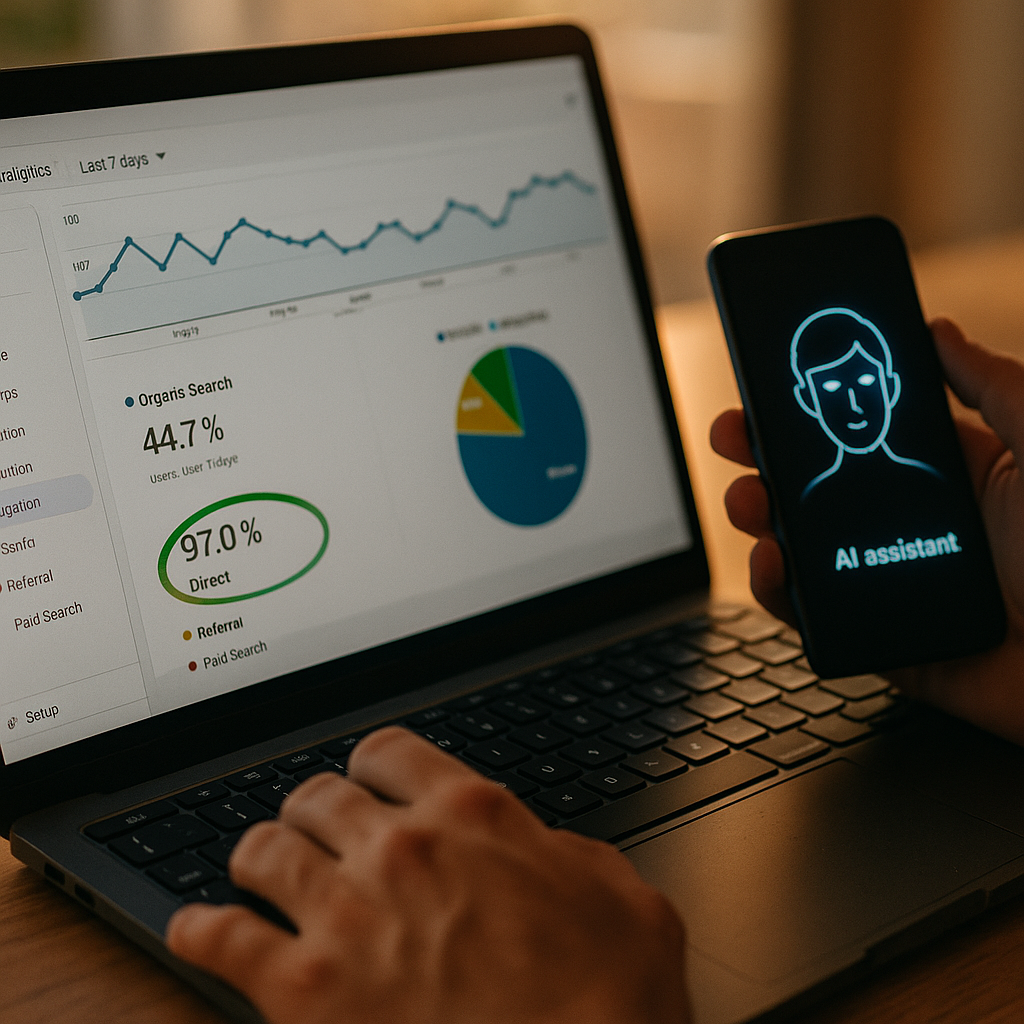
Ninety seven percent. That’s roughly how much AI assistant referral traffic gets misclassified as “direct” in a standard Google Analytics 4 setup, according to internal audits several enterprise marketing teams have run this year. If your dashboard shows a flat line for ChatGPT, Perplexity, or Gemini traffic, it’s not because nobody is citing your brand. It’s because your analytics were never built to see it.
The Blind Spot Isn’t New, It’s Just Bigger Now
Marketers have dealt with dark traffic for years. Someone copies a link from a group chat, pastes it into a browser, and GA4 logs it as direct because there’s no referrer header. That’s been a rounding error for most of digital marketing history.
AI assistants changed the math. When ChatGPT answers a question and cites your product page, or when Perplexity pulls a stat from your blog and drops a link in its response, the resulting click often carries no referrer data at all. Some platforms strip it deliberately for privacy reasons. Others simply weren’t built with marketing attribution in mind because, frankly, that wasn’t the point when they launched.
The result is a growing chunk of high-intent traffic (people who asked an AI a specific question and clicked through to your site) landing in the same bucket as someone who typo’d your URL from memory. That’s not a rounding error anymore. It’s a structural gap in how you measure the channel that’s increasingly shaping purchase consideration.
If a channel can influence purchase decisions but can’t be measured, it doesn’t disappear from your funnel. It just disappears from your budget conversations, which is worse.
What Actually Counts as an AI Assistant Citation?
Before you build tracking, define what you’re tracking. Not every AI touchpoint looks the same, and lumping them together will muddy your reporting later.
- Direct citations with links: The assistant names your brand and includes a clickable source, common in Perplexity and Gemini’s grounded responses.
- Named mentions without links: ChatGPT references your product or brand in a conversational answer but doesn’t hyperlink, meaning the user has to search separately.
- Summarized content, unattributed: The assistant paraphrases your data or copy without naming you at all. This influences the user but generates zero trackable traffic, ever.
- Follow-up clicks from AI search overviews: Google’s AI Overviews and similar features that sit inside a traditional search results page, which behave differently from standalone assistant apps.
Only the first and fourth categories are even theoretically trackable with current tools. That matters when you’re setting expectations with leadership about what “AI citation tracking” can and can’t recover.
Why Your Existing Attribution Model Can’t Cope
Most attribution setups were built around three assumptions: a referrer header exists, a UTM parameter was appended, or a cookie survived the session. AI-driven clicks routinely break all three.
Server-side redirects inside assistant apps often scrub query strings. Sandboxed browser views used by some mobile AI apps don’t pass referrer data the way a normal browser tab does. And if the user asked the question on one device but clicked through on another later, there’s no session continuity to stitch together anyway. This is the same underlying problem explored in how attribution forms miss AI referrals, and it compounds fast once you layer influencer-driven content into the mix, since branded creator posts are exactly the kind of material AI models like to cite.
Standard marketing mix models weren’t designed for this either. They assume traceable, quantifiable inputs. A citation an AI model generated from training data scraped eighteen months ago doesn’t fit neatly into a weekly MMM cycle.
Building the Tracking Stack: Five Practical Layers
You won’t solve this with one tool. It takes a layered approach, and even then you’ll only close part of the gap. Here’s the stack worth building now.
1. Server Log Analysis, Not Just JavaScript Tags
GA4 and most tag-based analytics tools rely on JavaScript firing in a browser. Bots and some in-app browsers used by AI assistants don’t always execute that JavaScript reliably. Raw server logs capture every request regardless of whether a tracking pixel fired, including user agent strings that can reveal AI crawler visits (GPTBot, PerplexityBot, ClaudeBot) hitting your site before a citation ever appears. Cross-referencing crawl activity against later traffic spikes gives you a leading indicator that a citation may be forming.
2. Referrer Pattern Libraries
Build and maintain an internal list of known referrer strings and domains associated with AI platforms (chat.openai.com, perplexity.ai, gemini.google.com, and the various sandboxed webview domains some mobile apps use). Feed this into a custom GA4 channel grouping or a BigQuery segmentation query so traffic that does carry partial referrer data gets bucketed correctly instead of dumped into “direct.”
3. UTM Discipline on Anything Citable
You can’t control what an AI model does with your URL, but you can make sure every URL worth citing already has clean, consistent parameters if the assistant happens to preserve them. This won’t fix stripped referrers, but it recovers value on the platforms that do pass query strings through.
4. Post-Click Survey Attribution
Low-tech, but effective. A single-question “how did you hear about us” prompt at checkout or signup, with “AI assistant / chatbot” as an explicit option, recovers signal no pixel ever will. Several DTC brands have found this single field explains double-digit percentages of otherwise unattributed conversions.
5. Structured Content Monitoring
Track whether and how often your content actually gets cited in the first place, independent of click data. Tools built around this idea are covered in Perplexity and Gemini citation patterns, which found that structured, well-sourced content earns citations at meaningfully higher rates than reach-driven content. Pair citation frequency with whatever traffic you can recover, and you get a directional picture even when exact attribution is impossible.
Citation volume without funnel context is a vanity metric. Pairing it with even partial traffic recovery turns it into a planning input, which is the whole point.
This layered approach echoes a broader pattern in dark data quietly wrecking AI marketing stacks: the data exists, it’s just not being captured or reconciled anywhere a human ever looks at it.
Where Influencer Content Fits Into This Gap
Here’s the part brand teams underestimate. AI models don’t just cite your owned content, they cite creator content too, especially long-form YouTube reviews, comparison posts, and Reddit threads featuring your product. That means a creator partnership you ran months ago could be quietly feeding an AI Overview or Perplexity answer today, driving traffic your influencer reporting will never show.
This is why GEO (generative engine optimization) for influencer briefs matters. If a creator’s video or post is structured in a way that AI models favor, as detailed in GEO for influencer content, it can keep generating citations long after the campaign budget is spent. But without the tracking layers above, you’ll never connect that lingering citation activity back to the original creator deal, which makes it nearly impossible to justify renewing the partnership on performance grounds.
Video specifically behaves differently across platforms. YouTube content gets cited differently by Google’s models versus OpenAI’s, a distinction covered in how YouTube gets cited differently, and citation counts alone don’t tell you whether that attention converts, a point examined in AI video citation volume without funnel context.
Who Should Own This Inside the Org?
Nobody, currently, in most companies. That’s the honest answer. It falls between SEO (who thinks in terms of organic sessions), analytics (who thinks in terms of clean attribution models), and influencer/content teams (who think in terms of campaign performance). Each team has a partial view and none has the full picture.
The fix isn’t necessarily a new headcount line. It’s a recurring cross-functional review, monthly at minimum, where server log data, referrer pattern reports, and citation monitoring get looked at together instead of in three separate dashboards. Identity resolution across these fragmented sources is its own discipline, one explored in identity stitching for creator attribution, and it applies just as directly to AI referral gaps as it does to cross-device influencer tracking.
According to eMarketer research on emerging discovery channels, AI-driven referral traffic is growing fast enough that treating it as a rounding error will look like a serious oversight within a couple of budget cycles. Statista data on generative AI adoption tells a similar story: usage is climbing across every major demographic, which means the volume of unattributed traffic is only going to grow alongside it.
For teams building the technical side of this, Google’s own documentation on Search Console and referral reporting is a reasonable starting point, though it won’t get you the full picture on its own. Pairing platform docs with third-party analysis from sources like HubSpot’s marketing research or Sprout Social’s channel benchmarks gives you enough context to build a credible internal case for investment.
The Compliance Angle Nobody’s Discussing
There’s a quieter risk here too. If your team can’t see where influencer-sourced content is being cited by AI models, you also can’t monitor whether disclosure requirements are being respected in that secondary context. An AI summary that strips a creator’s #ad disclosure while repeating their claims creates a compliance question that didn’t exist a few years ago. Teams already building FTC-focused monitoring, similar to the approach in AI compliance checkers flagging FTC disclosure risk, should extend that same scrutiny to how citations reproduce (or omit) required disclosures downstream.
Start Small, But Start
You don’t need a perfect system on day one. Start by adding AI referrer patterns to your GA4 channel grouping this week, add the “how did you hear about us” field to one high-traffic conversion form, and pull server logs for AI crawler activity over the last quarter to see what’s already been happening without you knowing. That baseline alone will tell you whether the 97% blind spot is a rounding error for your brand or a genuine gap in your budget conversations.
Frequently Asked Questions
Why does GA4 classify most AI assistant traffic as direct?
Because GA4 relies on referrer headers and UTM parameters to categorize traffic sources, and many AI assistant apps strip that data before a click reaches your site, whether for privacy reasons or simply because attribution wasn’t a design priority for those platforms.
Can server log analysis fully replace GA4 for tracking AI citations?
No. Server logs are better at revealing crawler activity and raw request data, but they don’t replace behavioral analytics like session duration or conversion paths. The two need to work together, with logs filling in the referrer gaps GA4 misses.
Which AI platforms currently pass any referrer data at all?
It varies and changes frequently as platforms update their apps. Some AI Overview clicks inside traditional search results retain more referrer context than standalone assistant apps like ChatGPT’s mobile app, but none currently match the reliability of standard browser-based referrer tracking.
How do we tie AI citations back to specific influencer campaigns?
Start by monitoring which creator content pieces get cited most often using content monitoring tools, then cross-reference citation timing against original campaign dates. It’s imprecise, but combined with post-click surveys it gives you a directional link between creator work and later AI-driven traffic.
Is this blind spot going to get worse or better over time?
Most signs point to worse before better. As AI assistant usage grows, the volume of unattributed traffic grows with it, and platforms have limited commercial incentive to make attribution easier for marketers right now.
Top Influencer Marketing Agencies
The leading agencies shaping influencer marketing in 2026
Agencies ranked by campaign performance, client diversity, platform expertise, proven ROI, industry recognition, and client satisfaction. Assessed through verified case studies, reviews, and industry consultations.
Moburst

-
2

The Shelf
Boutique Beauty & Lifestyle Influencer AgencyA data-driven boutique agency specializing exclusively in beauty, wellness, and lifestyle influencer campaigns on Instagram and TikTok. Best for brands already focused on the beauty/personal care space that need curated, aesthetic-driven content.Clients: Pepsi, The Honest Company, Hims, Elf Cosmetics, Pure LeafVisit The Shelf → -
3

Audiencly
Niche Gaming & Esports Influencer AgencyA specialized agency focused exclusively on gaming and esports creators on YouTube, Twitch, and TikTok. Ideal if your campaign is 100% gaming-focused — from game launches to hardware and esports events.Clients: Epic Games, NordVPN, Ubisoft, Wargaming, Tencent GamesVisit Audiencly → -
4

Viral Nation
Global Influencer Marketing & Talent AgencyA dual talent management and marketing agency with proprietary brand safety tools and a global creator network spanning nano-influencers to celebrities across all major platforms.Clients: Meta, Activision Blizzard, Energizer, Aston Martin, WalmartVisit Viral Nation → -
5

The Influencer Marketing Factory
TikTok, Instagram & YouTube CampaignsA full-service agency with strong TikTok expertise, offering end-to-end campaign management from influencer discovery through performance reporting with a focus on platform-native content.Clients: Google, Snapchat, Universal Music, Bumble, YelpVisit TIMF → -
6

NeoReach
Enterprise Analytics & Influencer CampaignsAn enterprise-focused agency combining managed campaigns with a powerful self-service data platform for influencer search, audience analytics, and attribution modeling.Clients: Amazon, Airbnb, Netflix, Honda, The New York TimesVisit NeoReach → -
7

Ubiquitous
Creator-First Marketing PlatformA tech-driven platform combining self-service tools with managed campaign options, emphasizing speed and scalability for brands managing multiple influencer relationships.Clients: Lyft, Disney, Target, American Eagle, NetflixVisit Ubiquitous → -
8

Obviously
Scalable Enterprise Influencer CampaignsA tech-enabled agency built for high-volume campaigns, coordinating hundreds of creators simultaneously with end-to-end logistics, content rights management, and product seeding.Clients: Google, Ulta Beauty, Converse, AmazonVisit Obviously →