


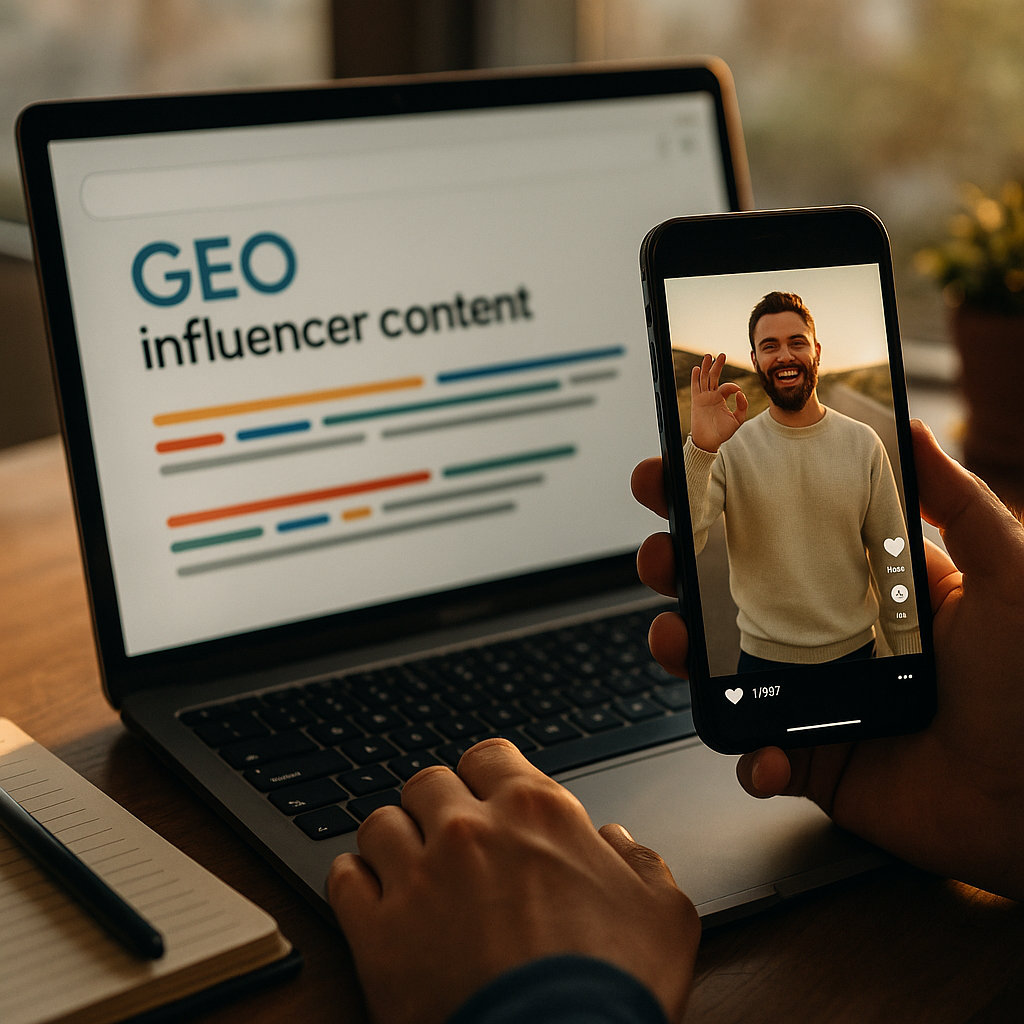
Only 25% of Google searches now end in a click, according to Sprout Social’s research on shifting search behavior, and that number keeps sliding as AI Overviews and chatbots absorb more queries. If your creator content is built for clicks, you’re optimizing for a shrinking slice of the funnel. GEO for influencer content is the discipline of structuring creator posts so large language models can lift, cite, and recommend them, no click required.
Why Zero Click Answers Change the Creator Content Game
For a decade, influencer marketing has been measured on link taps, swipe ups, and promo code redemptions. That model assumes a human reads the caption, clicks the bio link, and lands on a page you control. AI answer engines break that chain entirely.
When someone asks ChatGPT, Gemini, or Perplexity “what’s the best budget skincare routine,” the model isn’t sending them to a creator’s TikTok. It’s synthesizing an answer from scraped transcripts, captions, and reviews, then presenting a summary with maybe one citation. If your creator’s content isn’t structured in a way the model can parse and trust, you simply don’t exist in that answer.
The brands winning zero click visibility aren’t the ones with the biggest creator budgets. They’re the ones whose content is formatted for extraction, not just engagement.
This isn’t a hypothetical future problem. It’s already reshaping how brands brief creators, and it connects directly to broader shifts covered in zero-click funnel strategy work happening across search and content teams right now.
What Makes a Creator Post “Machine Readable”?
AI models don’t watch video the way humans do. They rely heavily on transcripts, captions, alt text, structured captions, and surrounding metadata. A gorgeous, high-production Reel with zero spoken clarity or on-screen text is nearly invisible to a large language model, no matter how many views it earned.
Three things determine whether an AI system can extract and cite a creator post:
- Explicit claims stated in plain language. “This retinol serum cleared my breakouts in three weeks” is extractable. A vague vibe-based voiceover is not.
- Structured formatting. Numbered steps, clear comparisons, and labeled pros and cons parse far more cleanly than stream-of-consciousness narration.
- Consistent entity naming. If a creator calls a product by five different nicknames across a series, the model struggles to connect the dots back to a single, citable entity.
This is the same logic behind training content models on top creator assets: you’re teaching a system to recognize patterns, and messy inputs produce messy outputs.
The Brief Has to Change, Not Just the Post
Most influencer briefs still optimize for aesthetic and CTA placement. GEO for influencer content requires a parallel set of instructions focused on structure. Ask creators to state the product name and category clearly in the first ten seconds. Ask them to include a spoken or captioned summary sentence, something a model could lift verbatim as an answer. Ask them to avoid burying the actual verdict under fifteen seconds of hook footage.
None of this has to kill authenticity. In fact, the clearest, most structured creator content often performs better with human audiences too, because it respects their time. Brands already rethinking briefing workflows for agentic tools should read how agentic AI briefing is going mainstream, since the same structural discipline applies whether a human or an AI system is parsing the brief.
Format Rules That Actually Move Citation Odds
There’s no universal algorithm you can reverse engineer here, these systems change weekly. But patterns from early GEO research and practitioner testing point to a few reliable tactics.
- Front-load the answer. State the core recommendation or verdict before the story. Models weight early content more heavily during summarization.
- Use comparison language. “Better than X for Y reason” gives the model a citable structure it can reuse almost verbatim in a comparative answer.
- Caption everything, thoroughly. Auto-generated captions are often riddled with errors. Clean, accurate captions double as the transcript that AI crawlers actually read.
- Repeat the entity name. Say the brand and product name multiple times across the post, not just once in the intro.
- Publish a written companion. A blog recap, YouTube description, or pinned comment summarizing the video’s claims gives models a cleaner text source to cite than raw video alone.
YouTube deserves special attention here. Google and OpenAI don’t treat YouTube citations the same way, and that gap matters enormously for creator strategy. Teams building video-heavy influencer programs should study how YouTube citations differ across AI platforms before assuming one format wins everywhere.
Measurement: What Counts as a Win When There’s No Click?
This is where most brands get stuck. If a creator post gets cited in an AI answer but nobody visits the site, was it worth the fee? The honest answer is that traditional attribution models simply weren’t built for this, and that’s a measurement problem, not a value problem.
eMarketer and other analysts have flagged that standard web forms and UTM tracking miss a growing share of AI-referred traffic entirely, because AI assistants often don’t pass referrer data the way browsers do. That gap is already skewing influencer ROI reports across the industry, a problem examined in detail in coverage of attribution forms missing AI referrals.
If your dashboard only counts clicks, you’re measuring a shrinking fraction of the actual influence your creator content generates.
Instead, track citation frequency directly. Run branded and category queries through ChatGPT, Perplexity, and Gemini on a recurring cadence and log which creators, claims, and phrases get surfaced. Pair that with brand lift surveys and direct traffic trends, since zero click visibility tends to show up as unattributed brand search rather than trackable referral traffic. For a structured approach, the audit framework in the machine readable AI content audit gives teams a repeatable way to score creator content for extractability before it ever goes live.
Compliance Doesn’t Disappear Just Because There’s No Click
One risk brands underestimate: when AI models summarize creator content, they can strip out disclosure language entirely. A creator says “#ad” in the caption, but the AI answer just presents the recommendation as neutral advice. That’s a genuine FTC exposure question, even though your brand didn’t control how the summary was generated.
The safest move is redundancy. Bake disclosure into the spoken or captioned content itself, not just the caption metadata, so it survives extraction. Tools that flag disclosure gaps before publishing are becoming standard practice, and the approach outlined in AI compliance checks for FTC disclosure risk is worth building into your GEO workflow from day one, not bolting on after a legal review flags it.
Structured Data Isn’t Just for Websites Anymore
Marketers already know schema markup helps traditional search engines understand page content, per Google’s own developer guidance. The same principle now extends to creator content ecosystems. Product pages linked in creator bios should carry clean structured data. Blog recaps of creator campaigns should use FAQ and Review schema where relevant. This creates a web of machine readable signals around the creator post itself, reinforcing the claims made on video and giving AI systems multiple corroborating sources to pull from.
HubSpot’s content research consistently shows that well-structured, clearly labeled content earns more organic visibility over time, and that principle now applies to the AI layer sitting on top of search, not just search results pages themselves.
The Bigger Shift Brands Need to Plan For
GEO for influencer content isn’t a bolt-on tactic. It’s a rebuild of how briefs, contracts, and reporting templates get structured. Creator agreements should start specifying formatting requirements, not just usage rights and posting windows, and reporting templates need a citation tracking column sitting right next to impressions and engagement rate. Brands still treating this as a future concern are already behind the ones testing it now.
Next step: pick your three highest-performing creator posts from the last quarter, run their core claims through two or three major AI assistants, and see if they get cited. If they don’t, that’s your starting brief for the next campaign.
Frequently Asked Questions
What is GEO for influencer content?
GEO, or generative engine optimization, for influencer content means structuring creator posts, captions, and companion assets so AI answer engines like ChatGPT, Gemini, and Perplexity can extract and cite them accurately, even when the user never clicks through to a website.
How is GEO different from traditional influencer marketing SEO?
Traditional SEO for influencer content focuses on driving clicks to a landing page through keywords and link placement. GEO focuses on making claims and formatting clear enough for an AI model to lift and cite directly in a generated answer, where there is often no click at all.
Can video content actually rank well in AI answers if it has no written transcript?
Rarely. AI systems primarily parse text, so accurate captions, clean transcripts, and a written companion summary dramatically increase the odds that a video’s claims get surfaced in an AI-generated answer.
How do brands measure ROI on zero click creator content?
Track citation frequency across major AI assistants for branded and category queries, monitor unattributed direct traffic and brand search lift, and pair those signals with periodic brand awareness surveys rather than relying solely on click-based attribution.
Does FTC disclosure still apply if a post is only ever summarized by an AI, not clicked?
Yes. Disclosure obligations attach to the creator’s original content and the brand relationship behind it, regardless of how that content is later summarized or surfaced. Building disclosure into spoken or captioned content, not just caption metadata, helps ensure it survives AI summarization intact.
Top Influencer Marketing Agencies
The leading agencies shaping influencer marketing in 2026
Agencies ranked by campaign performance, client diversity, platform expertise, proven ROI, industry recognition, and client satisfaction. Assessed through verified case studies, reviews, and industry consultations.
Moburst

-
2

The Shelf
Boutique Beauty & Lifestyle Influencer AgencyA data-driven boutique agency specializing exclusively in beauty, wellness, and lifestyle influencer campaigns on Instagram and TikTok. Best for brands already focused on the beauty/personal care space that need curated, aesthetic-driven content.Clients: Pepsi, The Honest Company, Hims, Elf Cosmetics, Pure LeafVisit The Shelf → -
3

Audiencly
Niche Gaming & Esports Influencer AgencyA specialized agency focused exclusively on gaming and esports creators on YouTube, Twitch, and TikTok. Ideal if your campaign is 100% gaming-focused — from game launches to hardware and esports events.Clients: Epic Games, NordVPN, Ubisoft, Wargaming, Tencent GamesVisit Audiencly → -
4

Viral Nation
Global Influencer Marketing & Talent AgencyA dual talent management and marketing agency with proprietary brand safety tools and a global creator network spanning nano-influencers to celebrities across all major platforms.Clients: Meta, Activision Blizzard, Energizer, Aston Martin, WalmartVisit Viral Nation → -
5

The Influencer Marketing Factory
TikTok, Instagram & YouTube CampaignsA full-service agency with strong TikTok expertise, offering end-to-end campaign management from influencer discovery through performance reporting with a focus on platform-native content.Clients: Google, Snapchat, Universal Music, Bumble, YelpVisit TIMF → -
6

NeoReach
Enterprise Analytics & Influencer CampaignsAn enterprise-focused agency combining managed campaigns with a powerful self-service data platform for influencer search, audience analytics, and attribution modeling.Clients: Amazon, Airbnb, Netflix, Honda, The New York TimesVisit NeoReach → -
7

Ubiquitous
Creator-First Marketing PlatformA tech-driven platform combining self-service tools with managed campaign options, emphasizing speed and scalability for brands managing multiple influencer relationships.Clients: Lyft, Disney, Target, American Eagle, NetflixVisit Ubiquitous → -
8

Obviously
Scalable Enterprise Influencer CampaignsA tech-enabled agency built for high-volume campaigns, coordinating hundreds of creators simultaneously with end-to-end logistics, content rights management, and product seeding.Clients: Google, Ulta Beauty, Converse, AmazonVisit Obviously →