


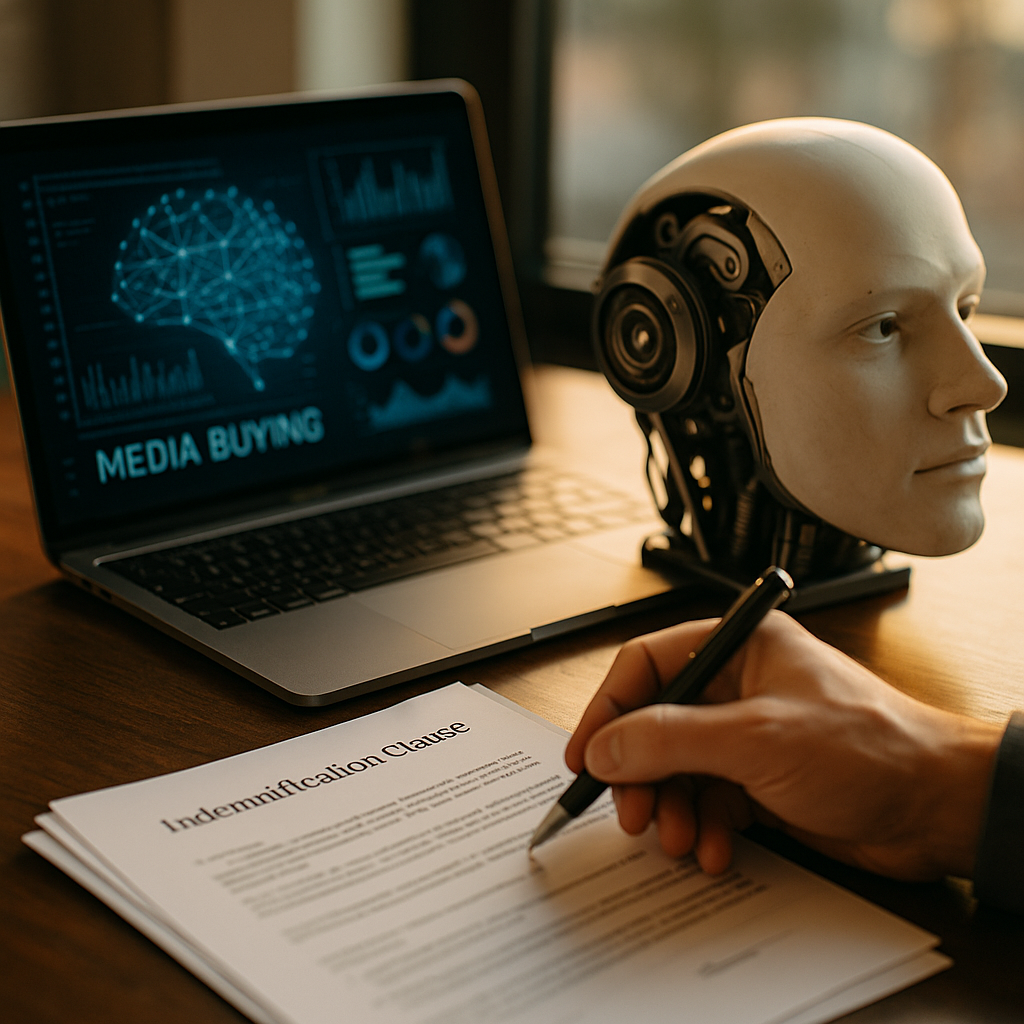
An AI agent placed 40,000 programmatic bids across creator-adjacent inventory last quarter without a single human reviewing the placements. One of those buys landed a beauty brand’s ad next to a deepfake endorsement video. Nobody signed off on it. Nobody could have. That’s the new liability surface, and most indemnification clauses in media contracts were never built to cover it.
Legal teams are still drafting indemnification language as if a media buyer, a human one, made the decision. That assumption is collapsing fast.
The Bidding Problem Nobody Priced Into Contracts
Autonomous bidding agents now handle a meaningful share of programmatic spend touching creator content: TikTok Shop affiliate placements, YouTube pre-roll adjacent to influencer uploads, retail media auctions that surface UGC clips. These agents optimize for performance signals, not brand safety nuance. They don’t read morality clauses. They don’t check whether a creator disclosed a paid partnership. They bid.
The result is a gap between who caused the harm and who’s contractually on the hook for it. Traditional media indemnification assumes a chain of human decisions: an agency selects inventory, a brand approves the plan, a platform serves the ad. When an AI agent inserts itself into that chain autonomously, the standard “each party shall indemnify the other for its own acts or omissions” language becomes almost meaningless. Whose act was it?
If your indemnification clause still assumes a human clicked “approve” on every media placement, you’re indemnifying against a world that no longer exists.
Why Standard Boilerplate Fails Here
Most media buying agreements use mutual indemnification templates drafted a decade ago. They cover things like IP infringement, defamation, and breach of representations. Useful, but incomplete for agentic bidding.
Three specific failure points show up repeatedly when legal teams audit these contracts:
- No definition of “agent action” as a triggering event. Most clauses trigger on “acts of the party” or “breach of agreement.” An autonomous bid isn’t clearly either one unless the contract says so explicitly.
- No allocation for third-party model failures. If the bidding logic runs on a foundation model licensed from a third party (OpenAI, Google, Anthropic, or a specialized ad-tech vendor), and that model misclassifies content or ignores a brand safety filter, who eats the loss? Rarely specified.
- No carve-out for disclosure and endorsement violations triggered by autonomous placement. If an AI agent buys media that amplifies an undisclosed sponsorship, the FTC doesn’t care that a human wasn’t involved. The brand is still exposed. Most contracts don’t even mention this scenario.
This isn’t hypothetical anxiety. The FTC has made clear that automated systems don’t shield brands from endorsement disclosure obligations, and enforcement priorities increasingly reference algorithmic decision-making explicitly. Related coverage on FTC endorsement rules for AI shopping agents walks through how this plays out in practice.
Where the Risk Actually Sits
Brand legal teams tend to focus indemnification energy on the agency relationship. That’s outdated thinking. In an agentic bidding environment, risk sits in at least four places simultaneously:
- The brand (as the party ultimately benefiting from and directing the ad spend)
- The agency or media buying platform operating the AI agent
- The AI model or bidding technology vendor (often a separate contractual party entirely)
- The ad exchange or supply-side platform surfacing creator-adjacent inventory
A single indemnification clause between brand and agency can’t realistically cover all four. Yet that’s exactly what most contracts attempt.
Structuring the Clause: A Layered Approach
The fix isn’t one clause. It’s a layered indemnification structure that mirrors the actual decision chain. Here’s the framework we’ve seen work in practice for brands renegotiating media contracts with agentic bidding provisions.
Layer one: define “autonomous placement” as a distinct contractual term. Don’t bury it inside “acts of the party.” Spell out that any media buy executed without direct human review, triggered by an AI agent’s bidding logic, constitutes a separate category of action subject to its own indemnification terms. This forces both sides to actually negotiate the allocation instead of assuming existing language covers it.
Layer two: tie indemnification triggers to override failures, not just outcomes. If the brand has established override thresholds (say, a rule that any bid above $5,000 CPM adjacent to creator content requires human sign-off), the indemnification clause should trigger differently depending on whether that threshold was respected. A failure of the override mechanism itself shifts liability toward the platform or vendor operating the agent. A properly functioning override that the brand simply set too loosely keeps more liability with the brand. This is where a documented AI governance charter becomes evidence, not just policy theater.
Layer three: carve out disclosure and endorsement risk separately from IP and defamation risk. These are different harms with different remediation paths and different regulatory exposure. Lumping them together in one indemnification bucket makes it harder to allocate fault cleanly when only one type of harm occurred.
Layer four: require flow-down indemnification from AI vendors. If your agency licenses a third-party bidding model, your contract with the agency should require the agency to obtain equivalent indemnification commitments from its AI vendor. Otherwise the agency becomes an uncompensated pass-through for liability it didn’t create. This mirrors how indemnification for AI creator-matching platforms has evolved, and the logic transfers cleanly to media buying.
A layered indemnification structure isn’t more paperwork for its own sake. It’s the only way to make liability actually traceable when a machine, not a person, pulled the trigger on the buy.
What About Insurance?
Indemnification clauses only matter if the indemnifying party can actually pay. This is where a lot of legal teams stop short. Media E&O policies and tech E&O policies frequently exclude “algorithmic decision-making” or “autonomous system errors” unless specifically endorsed onto the policy. Before finalizing indemnification language, confirm the counterparty’s insurance actually covers the scenario you’re allocating risk for. An indemnification clause backed by an excluded insurance policy is a promise on paper, nothing more.
Ask for a certificate of insurance with the specific endorsement named. Not just “cyber liability” or “tech E&O” as a category. If the agency or vendor can’t produce it, that’s a negotiating lever, not a formality.
Disclosure Exposure Doesn’t Disappear Just Because a Bot Did the Buying
One pattern keeps showing up in brand legal reviews: teams assume that because an AI agent made the media buy, the brand’s disclosure obligations somehow shift downstream to the platform or the creator. They don’t. Regulatory bodies evaluate the brand’s role in the overall marketing scheme, not just who clicked “submit” on the bid.
This connects directly to broader creator compliance work brands are already doing. If you’re auditing creator whitelisting agreements or tightening escalation triggers for undisclosed sponsorships, the indemnification language around AI-driven media buys should live in the same governance conversation, not a separate silo owned by ad ops.
According to eMarketer’s ongoing coverage of programmatic and AI-driven ad spend, autonomous and semi-autonomous bidding now touches a growing share of social and retail media budgets. That trajectory alone should push indemnification review higher on the legal team’s priority list, well before a regulator or plaintiff’s attorney forces the issue.
Practical Drafting Checklist
For legal teams sitting down to actually redline these clauses, a few concrete asks tend to move the negotiation forward without derailing the deal:
- Require logging of every autonomous bid above a defined spend threshold, retained for a minimum period (12-24 months is common), so fault can actually be reconstructed after the fact.
- Define “creator-adjacent inventory” explicitly in the contract, since ad exchanges classify this inconsistently.
- Specify whether indemnification caps differ for autonomous versus human-approved placements. Some brands are negotiating higher caps specifically for agentic bidding scenarios given the elevated, less-controllable risk.
- Include a mutual audit right allowing either party to review the AI agent’s bidding parameters after an indemnification claim is triggered.
- Cross-reference model version. If the underlying bidding model changes materially, indemnification terms tied to the old model’s behavior may not hold, a problem covered in more depth in AI model deprecation clauses.
None of this is exotic legal theory. It’s the same risk-allocation logic that’s governed programmatic advertising contracts for years, applied to a new decision-making actor that happens to not be human.
Get the legal team, the media buying team, and whoever owns the AI governance charter into the same room before the next contract renewal. Waiting until an autonomous bid triggers an actual claim is the most expensive way to learn where your indemnification clause has gaps.
FAQs
What makes indemnification for AI-driven media buys different from standard programmatic contracts?
Standard programmatic indemnification assumes a human made the placement decision. When an AI agent bids autonomously, there’s no clear “act of the party” to point to, which means contracts need explicit language defining autonomous placement as its own triggering event.
Who is liable when an AI agent buys ad space next to non-compliant creator content?
Liability typically depends on the contract’s allocation structure, but brands generally can’t shift disclosure and endorsement liability downstream simply because a bot executed the buy. Regulators evaluate the brand’s overall role, not just who clicked the button.
Should indemnification caps be higher for autonomous bidding than human-approved buys?
Many brands are negotiating higher caps or separate cap structures for autonomous placements, given the reduced human oversight and higher volume of bids typically involved.
Does standard media E&O insurance cover AI agent bidding errors?
Not always. Many policies exclude algorithmic or autonomous system errors unless a specific endorsement is added, so legal teams should confirm coverage before relying on indemnification language backed by that policy.
How does this connect to FTC disclosure requirements for creator content?
The FTC treats brands as responsible for endorsement disclosure compliance regardless of whether a human or an automated system executed the media placement, so indemnification clauses should carve out disclosure risk separately from IP or defamation risk.
FAQs
Top Influencer Marketing Agencies
The leading agencies shaping influencer marketing in 2026
Agencies ranked by campaign performance, client diversity, platform expertise, proven ROI, industry recognition, and client satisfaction. Assessed through verified case studies, reviews, and industry consultations.
Moburst

-
2

The Shelf
Boutique Beauty & Lifestyle Influencer AgencyA data-driven boutique agency specializing exclusively in beauty, wellness, and lifestyle influencer campaigns on Instagram and TikTok. Best for brands already focused on the beauty/personal care space that need curated, aesthetic-driven content.Clients: Pepsi, The Honest Company, Hims, Elf Cosmetics, Pure LeafVisit The Shelf → -
3

Audiencly
Niche Gaming & Esports Influencer AgencyA specialized agency focused exclusively on gaming and esports creators on YouTube, Twitch, and TikTok. Ideal if your campaign is 100% gaming-focused — from game launches to hardware and esports events.Clients: Epic Games, NordVPN, Ubisoft, Wargaming, Tencent GamesVisit Audiencly → -
4

Viral Nation
Global Influencer Marketing & Talent AgencyA dual talent management and marketing agency with proprietary brand safety tools and a global creator network spanning nano-influencers to celebrities across all major platforms.Clients: Meta, Activision Blizzard, Energizer, Aston Martin, WalmartVisit Viral Nation → -
5

The Influencer Marketing Factory
TikTok, Instagram & YouTube CampaignsA full-service agency with strong TikTok expertise, offering end-to-end campaign management from influencer discovery through performance reporting with a focus on platform-native content.Clients: Google, Snapchat, Universal Music, Bumble, YelpVisit TIMF → -
6

NeoReach
Enterprise Analytics & Influencer CampaignsAn enterprise-focused agency combining managed campaigns with a powerful self-service data platform for influencer search, audience analytics, and attribution modeling.Clients: Amazon, Airbnb, Netflix, Honda, The New York TimesVisit NeoReach → -
7

Ubiquitous
Creator-First Marketing PlatformA tech-driven platform combining self-service tools with managed campaign options, emphasizing speed and scalability for brands managing multiple influencer relationships.Clients: Lyft, Disney, Target, American Eagle, NetflixVisit Ubiquitous → -
8

Obviously
Scalable Enterprise Influencer CampaignsA tech-enabled agency built for high-volume campaigns, coordinating hundreds of creators simultaneously with end-to-end logistics, content rights management, and product seeding.Clients: Google, Ulta Beauty, Converse, AmazonVisit Obviously →