


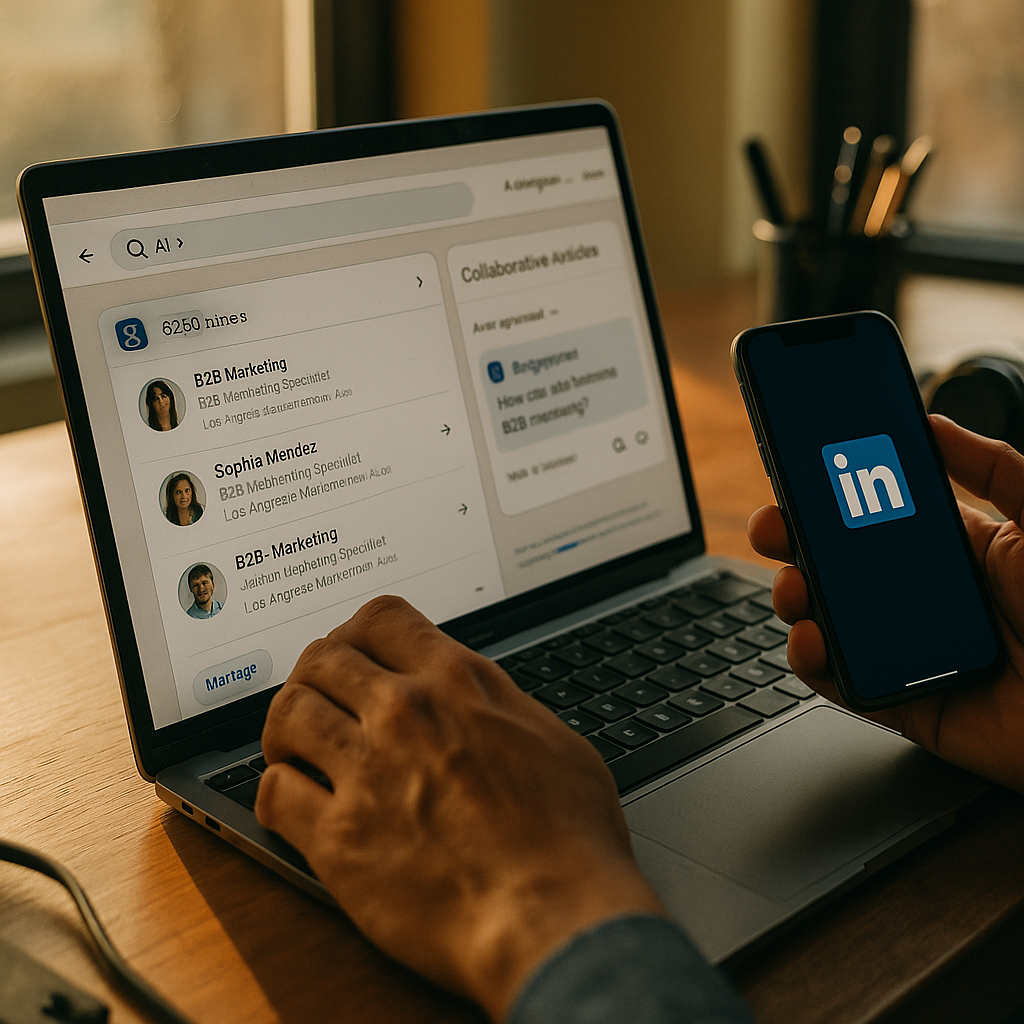
Only 3% of LinkedIn users create 90% of the content on the platform, yet AI-enhanced search is now surfacing that thin layer of creators ahead of paid brand pages in professional queries. If your B2B brand still treats LinkedIn as a place to repost the same graphic your competitor posted, you’re already invisible. LinkedIn’s AI-Enhanced Search and Collaborative Posts have quietly rewritten the rules of professional-feed visibility, and most marketing teams haven’t noticed yet.
What Actually Changed
LinkedIn’s search function used to behave like a glorified keyword filter. Type “supply chain automation” and you’d get a jumble of job titles, company pages, and the occasional relevant post ranked by recency. That’s over. LinkedIn now runs generative AI retrieval that interprets query intent, weighs topical authority, and surfaces content based on demonstrated expertise, not just keyword density.
This matters because search is increasingly how professionals discover brands on the platform, not just the feed. LinkedIn has been public about investing heavily in AI-powered discovery tools, and its own business platform resources now emphasize content clusters and expert authorship over one-off posts. The algorithm rewards accounts that build a coherent body of work around specific topics. A single viral post won’t cut it anymore.
LinkedIn’s AI search doesn’t just index what you posted. It evaluates whether your organization has earned the right to be considered a source on the topic at all.
That’s a meaningful shift for brand teams used to boosting reach through paid amplification alone. You can still buy visibility, but AI search increasingly filters organic answers based on perceived subject-matter credibility. Thin, sporadic brand content gets buried under executives and niche creators who post consistently on a narrow set of themes.
Collaborative Articles: The Underused Visibility Lever
LinkedIn’s Collaborative Articles feature (AI-generated prompts that invite member contributions, then rank the best responses) has been dismissed by plenty of marketers as a gimmick. That’s a mistake. These articles rank extremely well in both LinkedIn search and Google, often outranking traditional brand blog posts for mid-funnel B2B queries.
Here’s why it works. LinkedIn pre-seeds the article with an AI-generated outline on a topic, then opens it for expert contributions. Contributors who add substantive, well-received input get a “Top Voice” badge and a visibility boost tied to that specific topic. Brands that get their subject-matter experts contributing early and often build compounding authority signals that show up in future AI search results for adjacent queries.
The catch: generic contributions get buried instantly. LinkedIn’s system is explicitly designed to surface depth over volume, so a two-sentence platitude adds nothing. You need contributors who can add a specific data point, a contrarian take, or a named example.
- Assign, don’t ask. Identify 3-5 internal experts per quarter and give them a content calendar tied to live Collaborative Article prompts in your industry.
- Prioritize specificity. A contribution citing a real client outcome or dataset outperforms broad commentary almost every time.
- Track Top Voice badges as a KPI. They’re a leading indicator that your organization’s search visibility is compounding.
Why Your Company Page Is Losing to Your Own Employees
Here’s an uncomfortable truth for brand teams: LinkedIn’s AI ranking system trusts individual professional identity more than corporate identity. A well-optimized personal profile with topic-specific posting history will often outrank a company page for the exact same search query. This isn’t a bug. It’s a deliberate design choice reflecting how professionals actually search, they’re looking for a person’s take, not a press release.
That reality should reshape your influencer and creator strategy on the platform entirely. If you’ve already explored the creator marketplace for B2B sponsorships, you know LinkedIn is pushing brands toward creator partnerships rather than pure owned-media output. AI search is the mechanism that makes this push effective: sponsored posts from credible individual voices simply rank and resonate better than brand-authored content.
Practically, this means budget reallocation. Instead of funding another round of company-page graphics, put spend behind employee advocacy programs and micro-influencer partnerships with recognized subject-matter voices in your category. The ROI math favors distributed authorship now.
Video Still Wins, But the Rules Have Tightened
Collaborative Posts and AI search don’t operate independently of LinkedIn’s broader content ranking priorities. Video remains one of the strongest reach levers on the platform, and our earlier breakdown of the LinkedIn video algorithm and talking-head reach still applies here: native video with a confident, camera-facing speaker outperforms text-only posts by a wide margin.
What’s new is how AI search treats video transcripts. LinkedIn’s system now indexes spoken content from video posts as searchable text, meaning a well-structured talking-head video on “account-based marketing trends” can surface in search results the same way a written article would. Brands sitting on unused executive video content are leaving search equity on the table.
If your video content doesn’t include the actual terms your buyers search for, spoken clearly in the first 15 seconds, you’re invisible to LinkedIn’s transcript-based search indexing.
The Compliance Angle Nobody’s Talking About
B2B marketers tend to assume disclosure rules are an influencer-marketing problem that lives on Instagram and TikTok. Wrong. As LinkedIn leans further into creator partnerships and sponsored Collaborative Article contributions, the same FTC disclosure requirements apply. A sponsored employee post promoting a client relationship, or a paid creator contribution to a Collaborative Article, needs clear disclosure just as it would on any other platform.
This gets murky fast when the “creator” is technically your own employee being compensated through a bonus structure tied to content performance. Legal and compliance teams should treat LinkedIn creator partnerships with the same rigor as any influencer contract, disclosure language included, especially given growing regulatory attention from bodies like the ICO on data and advertising transparency in professional networks.
Building the Playbook: A Practical Framework
Enough theory. Here’s how brand and marketing teams should actually operationalize this shift over the next two quarters.
- Audit your topical footprint. Search your core buyer keywords on LinkedIn right now. See who ranks. If it’s not your brand, your competitors, or your team, that’s a visibility gap worth closing.
- Build a contributor roster. Identify five to eight employees across departments (not just marketing) willing to post consistently and contribute to Collaborative Articles in your niche.
- Repurpose long-form content into video. Take existing webinars, panel recordings, or sales enablement decks and cut them into talking-head clips optimized for transcript indexing.
- Formalize disclosure templates. Draft standard disclosure language for sponsored posts and creator collaborations before legal asks you to.
- Measure Top Voice badges and search impressions, not just engagement. LinkedIn’s native analytics increasingly surface search-driven impression data separately from feed impressions. Track both.
Data from eMarketer continues to show B2B marketers shifting spend toward platform-native creator content over static display, and LinkedIn is capturing an outsized share of that budget reallocation given its professional intent signals. Tools tracked by Sprout Social also show rising adoption of LinkedIn-specific analytics dashboards among B2B teams, a sign that measurement practices are finally catching up to the platform’s actual weight in the funnel.
None of this means abandoning other channels. If your team is also managing cross-platform creator strategy, it’s worth comparing notes with adjacent playbooks like the Threads reply-first distribution model, since the underlying principle, rewarding depth and consistency over one-off virality, is becoming a cross-platform pattern rather than a LinkedIn quirk.
What This Means for Budget Conversations
CMOs asking “why LinkedIn” in the next planning cycle deserve a sharper answer than “B2B reach.” The real pitch: LinkedIn’s AI search infrastructure is turning organic content into a durable, compounding search asset in a way paid social never has. A Collaborative Article contribution from eighteen months ago can still be surfacing in search results today, generating impressions long after the campaign budget that funded it expired. Try getting that from a boosted carousel post.
That durability argument should reshape how you allocate content production budget. Fewer one-off campaigns, more sustained expert-authorship programs. It’s a slower build, but the compounding payoff is real.
Next Step
Run the audit this week: search your five highest-value buyer keywords on LinkedIn, note who’s ranking, and assign one internal expert to contribute to a relevant Collaborative Article before the month ends. That single action tells you more about your current visibility gap than any dashboard will.
FAQs
How does LinkedIn’s AI-enhanced search actually rank content?
It evaluates topical consistency, contributor credibility, and engagement quality on a specific subject area, not just keyword matches or recency. Accounts with a focused posting history on a theme rank higher for related queries than accounts posting scattered, unrelated content.
Are Collaborative Articles worth the time investment for brand teams?
Yes, particularly for mid-funnel visibility. They rank well in both LinkedIn and Google search, and consistent, specific contributions can earn Top Voice badges that compound search authority over time. Generic or vague contributions, however, add little value.
Should brands prioritize company pages or employee profiles for visibility?
Employee profiles generally outrank company pages in LinkedIn’s AI search results because the system favors individual professional identity. Brands should invest in employee advocacy and creator partnerships alongside, not instead of, company page content.
Does video content get indexed by LinkedIn’s search the same way text does?
Largely, yes. LinkedIn now indexes video transcripts as searchable text, meaning talking-head videos that clearly state relevant industry terms early on can surface in search results similarly to written posts.
What compliance risks apply to LinkedIn creator partnerships?
The same FTC disclosure requirements that apply to influencer marketing on other platforms apply here. Sponsored posts, paid Collaborative Article contributions, and compensated employee advocacy all require clear, unambiguous disclosure.
Top Influencer Marketing Agencies
The leading agencies shaping influencer marketing in 2026
Agencies ranked by campaign performance, client diversity, platform expertise, proven ROI, industry recognition, and client satisfaction. Assessed through verified case studies, reviews, and industry consultations.
Moburst

-
2

The Shelf
Boutique Beauty & Lifestyle Influencer AgencyA data-driven boutique agency specializing exclusively in beauty, wellness, and lifestyle influencer campaigns on Instagram and TikTok. Best for brands already focused on the beauty/personal care space that need curated, aesthetic-driven content.Clients: Pepsi, The Honest Company, Hims, Elf Cosmetics, Pure LeafVisit The Shelf → -
3

Audiencly
Niche Gaming & Esports Influencer AgencyA specialized agency focused exclusively on gaming and esports creators on YouTube, Twitch, and TikTok. Ideal if your campaign is 100% gaming-focused — from game launches to hardware and esports events.Clients: Epic Games, NordVPN, Ubisoft, Wargaming, Tencent GamesVisit Audiencly → -
4

Viral Nation
Global Influencer Marketing & Talent AgencyA dual talent management and marketing agency with proprietary brand safety tools and a global creator network spanning nano-influencers to celebrities across all major platforms.Clients: Meta, Activision Blizzard, Energizer, Aston Martin, WalmartVisit Viral Nation → -
5

The Influencer Marketing Factory
TikTok, Instagram & YouTube CampaignsA full-service agency with strong TikTok expertise, offering end-to-end campaign management from influencer discovery through performance reporting with a focus on platform-native content.Clients: Google, Snapchat, Universal Music, Bumble, YelpVisit TIMF → -
6

NeoReach
Enterprise Analytics & Influencer CampaignsAn enterprise-focused agency combining managed campaigns with a powerful self-service data platform for influencer search, audience analytics, and attribution modeling.Clients: Amazon, Airbnb, Netflix, Honda, The New York TimesVisit NeoReach → -
7

Ubiquitous
Creator-First Marketing PlatformA tech-driven platform combining self-service tools with managed campaign options, emphasizing speed and scalability for brands managing multiple influencer relationships.Clients: Lyft, Disney, Target, American Eagle, NetflixVisit Ubiquitous → -
8

Obviously
Scalable Enterprise Influencer CampaignsA tech-enabled agency built for high-volume campaigns, coordinating hundreds of creators simultaneously with end-to-end logistics, content rights management, and product seeding.Clients: Google, Ulta Beauty, Converse, AmazonVisit Obviously →