


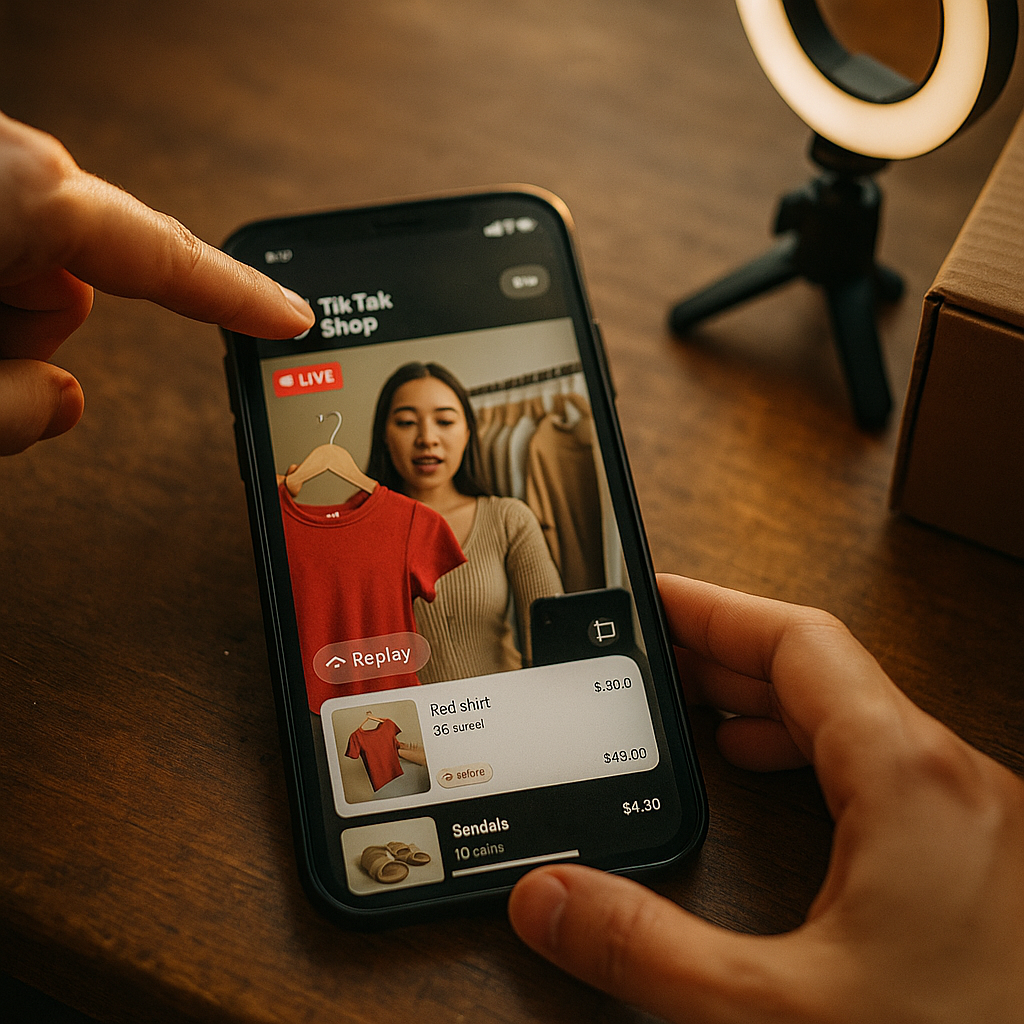
Most TikTok Shop lives generate 80% of their sales in the first three hours, then the replay dies quietly in a content graveyard nobody revisits. That’s a waste of production spend most brands can’t justify anymore. TikTok Shop live replay optimization is the discipline of taking that raw broadcast and re-engineering it into shoppable clips that keep selling for weeks, sometimes months, after the stream ends.
If your team treats live shopping as a one-and-done event, you’re leaving revenue on the table. This isn’t a hack. It’s an operational shift in how brands think about content lifecycle.
Why Replays Are the Most Underused Asset in Your Content Stack
Live shopping was pitched as an event format: hype it, air it, move on. But TikTok’s algorithm doesn’t care when content was made. It cares whether it converts right now. A 90-minute live stream sitting untouched in your Shop tab is a missed opportunity, not a finished project.
Brands like e.l.f. Cosmetics and Bloomchic have quietly built teams whose only job is chopping lives into micro-clips. Why? Because a single broadcast might contain a dozen genuinely good sales moments: a demo, an objection handled, a price reveal, a customer question answered on camera. Each of those is a standalone asset once you isolate it.
A 60-minute live stream can realistically yield 8 to 15 clip-worthy segments, each capable of independent distribution, independent performance, and independent shelf life in the algorithm.
Compare that to the cost of producing 8 to 15 separate pieces of short-form content from scratch. The math is obvious. Replay optimization is arbitrage on content you already paid for.
What Actually Makes a Clip “Evergreen” on TikTok Shop
Evergreen doesn’t mean timeless in a philosophical sense. It means the clip keeps earning impressions and conversions without a posting date attached to its relevance. Three things determine whether a clipped moment qualifies:
- Product-first framing. Clips centered on a product’s function, not a promo code or seasonal hook, survive longer. “This is how the serum absorbs” outlasts “50% off today only.”
- Self-contained context. A viewer landing on the clip cold should understand what’s happening in the first two seconds, no live-stream setup required.
- Native pacing. Live footage often runs slow. Clips need trimmed dead air, tightened captions, and a hook restructured for a scroll-first audience, not a stream-watching one.
Get those three right and a clip from a stream you ran last quarter can still be driving GMV today. Get them wrong and you’re just publishing recycled footage nobody asked for.
The Editing Workflow Brands Are Standardizing On
Most mid-market and enterprise teams running frequent TikTok Shop lives have settled into a fairly consistent post-production loop. It looks something like this:
- Pull the raw replay within 24 hours, before relevance decays further.
- Use timestamp markers from the live chat (spikes in comments or add-to-cart activity usually flag the strongest moments).
- Cut 3 to 5 candidate clips per hour of footage, each 15 to 45 seconds.
- Re-caption for sound-off viewing, since a large share of Shop traffic scrolls muted.
- Tag each clip to the specific product SKU in Shop, not just the general storefront.
- Stagger publishing over 10 to 14 days instead of dumping all clips at once.
That staggered release step matters more than most teams realize. Dumping every clip on day one just makes them compete against each other for the same algorithmic attention window. Spacing them out gives each one a clean shot at discovery.
This kind of systemized clipping pairs naturally with how TikTok Shop category managers are now recruiting creators specifically for repeatable live formats, since a creator who knows their broadcast will be mined for weeks of clips has real incentive to structure the stream around clean, quotable moments rather than rambling filler.
The Attribution Problem Nobody Talks About
Here’s the friction point: TikTok Shop’s native analytics dashboard reports live performance and short-video performance in ways that don’t always cleanly separate clipped-from-live content versus organically shot short-form. If your reporting stack can’t distinguish “this sale came from a replay clip” versus “this sale came from a fresh video,” you can’t prove the ROI of the clipping workflow to finance.
Brands solving this well are tagging clips with unique product links or using TikTok’s affiliate tracking parameters at the SKU level, then cross-referencing against Shop’s creator and content performance reports weekly, not monthly. Waiting a full month to check clip performance means you’ve already missed the window to double down on what’s working.
This is a smaller-scale version of a challenge brands are already fighting on other platforms. The attribution gaps that Instagram native checkout creates for creator sales are structurally similar: platforms are happy to show you gross performance, less happy to hand you the granular data that lets you optimize spend decisions with confidence.
Should You Re-Cut Every Live, or Just the High Performers?
Not every stream deserves the clipping treatment. A live that flopped in real time (low viewership, weak chat engagement, sluggish sell-through) usually won’t magically perform better as a clip. Garbage in, garbage out still applies.
The teams getting the best return are triaging lives before committing edit resources:
- Streams with above-average concurrent viewers get full clip treatment (8 to 15 cuts).
- Mid-performing streams get a lighter pass (2 to 4 cuts focused only on the clearest sales moments).
- Underperforming streams get archived without editing spend, full stop.
This triage approach saves editing hours for the content that’s actually earned a second life. It also forces a useful discipline back onto the live production side: if your team knows a mediocre stream won’t get clipped, there’s more incentive to nail the broadcast itself the first time.
Creator Incentives Need to Shift Too
Most creator contracts for TikTok Shop lives compensate for the live event itself: a flat fee, a commission rate, sometimes a bonus tied to GMV during the broadcast window. Almost none of them account for the fact that the brand is about to extract weeks of additional content value from that same session.
That’s a negotiation gap worth closing before it becomes a dispute. Some brands are now building a small usage-rights clause specifically for replay clipping into their live streaming agreements, similar to how paid usage rights get negotiated for UGC. It’s a minor line item, but it prevents the awkward conversation three weeks later when a creator notices their face is still driving sales in a clip they didn’t know was being reused.
This mirrors a broader shift happening across formats where AGC ad generated content is repurposed well beyond its original posting window. If a brand is extracting extended value from a creator’s likeness or voice, fair compensation structures need to reflect that, both for legal safety and for maintaining creator relationships worth renewing.
The brands winning at replay optimization treat it as a content supply chain, not a post-production afterthought, with clear triage rules, tagging standards, and creator compensation built in from the contract stage.
Where This Fits Into a Bigger Live Commerce Strategy
TikTok Shop isn’t the only place brands are rethinking live-to-clip pipelines. Amazon Live sellers are running similar playbooks, and understanding the Amazon Live algorithm gives useful cross-platform context on how live signals get weighted differently than static video. Whatnot sellers face a comparable calculus around formats and sell-through rates, and the clipping discipline translates well across both ecosystems.
The core principle holds regardless of platform: live commerce generates a burst of raw footage, and the brands that win are the ones with a repeatable system for mining that footage long after the stream ends, not the ones who just move on to the next broadcast.
According to industry data tracked by eMarketer, social commerce continues to grow as a share of total ecommerce spend, and platforms are investing heavily in the infrastructure to support it, per TikTok’s own advertising resources. That growth curve makes the case for treating replays as durable inventory even stronger. Brands relying on generic best practices from HubSpot or Sprout Social on video repurposing will find the same core logic applies here, just accelerated by TikTok Shop’s shorter content half-life.
Measuring Success Without Overcomplicating It
You don’t need a data science team to track this well. Three metrics tell you almost everything worth knowing:
- Clip-attributed GMV as a percentage of total post-live sales, tracked weekly for at least a month after the original broadcast.
- Cost per clip produced versus cost per equivalent fresh short-form video, to justify (or kill) the editing headcount.
- Clip lifespan, meaning how many days a given clip keeps generating meaningful impressions before performance flatlines.
If clip-attributed GMV is climbing while cost per clip is falling, you’ve built a genuinely efficient system. If clips are dying within 48 hours regardless of editing quality, the problem probably isn’t the edit, it’s the underlying live content itself.
A Quick Reality Check on Compliance
Repurposed clips still need to meet FTC disclosure standards if they contain paid partnerships or affiliate relationships, and that obligation doesn’t expire just because the content is being reused. Review the FTC’s endorsement guidelines before your team assumes an old disclosure still counts once footage gets re-edited and re-published under a new caption. It usually needs to be reaffirmed in the new post, not just implied by the original stream.
Next Step
Pull your last three TikTok Shop lives, triage them by concurrent viewership and sell-through, and clip only the top performers this week. Track clip-attributed GMV separately for 30 days before deciding whether to build a permanent editing workflow around it.
FAQs
How soon after a live stream should I start clipping replays?
Within 24 to 48 hours. Relevance and chat context decay fast, and delaying the edit makes it harder to identify which moments actually drove engagement or sales.
Do TikTok Shop replay clips need fresh captions or disclosures?
Yes. If the original live included a paid partnership or affiliate disclosure, that disclosure needs to be reaffirmed in the re-edited clip, not assumed to carry over automatically.
How many clips can realistically come from one live stream?
A well-run 60 to 90 minute live typically yields 8 to 15 usable clips, though underperforming streams may only justify 2 to 4 lighter edits, or none at all.
Should creators be paid extra for replay clipping?
Most brands are now negotiating usage-rights language specifically for clipping into live streaming contracts upfront, rather than treating it as a separate ask after the fact.
What’s the biggest mistake brands make with replay optimization?
Publishing every clip at once instead of staggering releases. Clips compete against each other for algorithmic attention when dumped simultaneously, reducing the performance of all of them.
FAQs
How soon after a live stream should I start clipping replays?
Within 24 to 48 hours. Relevance and chat context decay fast, and delaying the edit makes it harder to identify which moments actually drove engagement or sales.
Do TikTok Shop replay clips need fresh captions or disclosures?
Yes. If the original live included a paid partnership or affiliate disclosure, that disclosure needs to be reaffirmed in the re-edited clip, not assumed to carry over automatically.
How many clips can realistically come from one live stream?
A well-run 60 to 90 minute live typically yields 8 to 15 usable clips, though underperforming streams may only justify 2 to 4 lighter edits, or none at all.
Should creators be paid extra for replay clipping?
Most brands are now negotiating usage-rights language specifically for clipping into live streaming contracts upfront, rather than treating it as a separate ask after the fact.
What’s the biggest mistake brands make with replay optimization?
Publishing every clip at once instead of staggering releases. Clips compete against each other for algorithmic attention when dumped simultaneously, reducing the performance of all of them.
Top Influencer Marketing Agencies
The leading agencies shaping influencer marketing in 2026
Agencies ranked by campaign performance, client diversity, platform expertise, proven ROI, industry recognition, and client satisfaction. Assessed through verified case studies, reviews, and industry consultations.
Moburst

-
2

The Shelf
Boutique Beauty & Lifestyle Influencer AgencyA data-driven boutique agency specializing exclusively in beauty, wellness, and lifestyle influencer campaigns on Instagram and TikTok. Best for brands already focused on the beauty/personal care space that need curated, aesthetic-driven content.Clients: Pepsi, The Honest Company, Hims, Elf Cosmetics, Pure LeafVisit The Shelf → -
3

Audiencly
Niche Gaming & Esports Influencer AgencyA specialized agency focused exclusively on gaming and esports creators on YouTube, Twitch, and TikTok. Ideal if your campaign is 100% gaming-focused — from game launches to hardware and esports events.Clients: Epic Games, NordVPN, Ubisoft, Wargaming, Tencent GamesVisit Audiencly → -
4

Viral Nation
Global Influencer Marketing & Talent AgencyA dual talent management and marketing agency with proprietary brand safety tools and a global creator network spanning nano-influencers to celebrities across all major platforms.Clients: Meta, Activision Blizzard, Energizer, Aston Martin, WalmartVisit Viral Nation → -
5

The Influencer Marketing Factory
TikTok, Instagram & YouTube CampaignsA full-service agency with strong TikTok expertise, offering end-to-end campaign management from influencer discovery through performance reporting with a focus on platform-native content.Clients: Google, Snapchat, Universal Music, Bumble, YelpVisit TIMF → -
6

NeoReach
Enterprise Analytics & Influencer CampaignsAn enterprise-focused agency combining managed campaigns with a powerful self-service data platform for influencer search, audience analytics, and attribution modeling.Clients: Amazon, Airbnb, Netflix, Honda, The New York TimesVisit NeoReach → -
7

Ubiquitous
Creator-First Marketing PlatformA tech-driven platform combining self-service tools with managed campaign options, emphasizing speed and scalability for brands managing multiple influencer relationships.Clients: Lyft, Disney, Target, American Eagle, NetflixVisit Ubiquitous → -
8

Obviously
Scalable Enterprise Influencer CampaignsA tech-enabled agency built for high-volume campaigns, coordinating hundreds of creators simultaneously with end-to-end logistics, content rights management, and product seeding.Clients: Google, Ulta Beauty, Converse, AmazonVisit Obviously →