


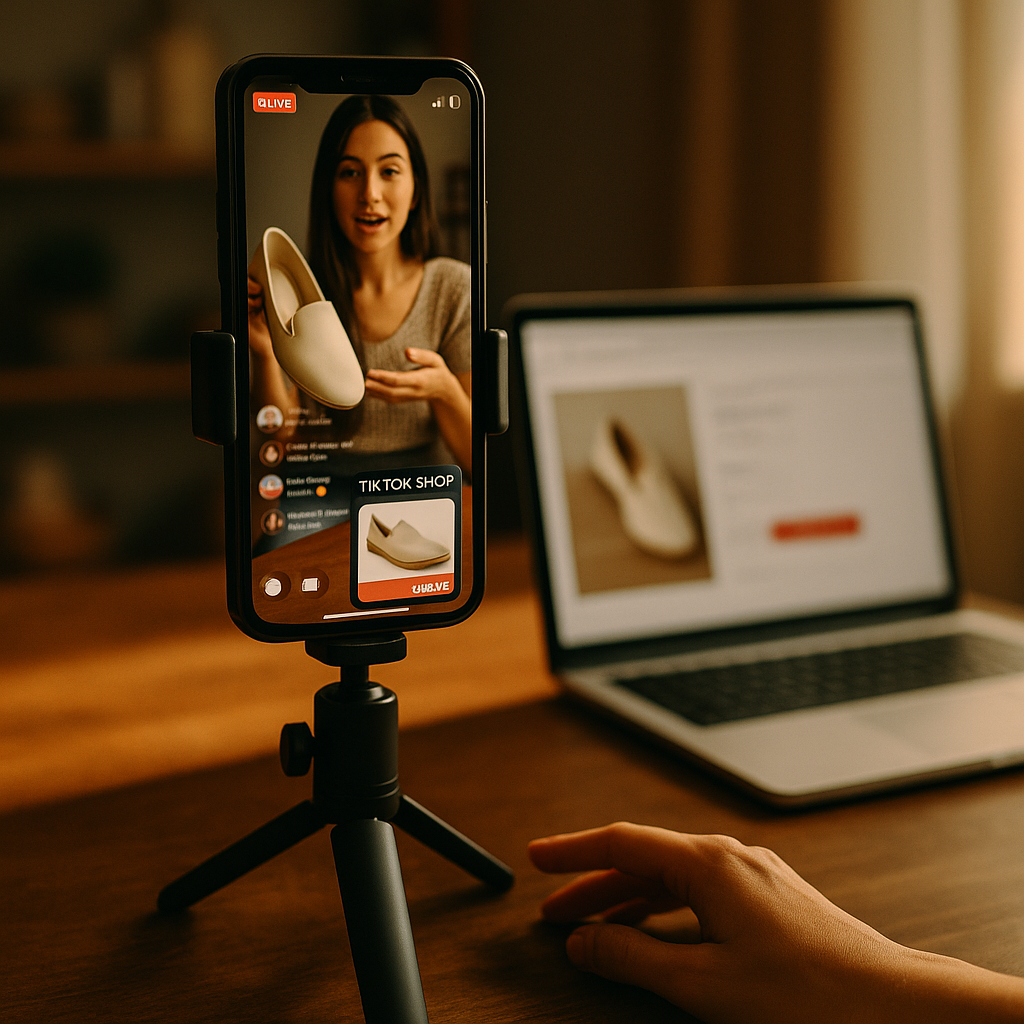
Ten times. That’s the conversion gap between livestream shopping and the static product page your team probably spent six figures optimizing this year. While brands keep A/B testing button colors and hero images, livestream shopping is quietly converting at roughly 30%, compared to the 2-3% most static e-commerce pages manage on a good day. If that number doesn’t make your CMO sit up, nothing will.
The Number That Should Reframe Your Q1 Budget Conversation
Let’s start with the uncomfortable math. A typical static product listing page converts somewhere between 2% and 3%, depending on category, price point, and how much traffic is actually qualified versus just curious. TikTok Shop Live sessions, by contrast, are converting at close to 30% among engaged viewers, according to platform data highlighted in recent reporting on TikTok Shop live-selling conversion. That’s not an incremental lift. That’s a different category of performance entirely.
Why does this matter to you specifically, the person who owns the media plan? Because most brands are still allocating budget as if static and live formats compete on equal footing. They don’t. Static ads are built for discovery and consideration. Livestream shopping compresses discovery, consideration, and purchase into a single session, often under 60 minutes, with a host actively answering objections in real time. That compression is where the conversion advantage lives.
Livestream shopping isn’t a better ad format. It’s a different funnel entirely — one that collapses discovery, trust-building, and checkout into a single continuous session.
Why Static Ads Keep Losing This Fight
Static creative has a structural problem: it asks the viewer to do all the cognitive work. Is this the right size? Does it work with my skin tone? Is the shipping legit? A static image or even a well-produced UGC video can gesture at answers, but it can’t respond to a specific viewer’s hesitation the moment it surfaces.
Livestream hosts can. They read comments, address objections instantly, and create urgency through limited-time bundles or flash pricing that disappears when the stream ends. This is the same psychological mechanism that made QVC and HSN billion-dollar businesses decades before TikTok existed — except now it’s algorithmically distributed to exactly the audience segment most likely to buy, and checkout happens without leaving the app.
There’s also a trust dimension that shouldn’t be underestimated. Viewers watching a live stream know it’s not pre-recorded and edited into perfection. That imperfection reads as authenticity. A stumble, a genuine question answered on the spot, a host trying on three sizes because the first one didn’t fit — none of that survives a static product shoot, but it’s exactly what builds the confidence to click “buy.”
What This Means for Budget Allocation, Concretely
Here’s where it gets practical. If your paid social budget is still split 70/30 in favor of static and short-form ad units, you are almost certainly leaving conversion efficiency on the table. That doesn’t mean zeroing out static entirely — top-of-funnel awareness still needs broad-reach creative. But the mid-to-lower funnel dollars, the ones currently funding retargeting carousels and product-feed ads, deserve a hard look.
Consider a simple reallocation model:
- Awareness (upper funnel): Keep static and short-form video here. Livestream isn’t built for cold discovery at scale.
- Consideration and conversion (mid-to-lower funnel): Shift 20-40% of this spend toward scheduled TikTok Shop Live sessions, ideally run with creators who already have category credibility.
- Retention and repeat purchase: Test live shopping for restock drops, limited editions, or loyalty-exclusive sessions. This is where livestream’s urgency mechanics do the most work.
Brands that have made this shift are reporting it not as a marginal optimization but as a genuine channel reallocation, consistent with broader trends showing creator economy budgets climbing sharply as CFOs approve spend that was unthinkable three years ago.
The Operational Case, Not Just the ROI Case
ROI gets the headline, but operational efficiency is the quieter win. A single livestream session can move inventory that would otherwise require weeks of static ad rotation, multiple creative refreshes, and constant A/B testing. Production costs are lower too: no elaborate photo shoot, no six-week creative approval cycle. You need a host, a product, a script outline, and a platform that supports checkout inside the stream.
That said, this isn’t a “set it and forget it” channel. Livestream shopping demands real-time moderation, inventory sync, and a host who can actually sell, not just read a script. Get any of those wrong and the format underperforms fast. This is also why brands increasingly treat creators less like campaign talent and more like business partners running their own commerce operation — the host is effectively your sales floor manager for that hour.
Risk Mitigation: What Could Go Wrong
Livestream shopping isn’t risk-free, and pretending otherwise does your budget conversation a disservice. Three risks deserve explicit planning:
- Platform concentration risk. TikTok Shop’s dominance in live commerce is real, but regulatory uncertainty around the platform in various markets means brands shouldn’t build an entire commerce strategy on one app. Diversifying creator and platform strategy remains sound practice, as outlined in guidance on platform risk and creator diversification.
- Compliance and disclosure. Live commerce moves fast, which makes FTC disclosure requirements easy to skip in the moment. Hosts need pre-briefed disclosure language, not improvised mentions. Review current guidance from the Federal Trade Commission before scaling live-selling programs, particularly around endorsement rules for paid hosts.
- Inventory and fulfillment strain. A successful stream can sell through inventory in minutes. Nothing kills the format faster than a host promising stock that isn’t there. Sync your commerce backend before you scale spend, not after.
Picking the Right Creators for Live Formats
Not every creator who performs well in static or short-form content translates to live selling. The skill set is different: live hosting demands quick thinking, product knowledge, and the ability to keep energy up for 30-90 minutes without a script to fall back on. Brands should look for creators who already run their own live sessions organically, even at small scale, because that’s a signal they can sustain the format.
This is also where the shift toward performance-based and equity-style creator deals becomes relevant. Paying a flat fee for a live session that could generate 10x the conversion of a static post undervalues what the creator brings to the table. Some brands are already restructuring compensation to reflect this, as covered in reporting on creator equity deals replacing flat sponsorship fees. A revenue-share or bonus-on-conversion structure aligns incentives better than a flat rate ever could for a format this performance-driven.
Mid-tier creators, sometimes called the creator middle class, are proving especially effective in live commerce. They have smaller but denser, more trusting audiences, and viewers are more likely to take a purchase recommendation seriously from someone who feels reachable rather than a mega-celebrity. Research on mid-tier creators outperforming top talent on ROI and retention supports building live commerce rosters around this segment rather than chasing the biggest name available.
How to Test This Without Blowing Up Your Media Plan
You don’t need to reallocate 40% of budget on day one. Start smaller and build the case internally with your own data.
- Run one live session per month for a single hero product, using a mid-tier creator already familiar with your category.
- Track conversion rate, average order value, and cost per acquisition against your best-performing static ad for the same product over the same period.
- Compare not just conversion but return rate. Live commerce audiences often have lower return rates because expectations are set more accurately during the stream.
- Scale spend only after two or three sessions confirm the pattern holds for your specific catalog and audience.
Industry-wide, this mirrors a broader reallocation already underway. The IAB’s forecast on creators outranking TV and display in media plans signals that budget owners across categories are already treating creator-led commerce as a primary channel, not an experimental sidebar. Livestream shopping is simply the most conversion-dense expression of that shift.
Worth checking your platform’s own tools too. TikTok’s advertising resources include creator matching and live shopping analytics that make it easier to run these tests without building new infrastructure from scratch. And for teams benchmarking format performance more broadly, eMarketer’s commerce research is a useful sanity check against platform-reported numbers.
The Takeaway
Don’t wait for a perfect internal case study to start testing. Run one live session against your best static creative this quarter, measure conversion and return rate side by side, and let the data — not the org chart — decide where next quarter’s budget goes.
FAQs
What conversion rate does TikTok Shop Live actually deliver compared to static e-commerce?
Reported figures place TikTok Shop Live sessions at roughly 30% conversion among engaged viewers, compared to 2-3% for typical static e-commerce product pages. Actual results vary by category, host quality, and pricing strategy.
Should brands cut static ad spend entirely in favor of livestream shopping?
No. Static creative still performs well for upper-funnel awareness and broad discovery. The stronger strategy is reallocating mid-to-lower funnel budget, the dollars currently spent on retargeting and conversion-focused static ads, toward livestream formats.
What’s the biggest operational risk with livestream shopping?
Inventory and fulfillment strain. A successful stream can sell through stock in minutes, and promising unavailable inventory during a live session damages trust fast. Backend commerce systems need to sync in real time before scaling spend.
How should brands structure creator compensation for live-selling sessions?
Flat fees often undervalue the performance potential of live commerce. Many brands are shifting toward revenue-share or bonus-on-conversion structures that align creator incentives with actual sales outcomes.
Are mid-tier creators better suited to livestream shopping than top-tier influencers?
Often, yes. Mid-tier creators typically have denser, more trusting audience relationships, which translates into stronger purchase intent during live sessions compared to the broader, less personally connected reach of top-tier talent.
What compliance issues should brands watch for in live commerce?
FTC disclosure requirements still apply during live sessions, and the fast-paced nature of live selling makes it easy for hosts to forget proper disclosure language. Brief hosts in advance and review current endorsement guidance from the FTC before scaling programs.
Top Influencer Marketing Agencies
The leading agencies shaping influencer marketing in 2026
Agencies ranked by campaign performance, client diversity, platform expertise, proven ROI, industry recognition, and client satisfaction. Assessed through verified case studies, reviews, and industry consultations.
Moburst

-
2

The Shelf
Boutique Beauty & Lifestyle Influencer AgencyA data-driven boutique agency specializing exclusively in beauty, wellness, and lifestyle influencer campaigns on Instagram and TikTok. Best for brands already focused on the beauty/personal care space that need curated, aesthetic-driven content.Clients: Pepsi, The Honest Company, Hims, Elf Cosmetics, Pure LeafVisit The Shelf → -
3

Audiencly
Niche Gaming & Esports Influencer AgencyA specialized agency focused exclusively on gaming and esports creators on YouTube, Twitch, and TikTok. Ideal if your campaign is 100% gaming-focused — from game launches to hardware and esports events.Clients: Epic Games, NordVPN, Ubisoft, Wargaming, Tencent GamesVisit Audiencly → -
4

Viral Nation
Global Influencer Marketing & Talent AgencyA dual talent management and marketing agency with proprietary brand safety tools and a global creator network spanning nano-influencers to celebrities across all major platforms.Clients: Meta, Activision Blizzard, Energizer, Aston Martin, WalmartVisit Viral Nation → -
5

The Influencer Marketing Factory
TikTok, Instagram & YouTube CampaignsA full-service agency with strong TikTok expertise, offering end-to-end campaign management from influencer discovery through performance reporting with a focus on platform-native content.Clients: Google, Snapchat, Universal Music, Bumble, YelpVisit TIMF → -
6

NeoReach
Enterprise Analytics & Influencer CampaignsAn enterprise-focused agency combining managed campaigns with a powerful self-service data platform for influencer search, audience analytics, and attribution modeling.Clients: Amazon, Airbnb, Netflix, Honda, The New York TimesVisit NeoReach → -
7

Ubiquitous
Creator-First Marketing PlatformA tech-driven platform combining self-service tools with managed campaign options, emphasizing speed and scalability for brands managing multiple influencer relationships.Clients: Lyft, Disney, Target, American Eagle, NetflixVisit Ubiquitous → -
8

Obviously
Scalable Enterprise Influencer CampaignsA tech-enabled agency built for high-volume campaigns, coordinating hundreds of creators simultaneously with end-to-end logistics, content rights management, and product seeding.Clients: Google, Ulta Beauty, Converse, AmazonVisit Obviously →