


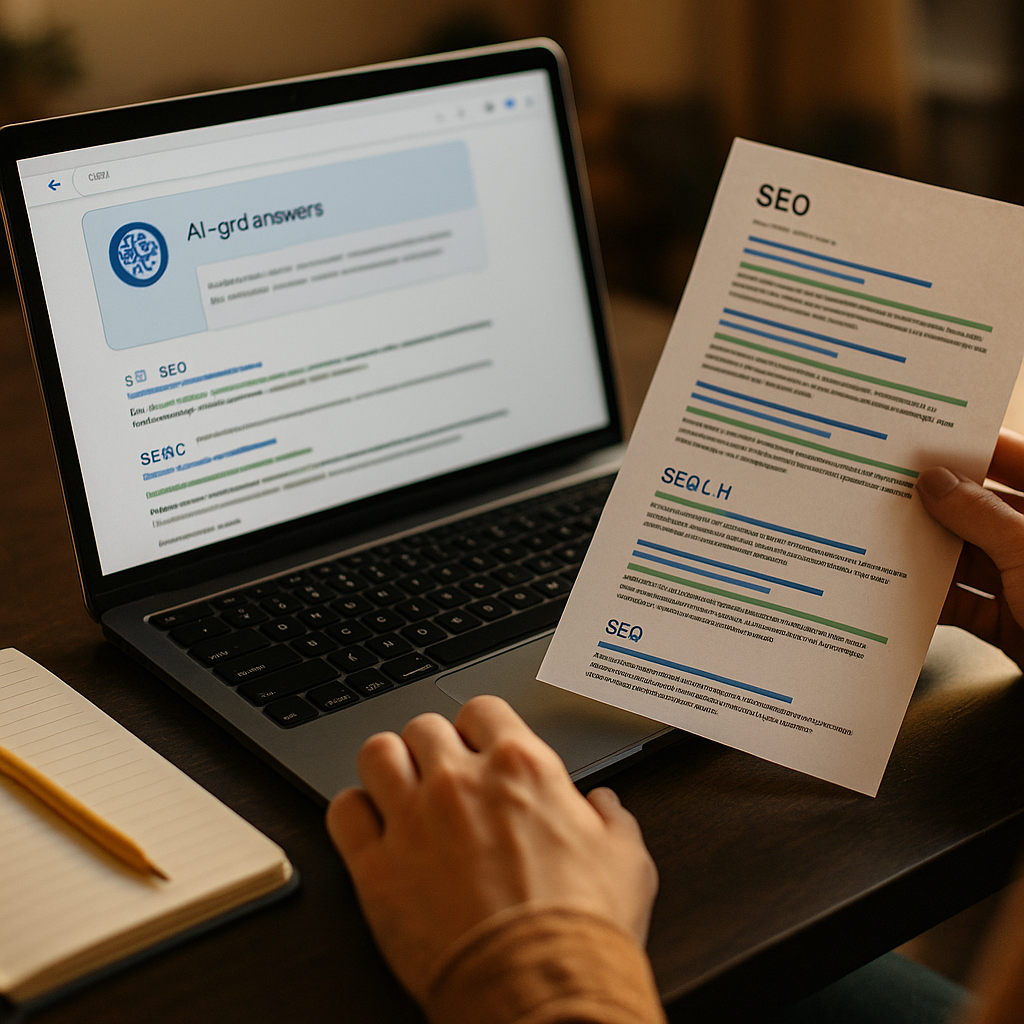
Sixty percent of Google searches now end without a click — the user gets their answer straight from an AI Overview and moves on. If your content strategy still revolves around ranking for keywords, you’re optimizing for a search engine that’s quietly disappearing. The rise of AI Overviews and Google’s Search Generative Experience isn’t a minor algorithm tweak. It’s a fundamental rewiring of how information gets surfaced, credited, and consumed.
The Click Is No Longer the Prize
For two decades, SEO ran on a simple contract: rank high, earn the click, convert the visitor. That contract is breaking down. When Google generates a synthesized answer at the top of the results page, most users never scroll to the traditional blue links below it. eMarketer and other analysts have flagged the steady decline in organic click-through rates as AI-generated summaries expand across more query categories, from product comparisons to how-to searches to brand research.
This matters enormously for B2B marketers. Your prospects are researching vendors, comparing platforms, and forming opinions about your brand inside an AI summary they never click through to verify. If your content isn’t the source material behind that summary, you’re invisible at the exact moment a buying decision is forming.
The new SEO battle isn’t for the click. It’s for the citation. Being the source an AI model quotes matters more than being the link a human clicks.
Why Keyword Density Stopped Working
Traditional SEO rewarded content built around keyword clusters, header hierarchies designed for crawlers, and internal linking structures meant to pass authority. That playbook still has value, but it’s no longer sufficient. AI Overviews and generative search don’t rank pages the way classic search did. They synthesize an answer from multiple sources, often pulling specific sentences, statistics, or definitions rather than entire pages.
That changes the unit of optimization. You’re no longer optimizing a page to rank. You’re optimizing individual claims, facts, and passages to be extractable, verifiable, and quotable. Google’s own guidance on how AI features work in Search emphasizes that these systems prioritize content that directly and clearly answers a query, with strong signals of accuracy and source credibility.
Marketers who’ve spent years chasing keyword volume are discovering that volume doesn’t equal visibility anymore. A page can rank on page one and still contribute zero citations inside an AI Overview if its content isn’t structured for extraction.
What “Citation-Ready” Actually Means
Citation-ready content has a few defining traits, and none of them are exotic. They just require discipline most content teams have never had to apply:
- Direct, declarative statements. Answer the question in the first sentence of a section, not the fifth paragraph.
- Structured data markup. Schema.org markup (FAQPage, HowTo, Article) gives AI crawlers explicit signals about content type and intent.
- Verifiable, sourced claims. Stats need attribution. Unsourced numbers get filtered out or, worse, hallucinated into something inaccurate.
- Consistent entity definitions. Your brand, product names, and category terms need to be defined the same way across every page, so models don’t get conflicting signals.
- Clear authorship and expertise signals. Bylines, credentials, and citations of primary research strengthen the EEAT profile these systems weigh heavily.
None of this is groundbreaking on its own. What’s new is that these elements now directly determine whether your content gets pulled into an AI answer, not just whether it ranks.
The Overlap Between GEO, AEO, and Classic SEO
Marketing teams are drowning in acronyms right now: SEO, GEO (Generative Engine Optimization), AEO (Answer Engine Optimization). The distinctions matter less than the underlying shift they all describe. Our team broke down the practical differences in AEO versus GEO, but the short version: AEO focuses on winning featured answers and voice results, GEO focuses on being cited inside generative AI outputs like AI Overviews, ChatGPT, and Gemini. Both require the same structural foundation — clean data, clear answers, verifiable sourcing.
If you’re building a content strategy today, don’t treat these as separate workstreams. Build one structured content foundation and let it serve all three channels simultaneously.
Measuring Something That Doesn’t Give You a Click
Here’s the uncomfortable operational question every CMO is facing: how do you measure ROI on visibility that never produces a session in Google Analytics? Traditional attribution models weren’t built for this. If your brand gets cited in an AI Overview but the user never clicks through, your analytics dashboard shows nothing. Zero traffic. Zero conversion path. Yet brand awareness, consideration, and trust just got built anyway.
This is why “share of model” tracking is becoming a serious discipline rather than a nice-to-have. Instead of just measuring organic rank, teams are now tracking how often their brand, product, and claims appear across AI Overviews, ChatGPT, Gemini, and Claude responses for target queries. We covered the mechanics of this in building a share-of-model dashboard, and it’s quickly becoming as standard as rank tracking was a decade ago.
Budget conversations follow the same logic. If leadership asks “what did we get for our content spend this quarter,” the answer increasingly needs to include AI visibility metrics alongside traffic and conversions. Otherwise you’re reporting on half the picture.
The Hallucination Risk Nobody’s Pricing In
There’s a sharper edge to this shift that marketing leaders can’t ignore: if your content isn’t clear, structured, and unambiguous, AI models will fill the gaps themselves — sometimes incorrectly. A vague product description, an outdated spec sheet, or an unclear pricing page can get summarized inaccurately inside an AI Overview, and that misinformation reaches your prospect before you even know it happened.
This isn’t hypothetical. Retrieval-augmented generation systems pull from whatever data is available, and when that data is thin or contradictory, hallucinated claims slip through. We’ve written extensively about this risk in the context of RAG vendor evaluation and how product teams can clean up product data feeds to prevent it. The brands treating this as a governance issue, not just an SEO issue, are the ones protecting themselves from reputational damage they didn’t cause but will still have to clean up.
Unstructured content doesn’t just lose visibility in AI search. It creates a vacuum that generative models fill with guesses, and guesses about your brand are rarely flattering.
What Structured Content Actually Looks Like in Practice
Let’s get tactical. A B2B SaaS company selling marketing automation software used to write a 2,000-word blog post targeting “best marketing automation platform” and hope it ranked. Today, the same company needs to think in terms of extractable units:
- A clear, one-sentence definition of what the product does, usable verbatim by an AI summarizer.
- A comparison table with structured data markup, so pricing and feature differences are machine-readable.
- FAQ blocks answering the specific questions buyers type into ChatGPT or Google, marked up with FAQPage schema.
- Named sources and dates for every statistic, so the claim is verifiable rather than orphaned.
- Consistent terminology across the website, help docs, and press materials, so there’s no conflicting signal for the model to resolve.
This is a heavier lift than writing a blog post and hoping for backlinks. But it’s also more durable. Structured, well-sourced content tends to hold up across algorithm updates and model retraining cycles, because it’s not dependent on gaming a ranking signal. It’s dependent on being genuinely useful and easy to parse.
Audit Before You Rebuild
Most content teams don’t need to start from zero. They need an audit. Which pages already contain citation-ready claims? Which are vague, unsourced, or structurally messy? A structured audit — similar in spirit to the ones outlined in our AI visibility audit buyer’s guide — gives you a prioritized list instead of a vague mandate to “fix SEO.” Start with your highest-intent commercial pages: pricing, comparison, and product pages where a hallucinated claim would do the most damage.
Where This Is Heading
Google isn’t slowing this down. AI Overviews are expanding into more query types, and Search Generative Experience features continue rolling into core search results rather than staying in a separate experiment. Statista’s search engine market data shows Google still commands the overwhelming majority of global search share, which means whatever Google does with AI Overviews effectively becomes the new baseline for organic visibility strategy, whether marketers are ready or not.
The organizations adapting fastest aren’t necessarily the ones with the biggest content teams. They’re the ones treating structured data, source credibility, and claim accuracy as core infrastructure rather than an SEO afterthought. That mindset shift, more than any specific schema tag or formatting trick, is what separates brands that show up in AI answers from brands that quietly disappear from the conversation.
Next step: pull your five highest-traffic commercial pages and check them against one question — could an AI model quote a single sentence from this page and get it completely right? If the answer is no, that’s your starting point.
FAQs
What are AI Overviews and how do they differ from traditional search results?
AI Overviews are Google’s AI-generated summaries that appear above traditional search results, synthesizing information from multiple sources into a single answer. Unlike traditional blue links, they often eliminate the need for users to click through to a website at all.
Does traditional SEO still matter if AI Overviews dominate search?
Yes, but its role has changed. Technical SEO fundamentals like site speed, crawlability, and mobile usability still matter, but ranking alone no longer guarantees visibility. Content also needs to be structured and sourced clearly enough for AI systems to extract and cite it directly.
How can a brand track visibility inside AI Overviews if there’s no click data?
Marketers are building “share of model” tracking systems that monitor how often a brand or product is mentioned across AI Overviews, ChatGPT, Gemini, and other generative platforms for target queries, independent of traditional click-through analytics.
What is the biggest risk of not optimizing for generative search?
Beyond lost visibility, there’s a hallucination risk: if your content is vague or unstructured, AI models may generate inaccurate summaries about your brand, products, or pricing, and prospects will see that misinformation before ever reaching your site.
What’s the difference between GEO, AEO, and SEO?
SEO focuses on ranking in traditional search results. AEO (Answer Engine Optimization) focuses on winning featured answers and voice search results. GEO (Generative Engine Optimization) focuses on being cited inside AI-generated outputs like AI Overviews and chatbot responses. All three increasingly rely on the same structured, well-sourced content foundation.
Top Influencer Marketing Agencies
The leading agencies shaping influencer marketing in 2026
Agencies ranked by campaign performance, client diversity, platform expertise, proven ROI, industry recognition, and client satisfaction. Assessed through verified case studies, reviews, and industry consultations.
Moburst

-
2

The Shelf
Boutique Beauty & Lifestyle Influencer AgencyA data-driven boutique agency specializing exclusively in beauty, wellness, and lifestyle influencer campaigns on Instagram and TikTok. Best for brands already focused on the beauty/personal care space that need curated, aesthetic-driven content.Clients: Pepsi, The Honest Company, Hims, Elf Cosmetics, Pure LeafVisit The Shelf → -
3

Audiencly
Niche Gaming & Esports Influencer AgencyA specialized agency focused exclusively on gaming and esports creators on YouTube, Twitch, and TikTok. Ideal if your campaign is 100% gaming-focused — from game launches to hardware and esports events.Clients: Epic Games, NordVPN, Ubisoft, Wargaming, Tencent GamesVisit Audiencly → -
4

Viral Nation
Global Influencer Marketing & Talent AgencyA dual talent management and marketing agency with proprietary brand safety tools and a global creator network spanning nano-influencers to celebrities across all major platforms.Clients: Meta, Activision Blizzard, Energizer, Aston Martin, WalmartVisit Viral Nation → -
5

The Influencer Marketing Factory
TikTok, Instagram & YouTube CampaignsA full-service agency with strong TikTok expertise, offering end-to-end campaign management from influencer discovery through performance reporting with a focus on platform-native content.Clients: Google, Snapchat, Universal Music, Bumble, YelpVisit TIMF → -
6

NeoReach
Enterprise Analytics & Influencer CampaignsAn enterprise-focused agency combining managed campaigns with a powerful self-service data platform for influencer search, audience analytics, and attribution modeling.Clients: Amazon, Airbnb, Netflix, Honda, The New York TimesVisit NeoReach → -
7

Ubiquitous
Creator-First Marketing PlatformA tech-driven platform combining self-service tools with managed campaign options, emphasizing speed and scalability for brands managing multiple influencer relationships.Clients: Lyft, Disney, Target, American Eagle, NetflixVisit Ubiquitous → -
8

Obviously
Scalable Enterprise Influencer CampaignsA tech-enabled agency built for high-volume campaigns, coordinating hundreds of creators simultaneously with end-to-end logistics, content rights management, and product seeding.Clients: Google, Ulta Beauty, Converse, AmazonVisit Obviously →