


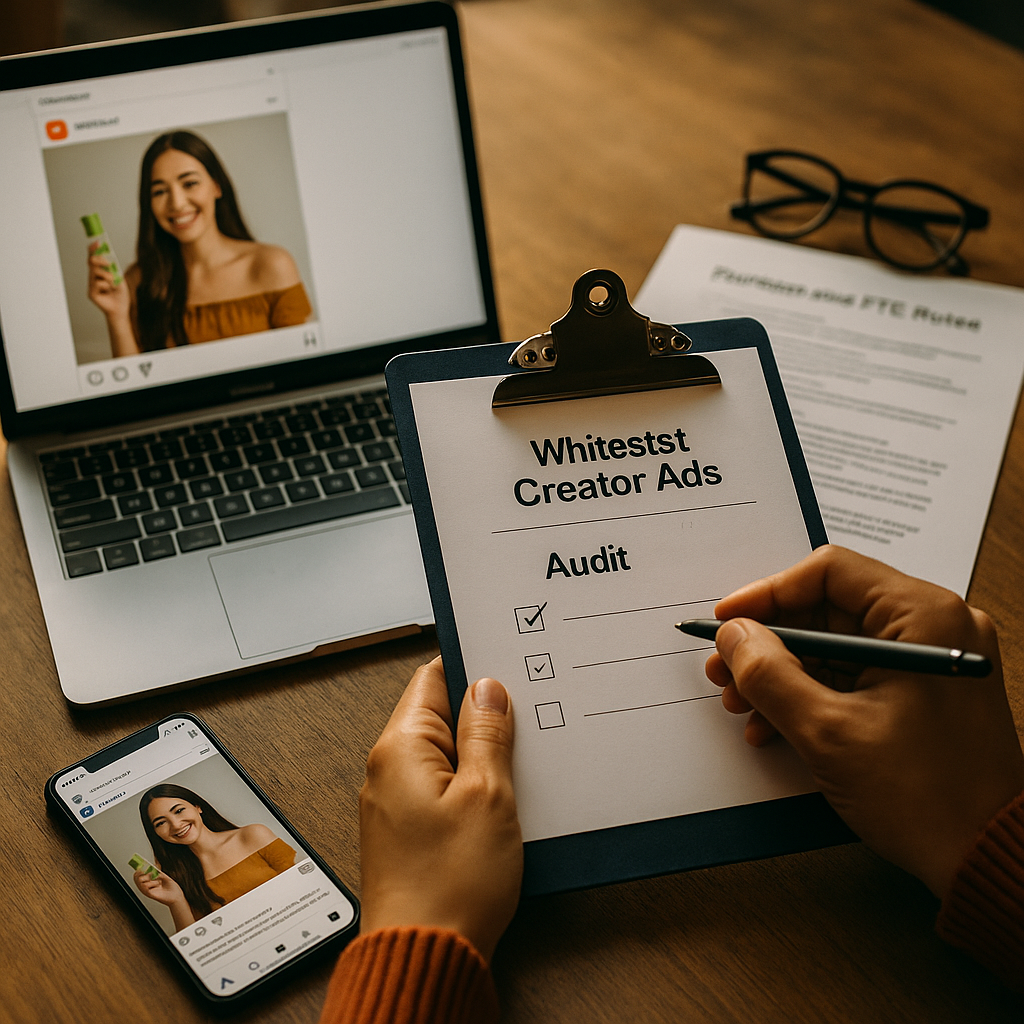
Seventy percent of the whitelisted ad spend Meta processes through Partnership Ads never gets seen by the creator whose face is on it. That’s not a compliance footnote — that’s the whole risk. When a brand runs paid media through a creator’s handle, two separate rulebooks apply at once, and most legal teams only check one. A proper legal framework for auditing whitelisted creator ads has to run platform policy and FTC endorsement law side by side, not sequentially, because a post that passes Meta’s review can still get a brand hit with a five-figure penalty.
Why Whitelisting Breaks the Old Audit Model
Whitelisting (or “creator partnership ads,” in Meta’s rebranded language) lets a brand run paid media through a creator’s account without the creator ever touching the campaign. The creator grants ad account access. The brand’s media team builds, targets, and optimizes. The creator’s name and face carry the message, but the creator may never review the final creative before it hits a feed.
That workflow is efficient. It’s also a compliance blind spot. Traditional influencer audits assume the creator posts organically, then a legal or compliance reviewer checks the post after publication. Whitelisted ads skip that step entirely. Media buyers iterate creative in real time, sometimes producing a dozen ad variants from a single piece of creator content. Each variant is a distinct legal artifact. Each one needs its own disclosure check.
If your review process treats a whitelisted ad campaign as one asset instead of a dozen, you’re auditing the wrong thing.
Two Rulebooks, One Ad Unit
Here’s the structural problem. Platform policy and FTC endorsement law aren’t the same body of rules, and they don’t fail the same way.
Meta, TikTok, and Snap each require a “paid partnership” or branded content tag when a business relationship exists. Miss that tag and the platform can throttle delivery, strip the ad from the library, or suspend the ad account. That’s a platform-side penalty — fast, automated, and largely invisible to legal teams until spend disappears.
The FTC operates on a different axis entirely. Its Endorsement Guides require disclosure to be clear, conspicuous, and understandable to an average consumer — regardless of what tag the platform applies. A brand can dutifully check Meta’s branded content box and still violate FTC guidance if the disclosure is buried, in a color that blends with the background, or placed where a “see more” truncation hides it. The FTC’s own guidance has been explicit that platform-native disclosure tools don’t automatically satisfy federal requirements.
So you can pass platform review and still fail federal law. You can also satisfy the FTC’s plain-language standard and still get flagged by an automated platform scanner that’s looking for a specific tag format. These are parallel systems that occasionally overlap and often don’t. An audit framework that checks only one is only half a framework.
What “Simultaneous” Actually Means in Practice
Simultaneous doesn’t mean two people reviewing the same ad at the same time. It means building a single checklist with two parallel columns, so no ad clears review until both boxes are checked by the same reviewer, in the same pass. In practice that looks like:
- Platform column: Correct branded content/partnership ad tag applied at the ad level, not just the organic post it was sourced from. Creator handle correctly tagged in the ad unit metadata. Compliance with platform-specific claim restrictions (health, finance, alcohol categories carry extra rules on most platforms).
- FTC column: Disclosure appears before the “more” cutoff on captions. Disclosure uses unambiguous language (“#ad,” “paid partnership”) rather than vague terms like “#sp” or “#collab” alone. Disclosure is legible against video backgrounds and not buried at the end of a long hashtag string. Claims made about the product are substantiated and match what the brand could legally claim in its own advertising.
Run both columns against every ad variant, not just the “hero” version. A campaign with fifteen creative permutations needs fifteen checks, because platform tagging and FTC-style disclosure legibility can both silently break when copy gets shortened or a video gets recut for a 9×16 placement.
Build the Audit Trail Before You Need It
Every whitelisting agreement should generate a paper trail automatically, not on request. Regulators and platform trust-and-safety teams both want evidence of process, not just good intentions after the fact.
What does that trail look like? A timestamped record of: the creator’s original disclosure language, the exact ad copy and creative served, the targeting parameters, and the reviewer sign-off with both platform and FTC checklist items marked. This isn’t bureaucratic overkill. It’s the difference between “we have a policy” and “we can prove compliance for this specific impression that ran on this specific date.” For related infrastructure, see how brands are building audit trails for marketing decisions before automated systems act on them — the same logic applies when a media buyer, not an algorithm, is making the call.
Whitelisted ads also frequently get auto-optimized by platform algorithms after launch — new headlines, new thumbnails, new CTA text, all generated and rotated without human review. That’s where the audit trail becomes essential, and where most legal frameworks fall short. If the platform’s own AI is remixing creative post-launch, your original disclosure check may no longer apply to what’s actually running. Build a recurring re-audit trigger, not a one-time gate. Similar dynamics are already forcing legal teams to rethink consent scope, as covered in AI remix consent clauses — the underlying risk (content changing after approval) is structurally identical.
Contract Language That Actually Does Something
Most whitelisting agreements have a boilerplate disclosure clause that says something like “creator agrees to comply with all applicable laws.” That’s not a framework. That’s a hope.
A working contract needs specificity: who has final sign-off authority on ad-level disclosure placement, what happens if the platform algorithm alters creative post-approval, and who bears liability if a disclosure gets stripped during a resize or edit. Brands running high-volume whitelisting programs should treat this the same way they’d treat live-selling script audits — a documented, repeatable review process rather than a one-off legal sign-off buried in a master services agreement.
Indemnification language matters more here than in standard creator deals, because the brand — not the creator — usually controls the final ad unit. If a media buyer strips a disclosure tag during creative iteration, that’s a brand-side failure, not a creator-side one. Contracts that assign all disclosure liability to the creator in a whitelisting arrangement are, frankly, not enforceable in the way brands think they are, since the creator often has zero visibility into the final ad. This mirrors the liability-shifting problems already documented in indemnification clauses for autonomous creator agents, where control and liability need to sit with whoever actually makes the final call.
Who Owns the Audit Function?
This is where most programs stall. Media buying teams optimize for CTR and CPA. Legal teams optimize for risk avoidance. Neither group naturally owns a recurring, ad-level compliance check, and so it falls through the org chart entirely until a regulator or platform trust team catches it first.
The fix isn’t hiring more lawyers. It’s building a lightweight, recurring dashboard that flags disclosure gaps before ads scale spend — something closer to a creator compliance dashboard than a legal memo. Give media buyers a real-time checklist tool, not a PDF policy they read once during onboarding. Escalation paths matter too: when a whitelisted ad gets flagged, someone needs clear authority to pull spend within the hour, not after a committee meeting. That’s the same structural gap addressed in frameworks for FTC compliance escalation — speed of response is itself a compliance control.
What the Data Says About Enforcement Risk
The FTC has been increasingly active on endorsement enforcement, and platform-level automated detection has gotten sharper too. Meta’s ad library now surfaces branded content flags publicly, meaning any competitor, journalist, or regulator can search for unflagged sponsored content in seconds. According to eMarketer, influencer marketing spend continues to climb well past traditional display budgets, and whitelisted/paid-partnership formats are the fastest-growing subset of that spend — which means the enforcement surface area is growing right alongside the budgets.
That growth is exactly why this can’t stay a manual, ad-hoc process. Brands scaling whitelisting programs across dozens of creators and hundreds of ad variants per quarter need a system, not a reviewer’s best judgment on a Friday afternoon.
Adjacent Risk Zones Brands Overlook
A few areas deserve specific mention because they compound the dual-audit problem:
- Creator equity or commission arrangements. If the creator has any financial upside beyond a flat fee, disclosure obligations don’t disappear just because the payment structure is unusual. This applies directly to equity-paid creators running whitelisted campaigns.
- Cross-border campaigns. A whitelisted ad running in both the US and EU needs to satisfy FTC rules and separate EU disclosure standards simultaneously — see how this plays out in the EU-US compliance matrix for youth-targeted content specifically.
- AI-generated or AI-edited creative. If any part of the ad copy was AI co-written or the visuals were AI-touched, that introduces a third disclosure layer worth checking against guidance on AI co-written scripts.
None of these are edge cases anymore. They’re standard features of a modern whitelisting program, and each one adds a third or fourth column to what should already be a two-column audit.
The Practical Next Step
Stop treating platform policy checks and FTC disclosure review as two separate approval gates run by two separate teams. Merge them into a single ad-level checklist, apply it to every creative variant (not just the hero asset), and store the sign-off record automatically so you can prove compliance retroactively — because eventually, someone will ask you to.
FAQs
What’s the difference between platform policy violations and FTC violations in whitelisted ads?
Platform violations relate to a network’s own rules — like missing branded content tags — and typically result in ad rejection or account restrictions. FTC violations relate to federal consumer protection law and can result in formal investigations or penalties, regardless of whether the platform’s own tagging requirements were met.
Does Meta’s branded content tag satisfy FTC disclosure requirements automatically?
No. The FTC has consistently indicated that platform-native tools are not automatically sufficient. Disclosures must independently meet the “clear and conspicuous” standard, meaning placement, visibility, and language matter beyond whatever tag a platform applies.
Who is legally responsible when a whitelisted ad lacks proper disclosure — the brand or the creator?
Both parties can face exposure, but brands typically carry greater practical risk in whitelisting arrangements because they control the final ad unit, targeting, and any creative edits made after the creator’s original post.
How often should whitelisted ad campaigns be re-audited after launch?
Any time the platform’s algorithm generates new creative variants, headlines, or thumbnails, or any time a media buyer manually edits the asset, the ad should be re-checked. Treat re-audits as recurring, not one-time.
Can AI-optimized ad variants break disclosure compliance without anyone noticing?
Yes. Automated creative optimization tools can crop, resize, or shorten copy in ways that strip or obscure disclosure language, which is why ad-level (not campaign-level) auditing matters.
FAQs
What’s the difference between platform policy violations and FTC violations in whitelisted ads?
Platform violations relate to a network’s own rules — like missing branded content tags — and typically result in ad rejection or account restrictions. FTC violations relate to federal consumer protection law and can result in formal investigations or penalties, regardless of whether the platform’s own tagging requirements were met.
Does Meta’s branded content tag satisfy FTC disclosure requirements automatically?
No. The FTC has consistently indicated that platform-native tools are not automatically sufficient. Disclosures must independently meet the “clear and conspicuous” standard, meaning placement, visibility, and language matter beyond whatever tag a platform applies.
Who is legally responsible when a whitelisted ad lacks proper disclosure — the brand or the creator?
Both parties can face exposure, but brands typically carry greater practical risk in whitelisting arrangements because they control the final ad unit, targeting, and any creative edits made after the creator’s original post.
How often should whitelisted ad campaigns be re-audited after launch?
Any time the platform’s algorithm generates new creative variants, headlines, or thumbnails, or any time a media buyer manually edits the asset, the ad should be re-checked. Treat re-audits as recurring, not one-time.
Can AI-optimized ad variants break disclosure compliance without anyone noticing?
Yes. Automated creative optimization tools can crop, resize, or shorten copy in ways that strip or obscure disclosure language, which is why ad-level (not campaign-level) auditing matters.
Top Influencer Marketing Agencies
The leading agencies shaping influencer marketing in 2026
Agencies ranked by campaign performance, client diversity, platform expertise, proven ROI, industry recognition, and client satisfaction. Assessed through verified case studies, reviews, and industry consultations.
Moburst

-
2

The Shelf
Boutique Beauty & Lifestyle Influencer AgencyA data-driven boutique agency specializing exclusively in beauty, wellness, and lifestyle influencer campaigns on Instagram and TikTok. Best for brands already focused on the beauty/personal care space that need curated, aesthetic-driven content.Clients: Pepsi, The Honest Company, Hims, Elf Cosmetics, Pure LeafVisit The Shelf → -
3

Audiencly
Niche Gaming & Esports Influencer AgencyA specialized agency focused exclusively on gaming and esports creators on YouTube, Twitch, and TikTok. Ideal if your campaign is 100% gaming-focused — from game launches to hardware and esports events.Clients: Epic Games, NordVPN, Ubisoft, Wargaming, Tencent GamesVisit Audiencly → -
4

Viral Nation
Global Influencer Marketing & Talent AgencyA dual talent management and marketing agency with proprietary brand safety tools and a global creator network spanning nano-influencers to celebrities across all major platforms.Clients: Meta, Activision Blizzard, Energizer, Aston Martin, WalmartVisit Viral Nation → -
5

The Influencer Marketing Factory
TikTok, Instagram & YouTube CampaignsA full-service agency with strong TikTok expertise, offering end-to-end campaign management from influencer discovery through performance reporting with a focus on platform-native content.Clients: Google, Snapchat, Universal Music, Bumble, YelpVisit TIMF → -
6

NeoReach
Enterprise Analytics & Influencer CampaignsAn enterprise-focused agency combining managed campaigns with a powerful self-service data platform for influencer search, audience analytics, and attribution modeling.Clients: Amazon, Airbnb, Netflix, Honda, The New York TimesVisit NeoReach → -
7

Ubiquitous
Creator-First Marketing PlatformA tech-driven platform combining self-service tools with managed campaign options, emphasizing speed and scalability for brands managing multiple influencer relationships.Clients: Lyft, Disney, Target, American Eagle, NetflixVisit Ubiquitous → -
8

Obviously
Scalable Enterprise Influencer CampaignsA tech-enabled agency built for high-volume campaigns, coordinating hundreds of creators simultaneously with end-to-end logistics, content rights management, and product seeding.Clients: Google, Ulta Beauty, Converse, AmazonVisit Obviously →