


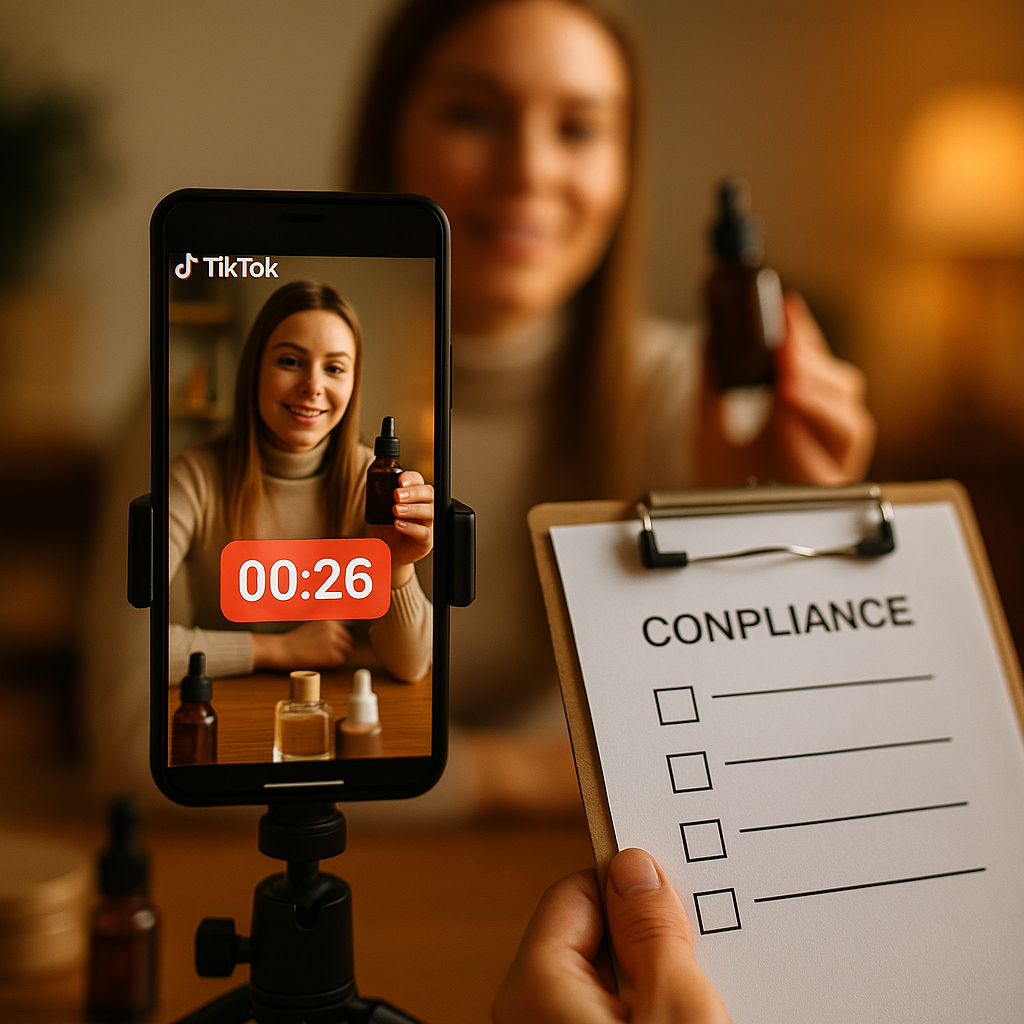
The FTC handed out more than $300 million in penalties tied to dark patterns and false urgency claims last year. Now overlay that number on the TikTok Shop Live boom, where countdown timers flash on nearly every stream. If your brand is running TikTok Shop Live events with a ticking clock and no documentation behind it, you’re not selling urgency. You’re inviting an investigation.
This isn’t theoretical anymore. The FTC’s updated guidance on deceptive urgency claims explicitly calls out countdown timers that reset, restart, or don’t reflect real inventory or pricing constraints. TikTok Shop’s live format makes this risk worse, not better, because streams move fast, hosts improvise, and nobody’s screenshotting the timer at minute 47 to check if it matches minute 12.
Why Countdown Timers Are Now a Legal Liability, Not Just a UX Tactic
Urgency has always worked. Scarcity sells. That’s not new. What’s new is the FTC’s willingness to treat fake countdowns as a per-violation issue under the FTC Act’s Section 5 unfairness and deception standards, plus the updated FTC guidance on dark patterns. A timer that hits zero and then quietly resets to another 24 hours isn’t a UX quirk. It’s evidence.
Brands assume TikTok Shop’s native timer tool is compliance-safe because TikTok built it. Wrong assumption. The platform gives you the mechanism, not the legal cover. TikTok’s TikTok Shop seller guidelines require accurate promotional claims, but they don’t audit whether your “only 3 left” banner reflects actual stock. That’s on you.
A countdown timer that doesn’t correspond to a real, enforced deadline is a deceptive urgency claim regardless of intent — the FTC doesn’t require proof you meant to mislead, only that a reasonable consumer would be misled.
Add the affiliate and creator layer, and the exposure multiplies. Hosts riffing live, saying “this deal disappears when the clock hits zero,” while the backend shows the same discount code still active two days later? That’s a paper trail auditors love to find.
The Core Compliance Checklist
Here’s the operational framework we’re seeing legal and compliance teams adopt for TikTok Shop Live events. Treat this as a pre-flight checklist, not a one-time policy document.
- Timer accuracy verification. Before any live event, confirm the countdown timer’s end state matches an actual, irreversible change: price increase, inventory removal, or offer expiration. If the “deal” is still live after the clock hits zero, don’t run the timer.
- No silent resets. If a promotion needs to extend, document why, and disclose the extension live and in post-event materials. A timer that mysteriously restarts without explanation is the single most common trigger for FTC scrutiny.
- Inventory claims tied to real numbers. “Only 12 left” must reflect actual TikTok Shop inventory data at the moment it’s said, not a static script line. Pull real-time stock counts into host talking points, or don’t use the claim at all.
- Script pre-approval for urgency language. Every phrase implying scarcity or time pressure should go through legal or compliance review before the host says it live. This is where a lot of brands fall down, because live selling scripts get treated as loose guidelines rather than compliance documents.
- Recording retention. Save the full stream, including chat replies and pinned comments, for at least the FTC’s typical lookback window. If a complaint surfaces months later, you need the raw footage, not a highlight reel.
- Disclosure of sponsored or affiliate status. Independent of the timer issue, hosts and creators must clearly disclose material connections per FTC endorsement guides. Urgency claims stacked on undisclosed sponsorships compound the risk.
- Post-event reconciliation. After the stream ends, compare what was said against what actually happened: did the price go up, did the item sell out, did the offer end. Log discrepancies and correct them publicly if needed.
None of this is glamorous work. But it’s cheaper than a consent decree.
Who Owns This Inside the Organization?
Ambiguity kills compliance programs. If your legal team assumes marketing is monitoring live scripts, and marketing assumes legal has already blessed the timer copy, you have a gap. Someone specific needs to own the checklist above, ideally a compliance lead who sits in on live event planning, not just post-mortems.
Some brands are formalizing this with a dedicated live-commerce compliance role, similar to how they structured oversight for scripted UGC. If that sounds like overkill, consider that TikTok Shop GMV in the US crossed multiple billions annually according to eMarketer estimates, and live shopping is the fastest-growing slice of it. Scale brings scrutiny.
Building the Script Review Layer
Countdown timers rarely fail in isolation. They fail alongside scripted urgency language that hosts read off a teleprompter or memorize from a brand brief. If you haven’t already built a review process for live-selling scripts, start there. We’ve covered the mechanics of this in detail in our piece on live-selling script audits, which walks through how to flag risky phrasing before it goes live.
The short version: every script needs a compliance pass that specifically hunts for absolute claims (“guaranteed,” “last chance,” “never again”), unverifiable scarcity (“almost gone”), and time pressure that isn’t backed by a real deadline. Build a banned-phrase list. Update it based on what FTC enforcement actions have flagged in the past cycle.
For brands running frequent live events, a standing checklist template pays for itself fast. We built one specifically around timer mechanics in our TikTok Shop Live compliance checklist for timers, which breaks the process into pre-event, live, and post-event stages.
Governance Beyond a Single Event
One clean live event doesn’t make you compliant. Regulators and plaintiffs’ attorneys look for patterns. If your brand runs weekly TikTok Shop Lives with recurring hosts, you need governance that scales across every session, not a one-off review before a big launch.
This is where a lot of brands underinvest. They’ll lawyer-check the flagship holiday event and then let a rotating cast of affiliate creators freestyle countdown language on smaller weekly streams. Guess which ones get flagged in complaints? The unmonitored ones. Our analysis on live-shopping governance structures digs into how brands are extending oversight to commission-based and equity-compensated hosts, who have their own incentive to oversell urgency because their pay is tied to conversion velocity.
The riskiest countdown timer isn’t the one your in-house team runs. It’s the one an independent affiliate sets up on their own stream using your product, with your brand tagged, and zero legal review in the chain.
That risk extends into broader creator compliance infrastructure. If you’re not already tracking disclosure and claims violations systematically, a creator compliance dashboard that flags urgency language and disclosure gaps in near real time is worth the build cost. Manual spot-checks don’t scale once you’re running dozens of live events a month across a creator roster.
What About AI-Assisted Live Scripts?
An increasing number of brands feed live-selling talking points through AI script generators to speed up production. That’s fine, until the model outputs urgency language nobody vetted. AI tools trained on generic sales copy will happily generate “hurry, this won’t last” phrasing because it’s statistically common in training data, not because it’s legally sound for your specific promotion.
If your team uses AI co-writing for live scripts, route the output through the same compliance layer as human-written scripts. Our coverage of FTC rules on AI-assisted scripts covers this exact overlap, and it applies directly to countdown-timer copy generated on the fly for live events.
Documentation Is Your Only Real Defense
If the FTC or a state attorney general comes knocking, the question isn’t “did you mean to deceive anyone.” It’s “can you prove the timer was accurate.” Intent is nearly irrelevant under Section 5. Evidence is everything.
That means your compliance file for every live event should include: the pre-approved script with urgency language highlighted, a timestamp log of the actual promotion’s start and end, inventory snapshots at key moments, the full stream recording, and sign-off from whoever approved the urgency claims. Store it somewhere retrievable for at least two years. Regulatory lookback periods are longer than most marketing teams assume, and consumer class actions can surface complaints well after a promotion ends.
Brands running high-frequency live commerce should treat this the way finance teams treat audit trails: assume someone will ask for the paperwork eventually, and build the habit of generating it as a byproduct of the workflow, not an afterthought. Our piece on audit trails for marketing decisions outlines a documentation structure that adapts well to live-event compliance, even outside the AI context it was originally written for.
None of this requires slowing your live commerce program to a crawl. It requires building the checklist into your pre-event runbook so compliance isn’t a gate you hit after the damage is done, but a step baked into how you launch every stream.
Frequently Asked Questions
Does a TikTok Shop countdown timer need to match a real inventory limit?
Yes. If the timer implies scarcity, whether it’s framed as limited stock or a limited-time price, the claim must reflect an actual, verifiable constraint at the time it’s made. A timer disconnected from real inventory or pricing changes is a deceptive urgency claim under FTC standards.
Can we extend a TikTok Shop Live promotion after the timer hits zero?
You can, but only if you disclose the extension clearly and document the business reason. Silently resetting a timer without explanation is one of the most common patterns the FTC flags as deceptive.
Who is liable if an affiliate creator uses a fake countdown on their own TikTok Shop Live?
Both the creator and the brand can face liability, especially if the brand supplied the promotional messaging, approved the offer terms, or benefited from the sale. Brands should extend compliance review to affiliate and commission-based hosts, not just in-house talent.
What records should brands keep after a TikTok Shop Live event?
Retain the pre-approved script, full stream recording, inventory snapshots taken during the event, timestamp logs of promotional start and end times, and sign-off documentation for any urgency claims used. Keep these for at least two years given regulatory and litigation lookback periods.
Does FTC enforcement require proof the brand intended to deceive consumers?
No. Under Section 5 of the FTC Act, deception is evaluated based on whether a reasonable consumer would be misled, not on the brand’s intent. This makes documentation and accuracy far more important than good-faith assumptions about messaging.
Visible FAQ (duplicate for schema requirement)
Build the checklist into your live-event runbook now, before your next flagship drop, not after a complaint forces the rewrite. The brands avoiding FTC scrutiny aren’t the ones skipping urgency tactics; they’re the ones who can prove every timer told the truth.
Top Influencer Marketing Agencies
The leading agencies shaping influencer marketing in 2026
Agencies ranked by campaign performance, client diversity, platform expertise, proven ROI, industry recognition, and client satisfaction. Assessed through verified case studies, reviews, and industry consultations.
Moburst

-
2

The Shelf
Boutique Beauty & Lifestyle Influencer AgencyA data-driven boutique agency specializing exclusively in beauty, wellness, and lifestyle influencer campaigns on Instagram and TikTok. Best for brands already focused on the beauty/personal care space that need curated, aesthetic-driven content.Clients: Pepsi, The Honest Company, Hims, Elf Cosmetics, Pure LeafVisit The Shelf → -
3

Audiencly
Niche Gaming & Esports Influencer AgencyA specialized agency focused exclusively on gaming and esports creators on YouTube, Twitch, and TikTok. Ideal if your campaign is 100% gaming-focused — from game launches to hardware and esports events.Clients: Epic Games, NordVPN, Ubisoft, Wargaming, Tencent GamesVisit Audiencly → -
4

Viral Nation
Global Influencer Marketing & Talent AgencyA dual talent management and marketing agency with proprietary brand safety tools and a global creator network spanning nano-influencers to celebrities across all major platforms.Clients: Meta, Activision Blizzard, Energizer, Aston Martin, WalmartVisit Viral Nation → -
5

The Influencer Marketing Factory
TikTok, Instagram & YouTube CampaignsA full-service agency with strong TikTok expertise, offering end-to-end campaign management from influencer discovery through performance reporting with a focus on platform-native content.Clients: Google, Snapchat, Universal Music, Bumble, YelpVisit TIMF → -
6

NeoReach
Enterprise Analytics & Influencer CampaignsAn enterprise-focused agency combining managed campaigns with a powerful self-service data platform for influencer search, audience analytics, and attribution modeling.Clients: Amazon, Airbnb, Netflix, Honda, The New York TimesVisit NeoReach → -
7

Ubiquitous
Creator-First Marketing PlatformA tech-driven platform combining self-service tools with managed campaign options, emphasizing speed and scalability for brands managing multiple influencer relationships.Clients: Lyft, Disney, Target, American Eagle, NetflixVisit Ubiquitous → -
8

Obviously
Scalable Enterprise Influencer CampaignsA tech-enabled agency built for high-volume campaigns, coordinating hundreds of creators simultaneously with end-to-end logistics, content rights management, and product seeding.Clients: Google, Ulta Beauty, Converse, AmazonVisit Obviously →