


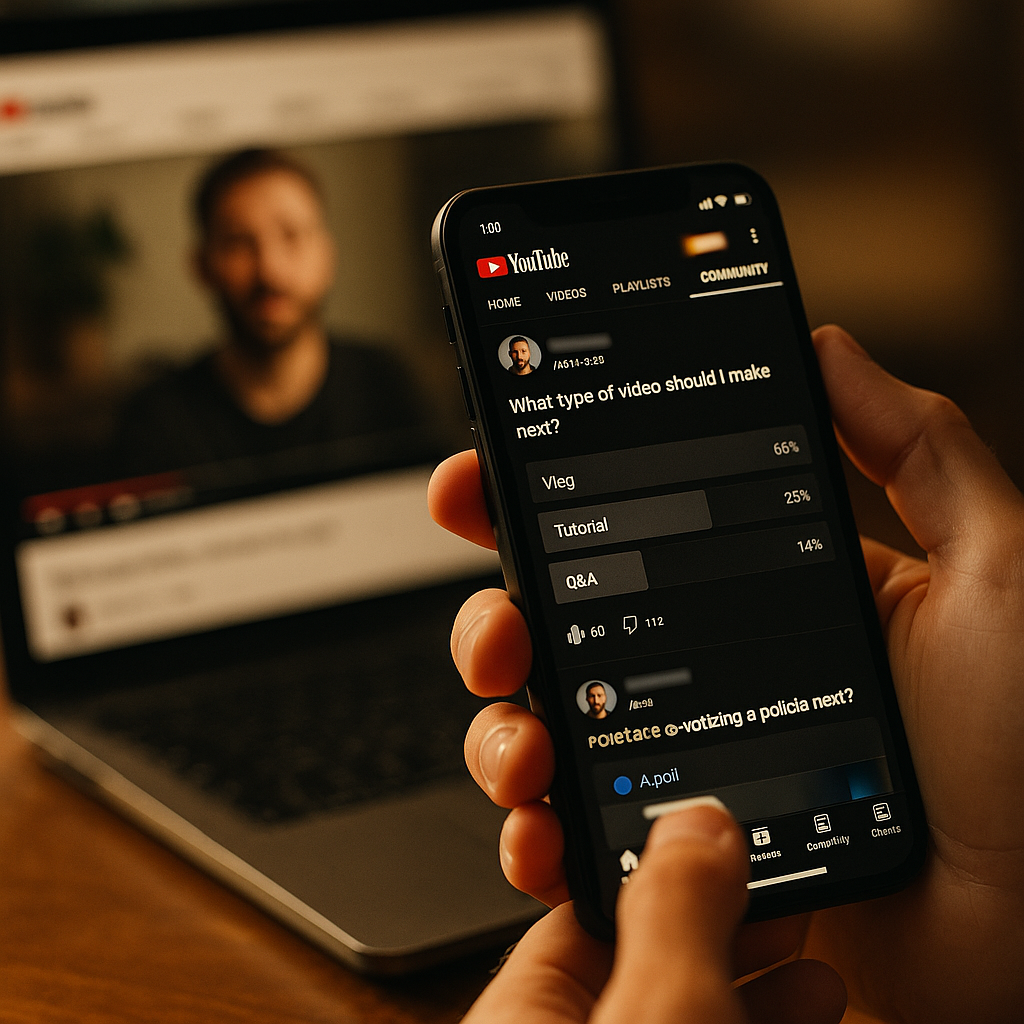
Most brands treat the YouTube Community Tab like a free bulletin board. Big mistake. Channels that post a strategic poll or teaser 24-48 hours before a sponsored video see measurably higher first-hour watch time, and YouTube’s algorithm rewards exactly that signal. The YouTube Community Tab playbook isn’t a nice-to-have anymore. It’s becoming table stakes for any brand serious about maximizing sponsored video performance.
Why the Community Tab Matters More Than You Think
Here’s the uncomfortable truth: a sponsored video’s fate is largely decided in its first 24-48 hours. YouTube’s recommendation system watches early click-through rate and average view duration, then decides how hard to push the video into suggested feeds and homepages. If those early signals are weak, no amount of post-launch promotion fixes it.
The Community Tab sits upstream of that window. It’s a feature available to channels with enough subscribers, letting creators post polls, text updates, images, and GIFs directly to subscriber feeds and notifications. Unlike a video, it costs almost nothing to produce. Unlike a tweet, it lands inside YouTube’s own ecosystem, feeding the same algorithm that will judge the sponsored video days later.
A well-timed poll doesn’t just build anticipation. It trains the algorithm that this creator’s audience is actively engaged before the sponsored video even uploads.
This matters because YouTube’s current ranking priorities favor loyalty signals over raw reach. A channel that shows consistent subscriber interaction, comments, votes, replies, gets more benefit of the doubt from the algorithm than one chasing cold traffic. Community Tab activity is one of the cheapest ways to manufacture that signal on demand.
What Actually Works: Polls, Not Announcements
Brands love to use the Community Tab for a straight announcement post: “New video dropping Friday, don’t miss it!” It reads like an ad. Predictably, it performs like one, too — low engagement, low reach.
Polls work because they ask for a tiny action. A single tap. Compare engagement rates on a bland text post versus a poll and the gap is stark; polls routinely pull double or triple the interaction rate of static text updates, based on patterns creators report across mid-size and large channels. That interaction is the entire point. Every vote is a micro-signal telling YouTube this audience is alive and paying attention.
Three poll formats consistently outperform for pre-launch priming:
- The curiosity poll — “Which feature do you think we tested first: battery life or camera speed?” Ties directly to the sponsored product without revealing the review’s conclusion.
- The relatability poll — “Have you ever had this problem with [category]?” Builds a shared context before the sponsor’s solution appears on screen.
- The prediction poll — “Guess the price before Friday’s review.” Creates a reason to return and check the actual video for the answer.
Notice none of these mention the brand name aggressively. That’s deliberate. Overt “sponsored content incoming” framing kills curiosity and can trigger disclosure fatigue among viewers who’ve grown wary of ad-heavy channels.
Text Posts: The Underrated Middle Step
Polls generate the spike. Text posts sustain the narrative between spike and drop. A common sequencing mistake: brands ask creators for one poll and call it done. The stronger cadence uses a short sequence across 48-72 hours.
- T-minus 3 days: Soft-launch text post hinting at a topic, no product mention. Sets a narrative hook.
- T-minus 2 days: Poll tied to the hook. Drives the engagement signal.
- T-minus 1 day: Behind-the-scenes image or GIF, reinforcing anticipation without spoiling the review.
- Day of: Direct text post with the video link, posted the moment the video goes live, not before.
That last point trips up a lot of coordination between brand and creator teams. Posting the link too early, before the video is indexed and ranking, wastes the traffic spike on a video the algorithm hasn’t fully processed yet. Timing the final Community post to go live within minutes of publish is a small operational detail with an outsized effect on first-hour view velocity.
Building This Into the Brief
None of this happens organically unless it’s written into the creator brief. Most influencer contracts specify the sponsored video deliverable and maybe one social cross-post. Community Tab priming rarely gets its own line item, which means it rarely gets executed with discipline.
Brands running structured campaigns are starting to add a “pre-launch engagement sequence” clause covering exactly this: number of Community posts, timing windows, and content type (poll vs. text vs. image). It’s a small ask of the creator, usually under fifteen minutes of extra work, but it needs to be scheduled, not left to spontaneity.
This mirrors a pattern seen across other platforms. The shift toward discovery-based algorithms on TikTok pushed brands to rebrief creators around early engagement windows rather than raw follower count. YouTube’s Community Tab dynamics are the same idea applied to a different mechanic: prime the signal, then let the algorithm do the distribution work.
If your creator brief doesn’t specify a pre-launch Community Tab sequence, you’re leaving algorithmic goodwill on the table for free.
Measuring Whether It’s Actually Working
Skepticism is healthy here. Correlation between a poll and video performance is easy to claim and harder to prove. A few practical ways to check the work:
- Compare launches with and without priming. Ask the creator (or check via YouTube Studio access, if you have brand-side visibility) whether videos preceded by a Community sequence show higher Day 1 click-through rate versus videos without one.
- Watch subscriber notification open rates. Community posts trigger notifications. A poll with strong vote counts within the first hour usually signals a healthy notification open rate, a proxy for how “warm” the audience is.
- Track average view duration on the sponsored segment specifically. If priming worked, viewers arrive with context and tend to sit through the sponsored read rather than skipping ahead.
None of this replaces a solid creative brief or an honest, well-integrated sponsorship. It’s a distribution lever, not a content strategy. But distribution levers compound, and in a landscape where organic reach keeps getting harder to earn, cheap and controllable levers deserve attention.
Where This Fits Against Other Platform Priming Tactics
YouTube isn’t unique in rewarding pre-content signals. Reddit AMAs work better with a pinned teaser thread beforehand, as outlined in the Reddit brand AMA playbook. Threads posts get more reply-driven reach when brands seed a question first, per the Threads reply-bait framework. The common thread: platforms increasingly reward pre-engagement, not just the content itself.
For YouTube specifically, the Community Tab is arguably underused relative to its cost. It requires no editing, no additional filming, and no extra creator fee in most cases. It just requires someone on the brand or agency side to actually plan for it, write it into the brief, and follow up to confirm it happened. That last part, follow-up, is where most campaigns quietly fail. Creators are busy. Without a checklist or a reminder built into the campaign timeline, the “quick poll” gets forgotten in the scramble to hit the actual video deadline.
Brands managing multiple creator partnerships at once should treat Community Tab priming the way they’d treat any other campaign workflow checklist: a standard operating step, not an optional extra.
FAQs
What is the YouTube Community Tab and who can use it?
The Community Tab is a feature on YouTube channels that meet a minimum subscriber threshold, allowing creators to post text updates, polls, images, and GIFs directly to subscribers’ feeds and notifications, separate from regular video uploads.
How long before a sponsored video should Community posts start?
A three-day sequence tends to work well: a soft-hint text post around 72 hours out, a poll around 48 hours out, a teaser image around 24 hours out, and a direct link post the moment the video goes live.
Do polls actually help the sponsored video’s algorithm performance?
Polls generate high-engagement, low-effort interactions that signal an active, attentive subscriber base to YouTube’s recommendation system. That signal contributes to how favorably the platform treats the creator’s subsequent uploads, including sponsored videos, though it works alongside other ranking factors like watch time and click-through rate.
Should the poll or text post mention the sponsor by name?
Generally no, not in the early priming posts. Curiosity-driven, product-agnostic framing tends to outperform direct promotional language, and it avoids triggering disclosure fatigue before the actual sponsored video, which still needs clear FTC-compliant disclosure, appears.
Can brands require Community Tab posts in a creator contract?
Yes. Brands can and increasingly do add a pre-launch engagement clause to creator agreements specifying the number, timing, and format of Community Tab posts around a sponsored video’s release.
Is this tactic only useful for large channels?
No. Mid-size channels with active, responsive subscriber bases often see proportionally stronger Community engagement rates than mega-channels, since smaller audiences tend to interact more per-capita with polls and text posts.
Visible FAQ Section
See above for the full FAQ content displayed on-page.
Add one line to your next creator brief: a required three-post Community Tab sequence before video launch, with exact timing windows. It costs nothing and it’s the cheapest algorithmic insurance policy available on the platform right now.
Top Influencer Marketing Agencies
The leading agencies shaping influencer marketing in 2026
Agencies ranked by campaign performance, client diversity, platform expertise, proven ROI, industry recognition, and client satisfaction. Assessed through verified case studies, reviews, and industry consultations.
Moburst

-
2

The Shelf
Boutique Beauty & Lifestyle Influencer AgencyA data-driven boutique agency specializing exclusively in beauty, wellness, and lifestyle influencer campaigns on Instagram and TikTok. Best for brands already focused on the beauty/personal care space that need curated, aesthetic-driven content.Clients: Pepsi, The Honest Company, Hims, Elf Cosmetics, Pure LeafVisit The Shelf → -
3

Audiencly
Niche Gaming & Esports Influencer AgencyA specialized agency focused exclusively on gaming and esports creators on YouTube, Twitch, and TikTok. Ideal if your campaign is 100% gaming-focused — from game launches to hardware and esports events.Clients: Epic Games, NordVPN, Ubisoft, Wargaming, Tencent GamesVisit Audiencly → -
4

Viral Nation
Global Influencer Marketing & Talent AgencyA dual talent management and marketing agency with proprietary brand safety tools and a global creator network spanning nano-influencers to celebrities across all major platforms.Clients: Meta, Activision Blizzard, Energizer, Aston Martin, WalmartVisit Viral Nation → -
5

The Influencer Marketing Factory
TikTok, Instagram & YouTube CampaignsA full-service agency with strong TikTok expertise, offering end-to-end campaign management from influencer discovery through performance reporting with a focus on platform-native content.Clients: Google, Snapchat, Universal Music, Bumble, YelpVisit TIMF → -
6

NeoReach
Enterprise Analytics & Influencer CampaignsAn enterprise-focused agency combining managed campaigns with a powerful self-service data platform for influencer search, audience analytics, and attribution modeling.Clients: Amazon, Airbnb, Netflix, Honda, The New York TimesVisit NeoReach → -
7

Ubiquitous
Creator-First Marketing PlatformA tech-driven platform combining self-service tools with managed campaign options, emphasizing speed and scalability for brands managing multiple influencer relationships.Clients: Lyft, Disney, Target, American Eagle, NetflixVisit Ubiquitous → -
8

Obviously
Scalable Enterprise Influencer CampaignsA tech-enabled agency built for high-volume campaigns, coordinating hundreds of creators simultaneously with end-to-end logistics, content rights management, and product seeding.Clients: Google, Ulta Beauty, Converse, AmazonVisit Obviously →