


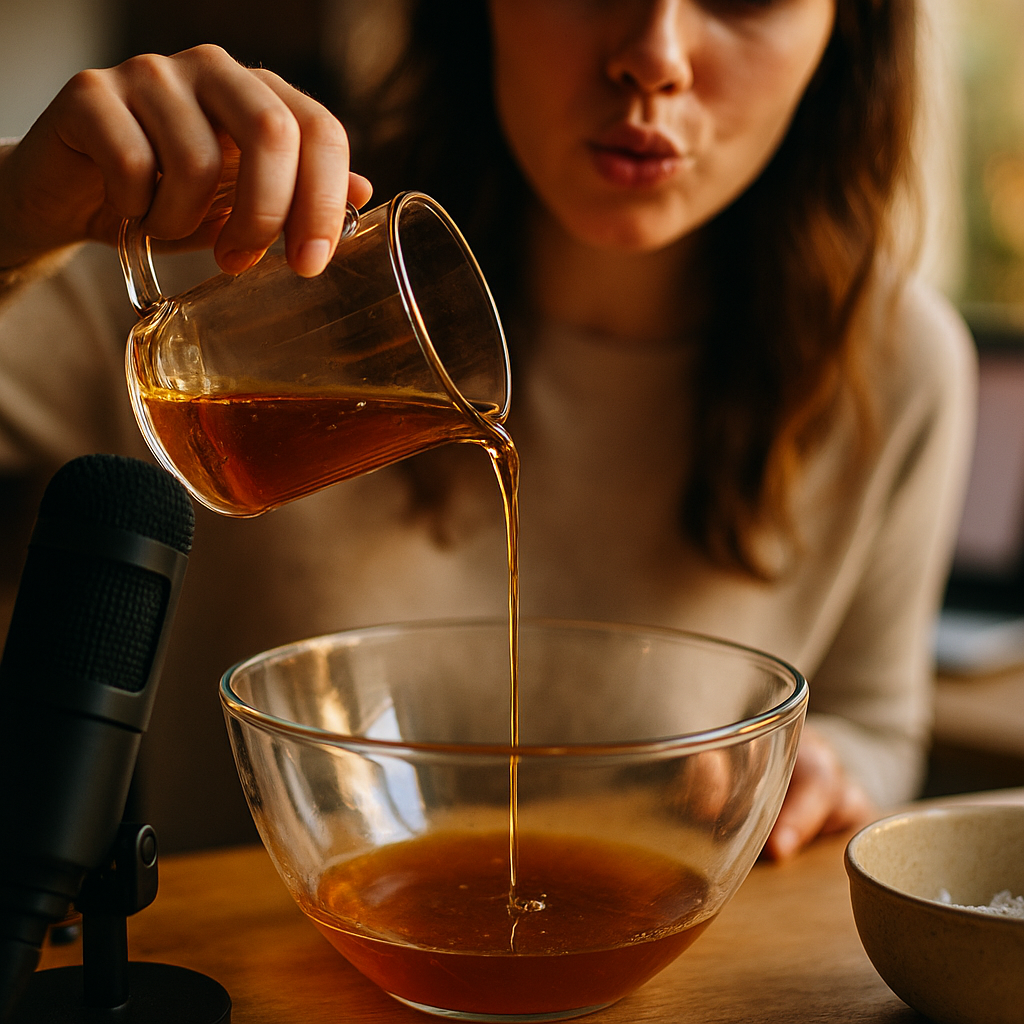
Scroll-stopping food content doesn’t need a jump cut or a trending song anymore. It needs a glug. A sizzle. The specific crack of a seal breaking. The sound-on ASMR ingredient pour has quietly become one of the highest-converting formats in food and beverage marketing, and most brands still aren’t briefing it correctly.
Why does a 12-second clip of honey dripping off a spoon outperform a polished commercial? Because sound bypasses skepticism. Viewers trust their ears before they trust a caption.
Why Sensory Sound Beats Polished Visuals
Food and beverage marketing has an authenticity problem. Consumers have seen enough over-lit, color-graded product shots to distrust them on sight. Studies on ASMR consumption habits, including research referenced by Sprout Social’s platform trend coverage, show that sound-triggered content generates measurably longer watch time than muted, music-backed alternatives. Longer watch time means more completions, more algorithmic favor, and more trust transferred to the product itself.
The pour format works because it’s unedited-feeling even when it’s carefully directed. A slow-motion syrup drizzle, the fizz of a can cracking open, oat milk swirling into cold brew, these are moments viewers can’t fake-react to. The texture either sounds rich or it doesn’t. That’s the entire pitch.
Sound-on ASMR content doesn’t sell a lifestyle. It sells a texture, a temperature, a crunch. That specificity is what makes it feel unsponsored, even when it’s clearly branded.
Compare this to more narrative-driven UGC. Formats like the grocery-aisle walkthrough format build trust through relatability and shopping context. ASMR pours build trust through sensory proof. Different mechanisms, same destination: a viewer who believes the product is real before they’ve tasted it.
What Makes a Pour Shot Actually Work
Not every pour is created equal. Brands routinely brief creators to “just film the product being poured,” then wonder why the clip underperforms. The difference between a viral ASMR moment and a forgettable one comes down to five technical details:
- Microphone proximity. Built-in phone mics rarely capture texture accurately. Creators need a shotgun or lavalier mic positioned within 6-12 inches of the pour point.
- Environmental silence. No background music, no dialogue over the pour itself. Ambient noise (HVAC hum, traffic, roommates) kills the effect instantly.
- Container acoustics. Glass, ceramic, and metal all produce different resonance. Briefs should specify the vessel, not leave it to creator preference.
- Temperature contrast. Cold liquids poured over ice, or hot liquids into cold cups, create audible crackle and steam that add a second sensory layer.
- Pacing. Pours shot in real time (not sped up) let the sound breathe. Rushing the edit strips out the exact detail viewers came for.
Get these wrong and you’ve got a muted lifestyle shot with extra steps. Get them right and you’ve got a clip viewers replay with headphones in, specifically to feel something.
Briefing Creators Without Killing the Authenticity
Here’s the tension every brand manager runs into: ASMR content only works if it feels unscripted, but you still need creative control, brand safety, and disclosure compliance. The solution isn’t looser briefs. It’s more precise ones that leave room for creator instinct on execution.
A strong brief for this format should include:
- The sensory goal, not just the shot list. Tell the creator what feeling you’re chasing (richness, crispness, refreshment) rather than dictating camera angles line by line.
- Audio equipment requirements. Specify minimum mic quality. Many nano and micro creators don’t own external mics; budget for equipment stipends if the format demands it.
- A no-music, no-voiceover clause. This is the single most common brief violation. Creators default to trending audio out of habit. State explicitly that silence (aside from ambient pour sound) is the deliverable.
- Disclosure placement that doesn’t disrupt immersion. A spoken “this is sponsored” ruins the ASMR effect. Text overlay disclosure, placed at the first frame, satisfies FTC disclosure requirements without breaking the sound experience.
- Multiple pour takes at varying speeds. Give editors options. A single take rarely nails pacing, viscosity, and framing all at once.
This is similar in spirit to the discipline required in AI nutrition-facts overlay briefs, where the compliance layer has to sit visually rather than verbally so it doesn’t undercut the format’s core appeal.
The FTC Angle Brands Keep Underestimating
ASMR content’s biggest legal risk isn’t disclosure language, it’s disclosure timing. Because these videos are short and sound-dependent, viewers often watch with the volume up and captions off. If your disclosure lives only in a spoken aside or buried caption text, you’re not meeting the “clear and conspicuous” standard the FTC has reinforced repeatedly in its endorsement guidance.
The safest approach: burn a text disclosure into the first three seconds of frame, sized large enough to read on a muted thumbnail preview. Pair it with a caption-level disclosure too. Redundancy here isn’t overkill, it’s risk mitigation. Brands that have been burned by ambiguous influencer disclosures know the FTC doesn’t grade on creative intent; it grades on what the average viewer would reasonably notice.
This mirrors the compliance logic used in “What’s in My Cart” briefs, where the format’s casual tone creates the same temptation to soften disclosure. The lesson repeats across formats: the more natural the content feels, the more deliberate the compliance layer needs to be.
The more “unsponsored” a format feels, the more precisely its disclosure needs to be engineered. Authenticity and compliance aren’t opposites, but they do require separate planning.
Where This Format Fits in a Broader Content Mix
ASMR pours aren’t a replacement for your full creator strategy. They’re a top-of-funnel trust builder, best paired with formats that carry the viewer further down the decision path. A pour clip earns attention and sensory credibility. A follow-up format like text-message-thread UGC or a two-truths-and-a-lie brief can carry the narrative and product claims that the pour format deliberately leaves out.
Think of it as a funnel handoff. ASMR content answers “does this look and sound like quality?” Everything after answers “should I actually buy it?” Brands that try to cram both jobs into one 15-second pour clip end up diluting the very thing that made it work.
For food and beverage brands specifically, this pairing matters more than in most verticals. Taste can’t be demonstrated on screen. Sound is the closest proxy available, and it’s a proxy consumers have learned, through years of ASMR content consumption, to trust instinctively. According to eMarketer’s coverage of short-form video engagement trends, sensory and process-driven content consistently ranks among the highest-retention subcategories on platforms like TikTok and Instagram Reels, ahead of many traditional product demo formats.
Measuring What Actually Matters
Standard engagement metrics undersell this format. Likes and shares matter less here than:
- Replay rate — ASMR content gets rewatched specifically for the sound. A high replay rate signals sensory success more than raw view count does.
- Watch-time-to-completion ratio — Since these clips are short, near-100% completion is the baseline expectation, not a bonus.
- Sound-on percentage — Platforms like TikTok surface this data in creator analytics. If sound-on rates are low, the pacing or mic quality likely needs revisiting.
- Comment sentiment around texture or sound — Comments like “the crunch” or “I can hear how cold that is” are qualitative proof the sensory goal landed.
Brands running paid amplification behind these clips, through TikTok’s ad platform or Meta’s creator ad tools via Meta Business Suite, should also A/B test sound-on placements against standard product ads in the same campaign. The lift in view-through rate is often the clearest ROI signal available.
Next Step
Don’t brief this format as an afterthought bolted onto a bigger shoot. Give creators a dedicated pour setup, a mic requirement, and a burned-in disclosure spec, then measure replay rate before you judge results by likes.
FAQs
What is the sound-on ASMR ingredient pour format?
It’s a short-form content style where creators film a close-up, sound-focused shot of a food or beverage ingredient being poured, without music or dialogue, to build sensory trust through audio texture rather than visual polish.
Why does ASMR content work for food and beverage brands specifically?
Taste can’t be shown on screen, but sound offers a close proxy. Viewers associate crisp, rich, or textured audio with product quality, which builds trust faster than a standard product shot.
How should brands handle FTC disclosure in a silent, sound-focused format?
Use a text overlay disclosure burned into the first few seconds of the video, paired with a caption disclosure. Spoken disclosures disrupt the ASMR effect, so visual placement is the safer, more compliant choice.
What equipment do creators need for this format?
A shotgun or lavalier microphone positioned close to the pour point is essential. Built-in phone microphones rarely capture the acoustic detail that makes ASMR content effective.
How do you measure success for ASMR pour content?
Prioritize replay rate, sound-on percentage, and completion rate over likes and shares. These metrics better reflect whether the sensory goal actually landed with viewers.
FAQPage Schema
Top Influencer Marketing Agencies
The leading agencies shaping influencer marketing in 2026
Agencies ranked by campaign performance, client diversity, platform expertise, proven ROI, industry recognition, and client satisfaction. Assessed through verified case studies, reviews, and industry consultations.
Moburst

-
2

The Shelf
Boutique Beauty & Lifestyle Influencer AgencyA data-driven boutique agency specializing exclusively in beauty, wellness, and lifestyle influencer campaigns on Instagram and TikTok. Best for brands already focused on the beauty/personal care space that need curated, aesthetic-driven content.Clients: Pepsi, The Honest Company, Hims, Elf Cosmetics, Pure LeafVisit The Shelf → -
3

Audiencly
Niche Gaming & Esports Influencer AgencyA specialized agency focused exclusively on gaming and esports creators on YouTube, Twitch, and TikTok. Ideal if your campaign is 100% gaming-focused — from game launches to hardware and esports events.Clients: Epic Games, NordVPN, Ubisoft, Wargaming, Tencent GamesVisit Audiencly → -
4

Viral Nation
Global Influencer Marketing & Talent AgencyA dual talent management and marketing agency with proprietary brand safety tools and a global creator network spanning nano-influencers to celebrities across all major platforms.Clients: Meta, Activision Blizzard, Energizer, Aston Martin, WalmartVisit Viral Nation → -
5

The Influencer Marketing Factory
TikTok, Instagram & YouTube CampaignsA full-service agency with strong TikTok expertise, offering end-to-end campaign management from influencer discovery through performance reporting with a focus on platform-native content.Clients: Google, Snapchat, Universal Music, Bumble, YelpVisit TIMF → -
6

NeoReach
Enterprise Analytics & Influencer CampaignsAn enterprise-focused agency combining managed campaigns with a powerful self-service data platform for influencer search, audience analytics, and attribution modeling.Clients: Amazon, Airbnb, Netflix, Honda, The New York TimesVisit NeoReach → -
7

Ubiquitous
Creator-First Marketing PlatformA tech-driven platform combining self-service tools with managed campaign options, emphasizing speed and scalability for brands managing multiple influencer relationships.Clients: Lyft, Disney, Target, American Eagle, NetflixVisit Ubiquitous → -
8

Obviously
Scalable Enterprise Influencer CampaignsA tech-enabled agency built for high-volume campaigns, coordinating hundreds of creators simultaneously with end-to-end logistics, content rights management, and product seeding.Clients: Google, Ulta Beauty, Converse, AmazonVisit Obviously →