


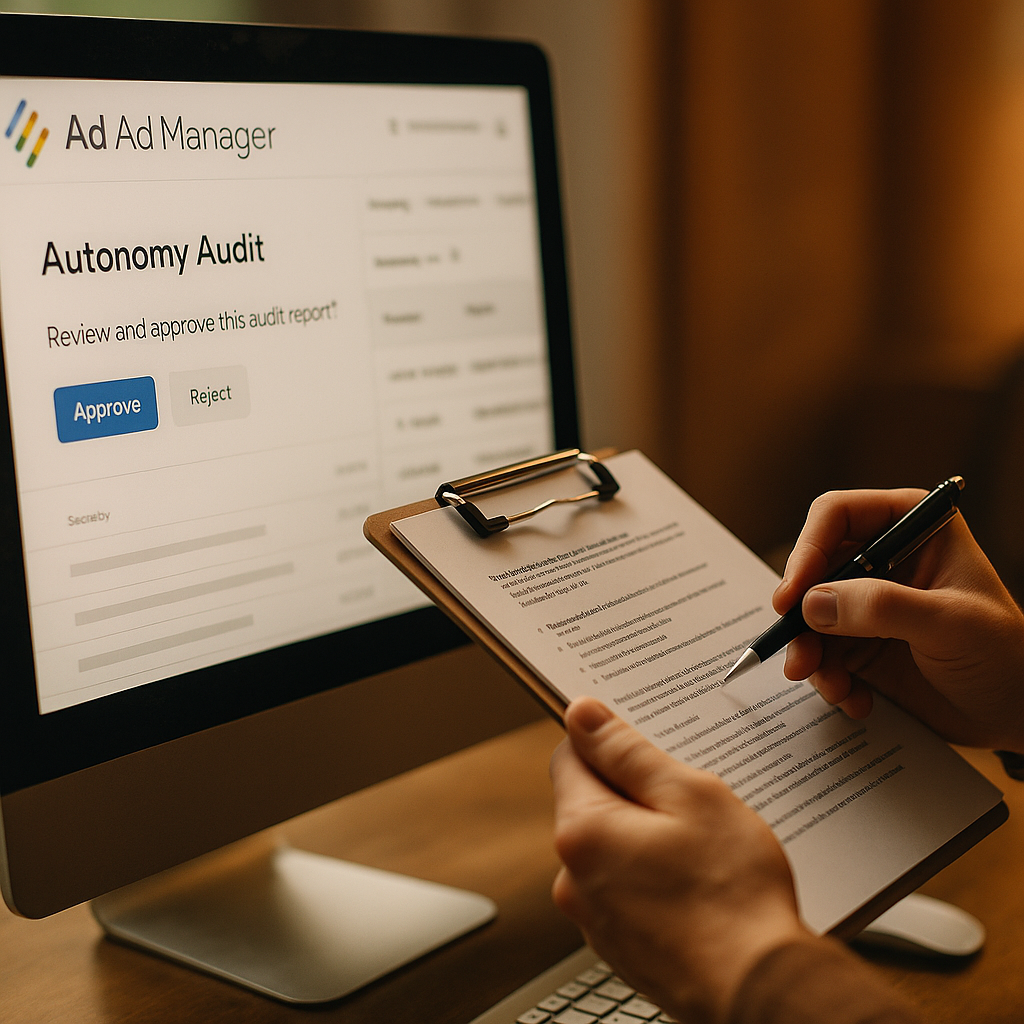
Google says its AI can now resolve 75% of Google Ads support cases without a human agent. That’s impressive. It’s also completely beside the point if you’re trying to figure out whether Ask Ad Manager can touch your live campaigns without someone in the loop. It can’t, not fully, and the gaps matter more than the marketing copy suggests.
Ad Manager teams have been quietly rolling out conversational AI inside Google Ad Manager for the better part of a year, positioning it as a natural-language layer over reporting, troubleshooting, and account configuration. The pitch is simple: ask a question, get an answer, maybe get an action taken. But “maybe” is doing a lot of work in that sentence. This audit walks through what the tool actually executes autonomously, what it merely recommends, and where the human sign-off wall still stands, based on Google’s own documentation and how the tool behaves in practice.
What Ask Ad Manager Actually Is
Ask Ad Manager is a conversational interface built into Google Ad Manager, Google’s publisher ad server and yield management platform. It’s aimed at publishers and ad ops teams managing programmatic inventory, not at advertisers buying media through Google Ads (a distinction that trips up a lot of people who assume “Ad Manager” means the same thing as “Ads Manager”). Think inventory forecasting, line item troubleshooting, delivery diagnostics, policy violation checks. The tool sits on top of Gemini and is trained to answer operational questions using account-specific data rather than generic web knowledge.
That’s the key differentiator from a general chatbot: it can see your actual line items, your actual delivery pacing, your actual blocked ads. It’s not guessing. It’s reading your account and summarizing what it finds in plain English.
The tool’s real value isn’t automation. It’s diagnostic speed. Ask Ad Manager compresses a 20-minute investigation into a 20-second answer, then hands the decision back to you.
The Autonomy Ceiling, Mapped
Here’s where it gets useful for anyone building a governance framework around AI tools in the ad stack. Break Ask Ad Manager’s capabilities into three tiers.
Tier 1: Fully autonomous, no sign-off needed. Answering questions about historical performance. Explaining why a line item under-delivered. Surfacing policy violations on specific creatives. Summarizing forecast data for a proposed campaign. These are read-only actions. The tool queries data, synthesizes it, and returns an answer. There’s no execution risk because nothing in the account changes.
Tier 2: Suggests, requires explicit approval. This is the largest and most interesting category. Ask Ad Manager can propose changes, things like adjusting line item priority, flagging inventory to pause, or recommending frequency cap changes. But it doesn’t push those changes live on its own. It generates the recommendation, and a human has to click through and confirm. This is the “human-in-the-loop” tier that Google has clearly built as a deliberate friction point, not a technical limitation.
Tier 3: Cannot do at all, full stop. Contractual changes, deal renegotiations, anything touching billing or payment terms, and irreversible deletions of historical data. These sit entirely outside the chatbot’s permission scope regardless of what you ask it. Google has, sensibly, drawn a hard line around anything with legal or financial exposure.
The pattern here isn’t unique to Google. It mirrors what we’ve seen across the industry’s broader move toward agentic ad buying with human checkpoints: the vendors building these tools understand that full autonomy in a live revenue system is a liability nobody wants to underwrite yet.
Why the Suggestion Layer Is the Real Story
Most coverage of AI ad tools obsesses over whether they can “take action.” Wrong question. The more important question is whether the suggestion layer is any good, because that’s where 80% of the actual time savings live.
If Ask Ad Manager correctly diagnoses a delivery problem and proposes the right fix, your ops team goes from triage to approval in one step. If it’s wrong, you’ve lost thirty seconds reading a bad suggestion. Compare that to a fully autonomous system that’s wrong: you’ve lost budget, inventory, or a client relationship.
This is why the sign-off wall isn’t a bug. It’s the feature that makes the tool tolerable to deploy at scale. Publishers running this at portfolio scale, dozens of sites, hundreds of line items, need speed on diagnostics but control on execution. Ask Ad Manager, at least in its current form, threads that needle.
Where It Breaks Down in Practice
Talk to anyone who’s run this for more than a quarter and you’ll hear the same complaints. First, context windows. The chatbot answers the question you asked, not the question you should have asked. Ask “why did this line item under-deliver” and you get a delivery diagnosis. You won’t get “and by the way, this is the third time this week this has happened across your portfolio” unless you explicitly ask for pattern analysis.
Second, the tool’s confidence doesn’t scale with its accuracy. It states forecasts and diagnoses with the same flat, declarative tone whether it’s 95% certain or extrapolating from thin data. That’s a known issue across generative AI tools generally, not specific to Google, but it matters more in a revenue-critical context than it does in, say, a marketing copy tool.
Third, and this is the one ops teams flag most: the tool doesn’t know what it doesn’t know about your specific deal structure. Custom private marketplace agreements, unusual floor price arrangements, seasonal exclusivity clauses, none of that context reliably makes it into the chatbot’s reasoning unless it’s explicitly documented in a place the AI can see. That’s less a Google problem and more a data hygiene problem, but it’s still your problem when the recommendation misses it.
We’ve written before about how retrieval-augmented systems can still produce hallucinated claims when the underlying knowledge base is incomplete or stale. Ask Ad Manager isn’t immune to that pattern. It’s grounded in your account data, which is better than a generic LLM, but “better grounded” isn’t the same as “always right.”
The Governance Gap Most Teams Miss
Here’s the thing nobody puts in the sales deck: even Tier 2 “suggest and confirm” workflows create a new failure mode, approval fatigue. When a chatbot generates twenty recommendations a day and nineteen are correct, your ops team starts rubber-stamping approvals. That’s how the one wrong suggestion gets through. It’s the same dynamic we’ve flagged in AI media-buying governance frameworks: humans in the loop only work as a safeguard if the humans are actually reading, not just clicking approve because the last nineteen were fine.
If you’re deploying Ask Ad Manager across a team, build override thresholds and audit logs into your workflow, not just a “someone has to click confirm” rule. That confirm click needs to mean something.
A human-in-the-loop checkpoint only reduces risk if the human is actually evaluating the recommendation, not just clicking through it. Approval fatigue is the silent failure mode nobody budgets for.
How This Compares to the Broader AI Ad Stack
Google isn’t alone in drawing this line between diagnosis and execution. Meta’s automated rules and Advantage+ campaigns operate similarly, offering optimization suggestions with varying degrees of auto-apply depending on how much control you’ve ceded in settings. TikTok’s Smart+ automation follows the same pattern. The industry has converged, whether by design or caution, on a model where full autonomy is reserved for low-stakes, easily reversible actions (bid adjustments within a set range, for instance) while anything touching contracts, budgets above a threshold, or brand-safety-adjacent decisions stays gated behind a human click.
This is consistent with what we outlined in the AI agent governance checklist covering spend caps and kill switches: the tools that survive scrutiny are the ones with clear, auditable boundaries, not the ones promising the most automation.
Worth noting too: trust in AI marketing tools hasn’t caught up with adoption. Recent survey data suggests marketers are deploying AI tools faster than they’re building confidence in the outputs, a gap we covered in depth around why AI marketing adoption is outpacing trust. Ask Ad Manager’s conservative permission structure is, in some ways, a rational response to that trust gap. Google would rather ship a tool that under-promises on autonomy than one that generates a headline about a chatbot draining someone’s ad budget overnight.
What Ops Teams Should Actually Do With This
Don’t treat Ask Ad Manager as a set-and-forget automation layer. Treat it as a very fast, very literal junior analyst. It’ll answer the question accurately most of the time. It won’t push back if your question was based on a wrong assumption. It won’t flag the deal-structure nuance unless that nuance lives somewhere it can query.
Practical steps: assign a named owner for reviewing Tier 2 suggestions rather than leaving it to whoever’s online. Log every accepted and rejected suggestion for at least a quarter, so you can spot patterns in where the AI is reliably right and where it’s reliably shaky. And keep the Tier 3 boundary (contracts, billing, irreversible deletions) explicitly documented in onboarding materials, because new hires will assume the chatbot can do more than it can. That assumption gap is where mistakes happen, not in the tool itself.
For teams managing this across multiple platforms, not just Google’s stack, it’s worth benchmarking against how other AI assistants handle the same autonomy question. We compared this directly in Gemini vs Copilot vs Claude for marketing teams, and the permission-tier logic holds up across vendors: none of the major players currently grant full execution rights on anything revenue-critical.
External data backs the caution. eMarketer’s ongoing coverage of AI ad tool adoption consistently shows publishers and advertisers prioritizing oversight features over raw automation speed when selecting tools. Gartner research on AI agent deployment echoes the same theme: governance maturity, not model capability, is the actual bottleneck slowing enterprise rollout. And Google’s own support documentation for Ad Manager features is notably explicit about which actions require manual confirmation, a level of transparency worth checking before you assume otherwise.
The Bottom Line
Ask Ad Manager’s autonomy ceiling is lower than the “AI-powered” framing implies, and that’s a good thing. It reads, it diagnoses, it recommends. It doesn’t sign contracts, move money, or delete history without you. Build your workflows around that reality rather than the aspirational version, and you’ll get the speed gains without the 2 a.m. incident report.
Next step: audit your team’s current Ask Ad Manager usage log (if you’re keeping one, and you should be) and tag every accepted recommendation from the last 30 days by risk tier. If nobody can produce that log, that’s your actual governance gap, not the chatbot’s permission settings.
FAQs
Can Ask Ad Manager make changes to live campaigns without approval?
No. For anything beyond read-only reporting and diagnostics, Ask Ad Manager generates a recommendation that requires explicit human confirmation before it takes effect. It does not autonomously push changes to line items, pricing, or delivery settings.
Is Ask Ad Manager the same as Google Ads’ AI features?
No. Ask Ad Manager operates within Google Ad Manager, the publisher-side ad server for managing programmatic inventory and yield. It’s distinct from AI features inside Google Ads, which is the advertiser-facing platform for buying media.
What tasks can Ask Ad Manager complete fully on its own?
Read-only tasks: answering performance questions, explaining delivery issues, surfacing policy violations, and summarizing forecast data. These don’t alter account settings, so they carry no execution risk and require no sign-off.
What can Ask Ad Manager never do, even with approval?
Contractual changes, deal renegotiations, billing or payment adjustments, and irreversible deletion of historical data all sit outside the tool’s permission scope entirely, regardless of user confirmation.
How should ad ops teams govern chatbot recommendations to avoid approval fatigue?
Assign a named reviewer for AI-generated suggestions, log every accepted and rejected recommendation, and periodically audit approval patterns to catch rubber-stamping before a wrong recommendation slips through unchecked.
FAQs
Can Ask Ad Manager make changes to live campaigns without approval?
No. For anything beyond read-only reporting and diagnostics, Ask Ad Manager generates a recommendation that requires explicit human confirmation before it takes effect. It does not autonomously push changes to line items, pricing, or delivery settings.
Is Ask Ad Manager the same as Google Ads’ AI features?
No. Ask Ad Manager operates within Google Ad Manager, the publisher-side ad server for managing programmatic inventory and yield. It’s distinct from AI features inside Google Ads, which is the advertiser-facing platform for buying media.
What tasks can Ask Ad Manager complete fully on its own?
Read-only tasks: answering performance questions, explaining delivery issues, surfacing policy violations, and summarizing forecast data. These don’t alter account settings, so they carry no execution risk and require no sign-off.
What can Ask Ad Manager never do, even with approval?
Contractual changes, deal renegotiations, billing or payment adjustments, and irreversible deletion of historical data all sit outside the tool’s permission scope entirely, regardless of user confirmation.
How should ad ops teams govern chatbot recommendations to avoid approval fatigue?
Assign a named reviewer for AI-generated suggestions, log every accepted and rejected recommendation, and periodically audit approval patterns to catch rubber-stamping before a wrong recommendation slips through unchecked.
Top Influencer Marketing Agencies
The leading agencies shaping influencer marketing in 2026
Agencies ranked by campaign performance, client diversity, platform expertise, proven ROI, industry recognition, and client satisfaction. Assessed through verified case studies, reviews, and industry consultations.
Moburst

-
2

The Shelf
Boutique Beauty & Lifestyle Influencer AgencyA data-driven boutique agency specializing exclusively in beauty, wellness, and lifestyle influencer campaigns on Instagram and TikTok. Best for brands already focused on the beauty/personal care space that need curated, aesthetic-driven content.Clients: Pepsi, The Honest Company, Hims, Elf Cosmetics, Pure LeafVisit The Shelf → -
3

Audiencly
Niche Gaming & Esports Influencer AgencyA specialized agency focused exclusively on gaming and esports creators on YouTube, Twitch, and TikTok. Ideal if your campaign is 100% gaming-focused — from game launches to hardware and esports events.Clients: Epic Games, NordVPN, Ubisoft, Wargaming, Tencent GamesVisit Audiencly → -
4

Viral Nation
Global Influencer Marketing & Talent AgencyA dual talent management and marketing agency with proprietary brand safety tools and a global creator network spanning nano-influencers to celebrities across all major platforms.Clients: Meta, Activision Blizzard, Energizer, Aston Martin, WalmartVisit Viral Nation → -
5

The Influencer Marketing Factory
TikTok, Instagram & YouTube CampaignsA full-service agency with strong TikTok expertise, offering end-to-end campaign management from influencer discovery through performance reporting with a focus on platform-native content.Clients: Google, Snapchat, Universal Music, Bumble, YelpVisit TIMF → -
6

NeoReach
Enterprise Analytics & Influencer CampaignsAn enterprise-focused agency combining managed campaigns with a powerful self-service data platform for influencer search, audience analytics, and attribution modeling.Clients: Amazon, Airbnb, Netflix, Honda, The New York TimesVisit NeoReach → -
7

Ubiquitous
Creator-First Marketing PlatformA tech-driven platform combining self-service tools with managed campaign options, emphasizing speed and scalability for brands managing multiple influencer relationships.Clients: Lyft, Disney, Target, American Eagle, NetflixVisit Ubiquitous → -
8

Obviously
Scalable Enterprise Influencer CampaignsA tech-enabled agency built for high-volume campaigns, coordinating hundreds of creators simultaneously with end-to-end logistics, content rights management, and product seeding.Clients: Google, Ulta Beauty, Converse, AmazonVisit Obviously →