


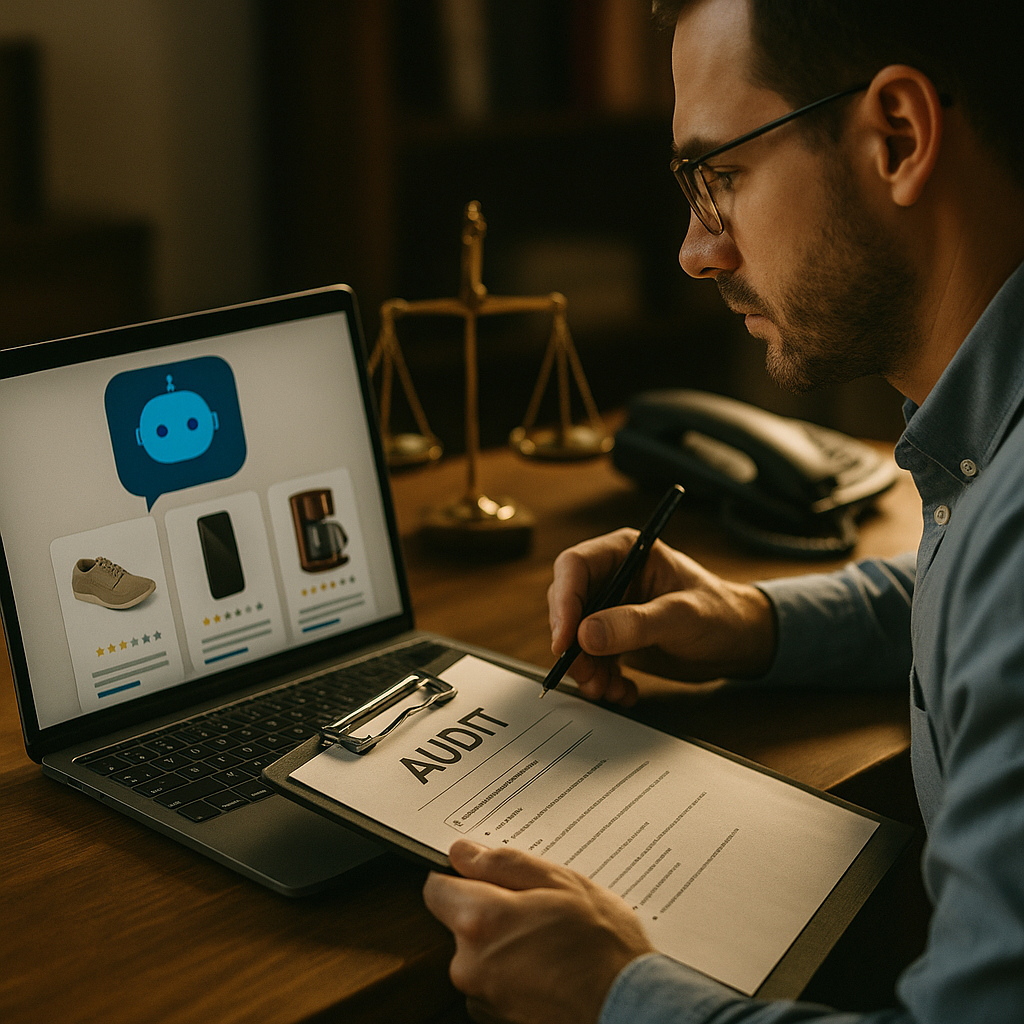
Your AI shopping assistant just told a customer your moisturizer “clinically reverses aging.” Nobody wrote that line. No creator said it on camera. A large language model generated it, in real time, with zero disclosure and zero substantiation. Welcome to the newest blind spot in influencer and brand compliance: an AI chatbot product recommendations FTC compliance gap that most legal teams haven’t even mapped yet.
The FTC’s Endorsement Guides were written with humans in mind — creators, testimonials, celebrity spokespeople. But the agency has been explicit that the same principles apply when the “endorser” is a non-human actor: a chatbot, a recommendation engine, a synthetic spokesperson. If your brand deploys conversational AI anywhere near a purchase decision, you now own an audit problem that didn’t exist three years ago.
Why Chatbots Count as Endorsers Now
The FTC has already signaled its position on AI-generated endorsements through enforcement actions and public statements warning against fake reviews, undisclosed AI-generated testimonials, and deceptive automated recommendations. The agency’s stance is simple: it doesn’t matter whether the “voice” making a claim is a person or a model. If the output influences a purchase and misrepresents facts, or fails to disclose a material connection, it’s a deceptive practice under Section 5 of the FTC Act.
Think about what that means operationally. A chatbot trained on your product catalog and marketing copy isn’t just a support tool anymore. It’s making claims. It’s comparing products. It’s sometimes recommending your item over a competitor’s, unprompted, based on training weights nobody in legal ever reviewed line-by-line.
If a human brand ambassador can’t legally say it, your chatbot shouldn’t be allowed to say it either — and right now, most brands have no process to verify that.
This isn’t a hypothetical. Retailers are rolling out AI shopping agents across e-commerce sites, and brands are integrating chatbot recommenders into TikTok Shop storefronts, DTC sites, and customer service flows. We’ve already covered the broader shift toward autonomous commerce in our AI shopping agent compliance checklist, but chatbot product recommendations deserve their own audit lane because the failure modes are different: hallucinated claims, inconsistent disclosure, and comparative statements that can trigger Lanham Act exposure on top of FTC risk.
The Four Failure Points Auditors Keep Finding
When compliance teams start actually testing their deployed chatbots against real customer prompts, four recurring problems show up. Every one of them maps to an existing FTC principle — the agency just hasn’t had to say “and this applies to bots” in plain language yet, because the Endorsement Guides were already written broadly enough to cover it.
- Unsubstantiated claims. Chatbots frequently generate superlative or comparative language (“best for sensitive skin,” “clinically proven”) that no one on the marketing or legal side ever approved or substantiated.
- No material connection disclosure. If the chatbot is recommending the brand’s own product versus a competitor, and the customer might reasonably assume it’s a neutral assistant, that’s a disclosure failure — the same logic that governs paid creator posts.
- Inconsistent output across sessions. Ask the same chatbot the same question five times and you’ll often get five different answers, some compliant, some not. Static one-time review misses this entirely.
- Drift after deployment. Models get updated, retrained, or fine-tuned on new data. A chatbot that passed review at launch can drift into risky territory within weeks with no alert to the compliance team.
Sound familiar? It should. These are the same categories of risk we’ve flagged in auditing AI-generated supplement claims and auditing AI-generated comparative claims. The chatbot is just a new delivery mechanism for an old compliance headache — unverified claims moving faster than legal review can keep up.
Building the Audit Framework: Five Layers
A workable compliance framework for chatbot recommendations needs to function like a recurring audit, not a one-time approval gate. Here’s the structure that’s actually holding up in brands running this well.
1. Claim inventory and mapping. Before you can audit output, you need a baseline. Pull every substantiated claim your legal and regulatory teams have approved for the product line — efficacy stats, comparative data, certifications. This becomes the “allowed claims” ledger the chatbot’s output gets checked against.
2. Prompt-based stress testing. Run a structured battery of customer-style prompts through the chatbot on a recurring schedule (weekly for high-risk categories like supplements or skincare, monthly for lower-risk categories). Include adversarial prompts designed to bait the model into overclaiming — “will this cure my acne,” “is this better than [competitor],” “is this safe during pregnancy.” If your team has already built a substantiation workflow for creator content, borrow the structure directly from the FTC substantiation checklist for GLP-1 creator campaigns — the logic transfers almost one-to-one.
3. Disclosure logic review. Does the chatbot identify itself as a brand-affiliated tool? Does it disclose when a “recommendation” is really just surfacing the brand’s own SKU? This is the non-human equivalent of the disclosure clauses we’ve written about for synthetic spokespeople — see our piece on the synthetic performer disclosure clause for how state and EU rules are converging on this exact question.
4. Output logging and version control. Every response the chatbot gives needs to be logged with a timestamp and model version. Without this, you can’t prove what the bot said last quarter, and you can’t isolate whether a compliance drift correlates with a model update. This is non-negotiable if you ever need to respond to an FTC inquiry or a state AG letter.
5. Escalation and remediation path. When the audit catches a violation, who gets notified, how fast does the prompt get patched or the model retrained, and who signs off that it’s fixed? Borrow the structure from the escalation matrix aligning FTC, state AG, and platform risk — chatbot violations should feed into the same triage system you already use for creator content violations, not a separate siloed process nobody checks.
Static compliance review works for a script. It fails for a model that generates a new answer every session — which is exactly why recurring, logged, adversarial testing has to replace one-time sign-off.
Who Owns This Inside the Org?
Here’s where it gets messy. Chatbot compliance usually falls between three teams: legal (owns FTC risk), marketing (owns brand voice and claims), and product/engineering (owns the actual model and its training data). None of them think it’s fully their job. That ambiguity is exactly how gaps form.
The brands handling this well have created a single owner — often a compliance or trust & safety function — with a documented sign-off process before any chatbot touches a live customer. This mirrors the structure we’ve recommended for AI-generated ad assets more broadly in our sign-off matrix for AI creator contracts and the pre-flight checklist for AI-generated ad assets. The chatbot isn’t a marketing channel exception. It’s another AI-generated asset, and it needs the same gate.
Don’t forget the data layer either. If your chatbot is pulling from customer purchase history or browsing behavior to tailor recommendations, you’re now stacking a privacy compliance problem on top of the endorsement problem — see the overlap we outlined in GDPR Article 22 risk in AI creator affinity scoring. Automated decision-making rules in the EU and UK apply here too, not just in the US.
What Regulators Are Actually Watching For
The FTC has made AI-washing and deceptive automated endorsements an active enforcement priority, and state attorneys general are following its lead with their own consumer protection statutes. The UK’s Information Commissioner’s Office has similarly focused on automated decision-making transparency, which bleeds into any chatbot recommending products to UK consumers.
Industry data backs up why this matters commercially, not just legally. Consumer trust research from firms like Statista and eMarketer consistently shows declining trust in AI-generated content when disclosure is absent or vague. Getting caught running an undisclosed AI endorsement engine doesn’t just risk a fine. It risks the exact trust asset your influencer program spent years building.
A Quick Gut-Check for Your Team
- Can you produce a log of everything your chatbot has told customers about product efficacy in the last quarter?
- Does the chatbot disclose its brand affiliation before making a recommendation?
- Is there a claims ledger the model’s output gets checked against, or is it improvising?
- Who signs off when the model gets updated, and does compliance get looped in before or after?
- If a state AG asked for your audit trail tomorrow, would you have one?
If you answered “no” or “not sure” to more than two of these, you don’t have a chatbot compliance program. You have a chatbot and a hope.
FAQs
Do FTC Endorsement Guides actually apply to AI chatbots?
Yes. The FTC has made clear that endorsement and disclosure principles are technology-neutral. A recommendation is deceptive under Section 5 regardless of whether a human, a bot, or an algorithm generated it, and the agency has taken action against AI-generated fake reviews and endorsements already.
What’s the biggest audit gap brands miss with chatbot recommendations?
Inconsistency across sessions. Most teams test a chatbot once at launch and assume it stays compliant. In reality, the same prompt can generate different, sometimes non-compliant, answers depending on model updates, so recurring adversarial testing is essential.
Does the chatbot need to disclose that it’s brand-affiliated?
If a reasonable customer might assume the bot is a neutral third-party assistant when it’s actually recommending the brand’s own products, disclosure is required. This follows the same material connection logic used for paid creator content.
How often should chatbot outputs be audited?
High-risk categories like health, beauty, and supplements warrant weekly prompt testing. Lower-risk categories can move to monthly cycles, but any model update or retraining event should trigger an immediate re-audit regardless of schedule.
Who should own chatbot compliance internally?
Ideally a single compliance or trust & safety function with authority over legal, marketing, and engineering sign-off, rather than leaving it split across three teams that each assume someone else is watching it.
Next step: Run your chatbot through a 20-prompt adversarial test this week, log every response, and check it against your existing claims ledger. If you don’t have a claims ledger, that’s the actual first fix — build it before you build anything else.
FAQs
Do FTC Endorsement Guides actually apply to AI chatbots?
Yes. The FTC has made clear that endorsement and disclosure principles are technology-neutral. A recommendation is deceptive under Section 5 regardless of whether a human, a bot, or an algorithm generated it, and the agency has taken action against AI-generated fake reviews and endorsements already.
What’s the biggest audit gap brands miss with chatbot recommendations?
Inconsistency across sessions. Most teams test a chatbot once at launch and assume it stays compliant. In reality, the same prompt can generate different, sometimes non-compliant, answers depending on model updates, so recurring adversarial testing is essential.
Does the chatbot need to disclose that it’s brand-affiliated?
If a reasonable customer might assume the bot is a neutral third-party assistant when it’s actually recommending the brand’s own products, disclosure is required. This follows the same material connection logic used for paid creator content.
How often should chatbot outputs be audited?
High-risk categories like health, beauty, and supplements warrant weekly prompt testing. Lower-risk categories can move to monthly cycles, but any model update or retraining event should trigger an immediate re-audit regardless of schedule.
Who should own chatbot compliance internally?
Ideally a single compliance or trust & safety function with authority over legal, marketing, and engineering sign-off, rather than leaving it split across three teams that each assume someone else is watching it.
Top Influencer Marketing Agencies
The leading agencies shaping influencer marketing in 2026
Agencies ranked by campaign performance, client diversity, platform expertise, proven ROI, industry recognition, and client satisfaction. Assessed through verified case studies, reviews, and industry consultations.
Moburst

-
2

The Shelf
Boutique Beauty & Lifestyle Influencer AgencyA data-driven boutique agency specializing exclusively in beauty, wellness, and lifestyle influencer campaigns on Instagram and TikTok. Best for brands already focused on the beauty/personal care space that need curated, aesthetic-driven content.Clients: Pepsi, The Honest Company, Hims, Elf Cosmetics, Pure LeafVisit The Shelf → -
3

Audiencly
Niche Gaming & Esports Influencer AgencyA specialized agency focused exclusively on gaming and esports creators on YouTube, Twitch, and TikTok. Ideal if your campaign is 100% gaming-focused — from game launches to hardware and esports events.Clients: Epic Games, NordVPN, Ubisoft, Wargaming, Tencent GamesVisit Audiencly → -
4

Viral Nation
Global Influencer Marketing & Talent AgencyA dual talent management and marketing agency with proprietary brand safety tools and a global creator network spanning nano-influencers to celebrities across all major platforms.Clients: Meta, Activision Blizzard, Energizer, Aston Martin, WalmartVisit Viral Nation → -
5

The Influencer Marketing Factory
TikTok, Instagram & YouTube CampaignsA full-service agency with strong TikTok expertise, offering end-to-end campaign management from influencer discovery through performance reporting with a focus on platform-native content.Clients: Google, Snapchat, Universal Music, Bumble, YelpVisit TIMF → -
6

NeoReach
Enterprise Analytics & Influencer CampaignsAn enterprise-focused agency combining managed campaigns with a powerful self-service data platform for influencer search, audience analytics, and attribution modeling.Clients: Amazon, Airbnb, Netflix, Honda, The New York TimesVisit NeoReach → -
7

Ubiquitous
Creator-First Marketing PlatformA tech-driven platform combining self-service tools with managed campaign options, emphasizing speed and scalability for brands managing multiple influencer relationships.Clients: Lyft, Disney, Target, American Eagle, NetflixVisit Ubiquitous → -
8

Obviously
Scalable Enterprise Influencer CampaignsA tech-enabled agency built for high-volume campaigns, coordinating hundreds of creators simultaneously with end-to-end logistics, content rights management, and product seeding.Clients: Google, Ulta Beauty, Converse, AmazonVisit Obviously →