


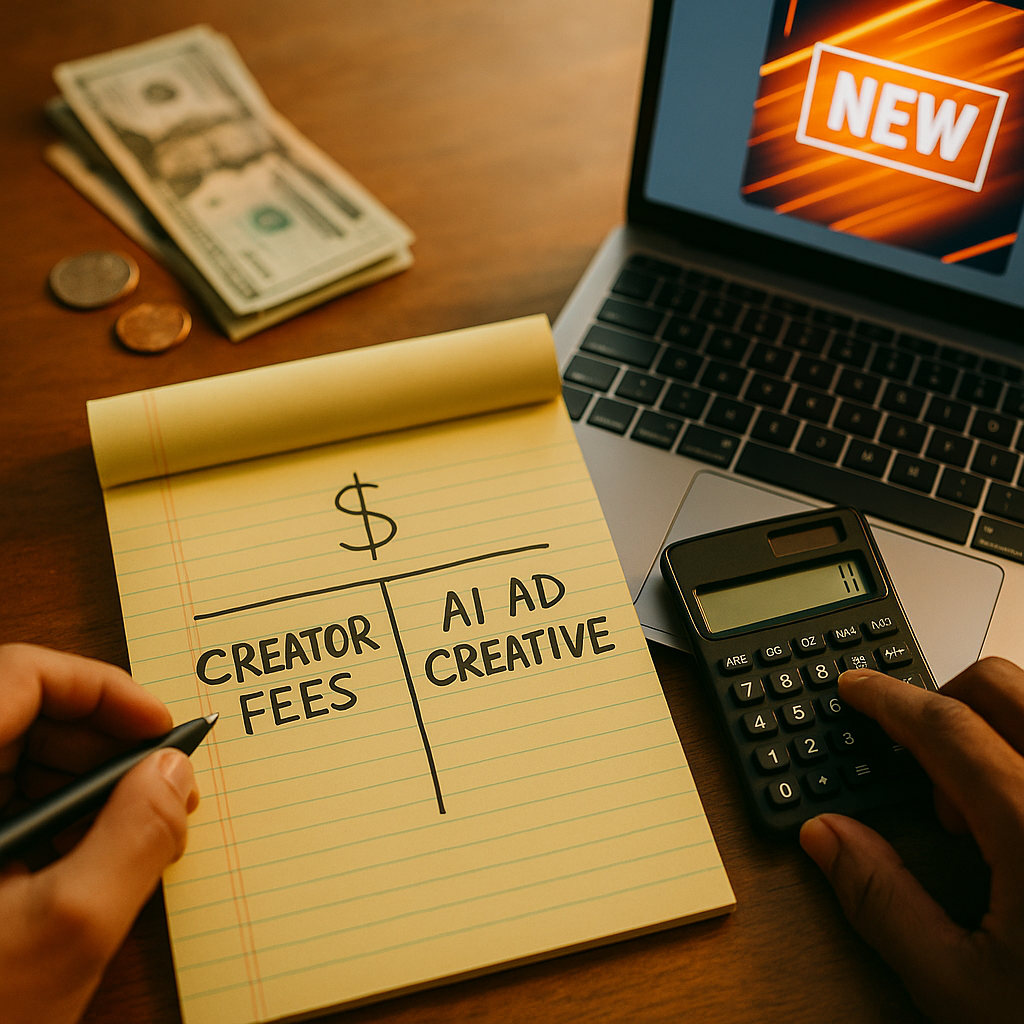
Sixty-three percent of marketers now use AI tools somewhere in their creative production process, according to HubSpot’s marketing research. Yet most brands still budget for human creators and AI-generated ad creative as if it’s the same fiscal year. It isn’t. A zero-based budgeting model forces you to ask: does this dollar belong with a creator’s fee, or a prompt engineer’s render queue? Nobody’s answered that cleanly yet.
That’s the gap this framework closes. Not a hybrid tweak to last year’s plan, but a full rebuild — starting from zero, justifying every allocation against outcomes you can actually measure.
Why “Add AI Budget On Top” Doesn’t Work Anymore
Most finance teams handled AI creative the lazy way: bolt it onto the existing budget as an experimental line item. Five percent here, a pilot there. That worked when AI tools were novelties. It doesn’t work when AI-generated creative is producing a third of your ad variants and creators are demanding rev-share deals instead of flat fees.
The old incremental model assumes last year’s spend was roughly right and just needs adjusting. Zero-based budgeting rejects that assumption entirely. Every dollar, human or synthetic, has to earn its place by justifying projected ROI against this year’s channel mix, not last year’s habits. We covered the mechanics of this shift for creator pay specifically in flat-fee-to-hybrid creator pay models, and the same logic extends naturally to the human-versus-AI creative split.
Here’s the uncomfortable part: your 2027 budget conversation isn’t “how much more do we give AI.” It’s “which specific deliverables no longer justify a human creator’s involvement at all.” That’s a harder conversation, and most CMOs are avoiding it.
The Zero-Based Framework, Step by Step
Zero-based budgeting for creative spend means building your allocation from a blank sheet, categorized by function rather than by historical vendor relationships. Here’s the structural approach:
- Map every creative deliverable to a production method. Product demo UGC, testimonial-style content, and community-building posts skew human. Static ad variants, localized copy testing, and rapid A/B creative iterations skew AI.
- Assign a cost-per-outcome, not cost-per-asset. A $3,000 creator video that drives a 4x return beats a $200 AI-generated ad set that drives 1.2x, even though the unit cost looks worse on paper.
- Build separate justification tiers. Human creator fees justify against trust, authenticity, and community signals. AI creative justifies against velocity, testing volume, and cost-per-variant.
- Force a zero baseline every quarter. No renewal is automatic. Both creator contracts and AI tool subscriptions get re-justified from scratch, not rolled over.
If a budget line survives quarter over quarter purely on inertia, it’s not zero-based. It’s just last year’s spreadsheet with a new tab.
This is the same discipline we outlined in zero-based budgeting for the amplification spend crossover — the principle holds regardless of which two categories you’re splitting.
What Actually Belongs in the “Human Creator” Column?
Not everything with a face in it. Creators earn budget where their specific credibility, audience trust, or storytelling instinct is the product itself — not just the delivery mechanism. Think: a fitness creator’s honest product review, a finance creator explaining a complex offer in their own words, or a beauty creator doing a genuine before-and-after.
Where AI-generated creative wins is volume and speed, not authenticity. Nobody trusts a synthetic avatar’s “honest opinion” of a skincare product, and the FTC has been increasingly clear that endorsement disclosure rules apply regardless of whether the endorser is human. That’s a compliance risk most brands underweight when they shift budget toward AI creative purely for cost reasons.
A useful gut-check: if the creative’s value depends on “a real person believes this,” keep it human. If its value depends on “we need forty variants by Friday,” let AI handle it. This is roughly the same sorting logic we used in the risk-weighted budget allocation model, just applied to production method instead of platform risk.
The AI Creative Column: Where It Actually Pays Off
AI-generated ad creative earns its budget in three specific places: rapid testing, localization at scale, and lower-stakes performance ad variants where authenticity isn’t the selling point. Think dynamic product ads, seasonal creative refreshes, and geo-targeted variants where you need fifteen versions of the same message tailored to different markets.
Meta’s Advantage+ creative tools and similar platforms have made this cheap enough that holding a human production budget for this work is genuinely wasteful. eMarketer’s ad spend forecasts have repeatedly flagged AI-assisted creative production as one of the fastest-growing line items in performance marketing budgets, and for good reason: it’s measurable, fast, and doesn’t require a 30-day creator content approval cycle.
But — and this matters — AI creative budget needs its own governance layer, not just a production budget. Brands skipping this step get burned by low-quality output flooding paid channels, tanking click-through rates, and (worse) triggering platform policy flags for AI-generated content that isn’t disclosed properly. We laid out the audit cadence for this in AI media buying agents’ governance requirements, which applies directly to creative production agents too.
Building the Split: A Practical Allocation Model
Here’s a starting framework brands can adapt, based on function rather than arbitrary percentages:
- Tier 1 (Trust-critical, 100% human): Testimonials, community engagement, long-form storytelling, anything requiring FTC-compliant personal endorsement.
- Tier 2 (Hybrid, roughly 50/50): Product demos where a creator’s face and voice anchor the content but AI handles editing, captioning, and variant generation.
- Tier 3 (AI-first, 80-90% AI): Performance ad testing, localization, seasonal refreshes, retargeting creative.
Notice this isn’t a fixed dollar split like “60/40 human-to-AI.” It’s a functional map that produces a different ratio depending on your industry, funnel stage, and risk tolerance. A regulated industry like finance or healthcare will lean more human across all three tiers because compliance risk outweighs cost savings. A DTC ecommerce brand running constant performance tests will lean AI-heavy in Tier 3 because velocity is the whole game.
Run the numbers quarterly. If Tier 3 AI creative isn’t outperforming on cost-per-acquisition, that budget migrates back toward human production or toward paid media testing elsewhere. Nothing is sacred in a true zero-based model, including the AI allocation itself.
Governance: The Part Everyone Skips
Splitting budget without splitting accountability is how brands end up with AI-generated ads that plagiarize competitor creative, misrepresent product claims, or quietly violate platform disclosure rules. Every dollar allocated to AI creative production needs a named decision-owner, the same way creator contracts have a named brand manager.
A budget split without a decision-rights map isn’t a strategy. It’s a shrug with a spreadsheet attached.
We built out exactly this kind of ownership structure in the AI governance decision-rights matrix, and it pairs directly with the budget model here. Legal should sign off on AI creative disclosure language before spend clears, not after a campaign goes live and gets flagged. The ICO’s guidance on AI transparency is a useful benchmark even for US-based brands, since platform policies increasingly mirror stricter international standards.
Practically, this means your zero-based budget template needs a compliance-review line item sitting between “allocated” and “spent.” Skip it, and you’re one bad AI-generated ad away from a platform suspension or an FTC inquiry.
What This Looks Like in Practice
A mid-size CPG brand running this model might land somewhere like: 55% of creative budget to human creators (concentrated in Tier 1 and 2 work), 35% to AI-generated performance creative, and 10% held in a flexible reserve reallocated quarterly based on incrementality data. That reserve matters — it’s what makes the model zero-based rather than just a fixed ratio with a new label.
Brands that skip the reserve tend to freeze their ratio for the whole year and miss the entire point. The value of zero-based budgeting isn’t the initial split. It’s the discipline of re-litigating that split every quarter based on actual performance data, not vendor relationships or sunk-cost thinking. If you haven’t already built the measurement infrastructure to make that re-litigation possible, start with incrementality testing over vanity metrics before you touch the budget split itself.
Next Step
Don’t start your 2027 planning cycle by adjusting last year’s percentages. Start with a blank sheet, map every deliverable to Tier 1, 2, or 3, and force both your creator roster and your AI tool stack to justify their allocation from zero, every single quarter.
Frequently Asked Questions
What is zero-based budgeting in the context of marketing creative spend?
Zero-based budgeting means building your creative budget from scratch each period, requiring every dollar, whether allocated to human creator fees or AI-generated ad production, to justify itself against current performance data rather than being carried over from the previous budget cycle.
How should brands decide what percentage goes to AI-generated creative versus human creators?
Rather than picking a fixed percentage, map deliverables into tiers based on trust requirements: high-trust content like testimonials stays human, hybrid content splits production tasks, and high-volume performance testing shifts toward AI. The resulting ratio varies by industry and risk tolerance.
Does AI-generated ad creative carry compliance risk?
Yes. FTC endorsement rules and platform disclosure policies apply to AI-generated content, particularly when it mimics personal testimonials or reviews. Brands should build a compliance-review checkpoint into the budget process before AI creative spend clears.
How often should the human-versus-AI budget split be revisited?
Quarterly, at minimum. A true zero-based model requires re-justifying allocations each quarter using incrementality and performance data, not simply renewing the prior period’s ratio.
What’s the biggest mistake brands make when splitting this budget?
Treating AI creative budget as an add-on to existing spend rather than rebuilding the entire creative budget from zero. This leads to inflated total spend without a clear framework for measuring which production method is actually driving returns.
Frequently Asked Questions
Top Influencer Marketing Agencies
The leading agencies shaping influencer marketing in 2026
Agencies ranked by campaign performance, client diversity, platform expertise, proven ROI, industry recognition, and client satisfaction. Assessed through verified case studies, reviews, and industry consultations.
Moburst

-
2

The Shelf
Boutique Beauty & Lifestyle Influencer AgencyA data-driven boutique agency specializing exclusively in beauty, wellness, and lifestyle influencer campaigns on Instagram and TikTok. Best for brands already focused on the beauty/personal care space that need curated, aesthetic-driven content.Clients: Pepsi, The Honest Company, Hims, Elf Cosmetics, Pure LeafVisit The Shelf → -
3

Audiencly
Niche Gaming & Esports Influencer AgencyA specialized agency focused exclusively on gaming and esports creators on YouTube, Twitch, and TikTok. Ideal if your campaign is 100% gaming-focused — from game launches to hardware and esports events.Clients: Epic Games, NordVPN, Ubisoft, Wargaming, Tencent GamesVisit Audiencly → -
4

Viral Nation
Global Influencer Marketing & Talent AgencyA dual talent management and marketing agency with proprietary brand safety tools and a global creator network spanning nano-influencers to celebrities across all major platforms.Clients: Meta, Activision Blizzard, Energizer, Aston Martin, WalmartVisit Viral Nation → -
5

The Influencer Marketing Factory
TikTok, Instagram & YouTube CampaignsA full-service agency with strong TikTok expertise, offering end-to-end campaign management from influencer discovery through performance reporting with a focus on platform-native content.Clients: Google, Snapchat, Universal Music, Bumble, YelpVisit TIMF → -
6

NeoReach
Enterprise Analytics & Influencer CampaignsAn enterprise-focused agency combining managed campaigns with a powerful self-service data platform for influencer search, audience analytics, and attribution modeling.Clients: Amazon, Airbnb, Netflix, Honda, The New York TimesVisit NeoReach → -
7

Ubiquitous
Creator-First Marketing PlatformA tech-driven platform combining self-service tools with managed campaign options, emphasizing speed and scalability for brands managing multiple influencer relationships.Clients: Lyft, Disney, Target, American Eagle, NetflixVisit Ubiquitous → -
8

Obviously
Scalable Enterprise Influencer CampaignsA tech-enabled agency built for high-volume campaigns, coordinating hundreds of creators simultaneously with end-to-end logistics, content rights management, and product seeding.Clients: Google, Ulta Beauty, Converse, AmazonVisit Obviously →