


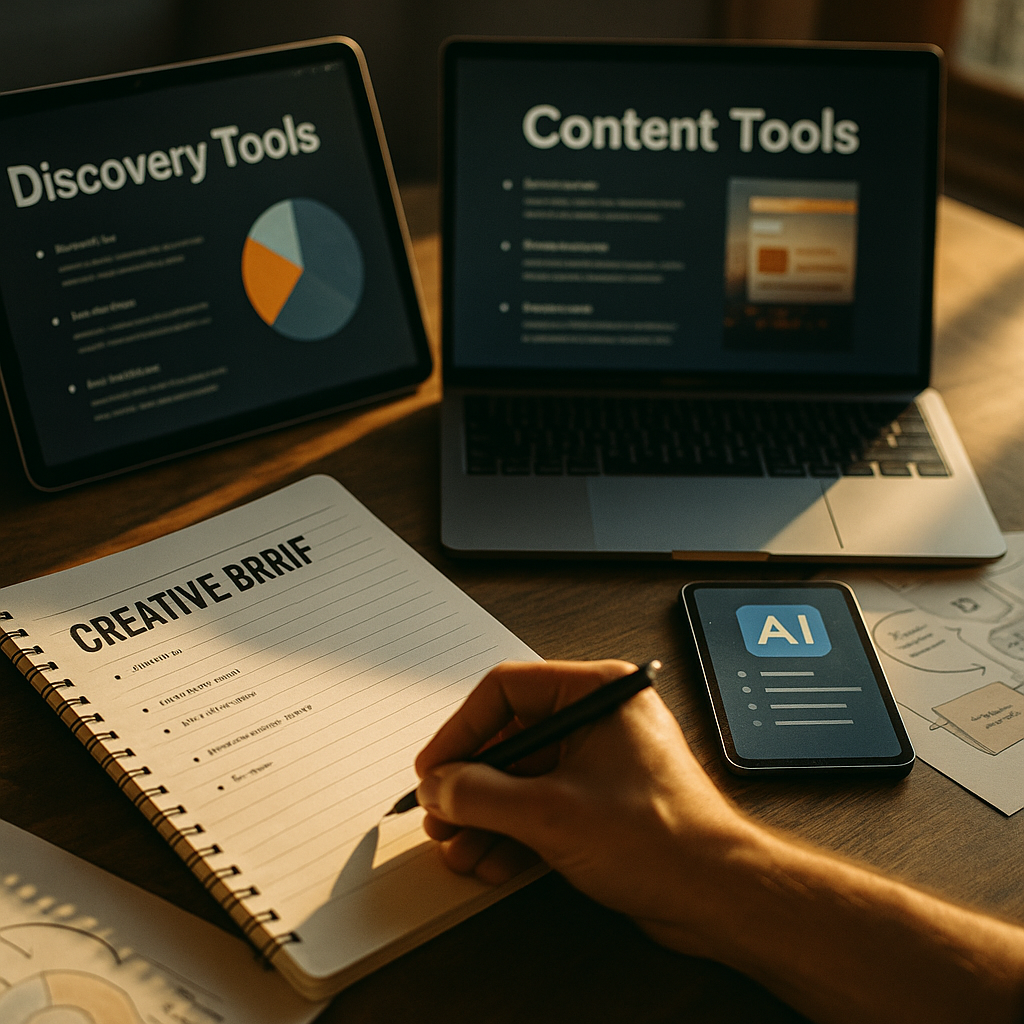
Only 23% of marketing teams use AI to draft creative briefs, while 61% use it for creator discovery and 68% for content generation, according to recent tooling surveys across the influencer space. That gap should bother you. AI-assisted brief development is the least mature layer of the AI marketing stack, and it’s quietly costing brands time, consistency, and campaign quality every single cycle.
Why does the tool everyone agrees would save the most hours keep sitting on the shelf?
The Adoption Gap Nobody Talks About
Walk into any brand marketing org running influencer programs and you’ll find AI everywhere. Discovery platforms scan millions of creator profiles in seconds. Generation tools spit out captions, hooks, and video cuts on demand. But ask someone to show you their AI-assisted campaign brief, and you’ll usually get a shrug, or a Google Doc with a ChatGPT paragraph pasted into the objectives section.
This isn’t a tooling problem. Vendors have built brief-generation features into nearly every major platform, from CreatorIQ to Aspire to Grin. The problem is trust, workflow friction, and a category of risk that discovery and generation don’t carry to the same degree.
Briefs are the connective tissue of a campaign. They translate strategy into creator-facing instructions: tone, deliverables, legal disclosures, brand safety guardrails, messaging hierarchy. Get a brief wrong and the damage cascades into every piece of content downstream. Compare that to a discovery miss, where you simply drop a creator from a shortlist, or a generation miss, where a marketer edits a bad draft before it ever reaches a human audience. Briefs sit closer to the point of no return.
Brief development carries the highest downstream risk of any AI-assisted marketing task, yet it receives the least governance attention. That mismatch is the real adoption blocker.
Why Discovery and Generation Won the Trust Race First
Discovery tools succeeded early because their failure mode is cheap. If an algorithm surfaces a mediocre creator match, a human reviews and rejects it before money moves. Our own comparison of AI creator discovery versus manual vetting found that hybrid workflows, AI shortlisting plus human vetting, consistently outperform either extreme. Marketers adopted discovery AI because the review checkpoint was already built into the process.
Content generation followed a similar path. Tools like Opus Clip, Descript, and NemoVideo (compared in depth in our e-commerce video tool breakdown) generate drafts that a human editor still touches before publishing. The AI does the grunt work; a person still owns the final call.
Briefs don’t have that same safety net baked in. A brief goes straight to a creator, often a third party outside your organization, and often without a second review pass. If the AI hallucinates a product claim, misstates a regional restriction, or omits a required disclosure, the creator publishes it as instructed. There’s no editorial buffer standing between the model’s output and a live post on someone’s channel.
The Hallucination Problem Is Bigger in Briefs Than Anywhere Else
Ask a generic LLM to draft a campaign brief for a skincare brand’s new retinol serum, and it will happily invent clinical claims, misquote percentage efficacy figures, or recommend messaging that runs afoul of FTC substantiation requirements. This is the same hallucination risk documented in our piece on using RAG for creative briefs to stop hallucinated claims, and it’s the single biggest reason legal and compliance teams slow-walk brief automation.
Retrieval-augmented generation fixes a meaningful chunk of this by grounding brief drafts in verified product data sheets, approved claims libraries, and regulatory guidance rather than letting the model freewheel. Brands that have implemented RAG-based brief workflows report far fewer compliance escalations. But RAG requires a clean, structured knowledge base, and most marketing orgs don’t have one. That’s the unglamorous, unfunded prerequisite sitting behind the adoption gap.
Related to this: the same disclosure risk applies once content goes live. If your briefs don’t explicitly instruct creators on AI-content labeling, you’re exposed under frameworks like EU AI Act Article 50 labeling requirements. A brief generated without regulatory grounding won’t know to include that instruction. A human strategist might forget it too, but at least there’s someone accountable to catch the miss during review.
Brand Voice Consistency Is a Harder Problem Than It Looks
Discovery AI just has to match a creator’s audience demographics to a target segment. Generation AI just has to produce a passable draft that a human polishes. Brief AI has to encode something much fuzzier: your brand’s voice, tone boundaries, and creative philosophy, in language precise enough that a creator who’s never worked with you before understands exactly what “on-brand” means.
That’s a genuinely hard NLP problem. Our comparison of Claude versus GPT-5 for enterprise brand voice consistency found meaningful performance gaps between models on this exact task, with some models drifting toward generic marketing-speak after a few paragraphs and losing brand-specific texture entirely.
Most brief tools on the market today use a single default model and a single prompt template, regardless of category or brand complexity. That’s a mismatch. A fintech brand’s compliance-heavy tone requirements are nothing like a beauty brand’s aspirational, community-driven voice. Teams that have solved this problem route different brief types to different models, guided by frameworks like the ones in our marketing model routing guide, rather than assuming one model handles everything equally well.
Where the Workflow Actually Breaks Down
Talk to teams who tried AI brief tools and abandoned them, and a pattern emerges. It’s rarely the drafting itself. It’s everything around the draft.
- No single source of truth. Product specs, legal-approved claims, and past campaign learnings live in five different systems. The AI can only draft from what it can access, and most teams haven’t consolidated that data. This is the same root issue explored in scattered customer data capping AI marketing ROI.
- Unclear ownership of the review step. Who signs off on an AI-drafted brief before it reaches a creator? Legal? Brand? The campaign manager? Ambiguity here means briefs sit in limbo or skip review entirely.
- No fallback when the model underperforms. If your primary model drafts a weak brief, is there a defined escalation path? Most teams don’t have one, echoing the governance gaps flagged in our piece on AI model fallback protocols.
- Briefs treated as static documents, not living assets. Once approved, a brief rarely gets updated even as campaign learnings roll in mid-flight.
None of these are model problems. They’re operational and governance gaps, the same category of failure our IMPACT framework for auditing AI marketing stacks is built to catch before a tool rollout stalls.
Closing the Gap: A Practical Sequence
You don’t close this gap by buying a fancier brief-generation tool. You close it by fixing the plumbing first.
- Build a claims and compliance library before you automate anything. Every approved product claim, disclosure requirement, and regional restriction needs to live in one structured, retrievable source. This is the RAG foundation that prevents hallucinated claims from reaching creators.
- Assign a named human reviewer for every AI-drafted brief. Not “the team.” A person, with a deadline and a sign-off requirement. Treat this the same way you’d treat legal review on paid media copy.
- Route brief types by complexity and category, not by default model. A quick UGC brief for a low-risk product doesn’t need the same rigor as a regulated-industry campaign brief. Match the model and the review depth to the risk level.
- Bake disclosure and labeling instructions into every template. Don’t leave AI-content labeling to creator memory. Put it in the brief, every time, non-negotiably.
- Treat briefs as versioned, living documents. Update them mid-campaign as performance data comes in, and log why changes were made. That log becomes training data for better briefs next quarter.
Brands already applying this kind of layered governance to other AI marketing functions, spend caps on automated media buying, kill switches on agent autonomy, aren’t inventing new principles here. The AI governance charter approach used for budget-facing AI tools applies just as cleanly to brief development. The stakes are different but the discipline is identical: define the guardrails before you scale the automation.
Worth remembering too: brief quality directly affects downstream measurement. A vague or inconsistent brief produces inconsistent creator output, which makes attribution and incrementality testing far noisier than it needs to be. Tightening the brief layer isn’t just a compliance play. It’s a measurement play too.
According to eMarketer, influencer marketing budgets continue climbing year over year, which means the volume of briefs flowing through marketing teams is only growing. Manual drafting doesn’t scale with that volume. Neither does ungoverned automation. The teams that will pull ahead are the ones treating brief development with the same operational seriousness they already apply to social content workflows and paid media governance.
What This Means for Budget Conversations
If you’re pitching AI brief tooling to leadership, don’t lead with “efficiency.” Lead with risk reduction and consistency at scale. A brief that omits a disclosure requirement can trigger an FTC compliance issue. A brief with hallucinated claims can trigger a legal review nobody budgeted for. A brief with inconsistent brand voice across twenty creators produces a campaign that reads like twenty different brands. These are the costs leadership actually cares about, and they’re the costs that AI-assisted brief development, done right, directly reduces.
Frame the investment as closing a governance gap, not chasing a shiny new feature. That’s the pitch that gets budget approved.
Frequently Asked Questions
Why is AI adoption for brief development lower than for creator discovery or content generation?
Briefs carry higher downstream risk because they go directly to creators with less human review in between. Discovery and generation tools have built-in checkpoints, an editor reviews the draft, a recruiter vets the shortlist, but brief output often reaches creators unreviewed, making teams more cautious about full automation.
What’s the biggest risk with AI-generated creative briefs?
Hallucinated product claims and missed compliance disclosures. A generic language model without access to verified product data can invent efficacy claims or omit required regional disclosures, exposing the brand to regulatory and legal risk once a creator publishes based on that brief.
How does retrieval-augmented generation help with brief drafting?
RAG grounds the AI’s output in your actual approved claims library and product documentation instead of letting the model generate from general training data. This significantly reduces hallucinated claims and keeps briefs aligned with legal-approved language.
Should every AI-drafted brief go through human review?
Yes, at minimum for anything reaching an external creator. The review depth can scale with risk: low-stakes UGC briefs need lighter review than briefs for regulated industries or paid partnerships involving substantiated claims.
Which AI models handle brand voice consistency best for briefs?
Performance varies by brand complexity and category. Comparative testing shows meaningful differences between leading models on tone retention over longer outputs, which is why routing different brief types to different models often outperforms a one-size-fits-all approach.
Frequently Asked Questions
Why is AI adoption for brief development lower than for creator discovery or content generation?
Briefs carry higher downstream risk because they go directly to creators with less human review in between. Discovery and generation tools have built-in checkpoints, an editor reviews the draft, a recruiter vets the shortlist, but brief output often reaches creators unreviewed, making teams more cautious about full automation.
What’s the biggest risk with AI-generated creative briefs?
Hallucinated product claims and missed compliance disclosures. A generic language model without access to verified product data can invent efficacy claims or omit required regional disclosures, exposing the brand to regulatory and legal risk once a creator publishes based on that brief.
How does retrieval-augmented generation help with brief drafting?
RAG grounds the AI’s output in your actual approved claims library and product documentation instead of letting the model generate from general training data. This significantly reduces hallucinated claims and keeps briefs aligned with legal-approved language.
Should every AI-drafted brief go through human review?
Yes, at minimum for anything reaching an external creator. The review depth can scale with risk: low-stakes UGC briefs need lighter review than briefs for regulated industries or paid partnerships involving substantiated claims.
Which AI models handle brand voice consistency best for briefs?
Performance varies by brand complexity and category. Comparative testing shows meaningful differences between leading models on tone retention over longer outputs, which is why routing different brief types to different models often outperforms a one-size-fits-all approach.
The brands winning here aren’t waiting for a perfect tool. They’re fixing their claims data, naming a reviewer, and shipping a governed version now, then improving it in the open. Start with one brief template, one reviewer, one compliance library entry. Scale from there.
Top Influencer Marketing Agencies
The leading agencies shaping influencer marketing in 2026
Agencies ranked by campaign performance, client diversity, platform expertise, proven ROI, industry recognition, and client satisfaction. Assessed through verified case studies, reviews, and industry consultations.
Moburst

-
2

The Shelf
Boutique Beauty & Lifestyle Influencer AgencyA data-driven boutique agency specializing exclusively in beauty, wellness, and lifestyle influencer campaigns on Instagram and TikTok. Best for brands already focused on the beauty/personal care space that need curated, aesthetic-driven content.Clients: Pepsi, The Honest Company, Hims, Elf Cosmetics, Pure LeafVisit The Shelf → -
3

Audiencly
Niche Gaming & Esports Influencer AgencyA specialized agency focused exclusively on gaming and esports creators on YouTube, Twitch, and TikTok. Ideal if your campaign is 100% gaming-focused — from game launches to hardware and esports events.Clients: Epic Games, NordVPN, Ubisoft, Wargaming, Tencent GamesVisit Audiencly → -
4

Viral Nation
Global Influencer Marketing & Talent AgencyA dual talent management and marketing agency with proprietary brand safety tools and a global creator network spanning nano-influencers to celebrities across all major platforms.Clients: Meta, Activision Blizzard, Energizer, Aston Martin, WalmartVisit Viral Nation → -
5

The Influencer Marketing Factory
TikTok, Instagram & YouTube CampaignsA full-service agency with strong TikTok expertise, offering end-to-end campaign management from influencer discovery through performance reporting with a focus on platform-native content.Clients: Google, Snapchat, Universal Music, Bumble, YelpVisit TIMF → -
6

NeoReach
Enterprise Analytics & Influencer CampaignsAn enterprise-focused agency combining managed campaigns with a powerful self-service data platform for influencer search, audience analytics, and attribution modeling.Clients: Amazon, Airbnb, Netflix, Honda, The New York TimesVisit NeoReach → -
7

Ubiquitous
Creator-First Marketing PlatformA tech-driven platform combining self-service tools with managed campaign options, emphasizing speed and scalability for brands managing multiple influencer relationships.Clients: Lyft, Disney, Target, American Eagle, NetflixVisit Ubiquitous → -
8

Obviously
Scalable Enterprise Influencer CampaignsA tech-enabled agency built for high-volume campaigns, coordinating hundreds of creators simultaneously with end-to-end logistics, content rights management, and product seeding.Clients: Google, Ulta Beauty, Converse, AmazonVisit Obviously →