


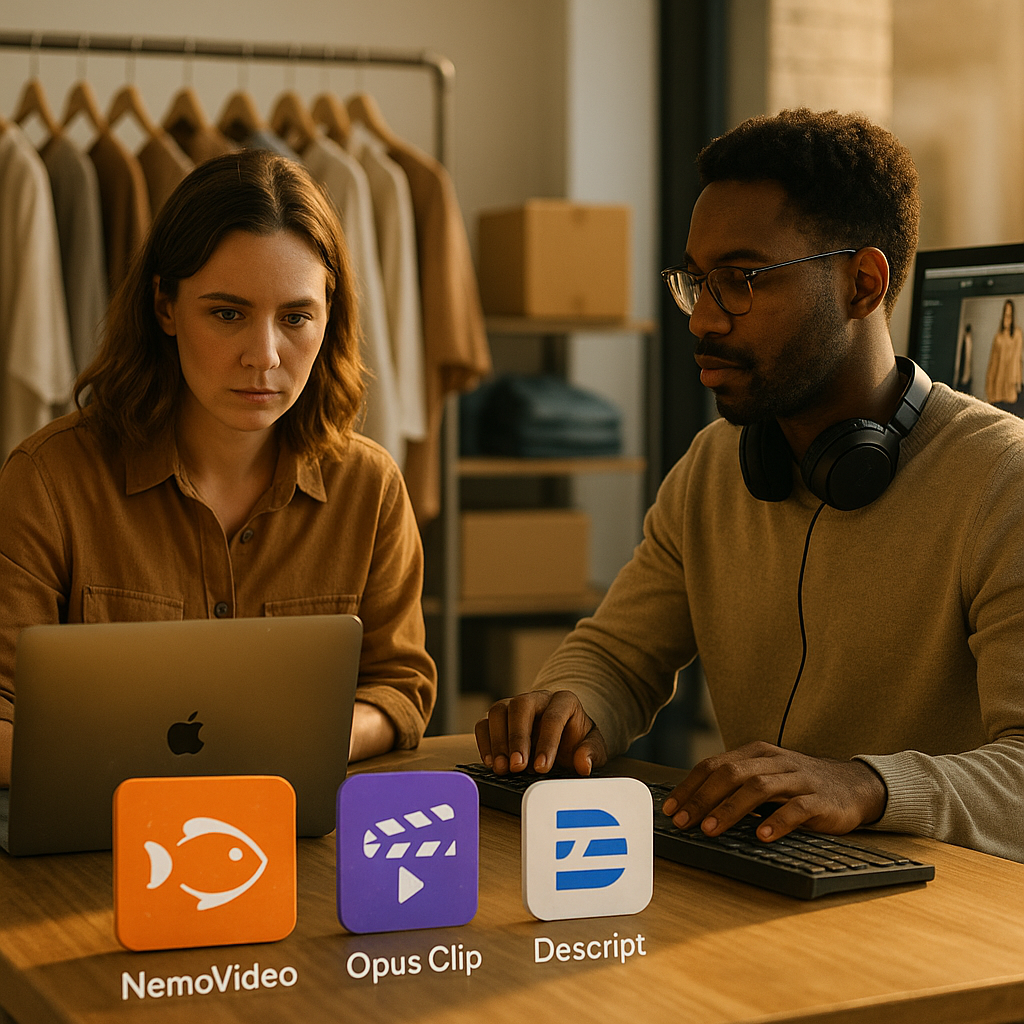
Seventy-two percent of marketers say video production still takes too long to keep pace with campaign demands, according to HubSpot research on content bottlenecks. For e-commerce brands pumping out UGC, product demos, and paid social creative weekly, that lag is a revenue leak. AI video editing agents promise to close the gap. But which one actually delivers for a brand’s workflow, budget, and risk tolerance?
This isn’t a feature-list comparison. It’s a working breakdown of NemoVideo, Opus Clip, and Descript from the angle that matters most to marketing leaders: how much time, headcount, and risk each tool actually removes from your production pipeline.
Why Creative Velocity Became a Boardroom Metric
Five years ago, video editing was a back-office function. Now it’s a growth lever. E-commerce brands running always-on paid social need dozens of creative variants weekly, not monthly. Testing hooks, formats, and CTAs at scale requires a production engine that doesn’t bottleneck on a single editor’s calendar.
That’s the pitch behind AI video editing agents: tools that ingest raw footage, long-form content, or livestreams and autonomously output short-form clips, captions, and platform-specific cuts. The promise is fewer freelancers, faster iteration, and lower cost-per-asset. The reality is more nuanced, and it depends heavily on which vendor you choose and how your team integrates it.
Brands that treat AI video agents as a full replacement for editorial judgment tend to see engagement drop within weeks. Brands that treat them as a first-draft engine see the real time savings.
This distinction matters because it echoes a pattern seen across other AI marketing tools: automation accelerates execution, but oversight still determines quality. The same principle shows up in generative AI campaign workflows, where unchecked automation quietly erodes brand consistency.
NemoVideo: Built for E-Commerce Product Loops
NemoVideo has positioned itself squarely at product-led brands. Its core differentiator is a “commerce mode” that ingests product feeds (Shopify, WooCommerce) and auto-generates short-form ad variants tied directly to SKUs, pricing, and inventory status. That’s a meaningfully different use case than general-purpose clipping tools.
- Strengths: Direct product feed integration, automated variant testing for hooks and CTAs, built-in compliance flags for pricing and claims language.
- Weaknesses: Smaller creator/influencer clip library support compared to competitors; steeper learning curve for teams without a dedicated ops person.
- Best fit: DTC brands running high-SKU catalogs with frequent price or promo changes.
The compliance flagging is worth dwelling on. Because NemoVideo cross-references generated copy against your product feed, it catches discrepancies before they go live, an outdated price mentioned in a voiceover, or a discontinued product still appearing in a rotation. That’s a real risk-mitigation feature, not just a nice-to-have. It’s the kind of guardrail marketing teams increasingly expect from automated systems, similar to the spend caps and kill switches discussed in AI governance frameworks for marketing.
Opus Clip: The Repurposing Powerhouse
Opus Clip built its reputation on one job: turning long-form video (webinars, podcasts, livestreams) into short-form clips optimized for TikTok, Reels, and Shorts. It’s fast, it’s cheap per-clip, and its virality scoring model has genuinely improved over recent iterations.
For e-commerce brands that run founder-led content, influencer collabs, or long-form UGC, Opus Clip is often the fastest way to multiply a single asset into a week’s worth of social content. Upload a 40-minute founder interview, get back a dozen ranked clips with captions burned in, ready for review.
- Strengths: Speed of clip generation, strong auto-captioning accuracy, virality scoring to prioritize which clips to publish first.
- Weaknesses: Limited product-feed or catalog integration; brand voice consistency requires manual template locking.
- Best fit: Brands with strong founder or creator content pipelines who need volume over precision.
The tradeoff here is control. Opus Clip’s automated selection is genuinely good at spotting quotable moments, but it doesn’t know your brand guidelines unless you feed it a locked template. Skip that step and you’ll get inconsistent fonts, colors, and pacing across your content calendar, small things, but they add up when you’re publishing daily.
Descript: The Editor’s Tool That Learned to Automate
Descript started as a text-based video editor (edit video by editing a transcript) and has layered AI agent features on top: Underlord for auto-editing, eye contact correction, overdub for voice cloning, and studio sound cleanup. It’s less “generate content for me” and more “let me edit ten times faster.”
That distinction matters for e-commerce teams with in-house creative staff. If your bottleneck is editor hours, not ideation, Descript compresses the manual timeline-scrubbing work dramatically. Teams report cutting rough-cut turnaround from days to hours for straightforward product demo edits.
- Strengths: Deepest manual control of the three, strongest for polished brand video (not just short-form social), robust voice/audio tools.
- Weaknesses: Steepest learning curve, least “hands-off” of the three, no native product-feed automation.
- Best fit: Brands producing higher-production-value content: brand films, tutorials, longer-form ads, where polish still matters more than raw volume.
Head-to-Head: Where the Time Savings Actually Show Up
Here’s the practical breakdown marketing ops leads actually care about.
- Speed to first draft: Opus Clip wins for repurposing long-form content. NemoVideo wins for catalog-driven ad variants. Descript wins for precision edits on existing footage.
- Brand consistency out of the box: NemoVideo and Descript both allow tighter template locking. Opus Clip needs manual setup to avoid drift.
- Compliance and risk controls: NemoVideo leads here with feed-based fact-checking. Neither Opus Clip nor Descript currently offers equivalent automated claims verification, which matters if your legal team is watching FTC disclosure requirements closely (see FTC guidance on endorsements and advertising).
- Cost per asset at scale: Opus Clip is generally cheapest per clip at high volume. NemoVideo’s pricing scales with catalog size. Descript’s value is in editor-hour savings, not per-clip cost.
None of these tools fully replace a human editor or strategist. What they replace is the grunt work: rough cuts, caption syncing, format resizing, first-pass selection. That’s the honest ROI story, and it’s a meaningful one. Marketing teams that reallocate freed-up editor hours toward strategy and testing tend to see better returns than teams that simply cut headcount.
The Governance Question Nobody’s Asking Loud Enough
Every AI agent making autonomous creative or publishing decisions introduces a new failure surface. Who approves a clip before it airs? What happens if Opus Clip’s virality algorithm surfaces a moment that’s technically accurate but contextually misleading? What if NemoVideo auto-generates an ad variant referencing a price that changed an hour ago?
These aren’t hypothetical. They mirror the same operational risks flagged in AI agent error-rate research in media buying, where autonomous systems without human checkpoints produced costly mistakes at scale. Video creative isn’t exempt from that dynamic just because it feels more “creative” than “operational.”
The brands getting the best ROI from AI video agents aren’t the ones with the most automation. They’re the ones with the clearest approval checkpoints before publish.
Build a lightweight review gate: someone signs off on brand voice, pricing accuracy, and claims language before anything goes live, regardless of which vendor generated it. This is the same logic behind tracking every AI-generated asset back to its source, so you know exactly what needs re-review when a product, price, or policy changes.
How to Choose: A Decision Framework, Not a Winner
There isn’t a single “best” tool here. There’s a best-fit tool depending on your production model.
- High-SKU catalog, frequent promos: Start with NemoVideo. The feed integration alone likely justifies the switch.
- Strong founder or creator content, need volume fast: Opus Clip. Lock your brand template first, then let it run.
- In-house editing team, higher production standards: Descript. It’s a force multiplier for people who already know how to edit, not a replacement for them.
- Hybrid teams running all three motions: Many mid-size e-commerce brands actually stack two tools, Descript for polished brand assets, Opus Clip or NemoVideo for high-volume social output. That’s not overkill. It reflects that different content types have genuinely different production needs.
Whichever path you take, measure the right thing. Don’t just track “hours saved.” Track cost-per-published-asset, time-to-first-draft, and error rate on compliance review. Those numbers tell you whether the tool is actually reducing risk and cost, or just moving the bottleneck somewhere less visible. For teams building a broader AI-driven marketing stack, this fits into the larger operational shift outlined in building an AI-ready marketing operating system.
Industry data backs the urgency here: eMarketer projects continued acceleration in short-form video ad spend through the next several quarters, meaning the volume demand on your creative team isn’t slowing down. Choosing the right agent now saves you a painful re-platforming exercise later.
Next step: Run a two-week pilot with your top candidate on a single product line before committing budget. Measure time-to-publish and compliance-flag rate against your current process, then decide whether to scale it or stack a second tool alongside it.
FAQs
What is an AI video editing agent, exactly?
It’s software that autonomously performs editing tasks, cutting clips, adding captions, resizing for platforms, sometimes even selecting which moments to feature, with minimal manual input. It differs from traditional editing software by making creative and structural decisions on its own, based on rules or machine learning models.
Can these tools fully replace a video editor on an e-commerce team?
Not reliably, at least not yet. They remove the repetitive, time-consuming parts of editing (rough cuts, resizing, caption syncing), but brand judgment, nuanced pacing, and compliance review still benefit from human oversight. Most teams see the best results using these tools to augment editors, not eliminate the role entirely.
Which tool is cheapest for high-volume social content?
Opus Clip generally offers the lowest cost per clip at scale, particularly for repurposing long-form content into multiple short-form assets. NemoVideo’s cost scales with catalog complexity, and Descript’s value shows up more in editor-hour savings than per-clip pricing.
Do these tools introduce compliance risk?
Yes, if left unchecked. Auto-generated captions or product claims can drift from accurate pricing, availability, or approved messaging. NemoVideo has built-in feed-based checks for this; Opus Clip and Descript currently rely more heavily on manual review before publishing.
How do I measure ROI on an AI video editing agent?
Track time-to-first-draft, cost-per-published-asset, and compliance-flag or correction rate. Hours saved alone is a misleading metric if it doesn’t account for rework caused by errors slipping through automated output.
FAQs
What is an AI video editing agent, exactly?
It’s software that autonomously performs editing tasks, cutting clips, adding captions, resizing for platforms, sometimes even selecting which moments to feature, with minimal manual input. It differs from traditional editing software by making creative and structural decisions on its own, based on rules or machine learning models.
Can these tools fully replace a video editor on an e-commerce team?
Not reliably, at least not yet. They remove the repetitive, time-consuming parts of editing (rough cuts, resizing, caption syncing), but brand judgment, nuanced pacing, and compliance review still benefit from human oversight. Most teams see the best results using these tools to augment editors, not eliminate the role entirely.
Which tool is cheapest for high-volume social content?
Opus Clip generally offers the lowest cost per clip at scale, particularly for repurposing long-form content into multiple short-form assets. NemoVideo’s cost scales with catalog complexity, and Descript’s value shows up more in editor-hour savings than per-clip pricing.
Do these tools introduce compliance risk?
Yes, if left unchecked. Auto-generated captions or product claims can drift from accurate pricing, availability, or approved messaging. NemoVideo has built-in feed-based checks for this; Opus Clip and Descript currently rely more heavily on manual review before publishing.
How do I measure ROI on an AI video editing agent?
Track time-to-first-draft, cost-per-published-asset, and compliance-flag or correction rate. Hours saved alone is a misleading metric if it doesn’t account for rework caused by errors slipping through automated output.
Top Influencer Marketing Agencies
The leading agencies shaping influencer marketing in 2026
Agencies ranked by campaign performance, client diversity, platform expertise, proven ROI, industry recognition, and client satisfaction. Assessed through verified case studies, reviews, and industry consultations.
Moburst

-
2

The Shelf
Boutique Beauty & Lifestyle Influencer AgencyA data-driven boutique agency specializing exclusively in beauty, wellness, and lifestyle influencer campaigns on Instagram and TikTok. Best for brands already focused on the beauty/personal care space that need curated, aesthetic-driven content.Clients: Pepsi, The Honest Company, Hims, Elf Cosmetics, Pure LeafVisit The Shelf → -
3

Audiencly
Niche Gaming & Esports Influencer AgencyA specialized agency focused exclusively on gaming and esports creators on YouTube, Twitch, and TikTok. Ideal if your campaign is 100% gaming-focused — from game launches to hardware and esports events.Clients: Epic Games, NordVPN, Ubisoft, Wargaming, Tencent GamesVisit Audiencly → -
4

Viral Nation
Global Influencer Marketing & Talent AgencyA dual talent management and marketing agency with proprietary brand safety tools and a global creator network spanning nano-influencers to celebrities across all major platforms.Clients: Meta, Activision Blizzard, Energizer, Aston Martin, WalmartVisit Viral Nation → -
5

The Influencer Marketing Factory
TikTok, Instagram & YouTube CampaignsA full-service agency with strong TikTok expertise, offering end-to-end campaign management from influencer discovery through performance reporting with a focus on platform-native content.Clients: Google, Snapchat, Universal Music, Bumble, YelpVisit TIMF → -
6

NeoReach
Enterprise Analytics & Influencer CampaignsAn enterprise-focused agency combining managed campaigns with a powerful self-service data platform for influencer search, audience analytics, and attribution modeling.Clients: Amazon, Airbnb, Netflix, Honda, The New York TimesVisit NeoReach → -
7

Ubiquitous
Creator-First Marketing PlatformA tech-driven platform combining self-service tools with managed campaign options, emphasizing speed and scalability for brands managing multiple influencer relationships.Clients: Lyft, Disney, Target, American Eagle, NetflixVisit Ubiquitous → -
8

Obviously
Scalable Enterprise Influencer CampaignsA tech-enabled agency built for high-volume campaigns, coordinating hundreds of creators simultaneously with end-to-end logistics, content rights management, and product seeding.Clients: Google, Ulta Beauty, Converse, AmazonVisit Obviously →