


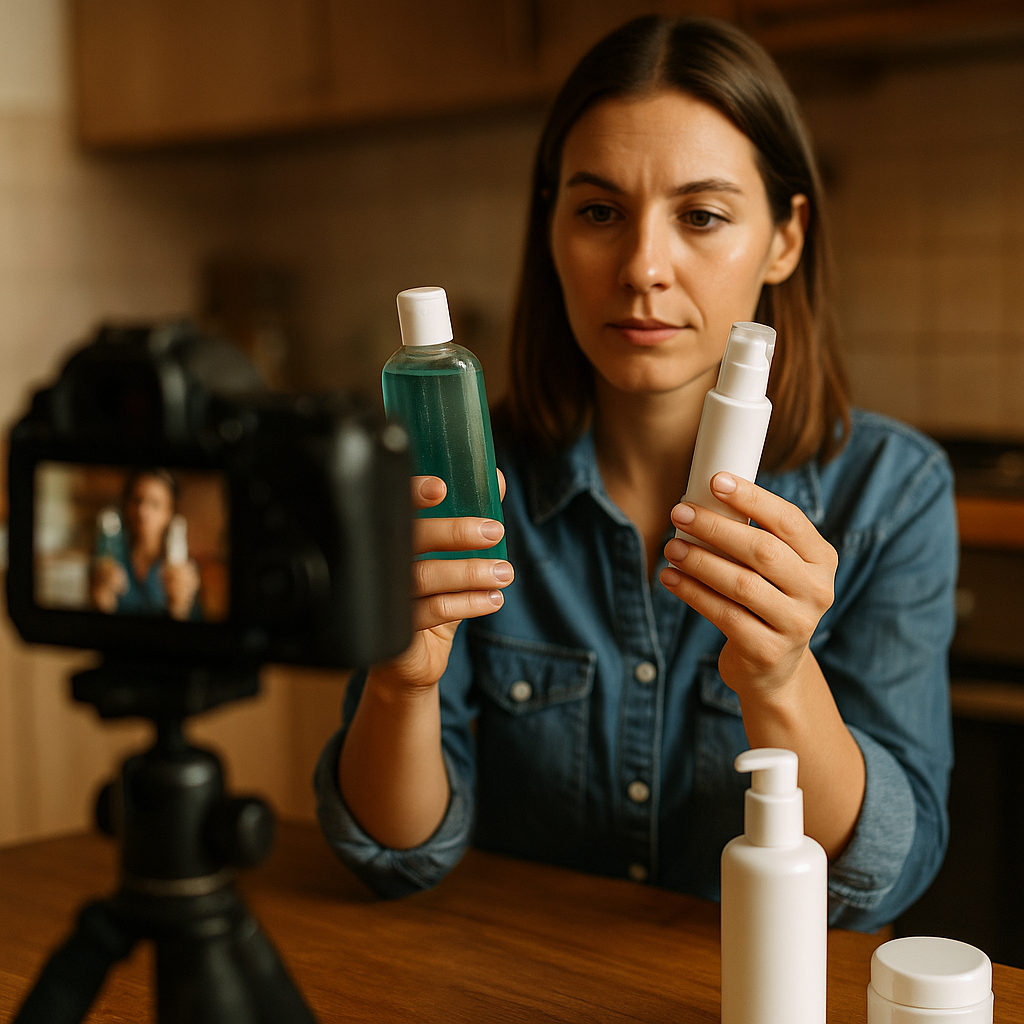
A creator holds two skillets. One egg slides off the nonstick pan. The other scrambles into a sticky mess. No voiceover. No text card screaming “BETTER.” Just eleven seconds of visual proof and a sound-off audience nodding along. That’s the silent comparison format, and it’s quietly outperforming scripted reviews across TikTok Shop and Instagram Reels right now.
Roughly 85% of Facebook video is watched without sound, and TikTok’s own creative guidance has pushed captions and visual storytelling for years because so much consumption happens muted, on transit, in offices, in bed next to a sleeping partner. Narrated claims get skipped, muted, or scrolled past mid-sentence. A side-by-side test doesn’t need to be heard. It needs to be seen for three seconds to land.
What the Silent Comparison Format Actually Is
Strip it down and it’s simple: two products, one frame, one variable changed. No script. No brand rep talking to camera. No “as you can see” narration walking viewers through the obvious. The creator sets up a controlled test, hits record, and lets the outcome speak.
Think stain removal on identical fabric swatches. Two phone screens dropped from the same height. Two coffee makers brewing side by side while a timer runs in the corner. The format borrows credibility from science-class demonstrations, not from advertising. That’s precisely why it works: audiences trust what they can verify with their own eyes far more than what a brand or paid creator tells them.
When the visual does the arguing, the creator never has to make a claim, which means there’s rarely a claim to fact-check, dispute, or file a complaint about.
This isn’t a new idea in consumer behavior. It’s the same logic behind blind ranking formats, where withholding the brand name until the reveal builds suspense and trust simultaneously. Silent comparison just takes it a step further by withholding commentary entirely.
Why Brands Are Testing This Now
Three forces are converging. First, sound-off viewing keeps climbing as short-form video gets consumed in more public and semi-public settings. Second, audiences have grown allergic to scripted enthusiasm. Every “OMG you guys, I’m obsessed” delivery now reads as a paid line, because it usually is. Third, platforms are rewarding watch-through rate more than ever in their ranking signals, and a visual mystery (which pan wins?) holds attention longer than a talking head reciting benefits.
There’s also a quieter, more strategic reason: legal exposure. Spoken superiority claims — “this cleans twice as fast” — require substantiation under FTC guidance. A visual demonstration of an actual test, filmed honestly and without staging tricks, is much closer to a factual disclosure than an advertising claim. That distinction matters more than most brand teams realize.
The Compliance Angle Nobody’s Briefing Correctly
Here’s the trap: brands assume that because there’s no narration, there’s no claim, and therefore no FTC exposure. Wrong. A visual demonstration is still a claim. If Pan A outperforms Pan B on camera, you are asserting a performance difference just as surely as if someone said it out loud. The FTC’s endorsement guidance doesn’t distinguish between spoken and visual claims. Deceptive editing, cherry-picked test conditions, or a competitor product that’s deliberately handicapped (old batteries, wrong setting, expired product) can trigger the exact same liability as a false verbal statement.
So the brief has to cover what the test conditions actually are, not just what the camera shows. Same starting temperature. Same amount of product. Same surface, same lighting, same everything except the one variable being tested. Document it. Keep a shot log. If a regulator or a skeptical journalist ever asks “was this rigged?”, you need a paper trail showing it wasn’t.
Disclosure still applies, too. A sponsored side-by-side test needs the same #ad or #partner disclosure as any other paid content, whether or not a single word is spoken. Silence isn’t a compliance loophole. It’s a storytelling choice. Brands that treat it as a way to dodge substantiation requirements are the ones who end up in enforcement letters.
This is where the format overlaps with work Influencers Time has covered on split-screen comparison briefs and confession-booth compliance — different formats, same underlying principle: the less a creator says, the more careful the brand has to be about what’s implied.
Directing the Shoot: What Actually Goes in the Brief
Silent formats demand more direction, not less. Removing narration removes the safety net that lets a creator explain away an awkward edit or a confusing shot. Every frame has to carry weight on its own.
A solid creative brief for this format should specify:
- The single variable being tested — one difference only. Two variables muddies the visual claim and invites skepticism.
- Camera framing — locked, static, symmetrical. Both products need equal visual real estate. A tilted or zoomed shot that favors one side reads as manipulation, even accidentally.
- Timing parity — if it’s a speed test, both clocks start and stop on camera. No cutting away mid-test.
- Text overlay rules — minimal labels only (Product A / Product B), no adjectives, no claims copy. Let a caption identify, not persuade.
- Sound design — ambient only. No music stings that cue “winner” and “loser.” That’s a narration substitute and it undermines the format’s neutrality.
- Disclosure placement — on-screen text disclosure at the start, not buried in a caption users won’t scroll to read.
Notice what’s missing from that list: a script. There isn’t one. That’s the point, but it means the brief has to be far more technical about production mechanics than a typical talking-head UGC ask. Creators used to freeform, personality-driven content sometimes resist this level of rigidity. Brief them on why: the format’s power comes from its neutrality, and neutrality requires discipline.
Picking the Right Creators for a Silent Format
Not every creator is suited to this. Personality-forward creators, the ones whose audience shows up for their voice and reactions, often struggle to hand over a video with no vocal presence at all. Their engagement usually comes from parasocial connection, not demonstration credibility.
Look instead for creators in test-and-review niches: home organization, cleaning, tech teardown, cooking gear, skincare texture testing. These audiences already expect visual proof over personality. A cleaning creator’s side-by-side stain test fits their content identity. A lifestyle vlogger doing the same thing feels like a detour, and audiences can sense the mismatch.
Micro and nano creators tend to overperform here, too. Their audiences trust them precisely because they’re not polished, and a silent, unscripted demonstration format plays to that authenticity rather than fighting it. If you’re building out a broader nano-creator strategy, the same trust logic that powers grocery-aisle walkthrough briefs applies here almost word for word.
Measuring a Format That Never Makes a Claim
How do you measure success when there’s no line of dialogue to test for resonance? Watch-through rate and rewatch rate become the primary signals. Because the format is built on suspense (which one wins?), a strong version should show elevated completion rates compared to narrated UGC in the same category. If viewers are dropping off before the reveal, the setup isn’t compelling enough or the variable isn’t visually obvious.
Comment sentiment matters more here than in most formats, too. Silent comparisons tend to generate comment threads litigating the test itself: “but did you use the same amount of product?”, “this isn’t a fair test.” That’s not necessarily bad. Debate signals engagement, and a brand that responds transparently, sharing the actual test protocol, converts skeptics into some of the most convincing organic advocates you’ll get. Brands that go silent in the comments after going silent in the video lose that opportunity entirely.
Track saves and shares separately from likes. Demonstration content tends to get saved for reference (“which vacuum should I actually buy”) far more than it gets liked, and that behavioral signal is a stronger purchase-intent indicator according to data Sprout Social and other platform analytics providers have highlighted around utility-driven content.
A silent comparison video that gets debated in the comments is doing its job. The format isn’t selling agreement, it’s selling proof, and proof invites scrutiny.
Where This Format Breaks Down
It doesn’t work for every product category. Abstract benefits, mood, emotional positioning, brand storytelling, none of these translate to a visual side-by-side. You can’t silently demonstrate “this fragrance makes you feel confident.” Save this format for products with a tangible, observable performance difference: absorbency, speed, durability, texture, cleaning power, battery life.
It also fails when the “losing” product in the comparison is a real, identifiable competitor rather than a generic stand-in or the brand’s own older product line. Comparative advertising naming a specific competitor brings a separate layer of legal risk around disparagement and false advertising claims, on top of the endorsement disclosure issues already discussed. Most brands are safer testing against an unbranded or blurred competitor product, or against their own previous-generation item, which sidesteps disparagement risk while still making the point.
If your product doesn’t win the visual test decisively, don’t publish it. That sounds obvious, but the pressure to hit a content calendar deadline has pushed more than one brand to post a comparison where the result was ambiguous at best. Ambiguous results in a format built entirely on visual certainty just look like a bad ad.
Next Step
Pick one product with a genuinely provable, single-variable advantage, brief a review-niche creator on locked framing and zero narration, and publish it as a test before scaling it into a paid campaign. If the comments start debating the methodology, you’ll know the format is working exactly as intended.
FAQs
Does a silent comparison video still need an FTC disclosure?
Yes. Disclosure requirements are based on whether the content is sponsored, not on whether it includes spoken claims. On-screen text disclosure at the start of the video is required regardless of narration.
Is a visual demonstration considered a “claim” under advertising law?
Yes. The FTC treats visual demonstrations the same as spoken or written claims. If a video shows one product outperforming another, that implied claim must be substantiated just like a verbal one.
What products work best for this format?
Products with a tangible, observable performance difference: cleaning power, absorbency, speed, durability, or texture. Emotional or abstract benefits don’t translate to a silent side-by-side test.
Can brands compare their product directly against a named competitor?
They can, but it introduces disparagement and comparative advertising risk beyond standard endorsement rules. Many brands opt for an unbranded competitor or their own prior product generation instead.
How is success measured without narration or a spoken CTA?
Watch-through rate, rewatch rate, saves, and comment sentiment are the primary signals. Because the format relies on suspense, completion rate is a stronger indicator than it would be for scripted content.
Top Influencer Marketing Agencies
The leading agencies shaping influencer marketing in 2026
Agencies ranked by campaign performance, client diversity, platform expertise, proven ROI, industry recognition, and client satisfaction. Assessed through verified case studies, reviews, and industry consultations.
Moburst

-
2

The Shelf
Boutique Beauty & Lifestyle Influencer AgencyA data-driven boutique agency specializing exclusively in beauty, wellness, and lifestyle influencer campaigns on Instagram and TikTok. Best for brands already focused on the beauty/personal care space that need curated, aesthetic-driven content.Clients: Pepsi, The Honest Company, Hims, Elf Cosmetics, Pure LeafVisit The Shelf → -
3

Audiencly
Niche Gaming & Esports Influencer AgencyA specialized agency focused exclusively on gaming and esports creators on YouTube, Twitch, and TikTok. Ideal if your campaign is 100% gaming-focused — from game launches to hardware and esports events.Clients: Epic Games, NordVPN, Ubisoft, Wargaming, Tencent GamesVisit Audiencly → -
4

Viral Nation
Global Influencer Marketing & Talent AgencyA dual talent management and marketing agency with proprietary brand safety tools and a global creator network spanning nano-influencers to celebrities across all major platforms.Clients: Meta, Activision Blizzard, Energizer, Aston Martin, WalmartVisit Viral Nation → -
5

The Influencer Marketing Factory
TikTok, Instagram & YouTube CampaignsA full-service agency with strong TikTok expertise, offering end-to-end campaign management from influencer discovery through performance reporting with a focus on platform-native content.Clients: Google, Snapchat, Universal Music, Bumble, YelpVisit TIMF → -
6

NeoReach
Enterprise Analytics & Influencer CampaignsAn enterprise-focused agency combining managed campaigns with a powerful self-service data platform for influencer search, audience analytics, and attribution modeling.Clients: Amazon, Airbnb, Netflix, Honda, The New York TimesVisit NeoReach → -
7

Ubiquitous
Creator-First Marketing PlatformA tech-driven platform combining self-service tools with managed campaign options, emphasizing speed and scalability for brands managing multiple influencer relationships.Clients: Lyft, Disney, Target, American Eagle, NetflixVisit Ubiquitous → -
8

Obviously
Scalable Enterprise Influencer CampaignsA tech-enabled agency built for high-volume campaigns, coordinating hundreds of creators simultaneously with end-to-end logistics, content rights management, and product seeding.Clients: Google, Ulta Beauty, Converse, AmazonVisit Obviously →