


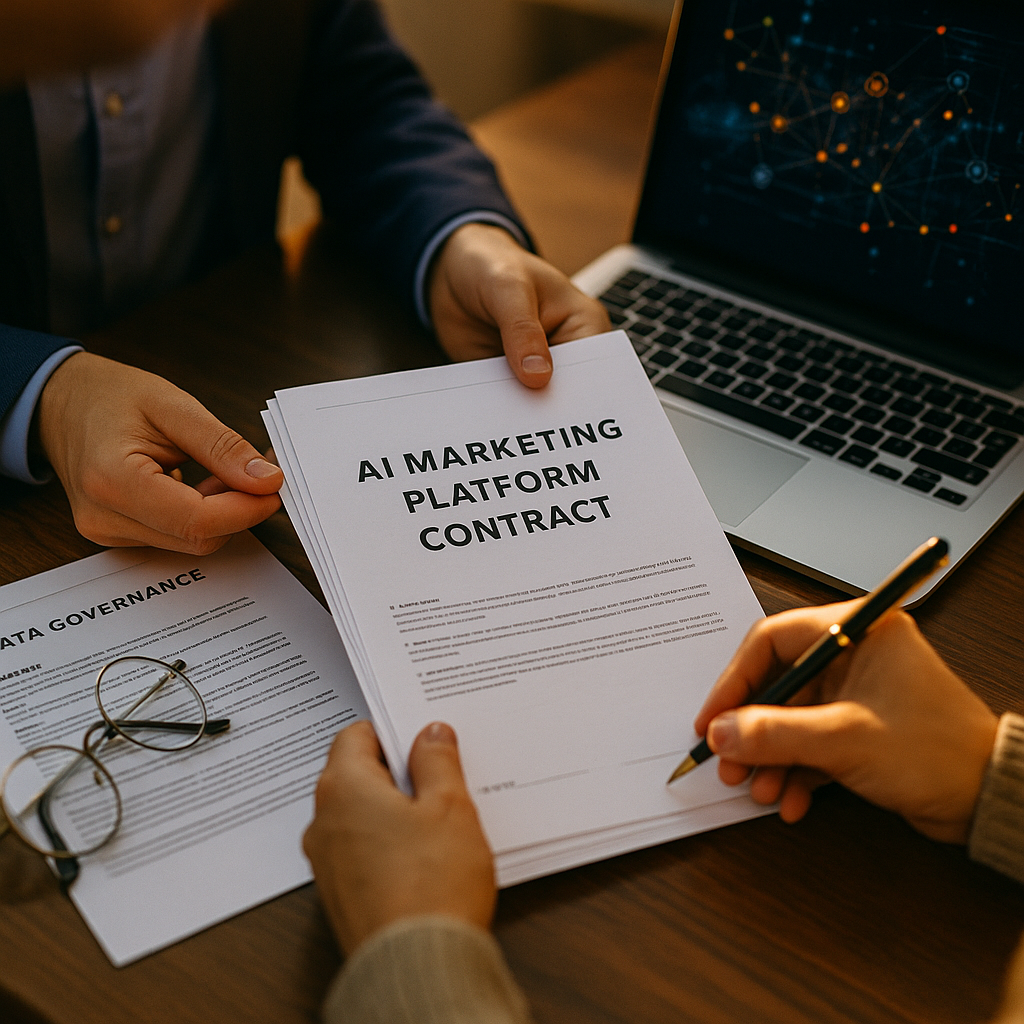
An all-in-one AI marketing platform can crawl your entire product catalog, generate ad creative, and launch campaigns before your legal team even knows a URL was touched. That’s not a hypothetical — it’s the default workflow for tools like Pencil, AdCreative.ai, and a growing wave of “connect your site and go” platforms. Data governance clauses in your vendor contract are the only thing standing between that convenience and a compliance mess you didn’t sign up for.
Marketers love the pitch: paste a URL, get fifty ad variants. But nobody’s asking what the scraper actually collected, where it’s stored, or who owns the derivative content. That’s the gap this article closes.
Why Auto-Scraping Product URLs Is Riskier Than It Looks
When an AI platform scrapes a product page, it’s not just grabbing the headline and hero image. It’s pulling pricing, customer reviews, embedded metadata, sometimes even cached personalization data if your site serves dynamic content. Some tools scrape competitor pages too, for “market benchmarking.” That’s a different legal animal entirely, touching on web scraping law and potential breach-of-terms issues with third-party sites.
Here’s the uncomfortable truth: most marketing teams adopt these platforms through a self-serve signup, not a procurement review. The legal team finds out after the first campaign launches. By then, the platform has already ingested a quarter’s worth of product data into its training pipeline, and there’s no clean way to claw that back.
If your AI marketing platform can access a URL, it can probably store, retrain on, and redistribute what it finds there — unless your contract says otherwise in writing.
This isn’t paranoia. It’s the same pattern that’s already forced brands to rewrite vendor contract terms around model changes, and the same logic driving scrutiny of AI shopping agents that pull product data without clear consent trails.
What Exactly Gets Scraped — And Who Actually Owns It?
Before you draft a single clause, map the data flow. Ask the vendor these questions directly, and get the answers in writing, not in a sales deck:
- Does the scraper capture only public-facing product data, or does it also pull cookies, session data, or backend metadata exposed through the DOM?
- Is scraped content used to train the vendor’s foundation model, or is it processed in a sandboxed instance specific to your account?
- Where is the data stored — which region, which cloud provider, and for how long?
- Can you request full deletion, including from any fine-tuned model checkpoints?
- Does the platform scrape competitor URLs on your behalf, and if so, whose liability is that?
Most vendors won’t have crisp answers to all five. That’s fine — but their vagueness should show up as risk in your contract, not get waved away because the demo looked slick.
The Ownership Trap
Standard SaaS terms often include a clause granting the vendor a “non-exclusive license to use Customer Data to improve the Services.” Sounds harmless. In practice, this can mean your product descriptions, pricing strategy, and even scraped customer review sentiment become training fodder for a model your competitors also use. Strike that clause, or narrow it hard.
Negotiate for explicit, enumerated data use: scraping is permitted only for generating creative assets tied to your account, full stop. Anything beyond that — model training, aggregated benchmarking, third-party resale — needs separate, opt-in written consent.
Building the Clause: Five Components That Actually Hold Up
A data governance clause isn’t one paragraph. It’s a cluster of provisions working together. Here’s what belongs in the contract, roughly in order of negotiation priority.
1. Scope of Collection
Define precisely what the platform is authorized to scrape. Name the domains, subdomains, or URL patterns explicitly. If the tool is scraping competitor sites for pricing intelligence, that needs its own carve-out with indemnification language, because you don’t want to inherit liability for someone else’s terms-of-service violation.
2. Retention and Deletion Rights
Specify a maximum retention period — 90 days is a reasonable ceiling for raw scraped content once it’s been processed into creative output. Require certified deletion on contract termination, including from backups and any model fine-tuning artifacts. Most vendors will resist the “model artifacts” part. Push anyway; it’s the piece that actually matters.
4. Audit and Reporting Rights
You need the contractual right to request a data processing log: what was scraped, when, and what it was used to generate. Without this, you’re trusting a black box. Some platforms already offer this as a dashboard feature — if yours doesn’t, make it a contract requirement, not a nice-to-have.
5. Breach Notification Timelines
Generic SaaS contracts often say “notification without undue delay.” That’s meaningless. Pin it to a number: 72 hours from discovery, aligned with UK ICO breach reporting expectations and comparable state-level thresholds in the US. If the vendor’s scraper touches EU consumer data through your international product pages, this timeline also needs to satisfy GDPR notification norms.
A 72-hour notification clause isn’t bureaucratic box-checking — it’s the difference between managing a breach and discovering it in a subpoena.
Cross-Border Data Flows Nobody Reads the Fine Print On
If your product URLs include region-specific pricing, localized reviews, or EU customer testimonials embedded on the page, scraping that content can trigger cross-border transfer obligations. Many AI marketing platforms process data through US-based servers by default, regardless of where your storefront is hosted. That’s a live issue if you’re running EU campaigns and haven’t confirmed adequacy mechanisms are in place.
This connects directly to work brands are already doing on EU AI Act compliance and disclosure harmonization. Data governance and disclosure compliance aren’t separate workstreams anymore — they’re the same contract review, just different clauses.
Practical fix: require the vendor to specify data residency options in the contract, not just in a help-center article. If they can’t guarantee EU-resident processing for EU-sourced content, that’s a real limitation on which markets you can safely run the tool in.
Liability When the AI Gets It Wrong
Scraped product data feeds directly into auto-generated ad copy. If the scraper misreads a discontinued product page and the platform generates an ad for a product you no longer sell — or worse, misstates pricing or a health claim — who’s liable? Increasingly, brands are borrowing indemnification language from adjacent categories, like the frameworks emerging around autonomous bidding agent contracts and AI agent liability riders.
The core principle transfers cleanly: if the platform’s automated scraping and generation pipeline produces a false or non-compliant claim, the vendor should bear first-line liability, with a capped indemnification obligation. Your brand still carries FTC exposure for what actually ships to consumers — the FTC’s endorsement guidance makes clear that advertisers can’t outsource responsibility to a tool. But the contract should at least give you recourse against the vendor when their scraping pipeline is the root cause.
This also ties into broader disclosure obligations. If AI-scraped content ends up repurposed into influencer briefs or UGC-style ads, the same accuracy standards apply that regulators are already applying to AI-generated UGC and AI-remixed creator content.
A Practical Rollout: What to Do Before Your Next Renewal
You don’t need to overhaul every vendor relationship simultaneously. Prioritize by exposure:
- Audit current tools first. List every AI marketing platform with URL-scraping or catalog-sync features already connected to your site. Most teams are surprised by the count.
- Request a data processing addendum (DPA) from each vendor if one doesn’t already exist. If they can’t produce one within a week, treat that as a signal.
- Flag renewal dates. Data governance terms are far easier to renegotiate at renewal than mid-contract. Build a 60-day lead time into your calendar for any platform touching product URLs.
- Loop in legal early — not after procurement, during it. Marketing ops teams that treat this as a checkbox at signup are the ones dealing with retroactive fixes later.
Industry data backs the urgency here. Enterprise adoption of generative AI marketing tools has outpaced formal governance policy by a wide margin, according to recent survey work from HubSpot’s marketing research and eMarketer’s platform adoption tracking. The tools are ahead of the paperwork. That gap is exactly where liability lives.
Next Step
Don’t wait for a renewal cycle to force the conversation — pull your current AI marketing vendor contracts this week, check for a data processing addendum, and if one doesn’t exist, request it before another product URL gets scraped without a paper trail.
FAQs
What is a data governance clause in an AI marketing platform contract?
It’s a set of contract provisions defining what data the platform can collect (including via URL scraping), how it’s stored, how long it’s retained, who owns derivative outputs, and what happens to that data on contract termination.
Can AI marketing platforms legally scrape competitor product pages?
It depends on the target site’s terms of service and applicable web-scraping law, which varies by jurisdiction. Brands should require vendors to disclose competitor-scraping practices and carry indemnification for any resulting claims.
Does GDPR apply if a US-based AI platform scrapes EU customer reviews from my product pages?
Potentially, yes. If scraped content includes EU personal data, cross-border transfer rules and adequacy mechanisms apply regardless of where your company is headquartered. Confirm the vendor’s data residency options before signing.
Who is liable if an AI platform generates a false product claim from scraped data?
Contractually, liability can be assigned to the vendor for pipeline errors through indemnification clauses. Regulatorily, the brand still bears FTC exposure for what’s published, since advertisers can’t delegate accountability to automated tools.
How often should brands audit AI marketing vendor contracts for data governance gaps?
At minimum, at every renewal cycle, with a full audit of all connected AI tools at least once a year given how quickly scraping and generation features are added to existing platforms.
FAQs
What is a data governance clause in an AI marketing platform contract?
It’s a set of contract provisions defining what data the platform can collect (including via URL scraping), how it’s stored, how long it’s retained, who owns derivative outputs, and what happens to that data on contract termination.
Can AI marketing platforms legally scrape competitor product pages?
It depends on the target site’s terms of service and applicable web-scraping law, which varies by jurisdiction. Brands should require vendors to disclose competitor-scraping practices and carry indemnification for any resulting claims.
Does GDPR apply if a US-based AI platform scrapes EU customer reviews from my product pages?
Potentially, yes. If scraped content includes EU personal data, cross-border transfer rules and adequacy mechanisms apply regardless of where your company is headquartered. Confirm the vendor’s data residency options before signing.
Who is liable if an AI platform generates a false product claim from scraped data?
Contractually, liability can be assigned to the vendor for pipeline errors through indemnification clauses. Regulatorily, the brand still bears FTC exposure for what’s published, since advertisers can’t delegate accountability to automated tools.
How often should brands audit AI marketing vendor contracts for data governance gaps?
At minimum, at every renewal cycle, with a full audit of all connected AI tools at least once a year given how quickly scraping and generation features are added to existing platforms.
Top Influencer Marketing Agencies
The leading agencies shaping influencer marketing in 2026
Agencies ranked by campaign performance, client diversity, platform expertise, proven ROI, industry recognition, and client satisfaction. Assessed through verified case studies, reviews, and industry consultations.
Moburst

-
2

The Shelf
Boutique Beauty & Lifestyle Influencer AgencyA data-driven boutique agency specializing exclusively in beauty, wellness, and lifestyle influencer campaigns on Instagram and TikTok. Best for brands already focused on the beauty/personal care space that need curated, aesthetic-driven content.Clients: Pepsi, The Honest Company, Hims, Elf Cosmetics, Pure LeafVisit The Shelf → -
3

Audiencly
Niche Gaming & Esports Influencer AgencyA specialized agency focused exclusively on gaming and esports creators on YouTube, Twitch, and TikTok. Ideal if your campaign is 100% gaming-focused — from game launches to hardware and esports events.Clients: Epic Games, NordVPN, Ubisoft, Wargaming, Tencent GamesVisit Audiencly → -
4

Viral Nation
Global Influencer Marketing & Talent AgencyA dual talent management and marketing agency with proprietary brand safety tools and a global creator network spanning nano-influencers to celebrities across all major platforms.Clients: Meta, Activision Blizzard, Energizer, Aston Martin, WalmartVisit Viral Nation → -
5

The Influencer Marketing Factory
TikTok, Instagram & YouTube CampaignsA full-service agency with strong TikTok expertise, offering end-to-end campaign management from influencer discovery through performance reporting with a focus on platform-native content.Clients: Google, Snapchat, Universal Music, Bumble, YelpVisit TIMF → -
6

NeoReach
Enterprise Analytics & Influencer CampaignsAn enterprise-focused agency combining managed campaigns with a powerful self-service data platform for influencer search, audience analytics, and attribution modeling.Clients: Amazon, Airbnb, Netflix, Honda, The New York TimesVisit NeoReach → -
7

Ubiquitous
Creator-First Marketing PlatformA tech-driven platform combining self-service tools with managed campaign options, emphasizing speed and scalability for brands managing multiple influencer relationships.Clients: Lyft, Disney, Target, American Eagle, NetflixVisit Ubiquitous → -
8

Obviously
Scalable Enterprise Influencer CampaignsA tech-enabled agency built for high-volume campaigns, coordinating hundreds of creators simultaneously with end-to-end logistics, content rights management, and product seeding.Clients: Google, Ulta Beauty, Converse, AmazonVisit Obviously →