


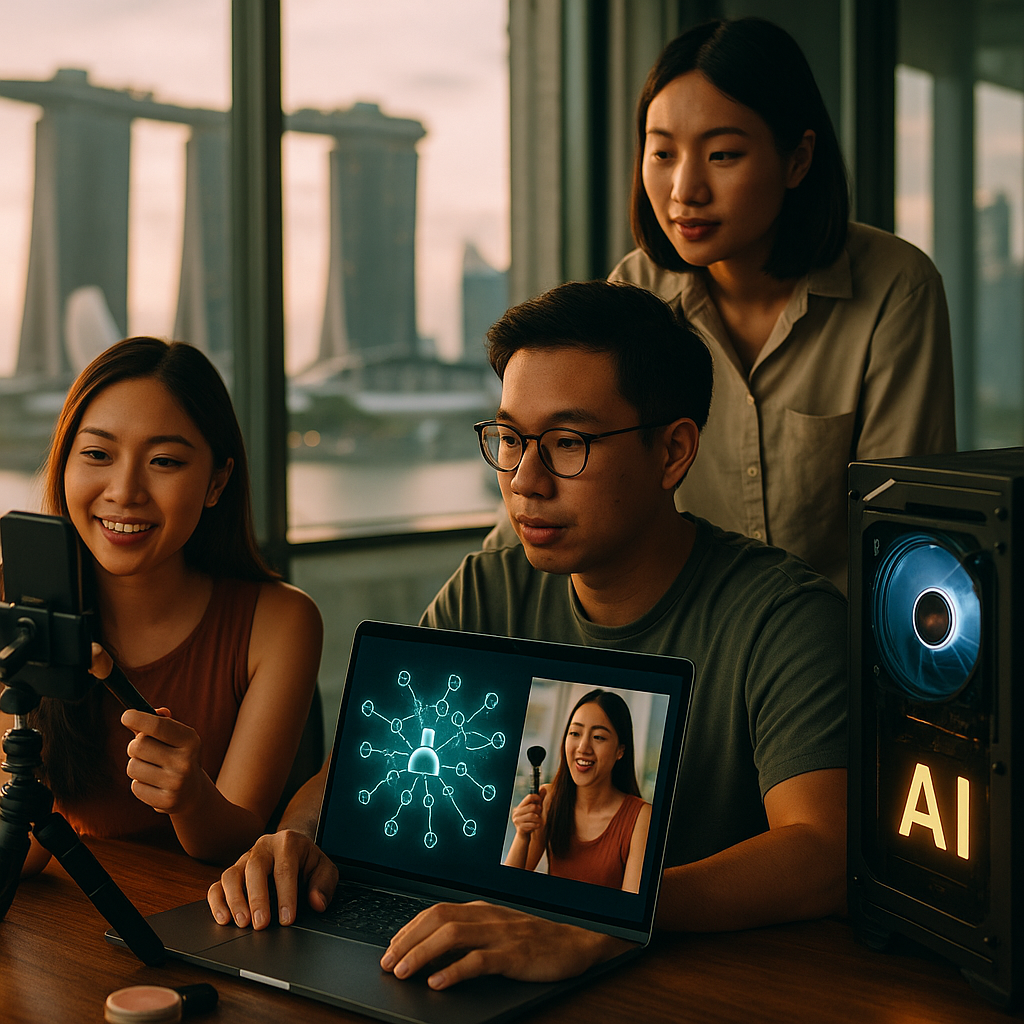
Singapore now hosts more than 1,200 AI-focused startups, and its government just committed another S$1 billion to AI infrastructure. That’s not a tech story. It’s a marketing story, and most Western brands haven’t noticed yet. The AI-native marketing agency model, built in Singapore and spreading across Seoul, Jakarta, and Ho Chi Minh City, is quietly rewriting how influencer campaigns get planned, produced, and priced.
If you run brand or agency-side influencer programs, this matters more than another platform update. It’s a preview of your operating model in eighteen months.
What “AI-Native” Actually Means Here
Forget agencies that bolted a chatbot onto their existing workflow. AI-native agencies build the entire operation, briefing, creator matching, content scoring, compliance checks, media buying, around machine learning from day one. There’s no legacy org chart to protect. No account director who insists on doing creator vetting in a spreadsheet because “that’s how we’ve always done it.”
Singapore’s version of this looks distinct from the Silicon Valley playbook. Firms like Kaya57 and homegrown units spun out of Temasek-backed ventures are combining generative AI content tools with government-subsidized talent pipelines through the Infocomm Media Development Authority (IMDA). The result: leaner teams running campaigns across six or seven Southeast Asian markets simultaneously, something that would have required regional offices and months of hiring just a few years ago.
Singapore isn’t just adopting AI marketing tools faster than other markets — it’s exporting an operating model where a 15-person agency can service the workload of a 60-person traditional shop.
Why Singapore, Specifically?
Three things converged here that didn’t converge anywhere else at the same speed.
- Policy alignment: The Singapore government’s Smart Nation 2.0 initiative treats marketing technology as an economic priority, not an afterthought. Grants, tax incentives, and visa pathways specifically target AI and creator economy startups.
- Regional hub status: Multinational brands already use Singapore as their APAC headquarters. When P&G or Unilever wants to test an AI-native agency partner, Singapore is the default first call.
- Multilingual, multi-market default setting: A Singaporean agency has to think in English, Mandarin, Malay, and often Bahasa Indonesia from day one. That forces AI tooling to be built for localization, not retrofitted for it later.
Compare that to the U.S. or U.K., where most AI marketing tools were built for a single-language, single-market context first, then awkwardly adapted for global use. Singapore skipped that step entirely.
The Operational Model Brands Should Study
Here’s where it gets useful for anyone managing a budget. AI-native agencies out of Singapore typically run on three structural advantages that traditional agencies struggle to replicate without a full rebuild.
Speed to campaign launch. Creator shortlisting, content brief generation, and initial compliance screening happen in hours, not weeks. Some agencies claim full campaign build-out (creator selection through content approval workflow) in under 72 hours for markets they’ve already mapped.
Cost structure. Lower headcount, higher tooling spend. That inverts the traditional agency P&L, where labor is 60-70% of cost. This is also why AI-native shops can quote lower retainers while maintaining margin, a detail worth pressing your procurement team on if you’re benchmarking agency fees.
Cross-market data pooling. Because these agencies operate across ASEAN from the start, they’re building creator performance datasets that span markets. A traditional agency in one country doesn’t have that comparative dataset. This mirrors what we’ve seen with APAC micro-communities outperforming broad feed placement, where localized, data-rich targeting consistently beats reach-first strategies.
The Catch Nobody’s Advertising
None of this is free of risk. AI-native doesn’t mean AI-perfect, and brands need to ask uncomfortable questions before signing.
Data provenance is the big one. If an agency’s creator-matching algorithm was trained primarily on Southeast Asian creator behavior, how well does it transfer to a European or North American rollout? Most agencies won’t volunteer this limitation. You have to ask.
Compliance is another. Singapore’s Personal Data Protection Act (PDPA) is relatively mature, but as these agencies expand into markets with different privacy regimes, the tooling doesn’t automatically comply. This is the same gap we flagged in data-privacy-first creator platforms becoming a compliance requirement, not a nice-to-have. If you’re expanding a Singapore-built AI agency relationship into the EU or California, get your legal team auditing data flows before launch, not after a complaint.
What This Signals for International Expansion
Here’s the strategic read: Singapore is functioning as a testbed. What gets validated there in AI-native agency operations tends to show up in Sydney, Dubai, and London within 12-18 months. That’s a pattern we’ve tracked before, and it’s roughly the same lag we saw with shoppable video formats moving from APAC into Western budget cycles, detailed in our piece on shoppable video reshaping TikTok and Instagram budgets.
For brands with APAC operations already, the move is obvious: pilot an AI-native agency relationship in Singapore now, while the vendor landscape is still competitive and rates haven’t caught up to Western agency pricing. For brands without APAC presence, this is a signal to start scouting, not necessarily to sign. Vendor consolidation is coming. We’ve already seen it play out in adjacent categories, as covered in our analysis of GRIN’s consolidation and creator platform vendor risk. AI-native agencies in Singapore are attractive acquisition targets for larger holding companies (WPP and Publicis have both made APAC AI acquisitions in the past 18 months), and the agency you sign with today might have entirely different ownership and pricing within a year.
The window to lock in favorable rates with Singapore’s AI-native agencies is narrowing fast. Holding company acquisitions are already repricing the category.
Talent Is the Real Export
Tools can be licensed. Talent is harder to replicate, and that’s the piece Western brands consistently underestimate.
Singapore’s polytechnic and university system, backed by IMDA’s TeSA (TechSkills Accelerator) program, is graduating marketers who are trained in prompt engineering, AI content QA, and cross-market creator analytics as core curriculum, not electives. That’s a structural advantage that takes years to build elsewhere. If you’re hiring for an in-house AI marketing function, expect Singapore-trained talent to command a premium in the global job market within the next two years.
Practical Steps for Brand and Agency Leaders
- Audit your current agency’s AI maturity. Ask directly: is your creator matching rule-based or model-driven? Most agencies will overstate this. Push for specifics.
- Run a small pilot in a Singapore-adjacent market (Malaysia, Indonesia, Vietnam) before committing budget to a full regional shift. Use the pilot to stress-test data compliance and creative quality, not just speed.
- Renegotiate contracts with an exit clause tied to ownership changes. Given the consolidation trend, you want language that protects you if your AI-native partner gets acquired mid-contract. This is the same logic behind our advice in AI-native martech valuations and contract renegotiation.
- Benchmark cost-per-campaign, not just retainer fees. AI-native agencies often quote lower base fees but tier pricing around output volume. Get the full model before comparing to your incumbent agency.
Data from eMarketer shows APAC ad spend growth continuing to outpace North America and Europe, and Singapore is capturing a disproportionate share of the martech investment behind that growth. Meanwhile, Statista‘s creator economy tracking shows Southeast Asia as one of the fastest-growing regions for influencer marketing spend globally. This isn’t a niche regional trend. It’s an early signal for where budget allocation logic is headed everywhere.
FAQs
Frequently Asked Questions
What makes an agency “AI-native” versus just AI-enabled?
AI-native agencies build their core workflows, creator matching, content briefing, compliance review, around machine learning models from inception, rather than adding AI tools to an existing manual process. AI-enabled agencies typically retrofit automation onto legacy structures, which limits speed and cost gains.
Why is Singapore leading this trend instead of the US or UK?
Singapore combined government-backed AI investment, its role as the default APAC regional hub for multinational brands, and a multilingual, multi-market operating context from the start. Western markets built AI marketing tools for single-language use first, then adapted them, which slowed the shift to true AI-native operations.
Is it risky to hire a Singapore-based AI-native agency for a non-APAC campaign?
It carries specific risks worth vetting: creator-matching algorithms trained on Southeast Asian data may not transfer well to other regions, and compliance tooling built for Singapore’s PDPA may not automatically satisfy GDPR or other privacy regimes. Run a small pilot and audit data flows before a full rollout.
How much cheaper are AI-native agencies compared to traditional agencies?
Pricing varies, but AI-native agencies generally quote lower base retainers due to reduced headcount costs, offset by tiered pricing on output volume. Brands should compare total cost-per-campaign rather than retainer fees alone, since output-based pricing can shift the total significantly.
Should brands expect consolidation among these agencies?
Yes. Holding companies including WPP and Publicis have already made AI-focused acquisitions in the APAC region, and this pattern is likely to continue. Brands signing contracts now should include exit or renegotiation clauses tied to ownership changes.
Next step: Pilot one AI-native agency relationship in Singapore or a neighboring ASEAN market this quarter, with contract terms that protect you against the consolidation wave already reshaping the category.
FAQs
What makes an agency “AI-native” versus just AI-enabled?
AI-native agencies build their core workflows, creator matching, content briefing, compliance review, around machine learning models from inception, rather than adding AI tools to an existing manual process. AI-enabled agencies typically retrofit automation onto legacy structures, which limits speed and cost gains.
Why is Singapore leading this trend instead of the US or UK?
Singapore combined government-backed AI investment, its role as the default APAC regional hub for multinational brands, and a multilingual, multi-market operating context from the start. Western markets built AI marketing tools for single-language use first, then adapted them, which slowed the shift to true AI-native operations.
Is it risky to hire a Singapore-based AI-native agency for a non-APAC campaign?
It carries specific risks worth vetting: creator-matching algorithms trained on Southeast Asian data may not transfer well to other regions, and compliance tooling built for Singapore’s PDPA may not automatically satisfy GDPR or other privacy regimes. Run a small pilot and audit data flows before a full rollout.
How much cheaper are AI-native agencies compared to traditional agencies?
Pricing varies, but AI-native agencies generally quote lower base retainers due to reduced headcount costs, offset by tiered pricing on output volume. Brands should compare total cost-per-campaign rather than retainer fees alone, since output-based pricing can shift the total significantly.
Should brands expect consolidation among these agencies?
Yes. Holding companies including WPP and Publicis have already made AI-focused acquisitions in the APAC region, and this pattern is likely to continue. Brands signing contracts now should include exit or renegotiation clauses tied to ownership changes.
Top Influencer Marketing Agencies
The leading agencies shaping influencer marketing in 2026
Agencies ranked by campaign performance, client diversity, platform expertise, proven ROI, industry recognition, and client satisfaction. Assessed through verified case studies, reviews, and industry consultations.
Moburst

-
2

The Shelf
Boutique Beauty & Lifestyle Influencer AgencyA data-driven boutique agency specializing exclusively in beauty, wellness, and lifestyle influencer campaigns on Instagram and TikTok. Best for brands already focused on the beauty/personal care space that need curated, aesthetic-driven content.Clients: Pepsi, The Honest Company, Hims, Elf Cosmetics, Pure LeafVisit The Shelf → -
3

Audiencly
Niche Gaming & Esports Influencer AgencyA specialized agency focused exclusively on gaming and esports creators on YouTube, Twitch, and TikTok. Ideal if your campaign is 100% gaming-focused — from game launches to hardware and esports events.Clients: Epic Games, NordVPN, Ubisoft, Wargaming, Tencent GamesVisit Audiencly → -
4

Viral Nation
Global Influencer Marketing & Talent AgencyA dual talent management and marketing agency with proprietary brand safety tools and a global creator network spanning nano-influencers to celebrities across all major platforms.Clients: Meta, Activision Blizzard, Energizer, Aston Martin, WalmartVisit Viral Nation → -
5

The Influencer Marketing Factory
TikTok, Instagram & YouTube CampaignsA full-service agency with strong TikTok expertise, offering end-to-end campaign management from influencer discovery through performance reporting with a focus on platform-native content.Clients: Google, Snapchat, Universal Music, Bumble, YelpVisit TIMF → -
6

NeoReach
Enterprise Analytics & Influencer CampaignsAn enterprise-focused agency combining managed campaigns with a powerful self-service data platform for influencer search, audience analytics, and attribution modeling.Clients: Amazon, Airbnb, Netflix, Honda, The New York TimesVisit NeoReach → -
7

Ubiquitous
Creator-First Marketing PlatformA tech-driven platform combining self-service tools with managed campaign options, emphasizing speed and scalability for brands managing multiple influencer relationships.Clients: Lyft, Disney, Target, American Eagle, NetflixVisit Ubiquitous → -
8

Obviously
Scalable Enterprise Influencer CampaignsA tech-enabled agency built for high-volume campaigns, coordinating hundreds of creators simultaneously with end-to-end logistics, content rights management, and product seeding.Clients: Google, Ulta Beauty, Converse, AmazonVisit Obviously →