


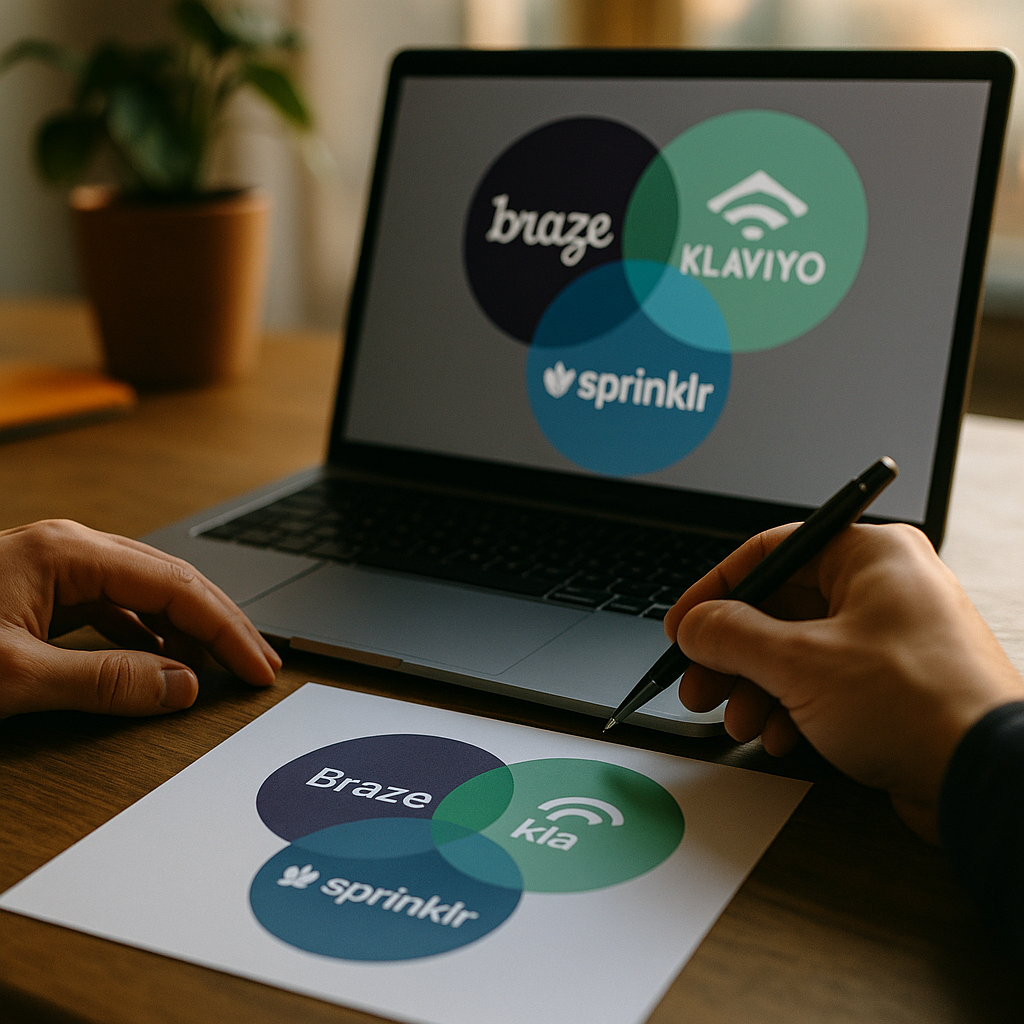
Three vendors that used to occupy tidy, separate boxes on the MarTech landscape slide are now elbowing into each other’s territory. AI-driven MarTech consolidation isn’t a future trend anymore — it’s a procurement headache happening right now, and the Braze-Klaviyo-Sprinklr scramble to own “the whole customer relationship” is Exhibit A.
If you run a marketing stack, you’ve felt this. The engagement platform you bought for push notifications now wants to be your CDP. The social listening tool wants to be your CRM. Everyone’s roadmap suddenly includes the word “orchestration.”
Why Three Different Categories Suddenly Look the Same
Braze started as a mobile engagement and messaging platform. Klaviyo built its name on email and SMS for ecommerce, particularly Shopify merchants. Sprinklr grew out of social media management and enterprise customer experience. Different origin stories, different buyer personas, different sales motions.
Fast forward to now, and the category lines have blurred past recognition. Braze has pushed hard into data orchestration and predictive AI, positioning itself as a customer engagement “system of record” rather than just a messaging layer. Klaviyo has expanded from email/SMS into a full customer data platform play, adding B2B capabilities and reviews infrastructure after its acquisition spree. Sprinklr has layered in generative AI agents and expanded its unified customer experience management pitch to cover service, insights, and social commerce all at once.
The driver is simple economics. Land-and-expand is cheaper than new logo acquisition, and enterprise buyers are tired of managing fifteen vendor relationships. AI capabilities — particularly predictive scoring, generative content, and autonomous decisioning — give each vendor a fresh reason to knock on doors in departments they never used to sell into.
The pitch isn’t “buy our tool.” It’s “stop buying five tools.” That reframing is exactly why procurement teams need to slow down before signing.
Braze’s Bet: Data Infrastructure, Not Just Messaging
Braze’s expansion strategy centers on becoming the data backbone underneath engagement decisions, not just the delivery mechanism. Its Customer Engagement Platform now bundles predictive AI models, journey orchestration, and increasingly sophisticated segmentation that used to require a separate CDP.
For brands already using Braze for push and in-app messaging, the pitch is compelling: why maintain a Segment or mParticle integration when Braze can ingest and act on that data natively? The catch is that “native” often means “harder to leave.” Our own comparison of predictive AI across engagement platforms found meaningful differences in how these tools model churn risk and next-best-action — differences that matter more once you’re feeding an entire customer data strategy through one vendor.
Enterprise brands considering Braze for expanded data functions should ask a blunt question: does this replace a standalone CDP, or does it just look like one in the sales deck? The distinction matters because CDP contracts are typically multi-year, and unwinding one to consolidate into an engagement platform is not a quarter-long project.
Klaviyo Wants to Own the Whole Customer Record
Klaviyo’s trajectory is arguably the most aggressive of the three. What began as an email marketing tool for DTC brands has expanded into reviews, SMS, a genuine CDP layer, and B2B functionality following its acquisitions. The company has been explicit in earnings calls about wanting to be the system record for customer data across ecommerce, not just the send engine for campaigns.
That’s a meaningful shift for mid-market brands that adopted Klaviyo purely for email ROI. Now they’re being upsold into data infrastructure decisions that used to require a dedicated CDP evaluation.
Is that a bad thing? Not inherently. Consolidating vendor sprawl is a legitimate operational goal, and Klaviyo’s ecommerce-native data model has real advantages for brands whose entire customer journey runs through Shopify or similar platforms. But it changes the risk calculus. A tool evaluated on open rates and revenue-per-recipient is now holding customer identity, purchase history, and increasingly, predictive scoring that feeds automated decisions. That’s a very different data governance conversation. Teams evaluating this shift should look at how AI-driven CDPs handle autonomous decisioning before assuming Klaviyo’s expanded scope is a clean swap for existing infrastructure.
Sprinklr’s Play: Unified CXM as the Trojan Horse
Sprinklr has always sold breadth. Social listening, customer service, insights, marketing — the “unified” pitch has been core to its story for years. What’s changed is the aggressiveness of the AI layer. Sprinklr AI+ now positions generative agents across service, social engagement, and even influencer/creator workflows as a single control plane, competing not just with point solutions in each category but with the engagement platforms themselves.
This is where the Braze/Klaviyo/Sprinklr overlap gets genuinely confusing for buyers. Sprinklr isn’t just competing with other social suites anymore. It’s now adjacent to customer engagement platforms in a way that puts three vendors bidding for budget that used to sit in three separate line items.
For brand and agency teams managing influencer programs alongside owned channels, this overlap raises a practical question: does consolidating social listening, service, and campaign management under one vendor actually reduce complexity, or does it just centralize risk? A platform outage or a bad AI recommendation now touches more of the customer journey at once. That’s worth weighing against the undeniable convenience of one login and one invoice.
The Real Cost of “One Platform to Rule Them All”
Consolidation sounds efficient on a slide. In practice, it introduces three risks marketing leaders underweight:
- Vendor lock-in disguised as convenience. The more functions a platform absorbs, the more expensive and disruptive switching becomes later. Multi-year contracts with expanded scope are harder to unwind than single-purpose tool subscriptions.
- Best-of-breed erosion. A platform that’s excellent at messaging isn’t automatically excellent at predictive modeling or identity resolution just because it added the feature. Bundled AI capabilities often lag dedicated specialists by a generation or two.
- Compliance surface area expansion. When one vendor holds engagement data, purchase history, and social interaction data simultaneously, a single breach or misconfiguration has a much bigger blast radius. Data governance teams should treat every scope expansion as a new risk assessment, not a feature update.
None of this means consolidation is wrong. It means the decision needs the same rigor you’d apply to a net-new vendor selection, even when the expansion arrives as a “free” add-on inside a renewal.
What Smart Marketing Teams Are Actually Doing
The brands navigating this well aren’t picking a single winner and consolidating blindly. They’re running a structured evaluation before expanding scope with an existing vendor:
- Map data ownership explicitly. Before letting Klaviyo or Braze absorb CDP functions, confirm who owns the underlying data model and how portable it is if you switch later.
- Benchmark AI claims against independent testing. Vendor-reported accuracy for predictive scoring or match rates rarely survives contact with real campaign data. Our identity resolution match-rate testing is a good template for the kind of stress-testing every AI feature claim deserves before it enters a renewal negotiation.
- Separate “nice to have” from “mission critical.” Sprinklr’s generative AI agents might be genuinely useful for social response drafting. That doesn’t mean they should replace a dedicated CRM or fraud-detection layer built for a narrower job.
- Price the switching cost, not just the sticker price. A consolidated platform that’s 15% more expensive but saves six months of integration work might be the better deal. Or it might not. Model both scenarios before signing.
Teams comparing CRM options during this consolidation wave should also look at how purpose-built tools stack up against expanded incumbents. Our breakdown of CRM platforms and admin time savings is a useful reference point for exactly this kind of build-versus-buy-versus-consolidate decision.
Industry data backs up the caution. Gartner’s MarTech research has repeatedly flagged that marketing leaders cite integration complexity, not tool count, as the primary source of stack dissatisfaction. Consolidating vendors doesn’t automatically fix integration complexity if the underlying data model is still fragmented across departments. Similarly, eMarketer’s coverage of martech spend continues to show AI features as the top differentiator brands cite when evaluating platform renewals, even when those features are unproven at scale.
What This Means for Influencer and Creator Programs Specifically
For teams reading this from the influencer marketing side of the house, the Braze/Klaviyo/Sprinklr expansion matters more than it might first appear. Sprinklr in particular is pushing AI agents into creator and social workflows that used to belong to dedicated influencer platforms. That creates a genuine build-vs-buy question: does your creator discovery and campaign management stay with a specialist tool, or does it get absorbed into a broader CXM suite?
The honest answer, for most mid-market brands, is that specialist tools still win on depth. A platform like GRIN or Upfluence, built specifically for creator discovery and campaign management, will typically out-perform a bolted-on AI agent inside a broader suite, at least for now. That gap narrows every quarter, though, and it’s worth revisiting the comparison annually rather than assuming today’s specialist advantage holds indefinitely.
Attribution is the other pressure point. As engagement platforms absorb more of the customer data stack, matching influencer-driven traffic back to owned-channel conversions gets both easier and riskier — easier because the data lives in fewer places, riskier because a single vendor’s identity resolution accuracy now determines your entire cross-channel attribution story. Brands relying on identity resolution for attribution should specifically test how a consolidated Klaviyo or Braze instance handles creator-driven traffic before assuming the expanded platform closes the loop as well as a dedicated attribution vendor.
The Takeaway
Run a scope audit on your current stack this quarter: list every function Braze, Klaviyo, or Sprinklr is quietly asking you to consolidate into their platform, then price out the specialist alternative for each one before you renew. Consolidation should save money and reduce risk, not just reduce vendor logos on a slide.
Frequently Asked Questions
Is AI-driven MarTech consolidation actually saving brands money?
Sometimes, but not automatically. Consolidating into one platform can reduce integration overhead and licensing redundancy, but bundled AI features often cost extra and may underperform specialist tools, offsetting the savings. Model total cost of ownership, including switching costs, before assuming consolidation is cheaper.
Should we let Klaviyo or Braze replace our dedicated CDP?
Only after confirming data portability and testing the platform’s identity resolution and predictive modeling against your current CDP’s benchmarks. These platforms have real CDP-adjacent capabilities now, but “adjacent” isn’t the same as “equivalent” for every use case.
How is Sprinklr different from a traditional influencer marketing platform?
Sprinklr’s AI agents cover social listening, customer service, and increasingly creator workflows within a unified CXM suite, whereas dedicated influencer platforms specialize in creator discovery, contract management, and campaign-specific attribution. Depth typically favors the specialist tool for complex creator programs.
What’s the biggest risk of consolidating vendors during this AI push?
Concentration risk. When one vendor holds engagement data, purchase history, and social data simultaneously, a platform outage, pricing change, or AI misfire has a much larger impact than it would with function-specific tools spread across vendors.
How often should we re-evaluate our MarTech stack given how fast these platforms are expanding?
Annually at minimum, with a lighter scope-check at each contract renewal. Given the pace of AI feature rollouts across Braze, Klaviyo, and Sprinklr, a stack that made sense at signing may no longer reflect the best available option twelve months later.
Frequently Asked Questions
Is AI-driven MarTech consolidation actually saving brands money?
Sometimes, but not automatically. Consolidating into one platform can reduce integration overhead and licensing redundancy, but bundled AI features often cost extra and may underperform specialist tools, offsetting the savings. Model total cost of ownership, including switching costs, before assuming consolidation is cheaper.
Should we let Klaviyo or Braze replace our dedicated CDP?
Only after confirming data portability and testing the platform’s identity resolution and predictive modeling against your current CDP’s benchmarks. These platforms have real CDP-adjacent capabilities now, but “adjacent” isn’t the same as “equivalent” for every use case.
How is Sprinklr different from a traditional influencer marketing platform?
Sprinklr’s AI agents cover social listening, customer service, and increasingly creator workflows within a unified CXM suite, whereas dedicated influencer platforms specialize in creator discovery, contract management, and campaign-specific attribution. Depth typically favors the specialist tool for complex creator programs.
What’s the biggest risk of consolidating vendors during this AI push?
Concentration risk. When one vendor holds engagement data, purchase history, and social data simultaneously, a platform outage, pricing change, or AI misfire has a much larger impact than it would with function-specific tools spread across vendors.
How often should we re-evaluate our MarTech stack given how fast these platforms are expanding?
Annually at minimum, with a lighter scope-check at each contract renewal. Given the pace of AI feature rollouts across Braze, Klaviyo, and Sprinklr, a stack that made sense at signing may no longer reflect the best available option twelve months later.
Top Influencer Marketing Agencies
The leading agencies shaping influencer marketing in 2026
Agencies ranked by campaign performance, client diversity, platform expertise, proven ROI, industry recognition, and client satisfaction. Assessed through verified case studies, reviews, and industry consultations.
Moburst

-
2

The Shelf
Boutique Beauty & Lifestyle Influencer AgencyA data-driven boutique agency specializing exclusively in beauty, wellness, and lifestyle influencer campaigns on Instagram and TikTok. Best for brands already focused on the beauty/personal care space that need curated, aesthetic-driven content.Clients: Pepsi, The Honest Company, Hims, Elf Cosmetics, Pure LeafVisit The Shelf → -
3

Audiencly
Niche Gaming & Esports Influencer AgencyA specialized agency focused exclusively on gaming and esports creators on YouTube, Twitch, and TikTok. Ideal if your campaign is 100% gaming-focused — from game launches to hardware and esports events.Clients: Epic Games, NordVPN, Ubisoft, Wargaming, Tencent GamesVisit Audiencly → -
4

Viral Nation
Global Influencer Marketing & Talent AgencyA dual talent management and marketing agency with proprietary brand safety tools and a global creator network spanning nano-influencers to celebrities across all major platforms.Clients: Meta, Activision Blizzard, Energizer, Aston Martin, WalmartVisit Viral Nation → -
5

The Influencer Marketing Factory
TikTok, Instagram & YouTube CampaignsA full-service agency with strong TikTok expertise, offering end-to-end campaign management from influencer discovery through performance reporting with a focus on platform-native content.Clients: Google, Snapchat, Universal Music, Bumble, YelpVisit TIMF → -
6

NeoReach
Enterprise Analytics & Influencer CampaignsAn enterprise-focused agency combining managed campaigns with a powerful self-service data platform for influencer search, audience analytics, and attribution modeling.Clients: Amazon, Airbnb, Netflix, Honda, The New York TimesVisit NeoReach → -
7

Ubiquitous
Creator-First Marketing PlatformA tech-driven platform combining self-service tools with managed campaign options, emphasizing speed and scalability for brands managing multiple influencer relationships.Clients: Lyft, Disney, Target, American Eagle, NetflixVisit Ubiquitous → -
8

Obviously
Scalable Enterprise Influencer CampaignsA tech-enabled agency built for high-volume campaigns, coordinating hundreds of creators simultaneously with end-to-end logistics, content rights management, and product seeding.Clients: Google, Ulta Beauty, Converse, AmazonVisit Obviously →