


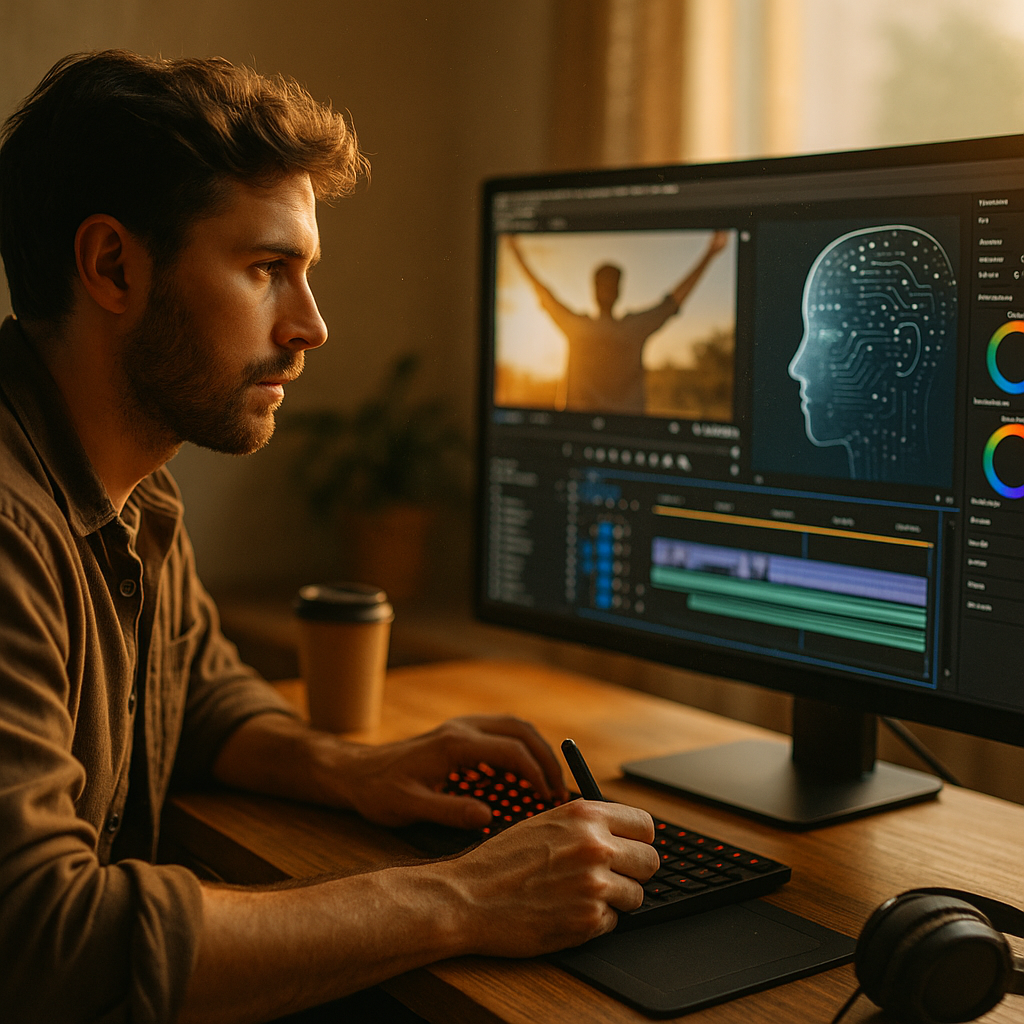
Creators spend roughly 60% of their working hours on tasks that have nothing to do with creativity: transcribing interviews, hunting for b-roll, syncing captions, or rewatching footage frame by frame to find the one usable clip. That math doesn’t work anymore. AI-driven editing tools are quietly rewriting the economics of content production, and brands that ignore this shift are paying creator rates for editor labor.
This isn’t a story about robots replacing talent. It’s about talent finally getting their time back.
The Grunt Work Problem Nobody Talks About
Ask any working creator what eats their week and you’ll rarely hear “coming up with ideas.” You’ll hear about scrubbing through two hours of raw footage to find eight usable seconds. You’ll hear about manually adding captions because platforms still punish videos without them. You’ll hear about researching a topic for three hours before ever touching a camera.
Brands feel this pain too, just indirectly. A creator burning 20 hours on post-production is a creator with less bandwidth for the next brand deal, slower turnaround on deliverables, and less energy left for the strategic thinking that actually moves a campaign. Agencies negotiating usage rights and revision cycles know this friction firsthand — it’s a big reason timelines slip and budgets balloon.
Every hour a creator spends on manual transcription or clip-hunting is an hour not spent on hooks, narrative, or the creative risk-taking that actually drives engagement.
What AI Editing Tools Actually Do Now
The category has matured fast. Tools like Descript, Adobe Premiere’s AI-powered features, Opus Clip, and CapCut’s automated editing suite now handle tasks that used to require a dedicated editor on payroll:
- Auto-transcription and searchable footage: Editors can search raw video by spoken word instead of scrubbing timelines manually.
- Silence and filler-word removal: Tools cut “ums,” dead air, and awkward pauses automatically, shaving hours off rough cuts.
- Auto-clipping for short-form: AI identifies the most engaging moments in long-form video and generates vertical clips ready for TikTok, Reels, or Shorts.
- Style-matched captioning: Auto-generated captions now match brand fonts and creator aesthetics instead of looking like an afterthought.
- Voice cleanup and color matching: Audio leveling and visual consistency, once the domain of post-production specialists, now run in the background.
None of this is speculative. Adobe has published data on Premiere Pro’s AI adoption rates among content professionals, and the broader trend lines up with what eMarketer’s creator economy research has tracked: automation is moving from novelty to default workflow.
Research Tools Are Catching Up Fast
Editing gets the headlines, but research automation might matter more for content quality. Creators used to spend hours reading competitor content, checking claims, and building outlines before scripting a single line.
Now, AI research assistants pull competitive analysis, summarize long-form sources, and flag factual gaps in minutes. Perplexity and similar tools have become de facto research partners for creators who need to sound credible on niche topics fast — finance, health, tech reviews — without spending a full day in research mode.
This matters for brands in a very specific way: accuracy risk. A creator who skips research to save time is a creator more likely to make a claim that gets a brand in trouble with the FTC or triggers a correction. Faster research tools, ironically, can mean *more* accurate content, not less, because the time saved on gathering information gets reinvested into verification. Influencers Time has covered how brands are building internal systems to catch these gaps before they go public in fact-check agent workflows — a natural companion to creator-side research automation.
Why This Is a Brand Problem, Not Just a Creator One
Here’s the part brand and agency teams tend to miss: creator production efficiency directly affects campaign economics. When a creator saves eight hours per video on editing, that’s eight hours that can go toward:
- Additional content variations for A/B testing across platforms
- Faster turnaround on time-sensitive campaigns (product launches, trending moments)
- More thoughtful creative concepting instead of rushed, formulaic content
- Lower per-deliverable rates, since less labor is baked into the quote
Brands negotiating creator rates without accounting for this shift are either overpaying for outdated production timelines or underestimating what a creator can realistically deliver on a compressed schedule. Either way, it’s a planning gap. The same logic that’s reshaping brief generation and launch timelines on the brand side applies to production timelines on the creator side — automation speeds up the input, but the real bottleneck often shifts elsewhere in the workflow.
If your creator contracts and rate cards still assume manual editing timelines, you’re negotiating against a production reality that no longer exists.
The Originality Dividend
There’s a reasonable worry buried in all this automation: if AI handles editing and research, does content start looking the same? Templated auto-clips, formulaic captions, algorithmically “optimal” hooks — it’s a real risk, and some corners of the creator economy already show the signs of it.
But the counterargument holds up under scrutiny. Automation only produces sameness when creators use it as a substitute for judgment rather than a support for it. The creators pulling ahead right now are the ones using AI to eliminate the boring 80% of production so they can spend more time on the 20% that actually differentiates their content: voice, framing, timing, and the specific creative instinct that made a brand want to work with them in the first place.
This mirrors a pattern Influencers Time has flagged before on the brand side: AI adoption is climbing, but performance scores aren’t automatically climbing with it. The tools aren’t the differentiator. What creators and brands do with the freed-up time is.
What Brands Should Actually Do With This Shift
Sitting back and letting creators adopt these tools organically is one option. A more strategic option is building AI literacy into how you evaluate and brief talent.
- Update rate expectations. If a creator’s production timeline has genuinely shortened, factor that into negotiations — but also recognize that faster turnaround doesn’t mean lower value; it often means more capacity for testing and iteration.
- Ask about tool stacks in vetting. Creators who’ve adopted AI-driven editing and research tools tend to be more consistent, more scalable partners for ongoing programs. It’s a reasonable question to add to your creator vetting checklist, similar to how brands are learning to evaluate AI vendors with real proof points instead of hype.
- Build accuracy checks into briefs. Faster research doesn’t eliminate the need for fact-checking on regulated or sensitive claims. Bake verification steps into the brief itself.
- Reinvest time savings into testing. Ask creators to produce two or three hook variations instead of one final cut. The time saved on editing makes this request far more reasonable than it used to be.
None of this requires a massive process overhaul. It requires acknowledging that the production math has changed and adjusting expectations accordingly.
The Compliance Angle Brands Can’t Skip
AI research tools speed up fact-gathering, but they don’t absolve anyone of disclosure or accuracy obligations. The FTC’s endorsement guidelines still apply regardless of how a creator sourced their claims, and brands remain on the hook for material misstatements made in sponsored content. If anything, the speed of AI-assisted research raises the bar for brand-side review, not lowers it. Faster doesn’t mean less scrutiny.
Marketing teams already juggling AI operating systems and vendor sprawl internally should treat creator-side AI tools the same way: as infrastructure worth understanding, not a black box to ignore until something goes wrong.
Where This Goes Next
Expect editing and research automation to keep compressing timelines, but expect the differentiation to keep shifting toward judgment, voice, and strategic creative choices — the things AI still can’t fake convincingly. Brands that update their rate cards, vetting criteria, and briefs now will get more creative output per dollar than those still pricing content like it’s cut by hand.
Frequently Asked Questions
Do AI editing tools reduce the quality of creator content?
Not inherently. Quality depends on how creators use the extra time these tools free up. Tools that automate transcription, clipping, and captioning tend to raise output quality because creators reinvest saved hours into scripting and creative refinement rather than mechanical tasks.
Should brands pay creators less if they use AI tools to speed up editing?
No. Faster production doesn’t mean less creative value delivered. A more accurate approach is renegotiating deliverable volume or turnaround expectations rather than cutting rates, since the creative judgment and strategy still come from the creator.
What AI research tools are creators using most for content accuracy?
Tools like Perplexity and similar AI research assistants are common for competitive research and fact summarization, though creators still need to verify claims manually for regulated categories like health, finance, and legal content.
How does AI-driven production efficiency affect campaign timelines?
Automated editing and research can shorten production windows significantly, which matters most for time-sensitive campaigns tied to product launches or trending moments. Brands should factor this into campaign planning and briefing timelines.
Are there compliance risks tied to AI-assisted creator content?
Yes. Faster research and editing don’t remove disclosure obligations under FTC guidelines. Brands should build verification steps into briefs regardless of how quickly content gets produced.
The Bottom Line
Update your creator rate cards and vetting process to reflect what AI editing and research tools actually do: they don’t replace creative judgment, they free up hours for more of it. Brands that adjust their expectations and briefs now will get more original, better-tested content per dollar than those still pricing production the old way.
Frequently Asked Questions
Do AI editing tools reduce the quality of creator content?
Not inherently. Quality depends on how creators use the extra time these tools free up. Tools that automate transcription, clipping, and captioning tend to raise output quality because creators reinvest saved hours into scripting and creative refinement rather than mechanical tasks.
Should brands pay creators less if they use AI tools to speed up editing?
No. Faster production doesn’t mean less creative value delivered. A more accurate approach is renegotiating deliverable volume or turnaround expectations rather than cutting rates, since the creative judgment and strategy still come from the creator.
What AI research tools are creators using most for content accuracy?
Tools like Perplexity and similar AI research assistants are common for competitive research and fact summarization, though creators still need to verify claims manually for regulated categories like health, finance, and legal content.
How does AI-driven production efficiency affect campaign timelines?
Automated editing and research can shorten production windows significantly, which matters most for time-sensitive campaigns tied to product launches or trending moments. Brands should factor this into campaign planning and briefing timelines.
Are there compliance risks tied to AI-assisted creator content?
Yes. Faster research and editing don’t remove disclosure obligations under FTC guidelines. Brands should build verification steps into briefs regardless of how quickly content gets produced.
Top Influencer Marketing Agencies
The leading agencies shaping influencer marketing in 2026
Agencies ranked by campaign performance, client diversity, platform expertise, proven ROI, industry recognition, and client satisfaction. Assessed through verified case studies, reviews, and industry consultations.
Moburst

-
2

The Shelf
Boutique Beauty & Lifestyle Influencer AgencyA data-driven boutique agency specializing exclusively in beauty, wellness, and lifestyle influencer campaigns on Instagram and TikTok. Best for brands already focused on the beauty/personal care space that need curated, aesthetic-driven content.Clients: Pepsi, The Honest Company, Hims, Elf Cosmetics, Pure LeafVisit The Shelf → -
3

Audiencly
Niche Gaming & Esports Influencer AgencyA specialized agency focused exclusively on gaming and esports creators on YouTube, Twitch, and TikTok. Ideal if your campaign is 100% gaming-focused — from game launches to hardware and esports events.Clients: Epic Games, NordVPN, Ubisoft, Wargaming, Tencent GamesVisit Audiencly → -
4

Viral Nation
Global Influencer Marketing & Talent AgencyA dual talent management and marketing agency with proprietary brand safety tools and a global creator network spanning nano-influencers to celebrities across all major platforms.Clients: Meta, Activision Blizzard, Energizer, Aston Martin, WalmartVisit Viral Nation → -
5

The Influencer Marketing Factory
TikTok, Instagram & YouTube CampaignsA full-service agency with strong TikTok expertise, offering end-to-end campaign management from influencer discovery through performance reporting with a focus on platform-native content.Clients: Google, Snapchat, Universal Music, Bumble, YelpVisit TIMF → -
6

NeoReach
Enterprise Analytics & Influencer CampaignsAn enterprise-focused agency combining managed campaigns with a powerful self-service data platform for influencer search, audience analytics, and attribution modeling.Clients: Amazon, Airbnb, Netflix, Honda, The New York TimesVisit NeoReach → -
7

Ubiquitous
Creator-First Marketing PlatformA tech-driven platform combining self-service tools with managed campaign options, emphasizing speed and scalability for brands managing multiple influencer relationships.Clients: Lyft, Disney, Target, American Eagle, NetflixVisit Ubiquitous → -
8

Obviously
Scalable Enterprise Influencer CampaignsA tech-enabled agency built for high-volume campaigns, coordinating hundreds of creators simultaneously with end-to-end logistics, content rights management, and product seeding.Clients: Google, Ulta Beauty, Converse, AmazonVisit Obviously →