


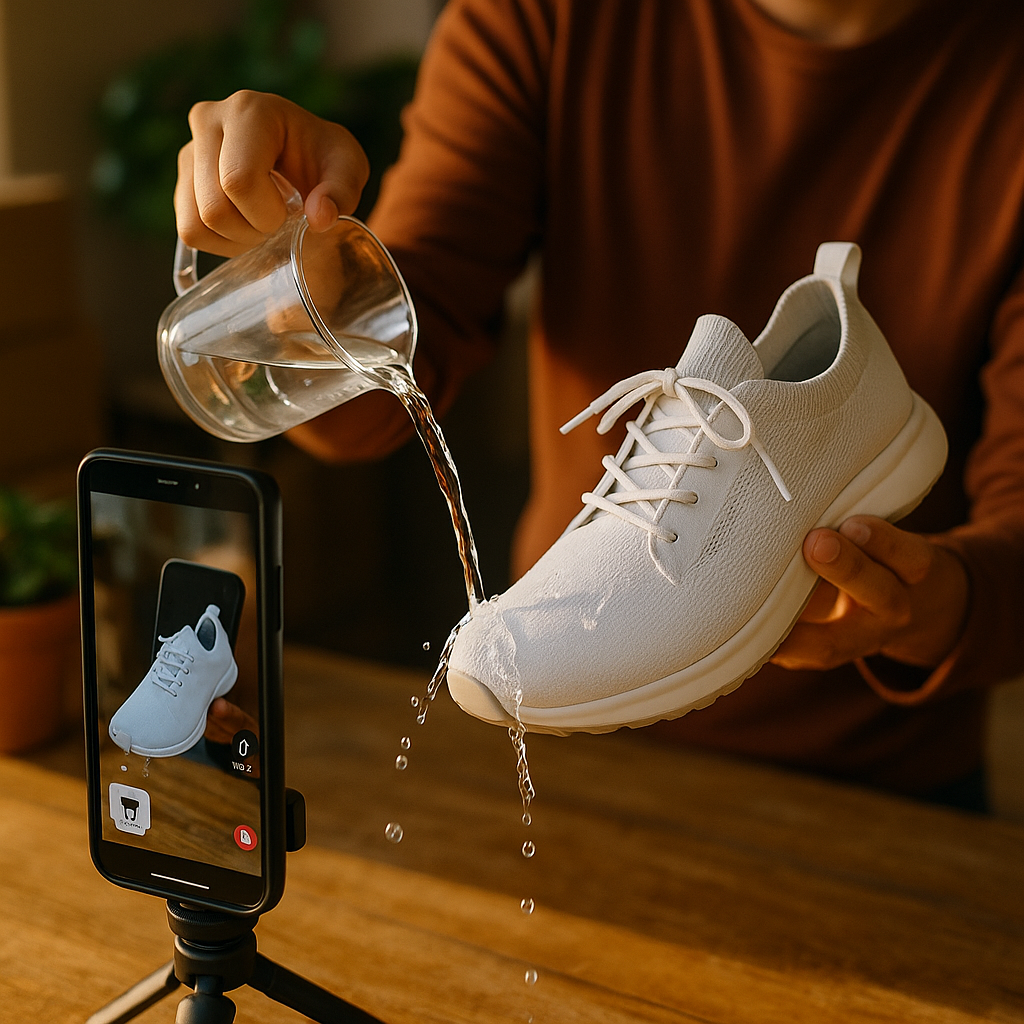
Can a shoe brand outperform celebrity-backed campaigns using nothing but rain puddles and unpaid creators? Vessi did exactly that, turning its TikTok Shop presence into a referral machine built almost entirely on demo videos. No A-list endorsement deals. No seven-figure media buys. Just proof, repeated thousands of times, by people who actually own the shoes.
That’s the part most brands get wrong about creator commerce. They chase reach when they should be chasing repeatability.
The Setup: A Product Built for Skepticism
Vessi sells waterproof knit sneakers, a category crowded with claims that rarely survive contact with reality. “Water-resistant” is a phrase consumers have learned to distrust. So Vessi’s core marketing challenge was never awareness. It was credibility.
The brand’s answer: stop telling people the shoes are waterproof and start showing it, in real time, with no edits hiding the outcome. Pour water on the shoe. Submerge it. Walk through slush. Let the sock stay dry on camera. This is the demo video format that became Vessi’s signature, and it’s the format hundreds of creators have now replicated organically.
Vessi didn’t need a celebrity to prove its product worked. It needed a thousand ordinary people to prove it couldn’t be faked.
This is a pattern worth studying if you’re running any DTC program right now. Compare it to how YETI built a premium category without traditional ads — durability claims, demonstrated visually, beat any tagline a copywriter could write.
Why Demo Content Outperforms Polished Ads on TikTok Shop
TikTok’s algorithm rewards watch-through and shareability, not production value. A 12-second clip of water beading off a shoe while a friend gasps in disbelief satisfies both. It’s short. It’s surprising. And it answers the exact objection a buyer has before they even type it into search.
Vessi leaned into this by seeding product with micro and nano creators rather than chasing celebrity or mega-influencer placements. The logic is simple: a creator with 8,000 followers who genuinely tests the shoe in the rain reads as more credible than a celebrity who clearly received a check. Audiences have gotten good at spotting the difference, and TikTok Shop’s commerce layer rewards authenticity with actual conversion data, not just impressions.
According to eMarketer, social commerce sales in the US are projected to keep climbing sharply through the back half of the decade, with TikTok Shop cited repeatedly as a primary growth driver among younger shoppers. Brands that treat the platform as a UGC-native storefront, rather than a broadcast channel, are the ones capturing that growth.
This isn’t unique to footwear. Graza’s olive oil content and Grind Coffee’s TikTok Shop live playbook both prove the same point: demonstrable, sensory content converts better than aspirational lifestyle imagery when the format is native to how people actually browse the app.
The Referral Loop, Explained
Here’s where Vessi’s strategy gets operationally interesting for anyone managing a creator budget. Instead of one-off gifting, the brand built a structure that made each successful demo video a template for the next creator to replicate.
- Seeding with a script, not a mandate. Creators weren’t told what to say. They were shown the format — pour, submerge, react — and given room to riff.
- Affiliate commissions baked into TikTok Shop’s native tools. Every creator who posted got a trackable link and a commission rate, turning organic enthusiasm into a measurable revenue channel.
- Comment-section remixing. Skeptical comments (“bet it’s fake” or “try it with a hose”) became prompts for the next wave of creators to one-up the last demo.
- Low-friction resends. High-performing creators were re-seeded with new colorways or styles, compounding their existing audience trust instead of starting from zero with someone new.
The result is a loop that self-perpetuates. One good demo invites a duet, a stitch, or a “let me try this” response video. Each new video is technically new content, but it inherits credibility from the one before it. That’s a referral engine in the truest sense: not customers referring customers, but creators referring creators into the same content format, with the brand’s product as the constant.
This mirrors the mechanics behind Stanley’s nano-creator seeding playbook, where volume and repetition across ordinary creators outperformed a smaller number of high-cost placements.
What This Costs Compared to Celebrity Spend
Let’s talk numbers, because this is the section brand leads actually forward to finance.
A single mid-tier celebrity endorsement deal can run anywhere from six figures to well over a million dollars depending on category and exclusivity terms, before a single ad dollar is spent amplifying it. Vessi’s approach, by contrast, distributes spend across dozens or hundreds of smaller creator relationships, most paid through product plus a modest commission on TikTok Shop sales rather than flat fees.
This isn’t just cheaper. It’s less risky. A celebrity misstep, a PR controversy, a lawsuit, an off-brand tweet, can retroactively damage every dollar spent on that partnership. Diversify across a large creator base, and no single relationship carries existential brand risk.
Spreading spend across hundreds of nano and micro creators isn’t just a cost play — it’s a hedge against the reputational risk concentrated in any single celebrity deal.
It also compounds differently. Celebrity content typically spikes and decays fast, front-loaded around a launch date. Referral-style creator content, especially demo formats with evergreen appeal (rain doesn’t stop happening), keeps generating new views and new affiliate sales months after the original seed. Vessi’s rainy-day demo videos aren’t seasonal campaigns. They’re always relevant somewhere, because it’s always raining somewhere.
Operational Lessons for Brand and Agency Teams
If you’re building a similar program, a few things from Vessi’s execution translate directly:
- Pick a format that survives skepticism. If your product’s core claim can be visually demonstrated, build your entire seeding strategy around proving it, not describing it.
- Give creators a format, not a script. Rigid brand messaging kills the authenticity that makes demo content work. Show the shape of the content, let personality fill it in.
- Use native commerce tools for tracking. TikTok Shop’s affiliate infrastructure gives you real attribution data most other UGC campaigns lack. Use it to identify which creators are actually driving sales, not just views.
- Re-invest in winners. Don’t spread your seeding budget so thin that you miss the chance to double down on creators whose content is already converting.
- Treat comments as a content pipeline. Skeptical or challenging comments under top-performing videos are free creative briefs for your next wave of seeding.
Brands in adjacent categories, from Duluth Trading’s workwear seeding to REI’s trail review program, have found similar success by matching format to product truth rather than borrowing a generic influencer playbook.
One more operational note: compliance still matters here, even without celebrity contracts. The FTC’s endorsement guidelines apply to affiliate and gifted content just as much as paid celebrity placements. Brands running high-volume nano-creator programs need disclosure processes that scale, not just spot-checks. Platforms like Sprout Social and native TikTok Shop dashboards can help manage this at volume, but the responsibility sits with the brand, not the creator.
Is This Repeatable Outside Footwear?
The honest answer: only if your product has a demonstrable, visual truth claim. Waterproofing works because it’s binary and visual. Not every category has that built in. Skincare brands have found workarounds through before/after formats, as seen in how a skincare brand cut CPA using shoppable UGC and AI targeting. Food and beverage brands lean on taste reactions and texture, as with Fly By Jing’s chili crisp seeding strategy.
The through-line across all of these: find the moment where your product either proves itself or doesn’t, on camera, in real time. Build your creator strategy around capturing that moment at scale. Everything else, the affiliate structure, the reseeding, the comment mining, is operational scaffolding around that single creative insight.
FAQs
Frequently Asked Questions
What made Vessi’s TikTok Shop strategy different from typical influencer campaigns?
Vessi prioritized volume and authenticity over celebrity reach, seeding product to nano and micro creators who filmed unscripted waterproof demos. The repeatable format, combined with TikTok Shop’s affiliate tracking, turned organic content into a measurable sales channel rather than a brand awareness exercise.
Why do demo videos convert better than traditional ads on TikTok Shop?
Demo videos answer the buyer’s core objection directly and visually, in a format the TikTok algorithm already favors for watch-through and shares. Polished ads often read as less credible than a real person testing the product on camera.
How much does a referral-driven creator program cost compared to celebrity endorsements?
Celebrity deals can run from six figures into the millions before amplification spend. Referral-driven nano and micro creator programs typically distribute cost across product seeding and modest commissions, making total spend lower and risk more diversified across many smaller relationships.
Do brands still need to worry about disclosure rules with unpaid or gifted creator content?
Yes. FTC endorsement guidelines apply to gifted and affiliate content, not just paid celebrity placements. Brands running high-volume seeding programs need scalable disclosure processes to stay compliant.
Can this referral-loop strategy work for products without an obvious visual proof point?
It’s harder, but not impossible. Brands in categories like skincare and food have adapted the concept using before/after transformations or taste-reaction content instead of a binary demonstration like waterproofing.
The takeaway for your next planning cycle: audit your product for one visually provable claim, then build a nano-creator seeding structure around proving it repeatedly, before you write another celebrity contract.
Top Influencer Marketing Agencies
The leading agencies shaping influencer marketing in 2026
Agencies ranked by campaign performance, client diversity, platform expertise, proven ROI, industry recognition, and client satisfaction. Assessed through verified case studies, reviews, and industry consultations.
Moburst

-
2

The Shelf
Boutique Beauty & Lifestyle Influencer AgencyA data-driven boutique agency specializing exclusively in beauty, wellness, and lifestyle influencer campaigns on Instagram and TikTok. Best for brands already focused on the beauty/personal care space that need curated, aesthetic-driven content.Clients: Pepsi, The Honest Company, Hims, Elf Cosmetics, Pure LeafVisit The Shelf → -
3

Audiencly
Niche Gaming & Esports Influencer AgencyA specialized agency focused exclusively on gaming and esports creators on YouTube, Twitch, and TikTok. Ideal if your campaign is 100% gaming-focused — from game launches to hardware and esports events.Clients: Epic Games, NordVPN, Ubisoft, Wargaming, Tencent GamesVisit Audiencly → -
4

Viral Nation
Global Influencer Marketing & Talent AgencyA dual talent management and marketing agency with proprietary brand safety tools and a global creator network spanning nano-influencers to celebrities across all major platforms.Clients: Meta, Activision Blizzard, Energizer, Aston Martin, WalmartVisit Viral Nation → -
5

The Influencer Marketing Factory
TikTok, Instagram & YouTube CampaignsA full-service agency with strong TikTok expertise, offering end-to-end campaign management from influencer discovery through performance reporting with a focus on platform-native content.Clients: Google, Snapchat, Universal Music, Bumble, YelpVisit TIMF → -
6

NeoReach
Enterprise Analytics & Influencer CampaignsAn enterprise-focused agency combining managed campaigns with a powerful self-service data platform for influencer search, audience analytics, and attribution modeling.Clients: Amazon, Airbnb, Netflix, Honda, The New York TimesVisit NeoReach → -
7

Ubiquitous
Creator-First Marketing PlatformA tech-driven platform combining self-service tools with managed campaign options, emphasizing speed and scalability for brands managing multiple influencer relationships.Clients: Lyft, Disney, Target, American Eagle, NetflixVisit Ubiquitous → -
8

Obviously
Scalable Enterprise Influencer CampaignsA tech-enabled agency built for high-volume campaigns, coordinating hundreds of creators simultaneously with end-to-end logistics, content rights management, and product seeding.Clients: Google, Ulta Beauty, Converse, AmazonVisit Obviously →