


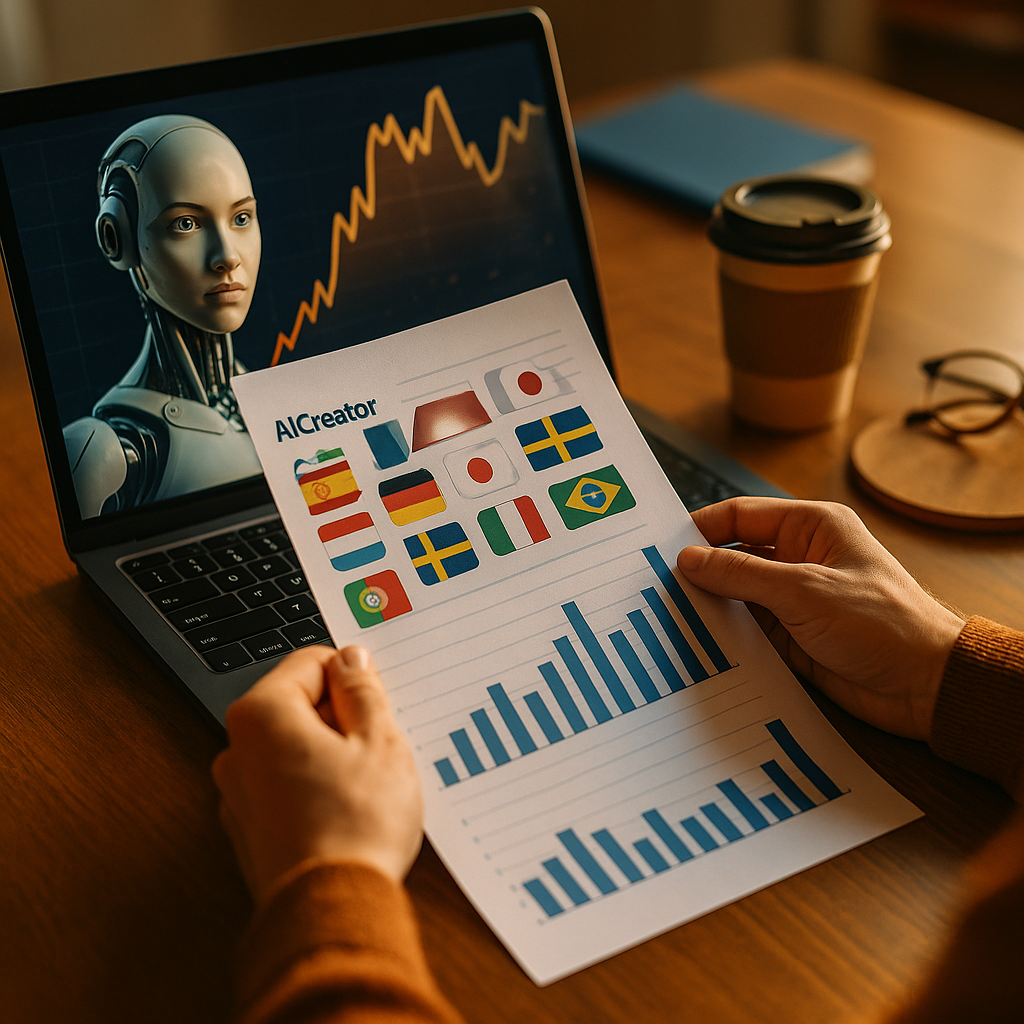
A single TikTok creator video, localized into 12 languages with dubbing, subtitling, and cultural adaptation, used to cost more than the media budget behind it. Now it can run $800 to $4,000 depending on vendor stack — and brands are shipping campaigns simultaneously across markets that once took six weeks to sequence. AI-assisted localization for creator content isn’t a novelty anymore. It’s becoming the default operating model for any brand running influencer programs across more than three markets.
The question isn’t whether to localize at scale. It’s what you’re actually paying for, what breaks when you automate too aggressively, and where the real savings hide versus where they get eaten by rework.
Why 12 Languages, Simultaneously, Is Suddenly Normal
Three years ago, “global creator campaign” meant picking your top four markets, dubbing the hero asset, and letting local teams wing the rest. That model is dying. Streaming and social platforms trained audiences to expect native-language content, not subtitled afterthoughts. Netflix proved the appetite years ago; creators are now held to the same bar.
AI dubbing and voice-cloning tools — think ElevenLabs, HeyGen, Papercup — collapsed the cost of producing broadcast-quality localized voice tracks by roughly 70-90% compared to studio dubbing, according to vendor pricing benchmarks widely cited across the localization industry. That’s the unlock. When a single creator video can be re-voiced in Spanish, Portuguese, Hindi, Japanese, German, French, Korean, Arabic, Indonesian, Vietnamese, Italian, and Thai for a few thousand dollars total, the math on simultaneous global launches suddenly works.
It’s not just cost. Speed matters more. A trending audio format has a shelf life measured in days, sometimes hours. Waiting six weeks for sequential market rollouts means missing the moment entirely. Simultaneous distribution isn’t a luxury — it’s the only way to catch a trend cycle before it’s dead everywhere at once.
The real shift isn’t that AI made translation cheap. It’s that AI made simultaneity possible — and simultaneity is what actually drives global campaign performance now.
What “12-Language Simultaneous Distribution” Actually Costs
Vendors rarely publish clean rate cards, so let’s build one from what’s actually being quoted in the market right now.
- AI dubbing/voice cloning per language: $50–$300 per minute of content, depending on voice quality tier and whether lip-sync matching is included.
- Subtitle generation and localization: $15–$60 per language for a 60-second asset, mostly automated with light human QA.
- Cultural adaptation review (human-in-the-loop): $75–$200 per language, per asset. This is the line item brands most often try to skip — and regret.
- Platform-specific reformatting (aspect ratio, caption burn-in, on-screen text): $25–$75 per language.
- Compliance and disclosure localization (FTC-equivalent labeling per market): variable, but budget $30–$100 per market for legal review on regulated categories.
Add it up for a single 60-second creator asset across 12 languages, mid-tier vendor stack, and you’re looking at roughly $2,400 to $7,800 per asset. Compare that to legacy studio dubbing, which routinely ran $3,000–$8,000 per language for professional voice talent, studio time, and translation agencies. The AI-assisted model isn’t marginally cheaper. It’s an order of magnitude cheaper, per language, even before you factor in speed.
But — and this matters — that’s the cost for one asset. Creator programs rarely run one asset. If you’re localizing a 15-video creator retainer across 12 markets, you’re now managing a five-figure-to-low-six-figure monthly localization line, not a one-off. That’s a new budget category most brands haven’t built a line item for yet, which ties directly into the broader restructuring covered in how brands must rebuild creator budgets.
The Hidden Cost Nobody Quotes You: Rework
Here’s the part vendors gloss over in the sales deck. Raw AI localization output needs review. Every time. No exceptions if you’re operating in regulated categories or culturally sensitive markets.
Idiom collisions are the most common failure point. A phrase that lands as playful in English can translate into something confusing, or worse, offensive, in Arabic or Thai without cultural context layered in. AI models have gotten better at flagging this, but they’re not reliable enough to run unsupervised — not yet. Brands that skip human review to save the $75–$200 per-language line often end up paying for a reshoot, a platform takedown, or a PR cleanup that costs 10x what the review would have.
There’s also a compliance layer that AI genuinely cannot own. Disclosure requirements differ by market. What satisfies an FTC endorsement guideline in the US doesn’t automatically satisfy the UK’s ICO expectations or ASA rules, and localization tools don’t know that unless someone builds it into the workflow. Sovereign data and AI regulations are also fragmenting how creator content can even move across borders in the first place — a trend covered in depth in how sovereign AI fragments cross-border campaigns.
The cheapest localization workflow on paper is often the most expensive one in practice, once you price in the rework, legal exposure, and reputational risk of skipping human review.
Trust Is the Real Currency, Not Just Reach
There’s a deeper issue simmering under the cost conversation: audiences are getting sharper at detecting AI-generated or AI-assisted content, and trust doesn’t localize the same way in every market. Regional research has shown meaningful variance in how comfortable different age groups and regions are with AI-generated advertising, a pattern documented in regional trust in AI-generated advertising. A dubbed voice that feels seamless in Germany might read as uncanny in Japan, where AI voice detection sensitivity appears higher based on consumer sentiment surveys.
This is why the “just run it through the AI pipeline” approach fails brands that care about long-term category trust, not just this quarter’s reach numbers. Algorithmic distribution is already shifting toward trust-weighted ranking rather than pure engagement, a dynamic explored in trust-based algorithm ranking. If your localized content reads as synthetic or culturally tone-deaf, you’re not just wasting the localization spend — you’re actively suppressing the asset’s reach on platforms that increasingly reward authenticity signals.
Practical implication: budget for a native-speaker review pass on every market, every time, even if it adds $100 per language. That review isn’t overhead. It’s the insurance policy on your entire localization investment.
Building the Vendor Stack: What to Actually Ask For
Most brands evaluating localization vendors are asking the wrong first question. They ask “how many languages do you support?” Almost every vendor says “50-plus” now. The real questions:
- What’s the human-in-the-loop model? Fully automated, spot-check sampling, or full native review? Get specifics, not marketing language.
- How is voice cloning consent handled for the original creator? This is a contract issue, not just a technical one. Creator agreements need to explicitly cover AI voice replication rights per market.
- What’s the turnaround SLA per language, at volume? A vendor quoting 24-hour turnaround for one asset may take a week when you send 15 assets across 12 languages simultaneously.
- Does the platform integrate with your existing creator discovery and attribution stack? Localization shouldn’t be a disconnected workflow bolted onto your existing tools — it needs to feed the same reporting layer your team already uses, similar to the integration pressure discussed in how AI cut creator discovery costs without touching vetting.
- What happens to disclosure and compliance labeling per market? If the vendor can’t answer this cleanly, budget separately for legal review.
Platforms like TikTok and Meta are building more native localization tooling directly into their ad and creator products — worth checking current capabilities via TikTok’s ad platform and Meta’s business tools before assuming you need a third-party stack for everything.
Where the ROI Actually Shows Up
Cost isn’t the only side of this ledger. The ROI case for AI-assisted localization gets stronger the more markets you’re already running programs in. Brands running creator campaigns in three or fewer markets often find the vendor onboarding and QA overhead isn’t worth it yet — manual translation and a couple of freelance reviewers might be cheaper at that scale.
The math flips hard once you cross six-plus markets simultaneously. That’s where per-language marginal cost drops fast, and where the speed advantage compounds. Faster localized distribution means faster feedback on which creators and formats are actually converting per region, which feeds directly into the kind of conversion-focused measurement now replacing pure reach metrics, as covered in conversion velocity replacing reach. Localization spend that used to be a pure cost center is becoming a lever for faster attribution signal, market by market.
Research firms tracking martech spend, including eMarketer and Statista, have both flagged localization and AI content tooling as among the fastest-growing line items inside broader creator and social budgets — consistent with the wider AI-martech growth trajectory outlined in the $74B AI-martech market forecast.
The takeaway for budget owners: model localization as a percentage of creator spend, not a flat line item. Somewhere between 8% and 15% of total creator production budget is a reasonable starting benchmark for brands running six or more markets, adjusted up if you’re in regulated categories requiring heavier legal review.
Run a pilot on one hero asset across your top four markets before committing to full 12-language simultaneous rollout. Track the rework rate, not just the sticker price — that number tells you whether your vendor stack is actually ready for scale, or whether you’re about to pay twice for the same content.
FAQs
What does AI-assisted localization for creator content typically cost per language?
Expect $50–$300 per minute for AI dubbing, $15–$60 for subtitle localization, and $75–$200 for human cultural review per language. A single 60-second asset localized into 12 languages typically runs $2,400–$7,800 depending on vendor tier and review depth.
Is AI dubbing actually cheaper than traditional studio dubbing?
Yes, substantially. Traditional studio dubbing often costs $3,000–$8,000 per language for professional voice talent and studio time. AI-assisted dubbing brings that down by 70-90% in most vendor benchmarks, though quality and cultural nuance still require human review to match studio standards.
Can brands skip human review to save on localization costs?
Skipping human review is the most common mistake in AI localization workflows. It risks idiom mistranslation, cultural tone-deafness, and compliance gaps that cost far more to fix after publication than the review would have cost upfront.
How many markets justify investing in a full AI localization vendor stack?
Generally, six or more simultaneous markets is the threshold where AI-assisted vendor stacks start outperforming manual translation on cost and speed. Below that, freelance translators and light-touch tools may be more cost-effective.
Does AI voice cloning for creator content raise legal or consent issues?
Yes. Creator contracts need explicit clauses covering AI voice replication rights per market, since voice cloning without documented consent creates both legal exposure and creator relationship risk.
FAQs
What does AI-assisted localization for creator content typically cost per language?
Expect $50–$300 per minute for AI dubbing, $15–$60 for subtitle localization, and $75–$200 for human cultural review per language. A single 60-second asset localized into 12 languages typically runs $2,400–$7,800 depending on vendor tier and review depth.
Is AI dubbing actually cheaper than traditional studio dubbing?
Yes, substantially. Traditional studio dubbing often costs $3,000–$8,000 per language for professional voice talent and studio time. AI-assisted dubbing brings that down by 70-90% in most vendor benchmarks, though quality and cultural nuance still require human review to match studio standards.
Can brands skip human review to save on localization costs?
Skipping human review is the most common mistake in AI localization workflows. It risks idiom mistranslation, cultural tone-deafness, and compliance gaps that cost far more to fix after publication than the review would have cost upfront.
How many markets justify investing in a full AI localization vendor stack?
Generally, six or more simultaneous markets is the threshold where AI-assisted vendor stacks start outperforming manual translation on cost and speed. Below that, freelance translators and light-touch tools may be more cost-effective.
Does AI voice cloning for creator content raise legal or consent issues?
Yes. Creator contracts need explicit clauses covering AI voice replication rights per market, since voice cloning without documented consent creates both legal exposure and creator relationship risk.
Top Influencer Marketing Agencies
The leading agencies shaping influencer marketing in 2026
Agencies ranked by campaign performance, client diversity, platform expertise, proven ROI, industry recognition, and client satisfaction. Assessed through verified case studies, reviews, and industry consultations.
Moburst

-
2

The Shelf
Boutique Beauty & Lifestyle Influencer AgencyA data-driven boutique agency specializing exclusively in beauty, wellness, and lifestyle influencer campaigns on Instagram and TikTok. Best for brands already focused on the beauty/personal care space that need curated, aesthetic-driven content.Clients: Pepsi, The Honest Company, Hims, Elf Cosmetics, Pure LeafVisit The Shelf → -
3

Audiencly
Niche Gaming & Esports Influencer AgencyA specialized agency focused exclusively on gaming and esports creators on YouTube, Twitch, and TikTok. Ideal if your campaign is 100% gaming-focused — from game launches to hardware and esports events.Clients: Epic Games, NordVPN, Ubisoft, Wargaming, Tencent GamesVisit Audiencly → -
4

Viral Nation
Global Influencer Marketing & Talent AgencyA dual talent management and marketing agency with proprietary brand safety tools and a global creator network spanning nano-influencers to celebrities across all major platforms.Clients: Meta, Activision Blizzard, Energizer, Aston Martin, WalmartVisit Viral Nation → -
5

The Influencer Marketing Factory
TikTok, Instagram & YouTube CampaignsA full-service agency with strong TikTok expertise, offering end-to-end campaign management from influencer discovery through performance reporting with a focus on platform-native content.Clients: Google, Snapchat, Universal Music, Bumble, YelpVisit TIMF → -
6

NeoReach
Enterprise Analytics & Influencer CampaignsAn enterprise-focused agency combining managed campaigns with a powerful self-service data platform for influencer search, audience analytics, and attribution modeling.Clients: Amazon, Airbnb, Netflix, Honda, The New York TimesVisit NeoReach → -
7

Ubiquitous
Creator-First Marketing PlatformA tech-driven platform combining self-service tools with managed campaign options, emphasizing speed and scalability for brands managing multiple influencer relationships.Clients: Lyft, Disney, Target, American Eagle, NetflixVisit Ubiquitous → -
8

Obviously
Scalable Enterprise Influencer CampaignsA tech-enabled agency built for high-volume campaigns, coordinating hundreds of creators simultaneously with end-to-end logistics, content rights management, and product seeding.Clients: Google, Ulta Beauty, Converse, AmazonVisit Obviously →