


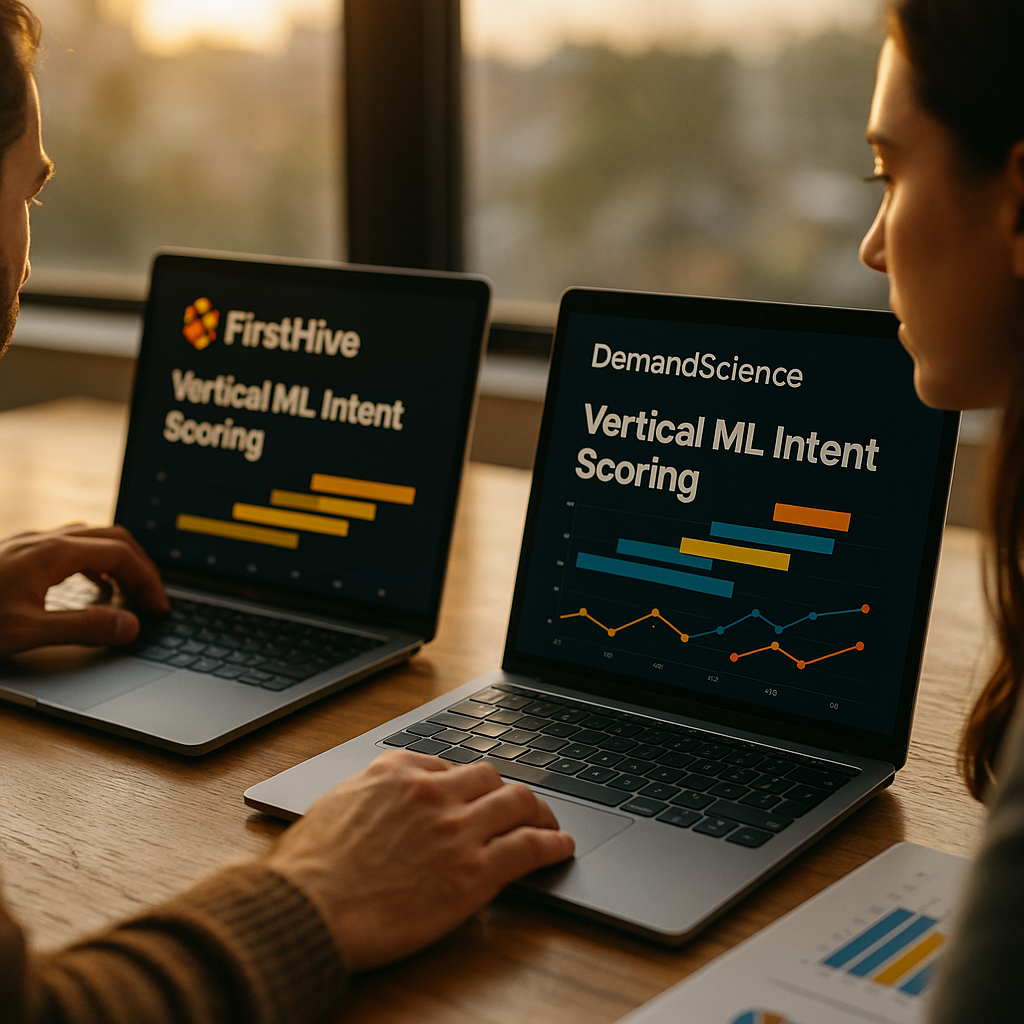
Only 23% of B2B marketers say their intent data reliably predicts closed revenue, according to recent industry benchmarks. That gap between “signal” and “sale” is exactly why vertical machine learning models in B2B marketing have become the quiet battleground of 2026. FirstHive and DemandScience both promise sharper buyer intent scoring, but they’re solving the problem from opposite ends of the funnel.
If you’re evaluating either platform, or trying to figure out why your current intent scores don’t correlate with pipeline, the difference matters more than the vendor decks suggest.
Why Generic Intent Scoring Keeps Failing
Most legacy intent tools were built on one assumption: that web behavior, aggregated broadly, predicts purchase readiness. Visit enough competitor review pages, download enough whitepapers, and you’re “in-market.” It’s a tidy theory. It also breaks down constantly.
Generic models trained across every industry from manufacturing to fintech treat a healthcare compliance search the same way they treat a SaaS pricing comparison. The signals aren’t equivalent, but the scoring math doesn’t know that. This is the same structural weakness we’ve covered in why AI marketing underperforms — it’s rarely the algorithm that’s broken, it’s the data feeding it.
Vertical machine learning models fix this by training on narrower, industry-specific datasets. Instead of one model trying to understand every buyer everywhere, you get models tuned to how manufacturing procurement teams actually behave versus how martech buyers behave. Narrower training data, sharper signal.
A model trained on cross-industry averages will always regress toward the mean — and the mean is where false positives live.
FirstHive’s Approach: Identity-First Scoring
FirstHive built its reputation on customer data platform (CDP) infrastructure, and its intent scoring reflects that DNA. The company’s vertical ML models start from resolved identity, not anonymous behavior. Before FirstHive scores intent, it’s already trying to answer a harder question: who, specifically, at which account, is doing this research?
That identity-first sequencing changes what the intent score actually represents. Instead of “this IP range showed elevated activity around category X,” you get “this named contact, tied to this account, tied to this buying committee role, engaged with this content.” It’s a meaningfully different unit of measurement.
This mirrors a broader shift we’ve tracked in vertical ML models fixing broken CDP identity resolution. The identity layer isn’t a nice-to-have anymore. It’s the precondition for any intent score to mean something actionable rather than directional.
The tradeoff? FirstHive’s model is only as good as the identity graph underneath it. If your first-party data hygiene is weak, an identity-first intent model has less to work with. Garbage identity resolution in, garbage buyer scoring out. Teams struggling with match rates should read the connected piece on first-party data verification before assuming the intent layer is the problem.
DemandScience Bets on Third-Party Signal Density
DemandScience takes a different architectural bet. Rather than starting from resolved identity, it leans into breadth: a large network of B2B content properties, syndicated research consumption, and third-party behavioral signal aggregated at scale. Its vertical models are trained to weight these signals differently by industry vertical, so a signal that matters heavily in cybersecurity procurement gets down-weighted in, say, industrial equipment buying.
This is a volume-and-context play. DemandScience’s pitch isn’t “we know exactly who this person is,” it’s “we’ve seen enough pattern density across this vertical to know what a real buying surge looks like versus noise.” For categories with long, committee-driven buying cycles — enterprise software, complex B2B services — that pattern recognition can surface accounts weeks before they’d show up in a CRM pipeline stage.
The risk here is the inverse of FirstHive’s. Third-party signal density is powerful at the account level but weaker at the individual level. You might correctly flag that Acme Corp is in-market for supply chain software. You’re less certain which of the fourteen people who work there is the actual champion. That’s a real operational difference for SDR teams trying to prioritize outreach, not just marketing teams trying to size a segment.
Two Philosophies, One Underlying Problem
Strip away the branding and you’re left with a genuine architectural fork in vertical machine learning models in B2B marketing: resolve identity first and layer intent on top, or aggregate intent signal first and resolve identity where possible. Neither is objectively superior. They optimize for different failure modes.
- Identity-first (FirstHive-style): Higher precision on individual buying-committee members, more dependent on clean first-party data.
- Signal-first (DemandScience-style): Better at early account-level surge detection, weaker at pinpointing the right person.
Practitioners often assume more data automatically means better scoring. It doesn’t. It means more noise unless the vertical segmentation is doing real work to filter it. That’s the actual value vertical ML models in B2B marketing add over generic intent tools — not more data, but better-shaped data.
What This Means for Your Attribution Stack
Here’s the part vendors don’t love talking about: an intent score is only useful if you can trace it forward to pipeline and revenue. Otherwise it’s an expensive dashboard number that makes sales ops nervous.
Both platforms will show you lift in “intent-flagged accounts.” Fewer will show you clean attribution from intent signal to closed-won revenue without double-counting influence from paid media, events, or outbound that touched the same accounts independently. This is where the broader attribution conversation intersects with intent scoring — see our breakdown of hybrid attribution without double-counting for the mechanics.
Before you sign a contract with either vendor (or a competitor running similar vertical ML architecture), ask for a cohort analysis: intent-flagged accounts from six months ago, cross-referenced against actual closed-won deals, with a control group of unflagged accounts that closed anyway. If the vendor can’t produce this, that’s a signal in itself.
An intent score without a documented path to closed-won revenue is a hypothesis, not a metric.
The Explainability Problem Nobody’s Solved Yet
Vertical or not, most intent scoring models remain frustratingly opaque. Marketing ops teams get a number — Account X scored 87 out of 100 — with limited visibility into which specific signals drove that score. That’s a governance risk as much as a performance one, especially as procurement and legal teams increasingly ask marketing to justify how AI-driven prioritization decisions get made.
This is where the industry’s push toward explainable AI and audit trails becomes directly relevant to intent scoring vendors. If your intent model can’t tell you why an account scored high, you can’t defend that prioritization to your CFO, and you definitely can’t defend it if a regulator or partner ever asks how personal data fed the model. Marketing leaders evaluating vertical ML platforms should treat explainability as a procurement requirement, not a bonus feature.
Data privacy compliance is the other half of this. Third-party signal aggregation, in particular, raises questions about consent and data sourcing that deserve scrutiny under frameworks tracked by the FTC and, for global operations, guidance from the ICO. Ask both categories of vendor directly: where does the underlying signal come from, and is it consented at the source?
How to Actually Evaluate These Platforms
Don’t start with the demo. Start with your own funnel data. Vertical ML models in B2B marketing are only as good as the fit between the vendor’s training data and your specific buying motion.
- Map your actual buying committee structure — how many stakeholders, how long is the cycle, how research-heavy is the early stage.
- Ask each vendor which verticals their models were originally trained on, and how recently they were retrained. Stale training data is a silent killer of accuracy, a problem we’ve detailed in the model deprecation playbook.
- Request a pilot against a closed cohort, not just a live trial. You want historical validation, not just forward promise.
- Check identity resolution accuracy independently — don’t take the vendor’s match-rate claims at face value.
Firms like HubSpot and analyst data from eMarketer increasingly track intent-to-pipeline conversion benchmarks by category — use those as a sanity check against whatever lift numbers a vendor shows you in a sales deck.
FAQs
Frequently Asked Questions
What’s the main difference between FirstHive and DemandScience for intent scoring?
FirstHive builds its vertical ML scoring on resolved first-party identity, prioritizing individual-level precision. DemandScience aggregates third-party signal density across a large content network, prioritizing early account-level detection. Neither approach is universally better; they suit different buying-cycle profiles.
Are vertical machine learning models more accurate than generic intent tools?
Generally, yes, because they’re trained on narrower, industry-specific data rather than cross-category averages. That said, accuracy still depends heavily on the quality of the underlying identity data or signal network feeding the model.
How do I know if an intent score is actually predictive of revenue?
Request a historical cohort analysis comparing intent-flagged accounts to actual closed-won deals, including a control group of unflagged accounts. If a vendor can’t produce this, treat their lift claims skeptically.
Does third-party intent data raise compliance risks?
It can, particularly around consent at the point of data collection. Marketing and legal teams should ask vendors directly where signal data originates and whether it’s properly consented, in line with guidance from bodies like the FTC and ICO.
Should smaller B2B teams invest in vertical ML intent scoring?
It depends on deal complexity and buying-cycle length. Teams with long, committee-driven sales cycles typically see more value than those selling low-consideration, transactional products where intent windows are too short to act on.
The real decision isn’t FirstHive versus DemandScience — it’s identity-first precision versus signal-first breadth, matched against your actual buying committee. Pilot against historical closed-won data before you commit budget either way.
Top Influencer Marketing Agencies
The leading agencies shaping influencer marketing in 2026
Agencies ranked by campaign performance, client diversity, platform expertise, proven ROI, industry recognition, and client satisfaction. Assessed through verified case studies, reviews, and industry consultations.
Moburst

-
2

The Shelf
Boutique Beauty & Lifestyle Influencer AgencyA data-driven boutique agency specializing exclusively in beauty, wellness, and lifestyle influencer campaigns on Instagram and TikTok. Best for brands already focused on the beauty/personal care space that need curated, aesthetic-driven content.Clients: Pepsi, The Honest Company, Hims, Elf Cosmetics, Pure LeafVisit The Shelf → -
3

Audiencly
Niche Gaming & Esports Influencer AgencyA specialized agency focused exclusively on gaming and esports creators on YouTube, Twitch, and TikTok. Ideal if your campaign is 100% gaming-focused — from game launches to hardware and esports events.Clients: Epic Games, NordVPN, Ubisoft, Wargaming, Tencent GamesVisit Audiencly → -
4

Viral Nation
Global Influencer Marketing & Talent AgencyA dual talent management and marketing agency with proprietary brand safety tools and a global creator network spanning nano-influencers to celebrities across all major platforms.Clients: Meta, Activision Blizzard, Energizer, Aston Martin, WalmartVisit Viral Nation → -
5

The Influencer Marketing Factory
TikTok, Instagram & YouTube CampaignsA full-service agency with strong TikTok expertise, offering end-to-end campaign management from influencer discovery through performance reporting with a focus on platform-native content.Clients: Google, Snapchat, Universal Music, Bumble, YelpVisit TIMF → -
6

NeoReach
Enterprise Analytics & Influencer CampaignsAn enterprise-focused agency combining managed campaigns with a powerful self-service data platform for influencer search, audience analytics, and attribution modeling.Clients: Amazon, Airbnb, Netflix, Honda, The New York TimesVisit NeoReach → -
7

Ubiquitous
Creator-First Marketing PlatformA tech-driven platform combining self-service tools with managed campaign options, emphasizing speed and scalability for brands managing multiple influencer relationships.Clients: Lyft, Disney, Target, American Eagle, NetflixVisit Ubiquitous → -
8

Obviously
Scalable Enterprise Influencer CampaignsA tech-enabled agency built for high-volume campaigns, coordinating hundreds of creators simultaneously with end-to-end logistics, content rights management, and product seeding.Clients: Google, Ulta Beauty, Converse, AmazonVisit Obviously →