


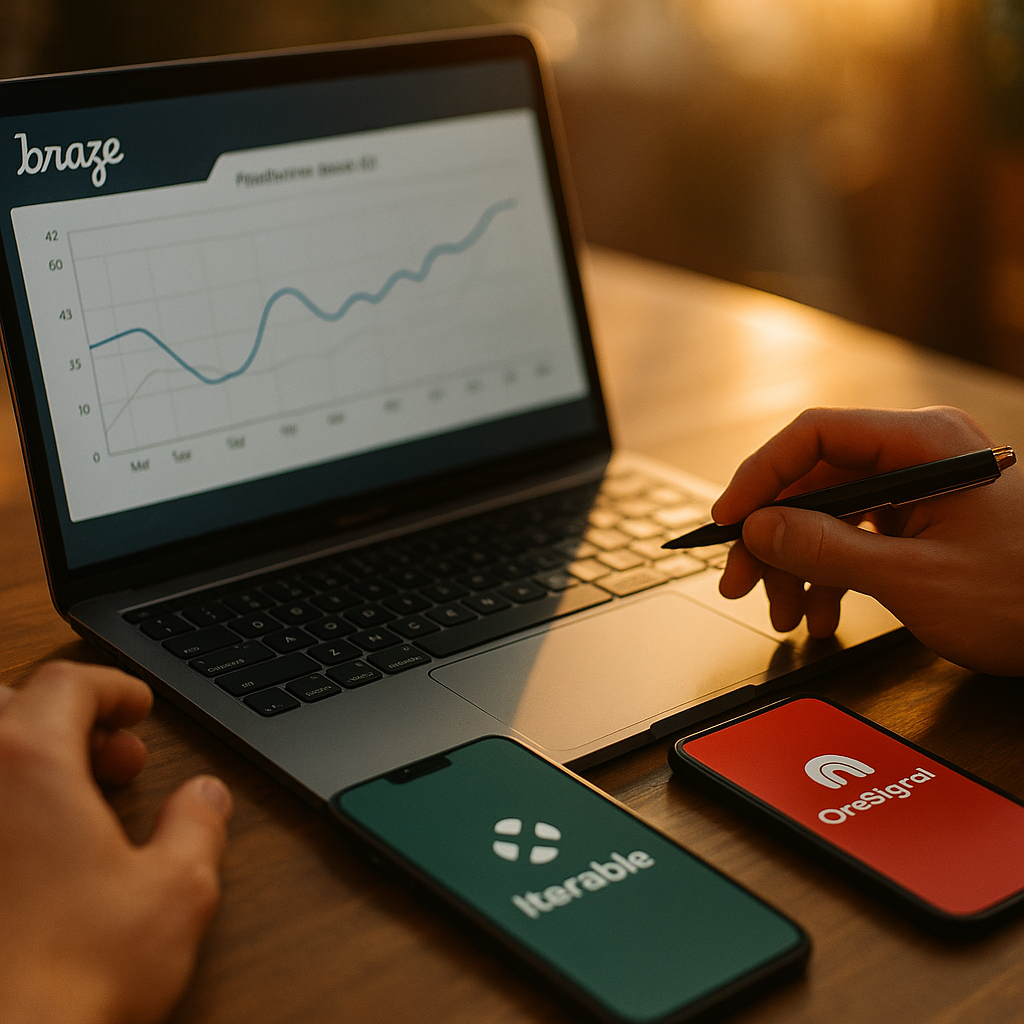
Send a push notification at the wrong hour and you don’t just lose one conversion — you train users to ignore your brand entirely. That’s the quiet math behind predictive AI send-time features, and it’s why lifecycle teams at companies spending six figures annually on messaging platforms are suddenly obsessed with a setting that used to be an afterthought.
Braze, Iterable, and OneSignal all promise the same outcome: send messages when each individual user is most likely to engage, not when your campaign calendar says so. But “predictive send-time” means three different things depending on which vendor’s contract you sign. If you’re evaluating these platforms, or trying to justify keeping the one you already have, the differences matter more than the sales decks suggest.
Why Send-Time Prediction Became a Board-Level Question
Lifecycle marketing used to run on batch-and-blast logic. Everyone gets the email at 9am Tuesday because that’s when the marketing team is in the office. That approach is dying, and fast. According to eMarketer, personalization-driven messaging (including timing) now accounts for a measurable lift in email and push engagement rates compared to static scheduling, and brands that ignore it are leaving retention revenue on the table.
The pressure isn’t just about open rates. It’s about deliverability reputation, unsubscribe rates, and the compounding cost of fatigue. Send at the wrong time repeatedly, and Gmail’s Postmaster Tools or Apple’s Mail Privacy Protection signals start working against you. Get it right, and you reduce unsubscribes while increasing frequency tolerance — which matters enormously for teams running win-back, onboarding, and cross-sell flows simultaneously.
The real ROI of predictive send-time isn’t the open-rate bump. It’s the reduction in list fatigue that lets you message more often without burning your subscriber base.
Braze: Intelligent Timing Built for Scale
Braze’s Intelligent Timing feature is arguably the most mature of the three, largely because Braze built its entire platform around real-time behavioral data from day one. The model looks at each user’s historical engagement patterns across channels — email opens, push taps, in-app session starts — and predicts a personalized send window, typically expressed as a specific hour rather than a broad daypart.
What sets Braze apart operationally is how it integrates with Canvas, its journey orchestration tool. You’re not bolting send-time prediction onto a static campaign; you’re embedding it into a multi-step flow where the AI can adjust timing at each node. For a subscription business running a 12-touch onboarding sequence, that’s the difference between a rigid drip and something that actually adapts.
The catch? Braze’s Intelligent Timing requires a meaningful data history to perform well — new apps or low-volume brands often see marginal gains until the model has enough behavioral signal. Braze is transparent about this in its documentation, which is a point in its favor from a trust standpoint, but it means smaller lifecycle teams may not see ROI in the first few months.
Braze also tends to sit at the higher end of the pricing spectrum, which makes sense given the breadth of its orchestration suite. If you’re already running CRM-CDP fusion as part of your stack, Braze’s data requirements align naturally — it wants a unified customer record, and if you have one, the predictive layer performs noticeably better.
Iterable: Send Time Optimization With an Experimentation Bent
Iterable’s approach, branded Send Time Optimization (STO), leans heavily into its broader philosophy of growth marketing through experimentation. Where Braze treats timing as part of a journey, Iterable treats it as a variable you can A/B test alongside content, channel, and frequency.
This matters for teams that run rigorous testing programs. Iterable lets you compare AI-predicted send times against fixed-time control groups directly inside its experimentation framework, so you get a defensible before/after number for your quarterly business review. That’s a meaningfully different value proposition than “trust the black box,” and it’s one reason Iterable has found traction with data-literate lifecycle teams at mid-market SaaS and e-commerce companies.
Iterable’s STO also plays well with its Brand Affinity and product recommendation features, meaning the same behavioral data powering timing predictions can inform content selection too. That cross-pollination is efficient, but it also means the quality of your send-time predictions is only as good as your event tracking hygiene. Garbage event data in, garbage timing predictions out — a lesson plenty of lifecycle teams learn the hard way after a rushed SDK implementation.
One practical note: Iterable’s documentation is candid that STO works best for daily or near-daily sending cadences. If your lifecycle program sends monthly newsletters and quarterly re-engagement campaigns, the model has far less signal to work with, and you may not see the lift Iterable advertises in its case studies.
OneSignal: Predictive Timing for High-Volume, Lower-Complexity Sends
OneSignal occupies a different tier of the market — historically strong in mobile push, now expanding into email and SMS orchestration. Its predictive send-time feature, part of the broader Journeys and Smart Delivery toolset, is designed for teams that need scale and simplicity more than granular experimentation controls.
For app-first businesses — gaming, mobile commerce, on-demand services — OneSignal’s predictive timing is often the fastest path to measurable lift because implementation is lighter. You don’t need the same depth of unified customer profile that Braze rewards; OneSignal’s model works reasonably well off push and in-app engagement data alone.
The tradeoff is depth. OneSignal doesn’t offer the same journey-level timing adjustments as Braze’s Canvas, nor the rigorous experimentation harness Iterable provides. It’s a strong tool if your primary channel is push notifications and you want predictive timing without building an entire orchestration strategy around it. But if your lifecycle program spans email, SMS, push, and in-app with complex branching logic, OneSignal can start to feel thin.
Pricing-wise, OneSignal remains the most accessible of the three, which explains its popularity among startups and mid-sized apps that outgrew manual scheduling but aren’t ready for enterprise CDP-adjacent spend.
The Data Quality Problem Nobody Wants to Talk About
Every vendor conversation about predictive send-time eventually skips past the uncomfortable truth: none of these models work without clean, high-volume behavioral data. Marketers evaluating these tools tend to ask “which AI is smartest?” when the better question is “which platform fits my data reality?”
If your event tracking is inconsistent, riddled with duplicate user IDs, or fragmented across a mobile SDK and a web pixel that don’t talk to each other, no send-time model will save you. This is the same identity resolution problem that shows up across the martech stack — it’s the reason teams are increasingly looking at server-side identity resolution as a prerequisite, not a nice-to-have, before layering AI features on top of messaging platforms.
It’s worth running an honest audit before you commit budget to any of these three platforms. The five-layer martech stack model is a useful framework here: messaging platforms sit near the top of the stack, and their predictive features inherit whatever mess exists in the layers below — identity, data collection, and orchestration.
How to Actually Choose Between Them
- Choose Braze if you’re running complex, multi-channel journeys with a mature CDP or unified customer record, and you have the data volume to feed the model properly.
- Choose Iterable if experimentation rigor matters to your team and you want to prove send-time lift with controlled A/B data rather than taking the vendor’s word for it.
- Choose OneSignal if push notifications are your primary channel, your team is lean, and you need predictive timing live in weeks rather than quarters.
None of these are wrong choices in isolation. The wrong choice is picking based on brand reputation alone without mapping the feature against your actual data maturity and channel mix. A lot of lifecycle teams switch platforms not because the AI failed, but because they picked a tool built for a data sophistication level they hadn’t reached yet.
This is also where outcomes-first stack rationalization becomes relevant. Before adding or switching a messaging platform for its AI features, define the specific business outcome — reduced churn, higher LTV, lower unsubscribe rate — and work backward to whether predictive send-time actually moves that number for your use case.
What About Cost and Vendor Lock-In?
Migrating lifecycle messaging platforms is expensive in ways that don’t show up on the invoice. Rebuilding journey logic, re-mapping event schemas, retraining teams — it’s a six-to-nine-month project for most mid-sized organizations, and predictive send-time models effectively reset when you switch, since they need fresh behavioral history to recalibrate.
That’s a strong argument for testing predictive send-time within your current platform before assuming you need to switch vendors entirely. Braze, Iterable, and OneSignal customers alike frequently underuse the predictive features already included in their contracts. Check your plan tier first — Braze and Iterable in particular often gate the more advanced timing models behind specific pricing packages, and it’s a quick win to confirm you’re not paying for a feature you haven’t activated.
For teams evaluating broader automation risk across their stack, it’s also worth reviewing how these AI features integrate with other automation layers. Poorly governed integrations — the kind flagged in discussions about hidden automation risk — can quietly break the data feeds these predictive models depend on, without anyone noticing until engagement metrics start slipping.
Next Step
Before signing or renewing a contract, request each vendor’s documentation on minimum data volume thresholds for their predictive timing model, then map that against your actual monthly active user count. If you don’t meet the threshold, you’re paying for AI that won’t perform.
Frequently Asked Questions
Which platform has the most accurate predictive send-time feature?
Accuracy depends heavily on your data volume and channel mix rather than the vendor alone. Braze tends to perform best for high-volume, multi-channel brands with unified customer data; Iterable offers the strongest experimentation tools to validate accuracy yourself; OneSignal performs well for push-heavy, high-frequency apps with lighter data requirements.
How much user data do I need before predictive send-time works well?
Most vendors recommend at least several weeks of consistent engagement history per user, and ideally tens of thousands of active users, before the model has enough signal to personalize reliably. Low-volume or seasonal senders often see limited lift.
Does predictive send-time actually improve conversion rates, or just open rates?
The clearest documented gains are in open and click-through rates, plus reduced unsubscribe rates from fatigue. Downstream conversion impact varies by industry and campaign type, so it’s worth running your own controlled test rather than relying solely on vendor case studies.
Can I use predictive send-time across email, push, and SMS simultaneously?
Braze and Iterable both support cross-channel predictive timing within their journey orchestration tools, though model quality varies by channel based on available data. OneSignal’s strength remains push and in-app, with email and SMS timing features less mature by comparison.
Is it worth switching platforms just for better AI send-time features?
Rarely on its own. Migration costs and the recalibration period for new predictive models usually outweigh incremental gains, unless your current platform’s AI features are gated behind a pricing tier you’re not on, or your channel mix has fundamentally shifted.
Frequently Asked Questions
Which platform has the most accurate predictive send-time feature?
Accuracy depends heavily on your data volume and channel mix rather than the vendor alone. Braze tends to perform best for high-volume, multi-channel brands with unified customer data; Iterable offers the strongest experimentation tools to validate accuracy yourself; OneSignal performs well for push-heavy, high-frequency apps with lighter data requirements.
How much user data do I need before predictive send-time works well?
Most vendors recommend at least several weeks of consistent engagement history per user, and ideally tens of thousands of active users, before the model has enough signal to personalize reliably. Low-volume or seasonal senders often see limited lift.
Does predictive send-time actually improve conversion rates, or just open rates?
The clearest documented gains are in open and click-through rates, plus reduced unsubscribe rates from fatigue. Downstream conversion impact varies by industry and campaign type, so it’s worth running your own controlled test rather than relying solely on vendor case studies.
Can I use predictive send-time across email, push, and SMS simultaneously?
Braze and Iterable both support cross-channel predictive timing within their journey orchestration tools, though model quality varies by channel based on available data. OneSignal’s strength remains push and in-app, with email and SMS timing features less mature by comparison.
Is it worth switching platforms just for better AI send-time features?
Rarely on its own. Migration costs and the recalibration period for new predictive models usually outweigh incremental gains, unless your current platform’s AI features are gated behind a pricing tier you’re not on, or your channel mix has fundamentally shifted.
Top Influencer Marketing Agencies
The leading agencies shaping influencer marketing in 2026
Agencies ranked by campaign performance, client diversity, platform expertise, proven ROI, industry recognition, and client satisfaction. Assessed through verified case studies, reviews, and industry consultations.
Moburst

-
2

The Shelf
Boutique Beauty & Lifestyle Influencer AgencyA data-driven boutique agency specializing exclusively in beauty, wellness, and lifestyle influencer campaigns on Instagram and TikTok. Best for brands already focused on the beauty/personal care space that need curated, aesthetic-driven content.Clients: Pepsi, The Honest Company, Hims, Elf Cosmetics, Pure LeafVisit The Shelf → -
3

Audiencly
Niche Gaming & Esports Influencer AgencyA specialized agency focused exclusively on gaming and esports creators on YouTube, Twitch, and TikTok. Ideal if your campaign is 100% gaming-focused — from game launches to hardware and esports events.Clients: Epic Games, NordVPN, Ubisoft, Wargaming, Tencent GamesVisit Audiencly → -
4

Viral Nation
Global Influencer Marketing & Talent AgencyA dual talent management and marketing agency with proprietary brand safety tools and a global creator network spanning nano-influencers to celebrities across all major platforms.Clients: Meta, Activision Blizzard, Energizer, Aston Martin, WalmartVisit Viral Nation → -
5

The Influencer Marketing Factory
TikTok, Instagram & YouTube CampaignsA full-service agency with strong TikTok expertise, offering end-to-end campaign management from influencer discovery through performance reporting with a focus on platform-native content.Clients: Google, Snapchat, Universal Music, Bumble, YelpVisit TIMF → -
6

NeoReach
Enterprise Analytics & Influencer CampaignsAn enterprise-focused agency combining managed campaigns with a powerful self-service data platform for influencer search, audience analytics, and attribution modeling.Clients: Amazon, Airbnb, Netflix, Honda, The New York TimesVisit NeoReach → -
7

Ubiquitous
Creator-First Marketing PlatformA tech-driven platform combining self-service tools with managed campaign options, emphasizing speed and scalability for brands managing multiple influencer relationships.Clients: Lyft, Disney, Target, American Eagle, NetflixVisit Ubiquitous → -
8

Obviously
Scalable Enterprise Influencer CampaignsA tech-enabled agency built for high-volume campaigns, coordinating hundreds of creators simultaneously with end-to-end logistics, content rights management, and product seeding.Clients: Google, Ulta Beauty, Converse, AmazonVisit Obviously →