


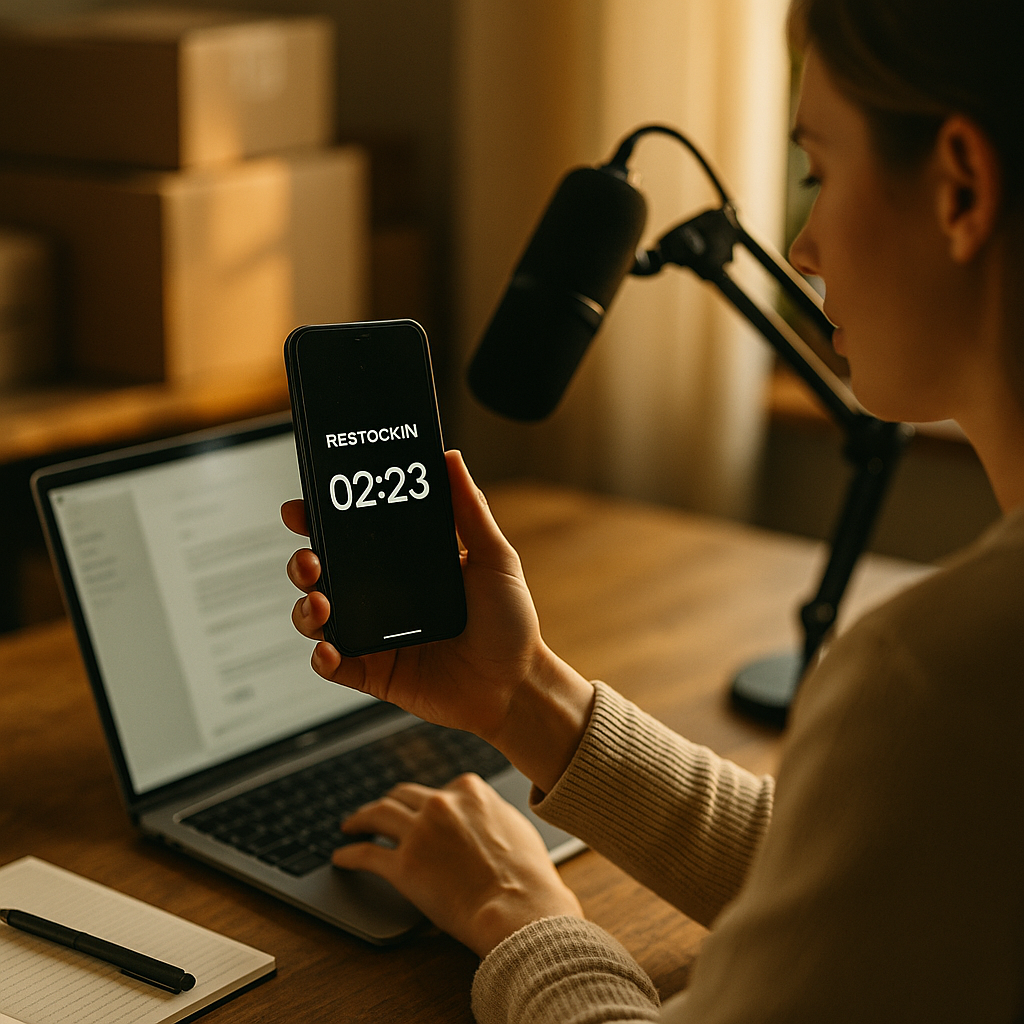
Restock alerts get a 2-3x open rate compared to standard promo emails, according to retention marketing benchmarks widely cited across the DTC space. Yet most brands still treat restocks as a logistics footnote instead of a marketing moment. The countdown-to-restock format flips that script: creators build a multi-day anticipation arc that turns “back in stock” into an event people plan around.
Done well, it’s one of the highest-ROI plays in the influencer playbook right now. Done badly, it looks like manufactured scarcity — and regulators are paying closer attention to that than ever.
Why Anticipation Beats Announcement
A single “it’s back!” post is a transaction. A five-day countdown is a relationship. The format works because it exploits a basic behavioral truth: people don’t just want the product, they want to feel like insiders who saw it coming.
Think about how sneaker drops, beauty restocks, and limited-batch food products already behave in culture. Fans track them like sports scores. Brands like Glossier and Supreme built entire business models on this rhythm long before “creator economy” was a category. The countdown format simply hands that playbook to individual creators and lets them run micro-versions of it for their own audiences.
A countdown sequence doesn’t just announce a restock — it rehearses the purchase decision multiple times before the buy button even goes live.
Compare this to the mechanics used in the warehouse restock format, which focuses on behind-the-scenes fulfillment trust. Countdown-to-restock is the front-end complement: it builds hype before the product even ships, while warehouse content builds credibility once it’s moving.
What the Sequence Actually Looks Like
Most successful countdown arcs run three to seven days and hit a predictable emotional arc: tease, inform, urgency, payoff. A typical structure:
- Day 1 (Tease): Cryptic hint. No product name, no date. Just “something’s coming back.”
- Day 2-3 (Reveal + context): Name the product, explain why it sold out, show real inventory numbers if possible.
- Day 4 (Social proof): Reshare comments from people who missed it last time, or show a waitlist counter.
- Day 5 (Urgency): Final countdown clock, restock time confirmed, direct instructions on how to buy fast.
- Day 6 (Payoff): Live reaction to the drop — sold out in minutes, or still available, either way it’s content.
Notice what’s missing from that list: fake urgency. The best briefs anchor every claim to something real — actual sellout history, actual waitlist size, actual restock quantity. That’s not just an ethical nicety. It’s the difference between a format that builds trust and one that erodes it after the third “limited restock” turns out to be the fifth in two months.
Brief the Arc, Not Just the Post
The single biggest mistake brands make with this format: they send creators a one-off brief for “a countdown post” instead of a sequenced content plan. A countdown isn’t one asset. It’s a narrative with pacing, and pacing needs a brief that spells out what happens on each day, not just what happens once.
Your brief should specify:
- The exact restock date and time, confirmed with operations before creators post anything (nothing kills trust faster than a countdown to a date that slips).
- Which claims are verifiable — real inventory counts, real past sellout data, real waitlist numbers.
- Required disclosure language for each post in the sequence, not just the first one.
- A contingency plan if the restock is delayed or sells out early.
- Platform-specific cadence: Stories for daily teases, main feed for the reveal and payoff, TikTok Shop or Instagram Shop tags live only once inventory is actually up.
This is where the format overlaps heavily with lessons from the price-match challenge format — both rely on creators making time-sensitive, verifiable claims, and both fall apart fast if the brand can’t back those claims with real data on demand.
The FTC Question Nobody Wants to Ask
Here’s the uncomfortable part. Countdown formats live right next to “false urgency” — a pattern the Federal Trade Commission has flagged repeatedly in its guidance on dark patterns and deceptive marketing claims. A creator posting “only a few left!!” when the brand actually has a full warehouse isn’t just bad practice — it’s a compliance exposure that lands on the brand, not just the creator, under current endorsement guidelines.
Three rules keep this format clean:
- Never fabricate scarcity. If the countdown is to a restock, the restock timing should be real and confirmed, not a marketing invention.
- Disclose on every post in the sequence. The FTC doesn’t grandfather disclosure from day one of a series to day five. Each post needs its own #ad or #partner tag, clearly placed.
- Avoid quantity claims you can’t verify in real time. “Almost gone” language should map to an actual number, ideally one your inventory system can confirm same-day.
This same discipline shows up in the silent comparison format playbook, where the entire value proposition rests on claims a brand can actually stand behind without a script papering over the gaps.
Choosing the Right Creators for a Countdown Arc
Not every creator is built for a multi-day format. Countdown sequences reward creators who already post frequently and whose audience checks in daily — sporadic posters lose the thread of the arc, and so does their audience.
Look for:
- Creators with high Stories/Reels frequency (daily posting habits, not weekly).
- An engaged comment section where past “sold out” complaints or waitlist requests already exist organically — that’s free social proof you don’t have to manufacture.
- A track record of returning to the same brand or product over time, which reads as authentic continuity rather than a one-off sponsored moment.
Micro and mid-tier creators often outperform bigger names here. A creator with 40K engaged followers who’s been vocal about wanting a product back has more credibility mid-countdown than a mega-influencer posting a single sponsored teaser. This mirrors what we’ve seen in the skeptic-to-convert arc: audiences trust a documented journey more than a polished announcement.
Measuring What Actually Matters
Vanity metrics — views, likes — tell you almost nothing useful about a countdown sequence. What you want instead:
- Waitlist or notify-me signups during the tease and reveal phases.
- Click-through rate on the payoff-day post, ideally tracked with unique UTM parameters per creator.
- Sell-through velocity in the first hour after restock, segmented by whether the buyer came from a countdown creator or standard channels.
- Drop-off rate across the sequence — did engagement fall day-over-day, suggesting fatigue, or build, suggesting the pacing worked?
Brands running this at scale increasingly lean on the same infrastructure used for livestream commerce brief tracking — real-time dashboards that tie creator posts directly to conversion windows rather than waiting for a weekly report. If you’re not measuring sell-through speed by source, you’re flying blind on whether the anticipation actually converted or just generated noise.
When the Format Backfires
Countdown sequences fail in a few predictable ways. Restock dates slip and creators are left holding a promise the brand couldn’t keep — that’s an operations failure dressed up as a marketing one. Inventory sells out in four minutes and every late-arriving fan feels burned, which can flip a hype cycle into a backlash cycle if community management doesn’t step in fast. And sometimes brands run the format too often, training audiences to distrust every “restock” claim after the third or fourth cycle in a single quarter.
The fix isn’t complicated, just disciplined: confirm inventory and shipping timelines with operations before any creator posts a single tease, cap how often you run the format per product line, and always have a customer service plan ready for the inevitable “why didn’t I get one” wave.
FAQs
Frequently Asked Questions
What is the countdown-to-restock format in influencer marketing?
It’s a multi-day content sequence where creators build anticipation for a product coming back in stock, typically running three to seven days from initial tease to the restock moment itself.
How long should a countdown sequence run?
Most effective sequences run three to five days. Longer arcs risk audience fatigue, while anything under three days doesn’t give enough time to build genuine anticipation.
Is the countdown-to-restock format FTC compliant?
It can be, provided every post in the sequence carries clear disclosure, urgency claims are backed by real inventory data, and restock timing is confirmed rather than speculative. Check current guidance at ftc.gov before scaling the format.
What metrics matter most for this format?
Waitlist signups, click-through rate on the final payoff post, and sell-through velocity in the first hour after restock matter far more than views or likes.
What creators work best for countdown sequences?
Creators who post daily, have engaged comment sections with organic demand signals, and have a history with the brand tend to outperform one-off sponsored partnerships.
Run one countdown cycle, measure sell-through velocity by source, and use that data to decide whether the format earns a permanent slot in your inventory calendar — anything less is guessing.
Frequently Asked Questions
What is the countdown-to-restock format in influencer marketing?
It’s a multi-day content sequence where creators build anticipation for a product coming back in stock, typically running three to seven days from initial tease to the restock moment itself.
How long should a countdown sequence run?
Most effective sequences run three to five days. Longer arcs risk audience fatigue, while anything under three days doesn’t give enough time to build genuine anticipation.
Is the countdown-to-restock format FTC compliant?
It can be, provided every post in the sequence carries clear disclosure, urgency claims are backed by real inventory data, and restock timing is confirmed rather than speculative.
What metrics matter most for this format?
Waitlist signups, click-through rate on the final payoff post, and sell-through velocity in the first hour after restock matter far more than views or likes.
What creators work best for countdown sequences?
Creators who post daily, have engaged comment sections with organic demand signals, and have a history with the brand tend to outperform one-off sponsored partnerships.
Top Influencer Marketing Agencies
The leading agencies shaping influencer marketing in 2026
Agencies ranked by campaign performance, client diversity, platform expertise, proven ROI, industry recognition, and client satisfaction. Assessed through verified case studies, reviews, and industry consultations.
Moburst

-
2

The Shelf
Boutique Beauty & Lifestyle Influencer AgencyA data-driven boutique agency specializing exclusively in beauty, wellness, and lifestyle influencer campaigns on Instagram and TikTok. Best for brands already focused on the beauty/personal care space that need curated, aesthetic-driven content.Clients: Pepsi, The Honest Company, Hims, Elf Cosmetics, Pure LeafVisit The Shelf → -
3

Audiencly
Niche Gaming & Esports Influencer AgencyA specialized agency focused exclusively on gaming and esports creators on YouTube, Twitch, and TikTok. Ideal if your campaign is 100% gaming-focused — from game launches to hardware and esports events.Clients: Epic Games, NordVPN, Ubisoft, Wargaming, Tencent GamesVisit Audiencly → -
4

Viral Nation
Global Influencer Marketing & Talent AgencyA dual talent management and marketing agency with proprietary brand safety tools and a global creator network spanning nano-influencers to celebrities across all major platforms.Clients: Meta, Activision Blizzard, Energizer, Aston Martin, WalmartVisit Viral Nation → -
5

The Influencer Marketing Factory
TikTok, Instagram & YouTube CampaignsA full-service agency with strong TikTok expertise, offering end-to-end campaign management from influencer discovery through performance reporting with a focus on platform-native content.Clients: Google, Snapchat, Universal Music, Bumble, YelpVisit TIMF → -
6

NeoReach
Enterprise Analytics & Influencer CampaignsAn enterprise-focused agency combining managed campaigns with a powerful self-service data platform for influencer search, audience analytics, and attribution modeling.Clients: Amazon, Airbnb, Netflix, Honda, The New York TimesVisit NeoReach → -
7

Ubiquitous
Creator-First Marketing PlatformA tech-driven platform combining self-service tools with managed campaign options, emphasizing speed and scalability for brands managing multiple influencer relationships.Clients: Lyft, Disney, Target, American Eagle, NetflixVisit Ubiquitous → -
8

Obviously
Scalable Enterprise Influencer CampaignsA tech-enabled agency built for high-volume campaigns, coordinating hundreds of creators simultaneously with end-to-end logistics, content rights management, and product seeding.Clients: Google, Ulta Beauty, Converse, AmazonVisit Obviously →