


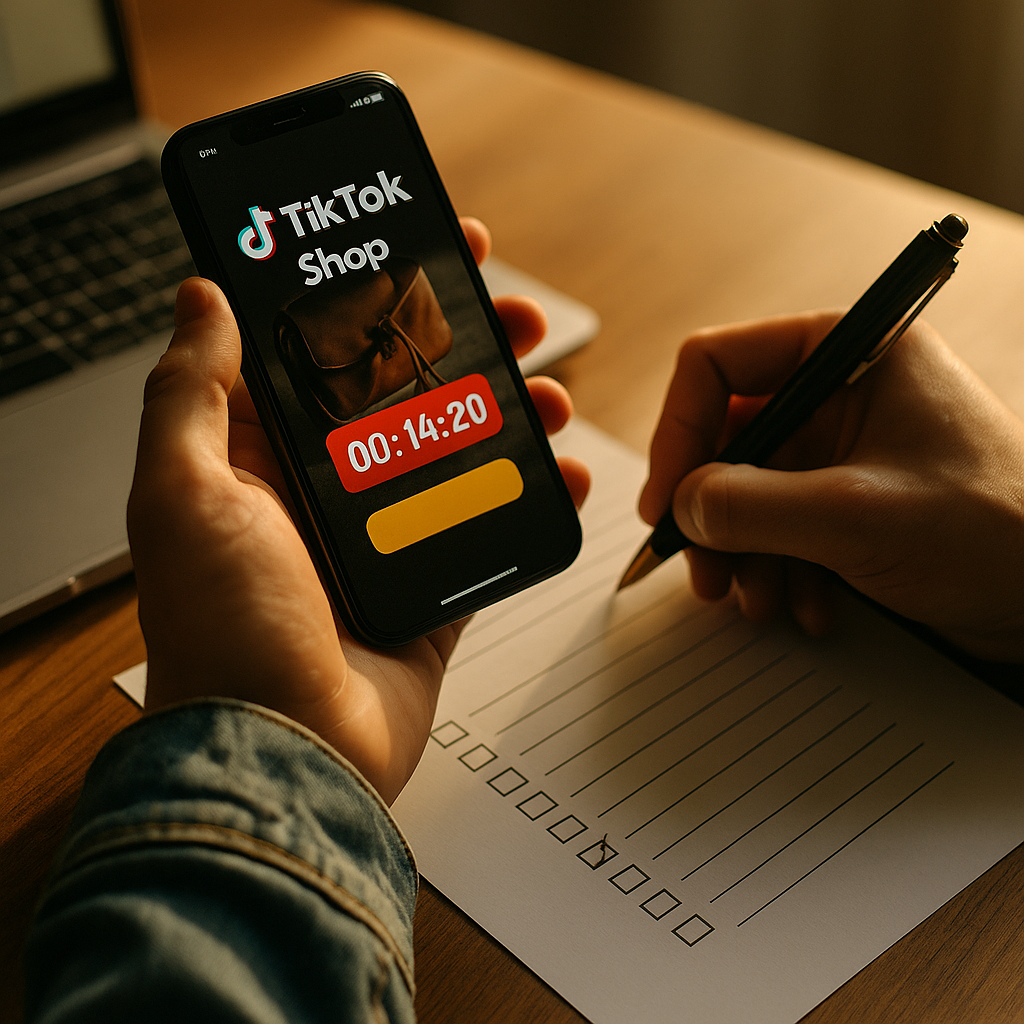
Forty-three state attorneys general have active deceptive-scarcity enforcement priorities on the books, and TikTok Shop’s native countdown timer is now Exhibit A in a growing pile of complaints. If your livestream sales rely on a ticking clock, a TikTok Shop countdown-timer compliance gap could cost you far more than a returned order.
Countdown timers work. That’s precisely the problem. They trigger urgency, spike conversion, and — when the clock resets identically the next hour — start looking a lot like manufactured scarcity to a state regulator reading a transcript. This isn’t a theoretical risk anymore. It’s an operational one, and it belongs on the same checklist as your FTC disclosure review.
Why State Law, Not Just the FTC, Is the Real Exposure
Most brand compliance teams have their FTC disclosure playbook memorized by now — first-line #ad tags, material connection rules, the works. Fewer have mapped the patchwork of state deceptive-scarcity statutes that govern “limited time,” “limited quantity,” and “act now” claims. That’s a mistake, because states don’t need the FTC to act. California’s Unfair Competition Law, New York’s General Business Law Section 349, and similar statutes in Texas, Florida, and Illinois all give state AGs and, in several cases, private plaintiffs, standing to sue over false urgency claims independent of federal action.
A countdown timer that doesn’t actually expire, resets without disclosure, or isn’t tied to real inventory data is a textbook deceptive-scarcity claim in at least a dozen states — and TikTok Shop’s livestream format makes that claim easy to document.
Livestream commerce compounds the risk because the “ad” is unscripted, live, and often hosted by a creator improvising urgency language on top of whatever the on-screen timer already implies. A host saying “only 12 left, clock’s almost up” while the countdown resets every 45 minutes isn’t just an FTC substantiation problem — it’s a state-law scarcity claim with a timestamp.
What Counts as “Deceptive Scarcity” Under State Statutes
State deceptive-scarcity statutes generally borrow language from broader unfair-and-deceptive-practices (UDAP) frameworks, but scarcity-specific enforcement tends to focus on a few recurring fact patterns:
- Fake countdowns: a timer that resets, restarts, or never actually reaches zero before the sale ends.
- Phantom inventory claims: “only 3 left” messaging not tied to actual, verifiable stock levels at the moment displayed.
- Recurring “limited time” offers: the same “24-hour flash sale” running weekly or continuously, undermining the claim of genuine limitation.
- Pressure tactics without basis: verbal urgency cues (“selling out as we speak”) unsupported by real-time data the host can see or verify.
None of this requires proving intent to defraud. Most UDAP statutes use a “capacity to deceive” standard — meaning the question isn’t whether your brand meant to mislead, it’s whether a reasonable consumer could be misled by what they saw on screen. That’s a much lower bar, and it’s why legal teams should treat this as a design-and-process problem, not a disclaimer problem.
The Compliance Checklist
Here’s the operational checklist we’d hand a brand or agency running countdown-timer livestreams on TikTok Shop today. Treat it as a pre-flight list, not a one-time policy document.
1. Verify the Timer Reflects a Real, Fixed End Time
Before any livestream goes up, confirm the countdown is tied to an actual promotion end time set in TikTok Shop’s seller dashboard — not a generic urgency widget that loops. If your commerce ops team is reusing the same timer template across multiple streams without resetting the underlying promotion window, you’re building a paper trail of “the sale never really ended.”
2. Reconcile Displayed Inventory Against Real-Time Stock
If the livestream shows “42 units left,” that number needs to match warehouse or 3PL data within a reasonable margin, refreshed at a defined interval. Static or manually-entered inventory counts are a liability magnet. Build an API-fed inventory display or, if that’s not feasible yet, cap urgency language to ranges you can actually substantiate (“limited stock” rather than a specific, unverified number).
3. Script Host Language Around What the Data Actually Supports
This is the piece most brands miss. The timer can be perfectly compliant and the creator can still torch it with ad-libbed claims. Hosts should have pre-approved urgency phrasing reviewed by legal, the same way script approval already works for material connection disclosures. If your team has already built a review process for AI-assisted scripts, extend it here — the frameworks in creator contracts for AI script review and the legal review checklist for AI-scripted content translate directly to livestream urgency scripting.
4. Document the Promotion Calendar
Keep a dated record of every “flash sale,” “limited drop,” or countdown promotion run on your TikTok Shop, including start/end times and whether it repeated. If a state AG’s office ever asks whether your “24-hour sale” ran four times in a month, you want an answer ready in minutes, not a scramble through screen recordings.
5. Audit State-Specific Thresholds Before Scaling Nationally
Not every state treats scarcity claims identically. California and New York have the most active enforcement histories and the broadest private right of action exposure. If your livestream audience skews toward those markets, your legal review should weight accordingly. This is the same logic already applied to age-gating and youth-safety compliance — treat scarcity claims with the same state-by-state rigor outlined in state-by-state age law comparisons.
6. Build a Post-Stream Archive
Save the full VOD of every countdown-timer livestream, along with the corresponding inventory logs, for a minimum retention period aligned with your state’s statute of limitations for UDAP claims (often three to four years). TikTok’s native replay tools aren’t built for legal retention — plan for a separate archive.
7. Tie Countdown Compliance to Vendor and Creator Contracts
If a third-party livestream agency or affiliate is running the show on your brand’s behalf, your contract needs explicit language requiring compliant urgency claims and giving you audit rights. This dovetails with broader vendor accountability work — see how notice-and-cure contract structures are already reshaping creator agreements more broadly.
How This Intersects With Existing TikTok Shop Compliance Work
Countdown timers don’t exist in isolation. They sit inside a broader TikTok Shop compliance environment that already includes merchant verification, entity-name matching, and testimonial substantiation. If your team has been through a merchant verification audit or cleaned up entity-name mismatches, extending that same audit muscle to scarcity claims is a natural next step rather than a brand-new workstream.
It’s also worth remembering that testimonial and results claims made during a countdown livestream carry their own separate substantiation burden. A host saying “this sold out in ten minutes last time” is both a scarcity claim and a results claim, and it needs to clear the bar described in the FTC’s typical-results guidance. Layering claim types like this is exactly how a single 60-second livestream clip ends up generating two separate legal exposures.
According to eMarketer, live shopping continues to grow as a share of U.S. social commerce spend, which means the volume of countdown-timer content is only increasing — and so is the surface area for a single bad script to trigger a multi-state complaint. Meanwhile, general guidance from the Federal Trade Commission on deceptive time-limited offers keeps getting cited by state regulators as persuasive authority even when the FTC itself hasn’t opened a case.
What This Costs If You Get It Wrong
UDAP penalties vary by state but frequently run per-violation, not per-campaign — meaning a countdown timer shown to 40,000 concurrent livestream viewers could theoretically be treated as 40,000 individual exposures in a worst-case reading, even if no regulator has pushed that interpretation to its full extreme yet. Add the reputational cost of a viral “this brand faked their countdown” clip, and the math on doing the compliance work upfront looks a lot better than the math on cleanup.
Brands that have already built quarterly compliance rhythms for creator content — the kind described in quarterly compliance audits tied to renewals — are in the best position here. Add a countdown-timer and scarcity-claim module to that existing cadence rather than standing up a separate process. Consistency, not heroics, is what holds up under regulator scrutiny.
Tools matter too. Platforms like Sprout Social and disclosure-scanning software already used for FTC compliance can often be extended or paired with a manual review layer to flag urgency language in livestream scripts before broadcast, similar to the approach covered in automated disclosure scanning.
The Bottom Line
Treat the countdown timer like any other claim in your marketing: it needs to be true, verifiable, and documented. Build the checklist above into your pre-stream sign-off process this quarter, assign clear ownership between legal, commerce ops, and the livestream host, and you’ll close the gap between “high-converting urgency tactic” and “the thing that gets your brand named in a state AG complaint.”
Frequently Asked Questions
What is a deceptive-scarcity statute?
A deceptive-scarcity statute is typically part of a state’s broader unfair-and-deceptive-practices law that prohibits false or unsubstantiated claims about limited time offers, limited inventory, or high demand used to pressure a purchase decision.
Does TikTok’s built-in countdown timer create legal risk on its own?
The timer itself isn’t inherently risky, but it becomes a liability when it doesn’t reflect a real, fixed promotion end time or when it’s reused repeatedly without disclosure, since that pattern can support a claim of manufactured urgency.
Who is liable if a creator makes an unsupported scarcity claim during a livestream?
Liability can extend to both the brand and the creator or agency running the stream, particularly if the brand approved the script, provided the inventory data, or had the ability to review the content before or during broadcast.
How long should brands retain livestream recordings for compliance purposes?
Most legal teams recommend retaining full VOD recordings and corresponding inventory logs for three to four years, aligning with common state statute-of-limitations windows for unfair-and-deceptive-practices claims.
Are scarcity claims regulated differently from testimonial or results claims?
Yes. Scarcity claims fall under deceptive-practices and UDAP frameworks, while testimonial and results claims are typically governed separately under FTC substantiation rules, though a single livestream can trigger both types of exposure simultaneously.
Visible FAQ Section (HTML)
Frequently Asked Questions
What is a deceptive-scarcity statute?
A deceptive-scarcity statute is typically part of a state’s broader unfair-and-deceptive-practices law that prohibits false or unsubstantiated claims about limited time offers, limited inventory, or high demand used to pressure a purchase decision.
Does TikTok’s built-in countdown timer create legal risk on its own?
The timer itself isn’t inherently risky, but it becomes a liability when it doesn’t reflect a real, fixed promotion end time or when it’s reused repeatedly without disclosure, since that pattern can support a claim of manufactured urgency.
Who is liable if a creator makes an unsupported scarcity claim during a livestream?
Liability can extend to both the brand and the creator or agency running the stream, particularly if the brand approved the script, provided the inventory data, or had the ability to review the content before or during broadcast.
How long should brands retain livestream recordings for compliance purposes?
Most legal teams recommend retaining full VOD recordings and corresponding inventory logs for three to four years, aligning with common state statute-of-limitations windows for unfair-and-deceptive-practices claims.
Are scarcity claims regulated differently from testimonial or results claims?
Yes. Scarcity claims fall under deceptive-practices and UDAP frameworks, while testimonial and results claims are typically governed separately under FTC substantiation rules, though a single livestream can trigger both types of exposure simultaneously.
Top Influencer Marketing Agencies
The leading agencies shaping influencer marketing in 2026
Agencies ranked by campaign performance, client diversity, platform expertise, proven ROI, industry recognition, and client satisfaction. Assessed through verified case studies, reviews, and industry consultations.
Moburst

-
2

The Shelf
Boutique Beauty & Lifestyle Influencer AgencyA data-driven boutique agency specializing exclusively in beauty, wellness, and lifestyle influencer campaigns on Instagram and TikTok. Best for brands already focused on the beauty/personal care space that need curated, aesthetic-driven content.Clients: Pepsi, The Honest Company, Hims, Elf Cosmetics, Pure LeafVisit The Shelf → -
3

Audiencly
Niche Gaming & Esports Influencer AgencyA specialized agency focused exclusively on gaming and esports creators on YouTube, Twitch, and TikTok. Ideal if your campaign is 100% gaming-focused — from game launches to hardware and esports events.Clients: Epic Games, NordVPN, Ubisoft, Wargaming, Tencent GamesVisit Audiencly → -
4

Viral Nation
Global Influencer Marketing & Talent AgencyA dual talent management and marketing agency with proprietary brand safety tools and a global creator network spanning nano-influencers to celebrities across all major platforms.Clients: Meta, Activision Blizzard, Energizer, Aston Martin, WalmartVisit Viral Nation → -
5

The Influencer Marketing Factory
TikTok, Instagram & YouTube CampaignsA full-service agency with strong TikTok expertise, offering end-to-end campaign management from influencer discovery through performance reporting with a focus on platform-native content.Clients: Google, Snapchat, Universal Music, Bumble, YelpVisit TIMF → -
6

NeoReach
Enterprise Analytics & Influencer CampaignsAn enterprise-focused agency combining managed campaigns with a powerful self-service data platform for influencer search, audience analytics, and attribution modeling.Clients: Amazon, Airbnb, Netflix, Honda, The New York TimesVisit NeoReach → -
7

Ubiquitous
Creator-First Marketing PlatformA tech-driven platform combining self-service tools with managed campaign options, emphasizing speed and scalability for brands managing multiple influencer relationships.Clients: Lyft, Disney, Target, American Eagle, NetflixVisit Ubiquitous → -
8

Obviously
Scalable Enterprise Influencer CampaignsA tech-enabled agency built for high-volume campaigns, coordinating hundreds of creators simultaneously with end-to-end logistics, content rights management, and product seeding.Clients: Google, Ulta Beauty, Converse, AmazonVisit Obviously →