


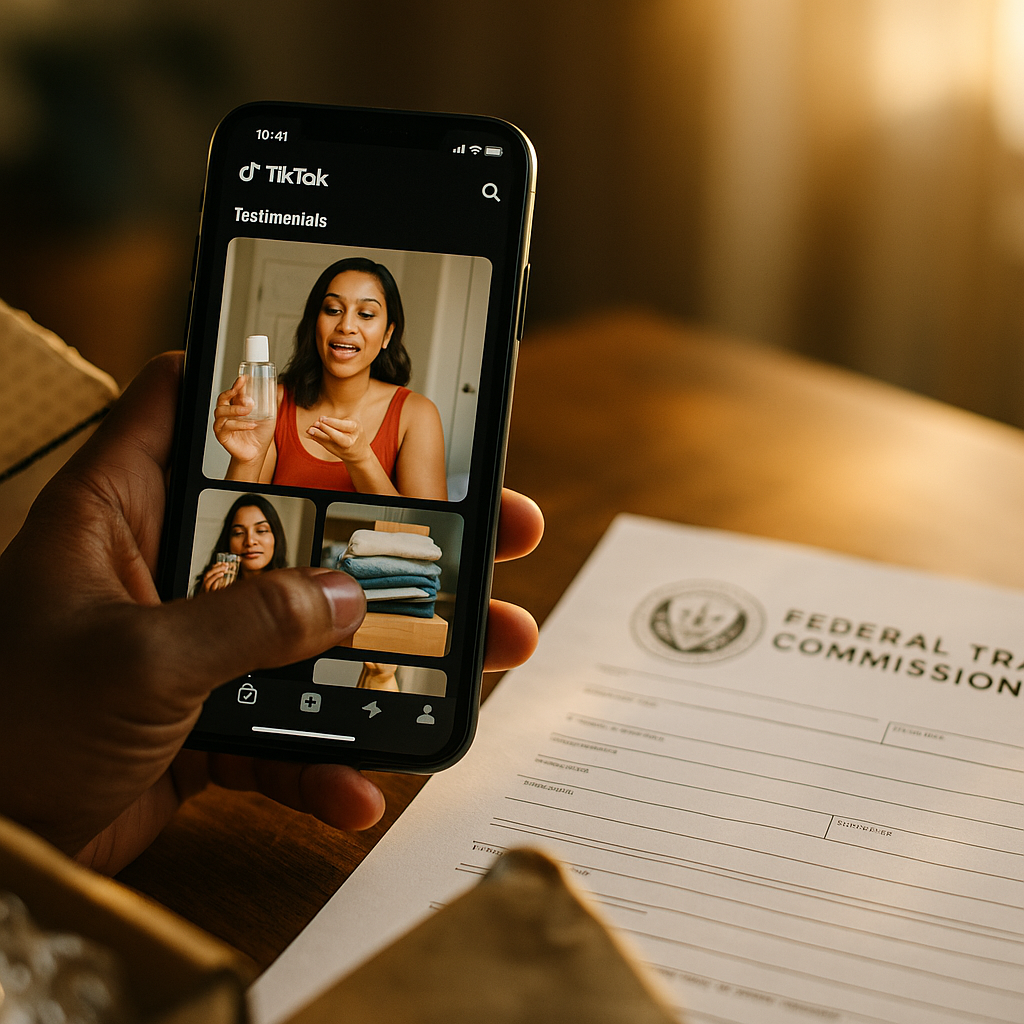
Six figures a month. Lost 30 pounds in three weeks. Sold out in a day. If your TikTok Shop creators are saying any of that without receipts, you’re not running an influencer program — you’re running a class-action waiting room. The FTC’s typical-results standard has quietly become the single biggest legal exposure point in creator commerce, and most brands still treat it as a disclosure footnote instead of a documentation requirement.
This guide breaks down what “substantiation” actually means under FTC rules, why a disclaimer alone won’t save you, and how to build a testimonial review process that survives regulatory scrutiny.
Why “Results May Vary” Doesn’t Work Anymore
For years, brands leaned on a boilerplate disclaimer — “results not typical,” tucked in 8-point font at the bottom of a video description — and called it compliant. That era is over. The FTC’s revised Endorsement Guides, along with the 2023 update to the agency’s testimonial rules, eliminated the old “results may vary” safe harbor for generalized disclaimers. If a creator says a product changed their skin, their income, or their business overnight, the brand behind that claim needs evidence the outcome reflects what a typical customer can expect. Not what’s possible. What’s typical.
That distinction is where most TikTok Shop programs fall apart. A creator testimonial showing dramatic before-and-after results implies an average outcome unless the ad clearly and conspicuously states what typical users actually experience — with data to back it up. No data, no defense.
The FTC doesn’t need to prove a testimonial is false. It only needs to show the brand lacked a reasonable basis for the implied claim. That’s a much lower bar to clear — and a much easier case to lose.
What “Reasonable Basis” Actually Requires
The FTC’s own guidance under FTC advertising rules defines “reasonable basis” as competent and reliable evidence that supports the claim being made, generated before the ad runs, not scrambled together after a complaint lands. For TikTok Shop specifically, that means:
- Documented customer outcome data — survey results, usage logs, verified purchase-to-result tracking — collected from a representative sample, not cherry-picked superfans.
- A clear methodology: sample size, timeframe, how “results” were measured, and whether the study reflects real-world usage conditions.
- Contemporaneous records. If your legal team can’t produce the substantiation file the same week the ad launched, it probably doesn’t exist in a form regulators will accept.
Here’s the part that surprises a lot of brand marketers: substantiation obligations attach to the brand, not just the creator. Even if a TikTok creator writes their own script and genuinely believes their results are typical, the brand paying for that content is on the hook if the underlying claim isn’t backed by data. This is the same liability logic explored in our breakdown of script approval and FTC liability — control over the message, not just payment for it, is what triggers legal exposure.
The Typical-Results Disclosure: What “Clear and Conspicuous” Means on a 30-Second Video
TikTok’s format makes this genuinely hard. You can’t Ctrl+F a disclosure buried in a caption when the viewer never scrolls past the video. The FTC has been explicit that disclosures need to be in the same modality as the claim — if the testimonial is spoken on camera, the typical-results disclosure needs to be visible on screen at the same time, not relegated to text description nobody reads.
Practically, that means:
- On-screen text disclosure during the testimonial moment, not just at video start or end.
- Disclosure language specific enough to mean something — “average user saw a 4% improvement over 8 weeks” beats generic “individual results vary” language every time.
- No reliance on TikTok Shop’s native “Paid Partnership” tag to carry the substantiation burden. That tag discloses the relationship. It says nothing about whether the results claim is true. Our previous coverage on why platform tags alone aren’t enough covers this gap in more detail, and it applies directly here.
One more wrinkle specific to TikTok Shop: Live Shopping and affiliate-driven content often move faster than legal review cycles. A creator going live and improvising claims about sales velocity (“this sold out in an hour last time!”) creates the exact same substantiation obligation as a scripted testimonial — arguably worse, because there’s no pre-approval checkpoint at all.
Building the Substantiation File Before You Brief Creators
The single biggest process fix brands can make: build the evidence file before the creative brief, not after the creator posts. Reverse-engineering substantiation after a video goes viral is a losing game — you’re now trying to prove a claim that’s already been made publicly, under time pressure, usually with legal and PR both breathing down your neck.
Instead, structure it like this:
- Define the claim universe first. Before any brief goes out, decide exactly what outcome claims are permitted — weight loss ranges, income figures, sell-through speed, whatever’s relevant to your category — and attach the supporting data to each one.
- Score creators against approved claims only. If a creator’s actual experience falls outside your substantiated range, that’s not testimonial gold, it’s a liability. Redirect the story, don’t amplify the outlier.
- Bake disclosure language into the script, not the caption. This ties directly into how deep your approval process should go — a topic covered well in our piece on when script edits trigger FTC liability.
- Log everything. Which claims were approved, what evidence supported them, who signed off. If TikTok Shop’s merchant verification systems ever flag your account — a real and growing risk covered in our Q4 merchant verification checklist — this paper trail is what separates a quick resolution from a frozen account.
This is where a lot of mid-market brands underinvest. Enterprise legal teams have substantiation workflows baked into their claims-review process already, inherited from traditional advertising compliance. Brands that grew up on TikTok Shop and performance creator marketing often don’t have that muscle built yet — and it shows the first time a regulator or a competitor’s FTC complaint puts a testimonial under a microscope.
AI-Generated Testimonials Add a New Layer of Risk
Increasingly, brands are using AI tools to draft testimonial scripts, generate “composite” customer stories, or synthesize UGC-style content at scale. This is a substantiation minefield. A composite testimonial — blending several real customer experiences into one narrative — needs to be disclosed as such, and the underlying claim still needs typical-results backing across the group it represents, not just the most flattering data points.
If your team is using generative tools anywhere in the testimonial pipeline, run it through a dedicated review process. Our legal review checklist for AI-scripted content and our explainer on FTC liability for AI-assisted scripts both address this directly, and it’s a fast-growing enforcement area heading into next year.
What Enforcement Actually Looks Like
The FTC doesn’t need a viral scandal to act. Complaints often originate from competitors, consumer advocacy groups, or state attorneys general who monitor TikTok Shop categories known for aggressive claims — supplements, skincare, business-opportunity products, and financial apps top the list. According to eMarketer’s creator commerce research, TikTok Shop’s GMV has grown fast enough that regulatory attention has followed almost in lockstep — enforcement risk scales with platform scale.
When an investigation starts, the brand’s first move is almost always a document request: show us your substantiation file. Brands that have one respond in days. Brands that don’t spend weeks reconstructing data, freezing campaigns, and burning legal budget on damage control instead of defense.
If you can’t produce your substantiation evidence within 48 hours of a claim being challenged, your program has a documentation problem, not just a legal one.
Operationalizing This Across a Creator Program
Substantiation isn’t a one-time legal sign-off — it needs to be a recurring operational checkpoint. Brands running quarterly reviews of creator content, contracts, and disclosure compliance catch problems before they compound. This is the same logic behind tying compliance audits to contract renewals: creators who consistently make unsubstantiated claims shouldn’t get automatic renewal, regardless of engagement numbers. Pair that with automated tools that flag risky claim language before content publishes — a growing category covered in our look at automated disclosure scanners — and you’ve got a system that catches problems at scale instead of relying on manual spot-checks.
For teams benchmarking industry practice more broadly, Sprout Social’s creator marketing research and HubSpot’s compliance resources are useful starting points for building internal training materials, even though neither is a substitute for direct legal review of your specific claim categories.
Next step: Pull your last ten TikTok Shop testimonial videos and ask one question for each: could you produce the underlying data behind that claim within 48 hours if asked? If the answer is no more than once, your substantiation process needs rebuilding before your next campaign brief goes out.
Frequently Asked Questions
What is the FTC’s typical-results standard?
It’s the requirement that testimonials implying a specific outcome must be accompanied by evidence that the outcome reflects what a typical customer actually experiences, not just what’s achievable in a best-case scenario. Generic disclaimers like “results not typical” no longer satisfy this requirement on their own.
Who is legally responsible for testimonial claims on TikTok Shop, the brand or the creator?
Both can face liability, but the brand carries primary responsibility for substantiating claims it pays to promote, even if the creator wrote the script and believes the claim is accurate. Brands cannot outsource substantiation obligations to creators.
Does TikTok’s Paid Partnership label satisfy FTC disclosure requirements?
No. That label discloses the commercial relationship between brand and creator. It does not address whether an outcome claim is truthful or substantiated, which is a separate legal obligation.
How much data is enough to substantiate a results claim?
There’s no fixed number, but the FTC expects a representative sample, a clear methodology, and results collected under realistic usage conditions. A handful of hand-picked superfan outcomes generally won’t meet the standard.
What happens if a brand can’t substantiate a testimonial after the FTC requests evidence?
Consequences can include formal investigations, consent orders, monetary penalties, and mandated changes to advertising practices. Reputational damage and platform-level account restrictions often follow as well.
Frequently Asked Questions
What is the FTC’s typical-results standard?
It’s the requirement that testimonials implying a specific outcome must be accompanied by evidence that the outcome reflects what a typical customer actually experiences, not just what’s achievable in a best-case scenario. Generic disclaimers like “results not typical” no longer satisfy this requirement on their own.
Who is legally responsible for testimonial claims on TikTok Shop, the brand or the creator?
Both can face liability, but the brand carries primary responsibility for substantiating claims it pays to promote, even if the creator wrote the script and believes the claim is accurate. Brands cannot outsource substantiation obligations to creators.
Does TikTok’s Paid Partnership label satisfy FTC disclosure requirements?
No. That label discloses the commercial relationship between brand and creator. It does not address whether an outcome claim is truthful or substantiated, which is a separate legal obligation.
How much data is enough to substantiate a results claim?
There’s no fixed number, but the FTC expects a representative sample, a clear methodology, and results collected under realistic usage conditions. A handful of hand-picked superfan outcomes generally won’t meet the standard.
What happens if a brand can’t substantiate a testimonial after the FTC requests evidence?
Consequences can include formal investigations, consent orders, monetary penalties, and mandated changes to advertising practices. Reputational damage and platform-level account restrictions often follow as well.
Top Influencer Marketing Agencies
The leading agencies shaping influencer marketing in 2026
Agencies ranked by campaign performance, client diversity, platform expertise, proven ROI, industry recognition, and client satisfaction. Assessed through verified case studies, reviews, and industry consultations.
Moburst

-
2

The Shelf
Boutique Beauty & Lifestyle Influencer AgencyA data-driven boutique agency specializing exclusively in beauty, wellness, and lifestyle influencer campaigns on Instagram and TikTok. Best for brands already focused on the beauty/personal care space that need curated, aesthetic-driven content.Clients: Pepsi, The Honest Company, Hims, Elf Cosmetics, Pure LeafVisit The Shelf → -
3

Audiencly
Niche Gaming & Esports Influencer AgencyA specialized agency focused exclusively on gaming and esports creators on YouTube, Twitch, and TikTok. Ideal if your campaign is 100% gaming-focused — from game launches to hardware and esports events.Clients: Epic Games, NordVPN, Ubisoft, Wargaming, Tencent GamesVisit Audiencly → -
4

Viral Nation
Global Influencer Marketing & Talent AgencyA dual talent management and marketing agency with proprietary brand safety tools and a global creator network spanning nano-influencers to celebrities across all major platforms.Clients: Meta, Activision Blizzard, Energizer, Aston Martin, WalmartVisit Viral Nation → -
5

The Influencer Marketing Factory
TikTok, Instagram & YouTube CampaignsA full-service agency with strong TikTok expertise, offering end-to-end campaign management from influencer discovery through performance reporting with a focus on platform-native content.Clients: Google, Snapchat, Universal Music, Bumble, YelpVisit TIMF → -
6

NeoReach
Enterprise Analytics & Influencer CampaignsAn enterprise-focused agency combining managed campaigns with a powerful self-service data platform for influencer search, audience analytics, and attribution modeling.Clients: Amazon, Airbnb, Netflix, Honda, The New York TimesVisit NeoReach → -
7

Ubiquitous
Creator-First Marketing PlatformA tech-driven platform combining self-service tools with managed campaign options, emphasizing speed and scalability for brands managing multiple influencer relationships.Clients: Lyft, Disney, Target, American Eagle, NetflixVisit Ubiquitous → -
8

Obviously
Scalable Enterprise Influencer CampaignsA tech-enabled agency built for high-volume campaigns, coordinating hundreds of creators simultaneously with end-to-end logistics, content rights management, and product seeding.Clients: Google, Ulta Beauty, Converse, AmazonVisit Obviously →