


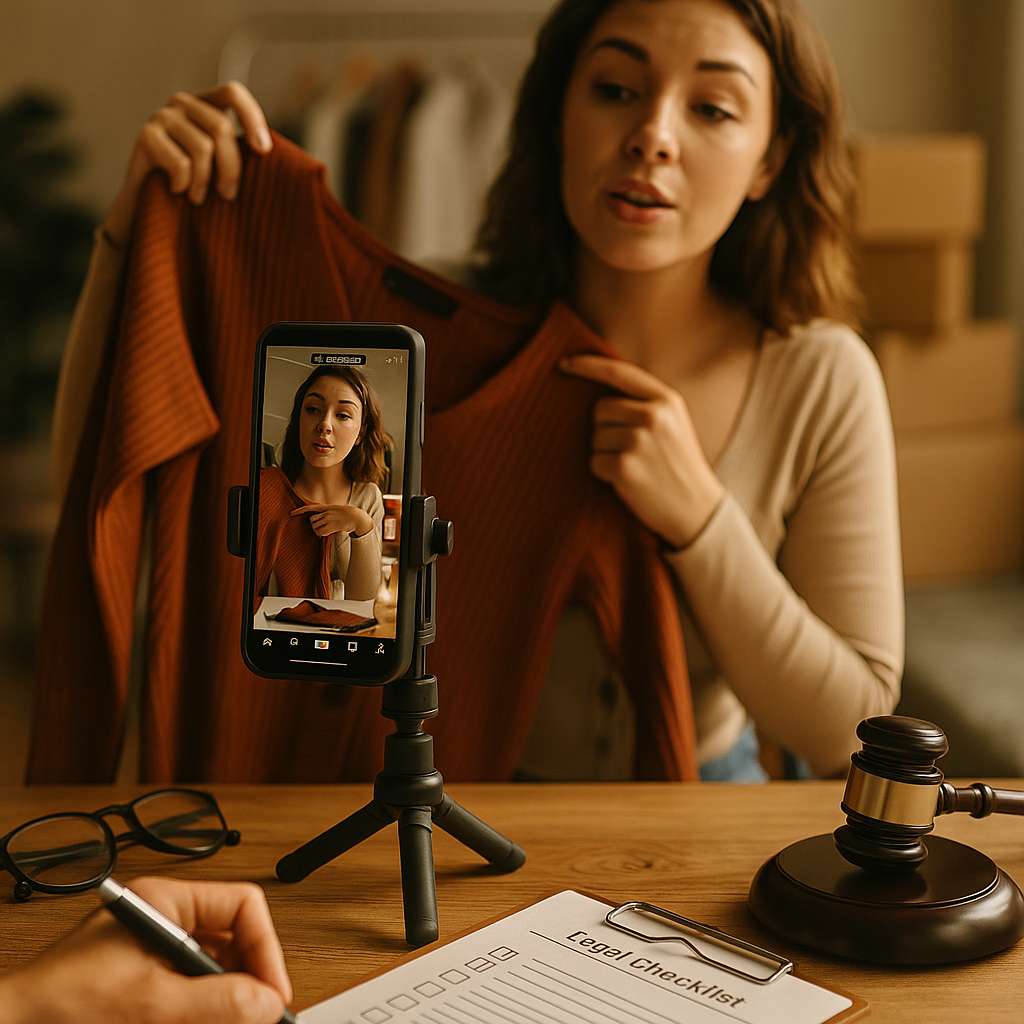
One unapproved supplement claim, spoken live, unscripted, in front of 40,000 viewers — that’s all it takes to trigger an FTC inquiry. TikTok Shop livestream selling has become the fastest-growing checkout channel for regulated categories, but most brands still treat legal review as a post-launch cleanup task instead of a pre-launch gate. That’s backwards, and it’s expensive.
Livestream commerce is unscripted by design. That’s what makes it convert. It’s also what makes it a compliance nightmare for anyone selling supplements, nootropics, credit products, or investment tools. A checklist isn’t bureaucratic overhead here — it’s the difference between a scalable channel and a shutdown notice.
Why Livestream Selling Breaks Standard Compliance Workflows
Most brand compliance processes are built around static assets: a script, a video, an Instagram caption you can review before it publishes. Livestream selling collapses that review window to zero. The host is talking in real time, reacting to comments, riffing on product benefits, and often making claims nobody at the brand has heard before they go out to thousands of viewers.
In regulated categories, that’s a liability multiplier. A skincare brand improvising a claim is annoying. A supplement host claiming a product “cures anxiety” or a fintech affiliate promising “guaranteed returns” is a regulatory incident waiting to happen. The FTC and FDA don’t care that the statement was unscripted — the brand that ran the campaign, and often the platform, still owns the fallout.
If your legal review process assumes there’s time to catch a bad claim before it reaches the audience, it wasn’t built for livestream — and it will fail there.
The Pre-Launch Legal Checklist
Here’s the framework we’ve seen compliance-mature brands adopt before greenlighting any regulated-category livestream on TikTok Shop. Treat it as a gate, not a suggestion — no stream goes live until every item is signed off.
- Category classification confirmed. Determine whether your product falls under FDA-regulated claims (supplements, cosmetics with drug claims), FTC financial promotion rules, or state-level licensing requirements (many fintech and lending products need state-by-state review). Get this wrong and every downstream control is built on sand.
- Approved claims library, locked. Build a pre-vetted list of exactly what hosts can and cannot say. Not general guidelines — literal phrasing. “Supports immune health” is different from “boosts your immune system,” and regulators know the difference even if your host doesn’t.
- Host briefing with sign-off, not a PDF nobody reads. Every livestream host and affiliate should complete a recorded briefing on prohibited claims, verbally confirm understanding, and sign an acknowledgment. This isn’t about trust — it’s about creating a paper trail regulators respect.
- Real-time moderation staffing. Assign a live compliance monitor with authority to flag or cut a stream mid-broadcast. TikTok Shop’s own moderation catches obvious violations, but brand-specific claim violations require someone who knows your regulatory profile watching in real time.
- Disclosure placement audit. Confirm material connection disclosures appear in the first line of on-screen text and are repeated verbally at intervals, not buried in a bio or pinned comment. This lines up with the standards outlined in FTC first-line disclosure rules that are already reshaping TikTok contracts.
- Entity name verification on the storefront. Regulators and TikTok Shop’s own verification systems both check whether the selling entity matches the registered business behind the product. Mismatches here have shut down accounts mid-campaign — see the guidance in the entity name mismatch compliance checklist.
- Countdown timer and urgency-language review. Regulated categories face extra scrutiny on manufactured urgency tactics. Cross-check your livestream’s pricing and countdown mechanics against the countdown timer compliance checklist before the stream goes live.
Supplements: Where the FDA and FTC Overlap Gets Messy
Supplement livestreams sit at the intersection of two regulators with different priorities. The FDA cares about disease claims — anything implying a product treats, cures, or prevents a medical condition. The FTC cares about substantiation — whether you have adequate evidence behind any claim made, disease-related or not.
A host saying “this helped my joint pain disappear in a week” is a testimonial. It’s also, potentially, an unsubstantiated efficacy claim if there’s no clinical backing and no “results not typical” context. The FTC’s endorsement guidelines apply just as much to live, unscripted commerce as to a polished ad. There’s no unscripted exemption.
Brands should build claim substantiation files before launch, not after a complaint. That means documenting the clinical or scientific basis for every claim in your approved library, and cross-referencing it against how the FTC evaluates testimonials, a topic covered in depth in TikTok Shop testimonials and the FTC typical-results rule. If a host’s personal result isn’t typical, that needs to be disclosed live, not just in fine print.
Before-and-after content is its own trap. Livestream hosts love showing transformation photos or describing dramatic change because it converts. But the FTC’s standards for substantiating before-and-after claims, detailed in before-and-after substantiation standards, apply regardless of whether the content is pre-recorded UGC or live commentary.
Financial Products: A Different Risk Profile Entirely
Financial livestream selling carries its own regulatory stack, and it’s arguably less forgiving than supplements. Credit products, buy-now-pay-later tools, investment apps, and crypto-adjacent offerings all face scrutiny from the FTC, the SEC, state financial regulators, and in some cases the CFPB.
The core risk in livestream financial selling is the improvised guarantee. A host trying to close a sale in real time will often reach for language that sounds persuasive but crosses a legal line: “you can’t lose,” “guaranteed approval,” “this beats your savings account.” None of that survives regulatory review, and none of it should make it into an approved claims library in the first place.
If your financial product touches crypto or live-traded assets in any way, the vetting bar goes up again. Platform-specific and product-specific due diligence should happen well before a livestream is scheduled — the live-product crypto platform vetting checklist is a useful baseline for what that diligence should cover, even for teams working outside crypto specifically, because the underlying principle — verify claims and licensing before broadcast — transfers directly.
In financial livestreams, the riskiest phrase isn’t the one your legal team reviewed and rejected. It’s the one nobody thought to ban because it seemed harmless in a rehearsal but became a guarantee under stage pressure.
Contracts Need to Catch Up to the Format
Most influencer contracts were written for scripted, pre-recorded content. They include script approval clauses, usage rights, and disclosure requirements — all built around a review-before-publish model. Livestream selling needs a different contract architecture entirely.
Contracts for regulated-category livestreams should specify: the approved claims library as a binding exhibit, real-time moderation authority (including the brand’s right to cut a feed), consequences for claim violations (not just usage violations), and clear allocation of liability if a host improvises outside approved language. The depth of script approval itself is now a live legal issue — see script approval depth and FTC material connection liability for how approval granularity affects who’s on the hook when something goes wrong.
Script edits made close to airtime also carry liability implications that many brands haven’t accounted for, particularly when a last-minute change alters a disclosure or claim. That risk is broken down in when script edits trigger FTC liability, and it applies with even more force to livestream, where “editing” often means a host paraphrasing on the fly.
For AI-assisted script generation — increasingly common as brands scale livestream volume — a separate review layer applies. The legal review checklist for AI-scripted content is worth running in parallel if any part of your host briefing or talking points were generated or assisted by AI tools, since AI-generated claims tend to drift toward exaggeration without human calibration.
Operationalizing the Checklist Without Slowing Down Launches
None of this works if legal review becomes a bottleneck that kills your livestream cadence. The brands doing this well treat the checklist as a repeatable template, not a bespoke review for every stream.
Build the approved claims library once per product line, refresh it quarterly, and require hosts to re-certify against it rather than starting from scratch each time. Pair that with a quarterly creator compliance audit cadence so drift gets caught before it compounds into a pattern regulators would flag as systemic rather than isolated.
Data collected during livestream checkout — especially in financial products, where lead capture is common — also needs its own governance layer. If your program collects contact or financial information through affiliate links or live checkout flows, align it with a data minimization policy so you’re not creating a second compliance exposure on top of the claims issue.
Industry data backs the urgency here. eMarketer has tracked livestream commerce as one of the fastest-growing retail formats in the US, and TikTok Shop specifically has pushed hard into regulated-adjacent categories like wellness and personal finance tools. Growth without a compliance backbone is just risk accumulating faster.
What This Looks Like Under Audit
If TikTok Shop, the FTC, or a state regulator ever asks your team to produce documentation on a specific livestream, what would you hand over? That’s the real test of whether your pre-launch checklist is functioning or just theoretical.
You should be able to produce, within hours: the approved claims library in effect at the time of the stream, the host’s signed briefing acknowledgment, disclosure placement records, the entity verification on file, and a substantiation file for any efficacy or performance claim made. If any of those documents don’t exist or take days to locate, the checklist isn’t actually operational — it’s aspirational.
Multi-language livestream selling adds another layer, since claims that are compliant in English can shift meaning in translation. Brands running livestreams across regions should cross-reference their process against the compliance audit template for multi-language campaigns to catch translation drift before it becomes a regulatory issue in a market you weren’t watching closely.
The Takeaway
Build the checklist before you book the first host, not after the first flagged claim. A pre-launch legal review process that includes locked claims, real-time moderation authority, and audit-ready documentation is the only way to scale TikTok Shop livestream selling in supplements and financial products without betting the brand on a host’s improvisation.
FAQs
What makes TikTok Shop livestream selling riskier than standard influencer content for regulated categories?
Livestreams are unscripted and real-time, removing the pre-publish review window that catches problematic claims in standard content. Hosts can improvise health or financial claims live, and the brand is still liable for what’s said, even without prior knowledge.
Who is legally responsible if a livestream host makes an unapproved claim?
Typically the brand, since regulators focus on who benefits from and controls the promotion. Contracts can allocate financial responsibility between brand and host, but that doesn’t shield the brand from regulatory action itself.
How often should an approved claims library be updated?
Quarterly at minimum, or immediately after any regulatory guidance change, product reformulation, or new market entry. Static claims libraries go stale fast in fast-moving categories like supplements and fintech.
Does real-time moderation actually reduce legal exposure?
Yes, provided the moderator has actual authority to interrupt or cut a stream. A monitor who only flags issues after the fact adds documentation value but doesn’t reduce the underlying exposure from the claim already being broadcast.
Are disclosure requirements different for livestream versus recorded content?
The standard is the same — clear, conspicuous, and placed where viewers will see it before purchasing intent forms — but livestream requires repeated verbal disclosure since viewers join mid-stream and won’t see an opening disclosure.
Top Influencer Marketing Agencies
The leading agencies shaping influencer marketing in 2026
Agencies ranked by campaign performance, client diversity, platform expertise, proven ROI, industry recognition, and client satisfaction. Assessed through verified case studies, reviews, and industry consultations.
Moburst

-
2

The Shelf
Boutique Beauty & Lifestyle Influencer AgencyA data-driven boutique agency specializing exclusively in beauty, wellness, and lifestyle influencer campaigns on Instagram and TikTok. Best for brands already focused on the beauty/personal care space that need curated, aesthetic-driven content.Clients: Pepsi, The Honest Company, Hims, Elf Cosmetics, Pure LeafVisit The Shelf → -
3

Audiencly
Niche Gaming & Esports Influencer AgencyA specialized agency focused exclusively on gaming and esports creators on YouTube, Twitch, and TikTok. Ideal if your campaign is 100% gaming-focused — from game launches to hardware and esports events.Clients: Epic Games, NordVPN, Ubisoft, Wargaming, Tencent GamesVisit Audiencly → -
4

Viral Nation
Global Influencer Marketing & Talent AgencyA dual talent management and marketing agency with proprietary brand safety tools and a global creator network spanning nano-influencers to celebrities across all major platforms.Clients: Meta, Activision Blizzard, Energizer, Aston Martin, WalmartVisit Viral Nation → -
5

The Influencer Marketing Factory
TikTok, Instagram & YouTube CampaignsA full-service agency with strong TikTok expertise, offering end-to-end campaign management from influencer discovery through performance reporting with a focus on platform-native content.Clients: Google, Snapchat, Universal Music, Bumble, YelpVisit TIMF → -
6

NeoReach
Enterprise Analytics & Influencer CampaignsAn enterprise-focused agency combining managed campaigns with a powerful self-service data platform for influencer search, audience analytics, and attribution modeling.Clients: Amazon, Airbnb, Netflix, Honda, The New York TimesVisit NeoReach → -
7

Ubiquitous
Creator-First Marketing PlatformA tech-driven platform combining self-service tools with managed campaign options, emphasizing speed and scalability for brands managing multiple influencer relationships.Clients: Lyft, Disney, Target, American Eagle, NetflixVisit Ubiquitous → -
8

Obviously
Scalable Enterprise Influencer CampaignsA tech-enabled agency built for high-volume campaigns, coordinating hundreds of creators simultaneously with end-to-end logistics, content rights management, and product seeding.Clients: Google, Ulta Beauty, Converse, AmazonVisit Obviously →